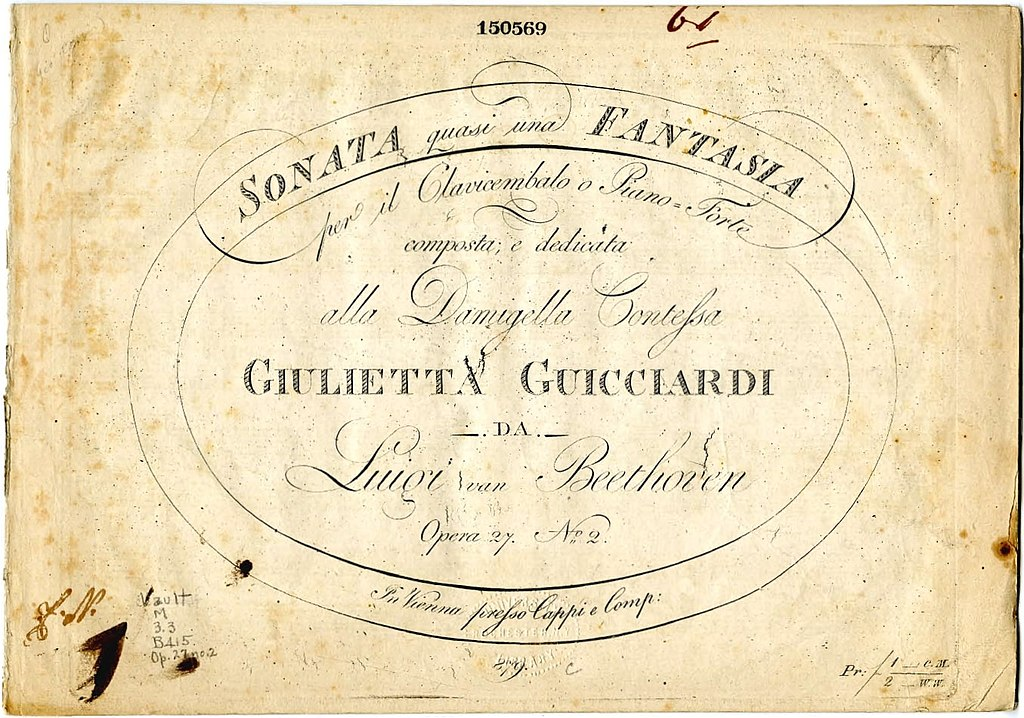
This Piano Sonata commonly known as ‘Moonlight Sonata‘ is one of Beethoven’s most recognised pieces. It was even a popular favourite in his own day. It was originally titled ‘Quazi una fantasia’ (Nearly a Fantasy), but the name Moonlight Sonata grew popular later, likely after Beethoven’s death. The subtitle reminds listeners that the piece, although technically a sonata, is suggestive of a free-flowing, improvised fantasia. It was completed in 1801 and dedicated in 1802 to his pupil Countess Julie “Giulietta” Guicciardi. You imagine having this dedicated you? ‘Oh gee, shucks the Van – you didn’t have to…‘
Moonlight Sonata is one of the first pieces I heard by Beethoven and made quite the impression, like it has on millions of people. After having heard it more than 100 times, there are other lesser-known Beethoven classics I prefer to listen to these days. But even still, as I listen to it again for this article, it makes me shudder in awe of its immense beauty.
(Most of the information presented in this article was sourced from the Wikipedia reference below)
Beethoven wrote the Moonlight Sonata in his early thirties, after he had finished with some commissioned work; there is no evidence that he was commissioned to write this sonata. This sonata is considered one of the earliest pieces of the Romantic era. Many sources say that the nickname Moonlight Sonata arose after the German music critic and poet Ludwig Rellstab likened the effect of the first movement to that of moonlight shining upon Lake Lucerne. This comes from the musicologist Wilhelm von Lenz, who wrote in 1852: “Rellstab compares this work to a boat, visiting, by moonlight, the remote parts of Lake Lucerne in Switzerland…”.
In his book Beethoven’s pianoforte sonatas, the renowned pianist Edwin Fischer suggests that the first movement of this sonata (Adagio sostenuto) is based on Mozart’s “Ah Soccorso! Son Tradito” of his opera Don Giovanni, which comes just after the Commendatore’s murder. Upon listening to that piece in Act 1 from Don Giovanni I can see why Fischer makes that argument. Fischer claims to have found, in the archives of the Wiener Musikverein, a sketch in Beethoven’s handwriting of a few lines of Mozart’s music (which bears the same characteristic triplet figuration) transposed to C♯ minor, the key of the sonata. Also, in 1787 when Don Giovani was written, a 16-year-old Ludwig van Beethoven came to Vienna and wanted to take lessons from Haydn and Mozart. This would not eventuate as Beethoven’s mother fatally fell ill and he had to return to Bonn.
Below is the full performance (3 movements) of Moonlight Sonata by pianist Valentina Lisitsa. She wrote:
‘Hello all. This is the original complete recording of the Sonata the way it was meant to be. Back in those days there was a 10 minutes file limit and therefore I had to split performance in 2 parts. The 3rd movement went viral while the first file did not. Playlist does not work in the opposite way and there are hundreds of channels that stole my recording and rebroadcast it in full. So I should have it published as it was played. Enjoy! I think when performed complete the concept of the performance is different.‘
References:
1. Piano Sonata No. 14 (Beethoven) – Wikipedia

“The more I live, the more I learn. The more I learn, the more I realize, the less I know.”- Michel Legrand


 Observation Blogger
Really calms my restless mind!
Nothing like a bit of the Van to rest the weary mind.
You only have to listen from 1.00 in the video below until 2.00 to understand with Van – we are never alone:
I listened to it all. I believe I needed that, this morning started out strange. Calmed me down. New day new challenges. Thanks!
I’m delighted to read that Dylan. We have a huge day of Sports – son (soccer) and my daughter (swimming). I’m up bright and early. Have a fantastic Saturday!
Have a great time with your kids! I have a birthday party for great nephew this afternoon. 3 years old. Got to mow lawn first. Have a great day!
It’s been a rocking weekend so far. In between Sports we’ve been rotating the music play list between ourselves.
I hope you enjoyed your nephew’s birthday. The lawn you speak of is the one in the photos you often present in your blog?
Matt
Great. Birthday party was fun. Had to watch myself lol The photos are of my property. This place keeps me sane. Ezra too lol