

“On the page it looked nothing. The beginning simple, almost comic. Just a pulse. Like a rusty squeeze box. And then suddenly, high above it. An oboe. A single note, hanging there, unwavering, until a clarinet took it over, sweetened it to a phrase of such delight.”
– Antonio Salieri (Monologue from the movie Amadeus)
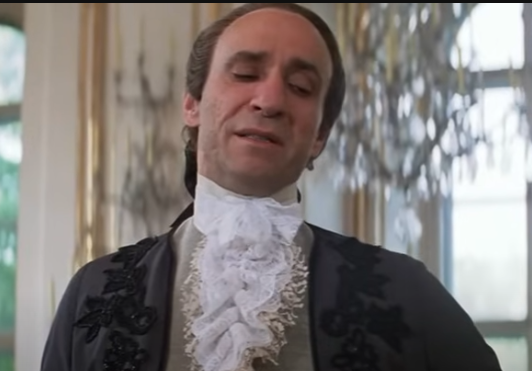
Anyone well acquainted with the movie Amadeus is likely to remember the scene in which today’s music piece Serenade No. 10 For Winds features. In the 1984 film Antonio Salieri’s first encounter with Mozart is at a performance of this work. Salieri has not been impressed with Mozart’s boorish behavior before the performance, but as he looks at the music on the page, he describes the beauty and delight of the solo oboe’s entry soon thereafter followed by the clarinet’s line (in the third movement), leading him to say, “This was no composition by a performing monkey. This was a music I’d never heard. Filled with such longing, such unfulfillable longing. It seemed to me that I was hearing the voice of God.” It is at this point that Salieri first questions how God could choose a vulgar man like Mozart as his voice; this question becomes a primary theme of the film.
The Serenade No. 10 For Winds consists of 7 movements, but we will only look at the third movement Adagio. Andante. In case people like me were wondering what these Italian words Adagio and Andante mean in Classical music: they provide guidance on the pace and character of the music. Two commonly used tempo indications are Adagio and Andante. Adagio refers to a slow tempo, often characterized by a sense of calmness, serenity, and contemplation. Andante, which translates to “walking pace,” indicates a slightly faster tempo than Adagio‘. So ‘Adagio. Andante‘ combined as seen in Mozart’s 3rd movement would suggest a slow and contemplative pace with a slight increase in movement.
Most of the following information was lifted from the Wikipedia reference below:
The serenade was scored for thirteen instruments: The work is scored for 2 oboes, 2 clarinets, 2 basset horns, 2 bassoons, 4 horns and double bass. The piece was probably composed in 1781 or 1782 and is often known by the subtitle Gran Partita (Great Game). The autograph of this work contains 24 leaves of paper-type 57. Four other compositions that used this paper can be securely dated to 1781.
Described by music critic Noël Goodwin who specialised in classical music as “virtually an ‘operatic’ ensemble of passionate feeling and sensuous warmth“, the third movement, marked Adagio, is in E flat major. A syncopated pulse occurs almost throughout the movement while solo lines alternate between the solo oboe, clarinet, and basset horn.
Reference:
1. Serenade No. 10 (Mozart) – Wikipedia

“The more I live, the more I learn. The more I learn, the more I realize, the less I know.”- Michel Legrand


 Observation Blogger
Leave a comment