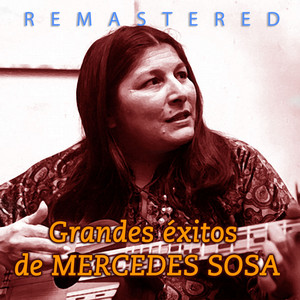
Haydée Mercedes “La Negra” Sosa was an Argentine singer who was popular throughout Latin America and many countries outside the region. With her roots in Argentine folk music, Sosa became one of the preeminent exponents of El nuevo cancionero (The new songbook). She gave voice to songs written by many Latin American songwriters. Her music made people hail her as the “voice of the voiceless ones”. She was often called “the conscience of Latin America”…..
After the military junta of Jorge Videla came to power in 1976, the atmosphere in Argentina grew increasingly oppressive. Sosa faced death threats against both her and her family, but refused for many years to leave the country. At a concert in La Plata in 1979, Sosa was searched and arrested on stage, along with all those attending the concert. Their release came about through international intervention. Banned in her own country, she moved to Paris and then to Madrid.
Sosa returned to Argentina from her exile in Europe in 1982, several months before the military regime collapsed as a result of the Falklands War.
Sólo Le Pido a Dios (Eng. I only ask God) was originally written and performed by Argentine singer-songwriter León Gieco in 1978. It was later performed by Argentine singer Mercedes Sosa (1935-2009) and it is her version (see below) which is the most recognised internationally. Sólo Le Pido a Dios is an anthem that was widely used throughout the social and political hardships and civil wars across Latin America, particularly in Argentina and Chile. It was written around the time that a military conflict between these two countries seemed all but inevitable. It belongs to the ‘Nueva Canción’ musical movement. It has also been performed by other groups and singer songwriters such as Bruce Springsteen (see his version below), Pete Seeger, U2, and Shakira.
A crude English translation of the lyrics follows:
I only ask of God
that the pain is not indifferent to me,
That the dried death does not encounter me
Empty and alone without having done enough.
I only ask of God
that injustice is not indifferent to me,
That they do not strike my other cheek
after a claw has scratched my fortune.
I only ask of God
that war is not indifferent to me,
It’s a large monster and it treads heavily
on all the poor innocence of the people.
It’s a large monster and it treads heavily
on all the poor innocence of the people.
I only ask of God
that treason is not indifferent to me,
If a traitor can do more than a few,
that this number of people will not forget easily.
I only ask of God
that the future is not indifferent to me,
Hopeless are those who must march on
to live a different culture.
The following was extracted from the Wikipedia reference below:
Gieco wrote it in 1978, at his parents’ house in his childhood village of Cañada Rosquín, a small town in the north of Santa Fe Province, Argentina. He wrote it in the presence of his father, who told him that the song would be “world-renowned”, which it eventually was. Gieco composed this song by first trying out melodies with his harmonica and guitar, then writing personal feelings which gradually turned into phrases inspired by the harsh social events of the time, such as the military dictatorship of his country, Mercedes Sosa’s exile, and the threat of war between Chile and Argentina at the time.
Gieco doubted whether or not to include the song on his 1978 album IV LP, believing it was “boring and monotonous“, but finally did, following the advice of Charly García. Thereafter, Gieco sang it as his closing song and has played it in all his national and international tours.
References:
1. Sólo le pido a Dios – Wikipedia

“The more I live, the more I learn. The more I learn, the more I realize, the less I know.”- Michel Legrand


 Observation Blogger
Leave a comment