
I first heard the Stabat Mater (translated from Latin: The Mother was Standing referring to the Holy Mother Mary) when I saw the movie Amadeus which still sits at No 1 on my 100 favourite movies list. More music has appeared here from that film’s soundtrack than any other. The scenes in which the Stabat Mater appears you can find here. It culminates in the death of Salieri’s father. A plot breakdown follows (ref: Wikipedia):
Salieri begins his confession by saying that he grew up hearing stories of Mozart the child prodigy. As a youth, Salieri offered God a deal: if He allowed Salieri to become a famous musician like Mozart, Salieri would—in return—promise his faithfulness, chastity, and diligence. Soon after, his unsupportive father chokes on his food and dies, which Salieri interprets as a sign that God has accepted his vow.
You can find more about Antonio Salieri’s ‘real life’ and not that which is portrayed in the film at my post:
The following information contains extracts from the Wikipedia article below:
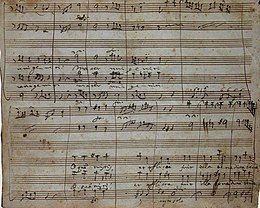
Stabat Mater was composed by the Italian composer Giovanni Battista Pergolesi in the final weeks of his life. The autograph manuscript of the work (image left) is preserved in the Benedictine Abbey of Monte Cassino. The work was composed for a Neapolitan confraternity, the Cavalieri della Vergine dei Dolori di San Luigi al Palazzo. Pergolesi composed it during his final illness from tuberculosis in a Franciscan monastery in Pozzuoli, along with a Salve Regina setting, and finished it shortly before he died. It is scored for soprano and alto soloists, violin I and II, viola and basso continuo.
The Stabat Mater is one of Pergolesi’s most celebrated sacred works, achieving great popularity after the composer’s death. Jean-Jacques Rousseau showed appreciation for the work, praising the opening movement as “the most perfect and touching duet to come from the pen of any composer“.
A translation of the Stabat Mater is as follows:
| 1. Stabat Mater dolorosa Iuxta crucem lacrimosa Dum pendebat Filius. | 1. The grieving Mother stood weeping beside the cross where her Son was hanging. |
| 2. Cuius animam gementem Contristatam et dolentem Pertransivit gladius. | 2. Through her weeping soul, compassionate and grieving, a sword passed. |
| 3. O quam tristis et afflicta Fuit illa benedicta Mater unigeniti! | 3. O how sad and afflicted was that blessed Mother of the only-begotten! |
| 4. Quae moerebat et dolebat, Pia Mater, dum videbat Nati poenas incliti. | 4. Who mourned and grieved, seeing and bearing the torment of her glorious child. |
| 5. Quis est homo qui non fleret, Matrem Christi si videret In tanto supplicio? | 5. Who is it that would not weep, seeing Christ’s Mother in such agony? |
| 6. Vidit suum dulcem natum Moriendo desolatum Dum emisit spiritum. | 6. She saw her sweet child die desolate, as he gave up His spirit. |
| 7. Eja Mater, fons amoris Me sentire vim doloris Fac, ut tecum lugeam. | 7. O Mother, fountain of love, make me feel the power of sorrow, that I may grieve with you. |
| 8. Fac, ut ardeat cor meum In amando Christum Deum Ut sibi complaceam. | 8. Grant that my heart may burn in the love of Christ my God, that I may greatly please Him. |
| 9. Sancta Mater, istud agas, Crucifixi fige plagas cordi meo valide. | 9. Holy Mother, may you do thus: place the wounds of the Crucified deep in my heart. |
| 10. Fac ut portem Christi mortem, passionis fac consortem, et plagas recolere. | 10. Make me to bear Christ’s death, sharing in His passion, and commemorate his wounds. |
| 11. Inflammatus et accensus per te, Virgo, sim defensus in die iudicii. | 11. Inflame and set on fire, may I be defended by you, Virgin, on the day of judgment. |
| Fac me cruce custodiri morte Christi praemuniri confoveri gratia. | Let me be guarded by the cross, armed by Christ’s death and His cherished by His grace. |
| 12. Quando corpus morietur, fac ut animæ donetur Paradisi gloria. Amen. | 12. When my body dies, grant that to my soul is given the glory of paradise. Amen. |
References:
1. Amadeus (Film) – Wikipedia
2. Stabat Mater (Pergolesi) – Wikipedia

“The more I live, the more I learn. The more I learn, the more I realize, the less I know.”- Michel Legrand


 Observation Blogger
Leave a comment