
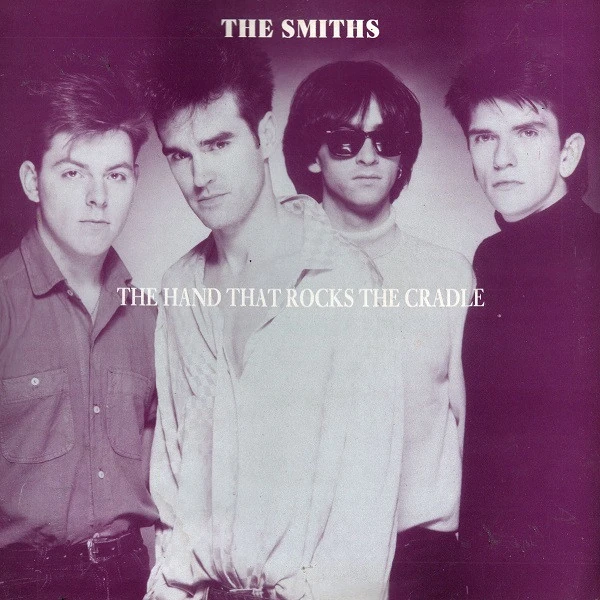
Here is a Smiths’ lullaby of love and unease. It showcases the eerie tenderness and poetic ambiguity that would come to define The Smiths. The Hand That Rocks the Cradle is said to be their first musical collaboration – Morrissey’s lyricism paired with Johnny Marr’s budding music composition – born in the confines of Marr’s attic in 1982. Though it never received the commercial attention of later tracks, it remains one of their most enigmatic and emotionally loaded songs. With no conventional chorus the song breathes the rhythm of a long monologue.
When I first heard The Hand That Rocks the Cradle I was stuck by the beauty of the lyrics (Ceiling shadows shimmy by/And when the wardrobe towers like a beast of prey/There’s sadness in your beautiful eyes), his delivery and Marr’s arrangement. Lyrically, the song is unrushed, ambiguous, and emotionally open. The song has been subject to a plethora of interpretations, which you can read in the SongMeanings reference below. Here are some of those perspectives:
The Hand That Rocks the Cradle on the surface is a passionate declaration of parental love. The narrator’s voice feels steeped in a yearning to protect a child from a threatening world. This is love is assured: “There never need be longing in your eyes / As long as the hand that rocks the cradle is mine.” It suggests not only love, but a need to shield, a fierce paternal (or maternal) instinct that manifests as a solemn promise. The lines, “Although you’re only three, sonny boy / You’re mine,” echoing old songs like Al Jolson’s Sonny Boy from which Morrissey borrows.
A more somber take sees the narrator as a single parent trying to comfort a child who has recently lost their mother. The imagery of looming wardrobes and “ceiling shadows” may reflect the child’s anxiety or trauma in a world now reckoned by absence. The parent’s words are gentle affirmations of presence and safety and holding space for a child’s grief while offering them the gift of ongoing love. Some listeners are unsettled by the song’s intensity, reading it not just as protective but as potentially overbearing.
Morrissey once said the song stemmed from “a relationship I had that didn’t really involve romance.” – (Morrissey, Melody Maker, March 16, 1985). So it could be a synthesis of Morrissey’s emotional themes: the longing to protect innocence, the melancholy of childhood, and perhaps even the frustrations of his own identity and unfulfilled familial roles. This ties in with other early Smiths songs like Suffer Little Children, about the Moors murders – dark memories rooted in Morrissey’s Manchester childhood that manifest as moral anxiety and grief.
Finally, there are those who would prefer not to over-analyse (like it about child abuse). They hear, like I do in this song the echoes of a traditional love song – albeit skewed and strange. In the end, what remains most clear is this: the child at the centre of the song is not to be done wrong. They are to be cherished.
Please don’t cry
For the ghost and the storm outside
Will not invade this sacred shrine
Nor infiltrate your mind
My life down I shall lie
If the bogey man should try
To play tricks on your sacred mind
To tease, torment, and tantalize
Wavering shadows loom
A piano plays in an empty room
There’ll be blood on the cleaver tonight
And when darkness lifts and the room is bright
I’ll still be by your side
For you are all that matters
And I’ll love you till the day I die
There never need be longing in your eyes
As long as the hand that rocks the cradle is mine
Ceiling shadows shimmy by
And when the wardrobe towers like a beast of prey
There’s sadness in your beautiful eyes
Oh, your untouched, unsoiled, wondrous eyes
My life down I shall lie
Should restless spirits try
To play tricks on your sacred mind
I once had a child, and it saved my life
And I never even asked his name
I just looked into his wondrous eyes
And said, “Never, never, never again”
And all too soon I did return
Just like a moth to a flame
So rattle my bones all over the stones
I’m only a beggar man whom nobody owns
Oh, see how words as old as sin
Fit me like a glove
I’m here and here I’ll stay
Together we lie, together we pray
There never need be longing in your eyes
As long as the hand that rocks the cradle is mine
As long as the hand that rocks the cradle is mine, mine
Climb up on my knee, sonny boy
Although you’re only three, sonny boy
Oh, you’re mine
And your mother, she just never knew, oh, your m—
Long as there’s love
As long as there’s love
I did my best for her
I did my best for her
As long as there’s love
As long as there’s love
I did my best for her
I did my best for her
Mother, mother
Mine
References:
1. The Hand That Rocks The Cradle – Song Meanings

“The more I live, the more I learn. The more I learn, the more I realize, the less I know.”- Michel Legrand


 Observation Blogger
I mostly know The Smiths, based on songs I heard on the radio back in Germany. “The Hand That Rocks the Cradle” scores many points from the get-go with Johnny Marr’s jangly guitar. I find Morrissey’s distinct vocals can become a bit overwhelming after some time, though they don’t bother me here.
I don’t know how someone so young wrote these lyrics. And it just keeps going on as if it co-joins a child who is just lying there with their all these thoughts swirling around. It’s quite amazing.
Still enjoy this song and band.
Same. I think they are the bee’s knees.