
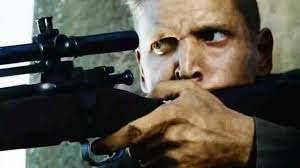
It’s said that Steven Spielberg’s war film Saving Private Ryan is one of the greatest war films ever made. The opening scene at Omaha Beach, in particular, is often cited as the benchmark for throwing the audience headfirst into what occurred. Many veterans who survived D-Day have said they cannot watch it, even after seeing only a short clip. I remember watching it on the big screen in Canberra and being taken aback by its realism.
According to Matt Damon, in the Omaha Beach landing craft scene, Spielberg chose to strip away almost all dialogue, aside from brief lines like “See you on the beach“. My reason for posting today is to highlight two other scenes in the film: ‘Winning the Omaha Beach battle’ and much later, a segment of the final battle when German forces attack the small defensive position at the bridge.
After having just watched them again, my regard for the movie has risen to another level. In the comments, you won’t find many people disputing its realism; on the contrary, it’s widely regarded as about as authentic as one could imagine – even within the confines of a fictionalised WWII battle. You can watch here a World War II historian rating ‘Saving Private Ryan‘ for realism.
So today’s Friday’s Finest pays homage to a film that will go down in the annals of cinema – not merely as a great movie overall, but as one that achieved near-perfection in its depiction of key action scenes from the Allied offensive in World War II.
Warning: Viewer discretion is advised due to scenes of war violence.

“The more I live, the more I learn. The more I learn, the more I realize, the less I know.”- Michel Legrand


 Observation Blogger
One Thanksgiving, a few years after this film was released, I was sitting with my family have coffee & pie & my Uncle started talking about the film. He said it was very realistic. He had been one of the GIs to storm the beach at Normandy on D-Day.
He talked for quite a while about D-Day & his role in that event. I knew he was a WWII vet ~ almost all the men were vets of either WWII or Korea or both ~ but he had never talked about it. Most of the men who fought in those wars never talked about it. They were a different breed than the boys who went to Vietnam or to Afghanistan or Iraq.
That’s fascinating you have an Uncle who was there and corroborated the realism of the film. Those guys were legends of course and your family must have been be so proud of him and honoured he shared his experiences with y’all.
While I don’t care for films that glorify war for the sake of entertainment, I see films like this as being helpful in the way they capture the absolute horror of armed conflict, sometimes as a statement against war. My late dad was in a WWII regiment of 600 in which he was among three to come back. He never talked about it with his children, though toward the end of his life he began to open up to the grandkids. I speculate maybe he felt a duty to ensure the stories of those who didn’t make it back were not forgotten.
I remember him talking a lot about the WWI film ‘Gallipoli’ at the time it came out. You likely know that one as well.
I’m very sorry for your loss. I was amazed to read that your father was one of only three men from his entire regiment who returned. That’s extraordinary. I can’t imagine how overjoyed his family must have been when they learned of his survival, and then seeing him upon return. At the same time, it’s hard to grasp how difficult it must have been for him to carry the weight of post-war grief and survivor’s guilt. It was lovely that he later opened up to the family through his grandchildren, ensuring his memories would live on.
Since ‘Gallipoli’ tells the story of the Australian campaign in Turkey, and as an Australian, my family watched it often when I was young. Even after repeated viewings, it always resonated just as strongly as the first time. I once wrote an article about that classic film by Peter Weir, comparing it with the more recent war film 1917 directed by Sam Mendes.
Steve, I hope you’re having a great Saturday. Cheers.
Thanks very much, Matt. He’s been gone 25 years now, still miss him. His younger brother also returned from the RAF but the youngest was too young, though he was in the Merchant Navy. Dad met up with one of the two other survivors decades later and they remained friends. An unlikely pairing as the friend was an officer and Dad was an enlisted man.
You’re right about all that… war is such a complex thing in the way it tears up families, often for generations and I’m sure he had survivor’s guilt.
Gallipoli (Weir; haven’t seen the other) was such an incredible film in the way it captured that absolute devastation and loss of life. I had pretty much figured you are in Australia, so I’m not surprised you saw it often.
I’m having a great Saturday evening, thanks, Matt, and I hope your Sunday afternoon is going swimmingly!
How wonderful both siblings came back from the war and that your father remained friends with another survivor who happened to be a an Officer.
I am an Australian living in Colombia. I came here over 16 years ago.
My Sunday was very tranquil thanks – went for a run in the morning and watched lots of golf on TV in the afternoon. I too, hope you had a great weekend, amigo. Cheers.
Ah, okay, so I was placing you further ahead in the time zones than you actually are!
Yes indeed, the family was fortunate that they all came back, as many families suffered terrible losses.
Pretty good weekend here too, an indoor bike trainer ride and a fair bit of loafing in front of the TV, too.
Great post Matt…excellent movie
Thanks Tom!