
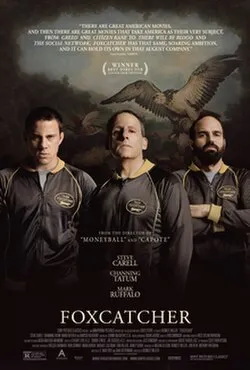
I would say I’m a keen sports fan, but wrestling would sit on the lower rung of the sports I’m interested in. Maybe that’s because I’m ignorant of the rules and tactics and, apart from the scant Olympic coverage, I just don’t watch it. However, today’s featured movie in my Friday’s Finest segment, Foxcatcher, delves right into the nitty-gritty of wrestling and sits in the top league of my favourite sports biographical movies.
Foxcatcher came on my MovieStar cable a couple of days ago, and I bunkered down to watch it yet again! It’s a psychological thriller based on the true story of the remarkable, yet chilling, rise and fall of the Schultz brothers and their involvement with the US wrestling team in the mid-to-late 1980s.
IMDB Storyline:
U.S. Olympic wrestling champions and brothers Mark Schultz and Dave Schultz join “Team Foxcatcher”, led by eccentric multi-millionaire John du Pont, as they train for the 1988 Olympic Games in Seoul, South Korea, but John’s self-destructive behavior threatens to consume them all.
Firstly, what’s curious to me about the movie is that the three principal actors – Steve Carell, Channing Tatum and Mark Ruffalo – are actors whose performances I’ve generally never thought much of in other films. Yet here, I find each of them engrossing. They really inhabit their real-life characters, bringing out all the little nuances that make their portrayals so convincing.
Big hats off to Steve Carell, who is chilling as John du Pont as he obsesses over the team, particularly the Olympic gold-medal-winning brothers Mark and Dave Schultz, played by Tatum and Ruffalo respectively. Carell is almost unrecognisable and another beast entirely from just about anything else he’s brought to the screen. He shows that he really does have some serious acting chops.
The more you see of du Pont over the course of the movie, the more apparent it becomes that he’s deeply damaged goods, seemingly a product of his inherited fortune and, most of all, his upbringing by a frightfully snobbish and rigid mother, who is as menacingly cold as you could wish upon any son or daughter.
Then you have du Pont trying to win her approval for his chosen project, Foxcatcher, and her love by presenting himself as the actual head coach of a sport he knows very little about. It’s beyond pathetic and downright sad to watch. He even tells Mark Schultz that, at one point, his mother had paid the family’s chauffeur to have his son befriend du Pont when he was a boy.
Now, if that isn’t sick, I don’t know what is. And it’s eerily disturbing that he has carried on this behaviour by paying people in his circle to prop him up as this towering figure of American patriotism. There is also a hint in the film that du Pont’s fascination with wrestling might have a sexual undertone, particularly in his fixation on watching the physical exchanges between the wrestlers and even putting himself in their position, and being physically dominated.
Anyway, the film, moreover, is just really clever and doesn’t try to be too much or feign dramatic moments. Rather, it just is, and that’s refreshing. They don’t belittle their audience, much like du Pont does in the film, with his obsessive-compulsive behaviour of trying to demonstrate to others just what a champion he is, when he’s really just the same scared and friendless boy he always was.
Paying people, or buying them things, in the hope that they’ll like you. It’s a sad reality of the materialistic age we live in. I personally relate to that. I really do. How many of us do that with our kids, too? Or, taking it one step further, trying to make ourselves out to be someone much more successful or brainy (insert whatever quality here) than we really are. The illusion of self-mastery, if you will.
As Charles Bukowski once said:
“Hey baby, when I write, I’m the hero of my shit.”
As you can probably see by now, this is why I find the film utterly captivating from a psychological perspective. It can really open a can of worms about oneself, if you let it. And that digging deep and confronting those dark recesses can sometimes be a transformative and life-changing experience.
It’s a bit like reading the Russian author Fyodor Dostoevsky. His writing puts a mirror up to your soul, and so does this film, in some respects, at least for me. I often find that when people refer to the soul, there’s an idealistic emphasis, with the word interpreted through rose-tinted glasses. It’s not so with Dostoevsky, nor with Foxcatcher. Rather, the soul they explore is often scarred, troubled and capable of some pretty dark things.
Now, if this article couldn’t have got any more tangential, I can’t think of a better way to close it than by presenting what couldn’t be a more apt song about everything we’ve been talking about here – Mike Batt’s Imbecile.
“Imbeciles, we are dancing down a darkened road
Though the stars are out, not one of us knows the way
Imbeciles up ahead of us and millions more behind
And we’re laughing and smiling
That’s why I say we’re all of us Imbeciles”
References:
1. Foxcatcher – Wikipedia
2. Foxcatcher – IMDB

“The more I live, the more I learn. The more I learn, the more I realize, the less I know.”- Michel Legrand


Leave a Reply