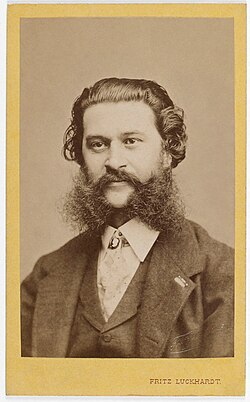
That man you see above – Austrian Johann Strauss II was arguably the biggest music star of his era in the 1870s. He was widely recognised as the undisputed king of the Viennese waltz. His portraits were sold in bookshops; jewellery stores stocked rings and brooches bearing his image; and even florists named bouquets after his waltzes. He was also laughing all the way to the bank – able to charge fees for single appearances that, in today’s terms, rival those of major pop stars.
But success didn’t come easily. Strauss worked relentlessly and struggled with bouts of exhaustion, anxiety, and recurring health problems throughout his life. Legend has it that while composing today’s featured music – Die Fledermaus, he worked for 43 days almost nonstop barely eating or sleeping – until the operetta was finished.
Die Fledermaus (The Bat), a classic operetta (or light opera), is built on a witty tale of intrigue, romance, and theatrical disguise, first cooked up by a pair of well-known French opera librettists. At its heart is a minor nobleman sentenced to eight days in prison for insulting a government official. Desperate to delay his punishment, he hatches a plan to postpone jail for just one night – long enough to enjoy an extravagant New Year’s celebration. When Johann Strauss II encountered the story, he asked his librettists Karl Haffner and Richard Genée to swap the dinner party for a lavish Viennese ball.
The operetta premiered on 5 April 1874 at the Theater an der Wien in Vienna and soon played in Berlin and was then brought back to Vienna. Since then it has never left the active repertory and many different arrangements have been produced, including a fiery take by the Ayoub Sisters.
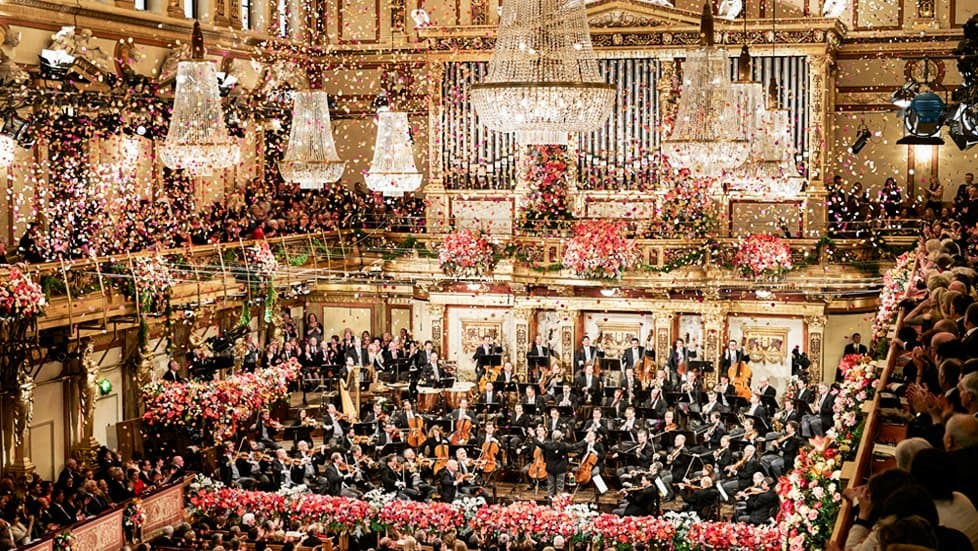
In the article below, Hermione Lai from Hong Kong recalls how her parents made her watch the Vienna Philharmonic’s New Year’s Concert every year (see image left). Over time, she noticed that certain selections by the undisputed king of the Viennese waltz, Johann Strauss Jr., appeared on the program year after year.
I loved to watch the golden hall, the beautifully dressed musicians, and specifically the ballet dancers. It was a world far removed from everyday Kowloon in Hong Kong, a fantasy world of dreams, really. And the music is simply out of this world; it is dancing and singing, celebrating and partying, and being completely carefree.
The following was abridged from the Wikipedia reference below:
Strauss was born into a Catholic family near Vienna, Austria, on 25 October 1825, to the composer Johann Strauss I and his first wife, Maria Anna Streim. His paternal great-grandfather was a Hungarian Jew – a fact which the Nazis, who lionised Strauss’s music as “so German”, later tried to conceal.
He composed over 500 waltzes, polkas, quadrilles, and other types of dance music, as well as several operettas and a ballet. composed over 500 waltzes, polkas, quadrilles, and other types of dance music, as well as several operettas and a ballet.
Strauss came to the United States in 1872, where he took part in the World’s Peace Jubilee and International Musical Festival in Boston at the invitation of bandmaster Patrick Gilmore and was the lead conductor in a “Monster Concert” of over 1000 performers.
References:
1. Johann Strauss Jr.’s Die Fledermaus “Overture”: “The Bat” in Arrangement – Interlude Hermione Lai
2. Die Fledermaus – Wikipedia
3. Johann Strauss II – Wikipedia

“The more I live, the more I learn. The more I learn, the more I realize, the less I know.”- Michel Legrand


Good post, where I learned more about Strauss than I knew before. Listening to the music, I’m surprised to recognize so much of it from here and there. Definitely some is used in the movie Brazil soundtrack. I’m sure I’ve heard some in old black and white movies.
Like I was in a shitty mood this morning and then I put this on and I was dancing to it washing the dishes. It’s just so good and ‘Waltz’ music ..really? you’ve got to be kidding me! Classical music in general is really making its mark on me as I get older. Yeh, I remember seeing Brazil a few years back which I’ve got somewhere. That’s right out there, but a goodie as far as Dystopian flicks are concerned.
lol on the surprise at yourself for your choice of dishwashing music. I just remember a section of this is a repeating thread through the movie. I like classical music when I can slow down enough to give it my full attention.
I used to have to be like that – give it my full attention. May be it’s just a listening adaptation thing over the years. Now, I just listen to a few bars and I’m just in the mood. What are your favourite classical music artists – songs?
I’d be happy to just sit through one song (or intro like I did today, with Strauss.) Bach is one of my favorites. The repetition is soothing to me. Verdi’s Nabucco Overture is one I got very familiar with when my son learned it in high school.
Wow that Verdi Nabucco is amazing! How did your son learn it? Thank you.
Bach’s La Traviata: ”Libiamo Ne’lieti Calici” I also love.
He played violin starting in middle school and continued to play through college. He was in a regional high school orchestra and that’s where he learned it. Will check La Traviata … out, thanks for the suggest. Have you heard Keith Jarrett’s cover of Bach’s Goldberg Variations? I have that on CD. Also Yo Yo Ma’s Bach CD (forgot the name.)
You must be very proud of your son. Super.
I just started listening to Jarretts’s covers of Bach’s Goldberg variation. Thanks for that.
Yes, I was mistaken about the La Traviata coming from Bach when I should have said Verdi.
Have a wonderful Christmas eve Lisa. Cheers.
Yes, I am proud of him, but after college he stopped playing. My older son plays trumpet but he gave that up after high school 😦
You are welcome on Jarrett and Bach 🙂
Happy Holidays to you (sorry I forgot your name) also!
Ah that’s ashame, but I suppose it gets all whiplashish lol.
No problem. Matt here.
Yes, if it’s not going to be a career, things like that often fall by the wayside. Oh, for the olden days of patronage 🙂 Matt, I will do my best to remember your name.
Wow, I’d be so honoured
🙂
the YT says it’s Verdi, not Bach. I recognized it right away. Again not sure from where, but maybe because it sounds similar to Nabucco?