
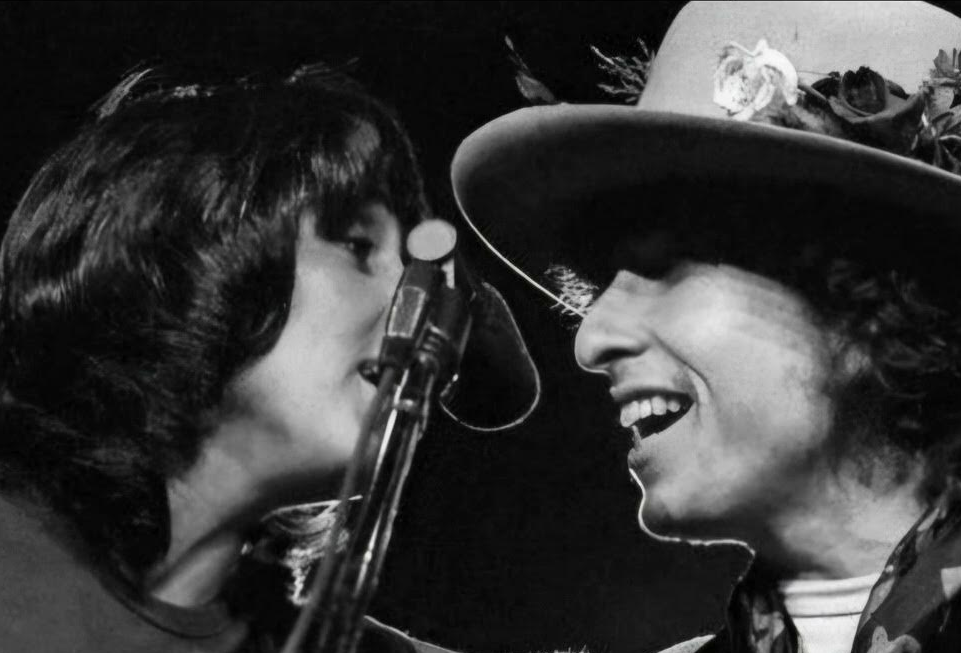
I’ve always had a soft spot for this live performance of the old British folk song The Water Is Wide. It was performed by Bob Dylan and Joan Baez during the 1975 Rolling Thunder Revue at the Boston Music Hall. There are three reasons I like it: Joan Baez’s voice, the excellent slide guitar, and the beautiful ending (mainly because of what Baez does with it). If it were just Dylan singing on his own here, without Baez’s contribution, there’s no way I would have included it in my collection.
In this version, Dylan’s vocal performance is unlikely to change the minds of those who already criticise his voice. However, if you fast-forward about twenty years to his tender, weathered delivery of The Water Is Wide during the Time Out of Mind sessions, and imagine him bringing that same sense of heartache to the 1975 performance, it might have been a true duet masterpiece.
The following draws from the two references below:
Dylan has certainly known this song since he moved to Greenwich Village in the early sixties. Many credit Peter Seeger for its popularity, having included it on his well-known 1958 recording, American Favorite Ballads, Vol. 2. It’s been covered by pretty much everybody and it remains popular in the 21st century, although not everybody does the exact same version.
Dylan said in the Biograph liner notes that he based Lay Down Your Weary Tune on a Scottish ballad, so the inspiration definitely could have been The Water Is Wide. The two songs definitely sound similar.
I wrote that on the West Coast, at Joan Baez’s house. She had a place outside Big Sur. I had heard a Scottish ballad on an old 78 record that I was trying to really capture the feeling of, that was haunting me. I couldn’t get it out of my head. I wanted lyrics that would feel the same way.
It’s a song about lost-love or rather a love that’s grown sour. It describes the challenges of love: “Oh love is gentle, love is kind” during the novel honeymoon phase of any relationship. However, as time progresses, “love grows old, and waxes cold“. Even true love, the lyrics say, can “fade away like morning dew“.
Cecil Sharp first published the song in Folk Songs From Somerset (1906). The modern lyric for The Water Is Wide was consolidated and named by Cecil Sharp in 1906 from multiple older sources in southern England, following English lyrics with very different stories and styles but the same meter. Performers or publishers would insert, remove, and adapt verses from one piece to another: floating verses are also characteristic of hymns and blues verses.
The song Van Diemen’s Land on the album Rattle and Hum by U2 uses a variation of the melody of The Water Is Wide.
The water is wide and I can’t cross over
Neither have I wings that I could fly
Build me a boat that can carry two
And both shall row my love and I.
There is a ship and it sails on the sea
Loaded deep as deep can be
But not as deep as the love I’m in
I know not if I sink or swim.
I leaned my back up against an oak
Thinkin’ it was a trusty tree
But first it bent and then it broke
Just like my own false love to me.
Oh love is gentle, love is kind
Gay as a jewel when first it’s new
But love grows old and waxes cold
And fades away like some morning dew.
The water is wide and I can’t cross over
Neither have I wings to fly
Build me a boat that can carry two
And both shall row my love and I
References:
1. The Water Is Wide – The Bob Dylan Commentaries
2. The Water Is Wide (song) – Wikipedia

“The more I live, the more I learn. The more I learn, the more I realize, the less I know.”- Michel Legrand


Thanks for sharing this song and the later version. I’m not familiar with much of Dylan’s catalogue… guess I left that to my older brothers! I completely agree that his ‘Time out of Mind’ vibe would have created a marvellous duet. The original seems a bit like shout-singing in comparison.
I enjoyed reading the history behind the track and can definitely hear the English folk origins.
Dylan’s music features here far more than any other artist, largely because I’ve been an avid fan since I was about 13. I’ve rarely had an issue with his voice – except here during the 1975 Rolling Thunder Tour. At times he sounds like he’s got a bad cold, and often, as you alluded to, he shouts the lyrics.
Thanks for checking it out, though it’s a pity this version of ‘The Water Is Wide’ was your first Dylan song on my blog – especially since my main reason for presenting it was really because of what Joan did with it. lol
Thanks for reading, and I appreciate the feedback. My name’s Matt, by the way. Cheers Steve.
My pleasure, and good to know you, Matt. I promise, I will make my way around your site and look forward to other gems as I learn more from your posts about this iconic artist.
Most kind of you Steve.
I’ve got your blog hooked up as well and looking forward to seeing your future posts.
Thanks, I’ve been enjoying our discussions and look forward to more of them, Matt.
love this…spot on