
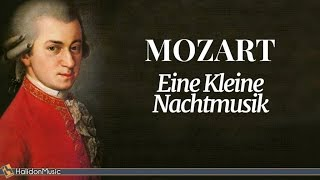
No other classical music composer has featured here more than Wolfgang Amadeus Mozart (1756 – 1791). Today’s serenade Eine Kleine Nachtmusik translated as A Little Night Music is one of the composers most recognisable and delectable pieces. In a catalog of his works, Mozart lists it as having five movements, but only four movements remain, the first minuet having been lost. It was written for an ensemble small enough to be practical for outdoor performance (more often than not an ensemble of winds) – two violins, viola, cello and double bass, but is often performed by string orchestras.
The following is mostly sourced from the Wikpedia article below:
The serenade was completed in Vienna on 10 August 1787, around the time Mozart was working on the second act of his opera Don Giovanni which has featured here already. It is not known exactly why it was composed, but there was probably some Viennese occasion (as aforementioned) for which Mozart supplied the work – a celebrative occasion, no doubt. Originally, a serenade was evening music with which to divert and/or woo a lover or to please persons of rank.
The work was not published until about 1827, long after Mozart’s death, by Johann André in Offenbach am Main. It had been sold to this publisher in 1799 by Mozart’s widow Constanze, part of a large bundle of her husband’s compositions. Today, the serenade is widely performed and recorded; indeed, both Jacobson and Hildesheimer opine that the serenade is the most popular of all Mozart’s works. Of the music, Hildesheimer writes, “even if we hear it on every street corner, its high quality is undisputed, an occasional piece from a light but happy pen.”
References:
1. Eine kleine Nachtmusik, K. 525 – Wikipedia – LA Phil
2. Eine kleine Nachtmusik – Wikipedia

“The more I live, the more I learn. The more I learn, the more I realize, the less I know.”- Michel Legrand


 Observation Blogger
I am privileged to have a very fond memory of this piece: 1999, studying abroad, I witnessed a performance of “Eine” in the very hall Mozart had it performing in Salzburg, Vienna. I will never forget the chamber quartet players dip their bodies to the grace note downbeat, the fluctuation of dynamics, and the smell of the dusty hall. Truly magical. Great selection, Matt!
No way. You heard this where Mozart had it performing! ‘The smell of the dusty hall’ – You have an irrepressible way with words Bernie. I can’t imagine what an amazing experience that was for you. Thanks so much for sharing it.
It was very special. I saw it with music appreciative people too, so the gratitude of the moment was jointly remarkable. Our jaws were dropped.
People who had an ‘ear’ for music like what was expounded in ‘Amadeus’. I just hope the youth of today who you are teaching to can appreciate and understand can relate to that in the midst of today’s music output. You are our only hope! haha
Haha! I certainly do try. We featured Schubert and Mozart at our Oct. 1 concert. It’s still sad that the music known as “classical” is basically “unpopular,” according to the youngsters. I always teach the fundamentals and how much of what we do today is all because of the tonal structure set by Bach, Mozart, and Beethoven. They enjoyed performing at the concert, but rehearsals were pulling teeth. “Amadeus” does such a marvelous job educating, entertaining, and thrilling the audience. I see it at least once a year. Never gets old!
Can I get way outta line here? lol and I’d love to know what you guys do…
If I was teaching music ‘101’ – it doesn’t matter which genre of music; I’d sit the youngens down in their first class and make them watch ‘Amadeus’. I would explain each scene, historical context and composition history and at each point gather there reflections on their current circumstances. Each scene, then move on..
It might take 3 months to complete haha. By the end if they didn’t love classical music, then I don’t know what would move them.
I teach anything from choir to AP Music Theory. Sometimes, I teach a Music Composition course. At the end of the semester, I tend to introduce “Amadeus” as both a learning tool and/or fun movie to celebrate the semester with. Attention spans are rough these days. It’s a miracle if half of them want to make it to the end…
I got ya. I’m talking about a fantastical world of exploring history which doesn’t happen in real life except in the movies, like ‘Waterland’ with Jeremy Irons. He’s about to get laid off as History teacher and decides ‘f&/k it’; I’m going to tell them my story of the fens. Btw I can’t recommend this movie more highly if you haven’t seen it already. The last scene gives Amadeus’ last scene a run for its money (as seen below).
You mentioned how watching all of Amadeus can be rough on the youngens; for that reason it needs walking through, scene by scene with exposition, history and reflection. It could be a whole course duration which I doubt you have time for. lol
I just added this to my Letterboxd Watchlist. Thank you for the rec! I’ve never heard of it before, and it sounds relatable and appealing! I love Jeremy Irons. Looks really good!
I hope you get to see it Bernie. Let me know what you think.
Will do! Absolutely 🙂
This is one of my favorite of Mozart’s many great compositions, probably because it’s so melodic and accessible.
It’s not in my top 20 by him, since its become so popularised and I’ve heard it so often. But the funny thing is when hearing it again it felt completely new to my ears. Mozart’s music has that incompensable ability to make all things seem new.
I didn’t realize some of Mozart’s work had been lost. I’m used to hearing about lost works from ancient Greece and Rome, or from the Middle Ages, or the early Renaissance. I guess I just assumed Mozart was modern enough that all his works would’ve been preserved somewhere.
I wrote that based on the first reference which stated the first minuet was lost. I agree that it’s difficult to fathom it happened in that epoch.
I like this. It was great after dinner tonight. Kinda cheerful.
Nice Tom. I heard a few times through yesterday. Mozart never disappoints.
Going to listen to this again. Soothing.