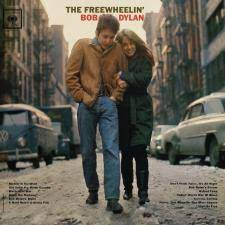
The key works of Dylan’s canon have invited debate for decades but there is a consensus that ‘A Hard Rain’s A-Gonna Fall‘ represents the first full blossom of Dylan as poet. The song’s “lines of terror” aren’t the finger-pointing literal ballads of the folk movement, but the cascade of symbolist/surrealist images that would later introduce listeners to Mr. Tambourine Man and the bleak Desolation Row. Such ambitious writing came as a shock to those expecting the second-coming of Woody Guthrie: “nothing in Dylan’s canon leads up to this example of wild mercury poetry … he abandoned any pretence that he was just a worried man with a worried mind and grabbed hold of word that has haunted him ever since – poet“. (Clinton Heylin)
– Sotheby’s Auction page
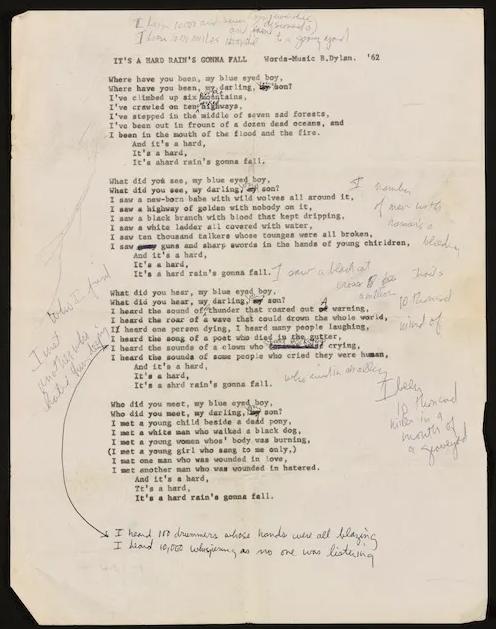
This typescript (see image left), which was probably written above the legendary Gaslight Folk Club in August-September 1962 is a highly important early working draft of the song that first revealed Dylan’s poetic ambitions as a songwriter. It was sold by Sotheby’s in 2014 for $400,000.
More cherry – picked from Sotheby’s page:
The folksinger Tom Paxton recalls the origins of the ‘Hard Rain‘:
“There was a hide-out room above The Gaslight where we could hang out. Once Dylan was banging out this long poem on Wavy Gravy’s typewriter. He showed me the poem and I asked, ‘Is this a song?’ He said, ‘No, it’s a poem.’ I said, ‘All this work and you’re not going to add a melody?‘”
Wavy Gravy was Hugh Romney who was helping to run The Gaslight as its poetry director.
Dylan’s template for ‘Hard Rain‘ was a traditional British folk-ballad, Lord Randal, from which the song takes its basic question and answer structure and also something of its tone: “The song, like the predecessor ballad, takes poison, and it knows what impends: hell” – Christopher Ricks, Dylan’s Visions of Sin (2001).
[Verse 1]
Oh, where have you been, my blue-eyed son?
And where have you been, my darling young one?
I’ve stumbled on the side of twelve misty mountains
I’ve walked and I crawled on six crooked highways
I’ve stepped in the middle of seven sad forests
I’ve been out in front of a dozen dead oceans
I’ve been ten thousand miles in the mouth of a graveyard
[Refrain]
And it’s a hard, it’s a hard, it’s a hard, it’s a hard
It’s a hard rain’s a-gonna fall
[Verse 2]
Oh, what did you see, my blue-eyed son?
And what did you see, my darling young one?
I saw a newborn baby with wild wolves all around it
I saw a highway of diamonds with nobody on it
I saw a black branch with blood that kept dripping
I saw a room full of men with their hammers a-bleeding
I saw a white ladder all covered with water
I saw ten-thousand talkers whose tongues were all broken
I saw guns and sharp swords in the hands of young children
[Refrain]
And it’s a hard, it’s a hard, it’s a hard, it’s a hard
It’s a hard rain’s a-gonna fall (Read the remainder here)
There has naturally been much discussion of what ‘Hard Rain‘ portends. Dylan himself has given typically inconsistent answers. He has claimed (and also denied) that it was written in response to the Cuban Missile Crisis, but it was performed at Carnegie Hall on 22 September 1962, some weeks before the crisis erupted, and was almost certainly sung at the Gas Light at an even earlier date. This draft, which surely precedes the Carnegie Hall performance, shows once and for all that the structure and theme were in place before nuclear war was suddenly an imminent possibility.
In Chronicles Dylan recalls that he took as his inspiration for the song an earlier, weirder, but just as harrowing, America of the 19th century. While poring over microfiche newspapers in the New York Public Library he found a world of slavery, religious movements, riots and anti-immigration violence until, “After a while you become aware of nothing but a culture of feeling, of black days, of schism, evil for evil, the common destiny of the human being getting thrown off course. It’s all one long funeral song…”
As with any great work of art, ‘Hard Rain‘ transcends its inspiration whatever that may have been. It sings of the dreadful allure of the promise of the end of days. Yet the song ends with an act of resilience, as the singer promises to continue with his song, “to tell it, and speak it, and think it, and breathe it“.
I watched on television live Patti Smith perform Bob Dylan’s A Hard Rain’s A-Gonna Fall at the Nobel Prize Award Ceremony 2016. Patti forgot the lines and said “Sorry, I’m so nervous”. After humbly apologizing, she started again.
I always had a penchant for the orchestral version (see below) when Dylan performed at Nara, Japan, May 22, 1994 with the Tokyo New Philharmonic Orchestra conducted by Michael Kamen.
References:
1. The Freewheelin’ Bob Dylan – Wikipedia
2. A Hard Rain’s a-Gonna Fall – Wikipedia
3. Sotheby’s ‘It’s A Hard Rain’s Gonna Fall’, revised typescript

“The more I live, the more I learn. The more I learn, the more I realize, the less I know.”- Michel Legrand


 Observation Blogger
Bob hits it this morning…it’s raining hard…
This one is one of the first Dylan songs I remember hearing. I was a kid but it drew me into it. I had no clue what the words meant but it stuck with me through the years.
I think it was one of the first I remember hearing. The first ever for me was Blowing in the Wind from the record Before the Flood with the Band. I was searching the song ‘Catch the Wind’ from the Wonder Years episode and thought ‘Blowing’ was it. Greatest error of my life!
Catch The Wind…I first saw that in Don’t Look Back…that was a great documentary…that was the first time I saw something with Bob in it.
Yes, Donovan and Dylan had that folk duel down at the ‘Ol Corral’ haha. I love Donovan’s ‘To Sing For You’ there.
I think I came to ‘Don’t Look Back’ late, perhaps in the mid 90’s. Cheers Max.
The Bard at his best. An epic piece.
Forgetting the words is a nightmare; perhaps that’s why the gods created humming.
Great ink, Matt.
I had never heard of ‘Bard’ before. I had to look up what it meant. Hehe.
I couldn’t rewatch the Smith performance because it upset me so much. The kids insisted they watch it, so I watched it again with them peering with so much trepidation through my hand covering my face. I’ve seen horror movies which scared me less. Thanks Nancy.
🫣