In response to my post on Vivaldi’s The Four Seasons, Polly MacDavid at SilverAppleQueen recommended today’s featured piece La Folia (Madness). The name refers to the frenzied way peasants twirled to the music. Interestingly La Folia is not attributed to a single inventor/composer rather it was developed from the folk music of late 15th-century Portugal and altered incrementally over the years and centuries. Today’s version just happens to be Vivaldi’s from his Opus 1 No. 12 of 1705. Well, I found it a most exhilarating and energizing musical theme.
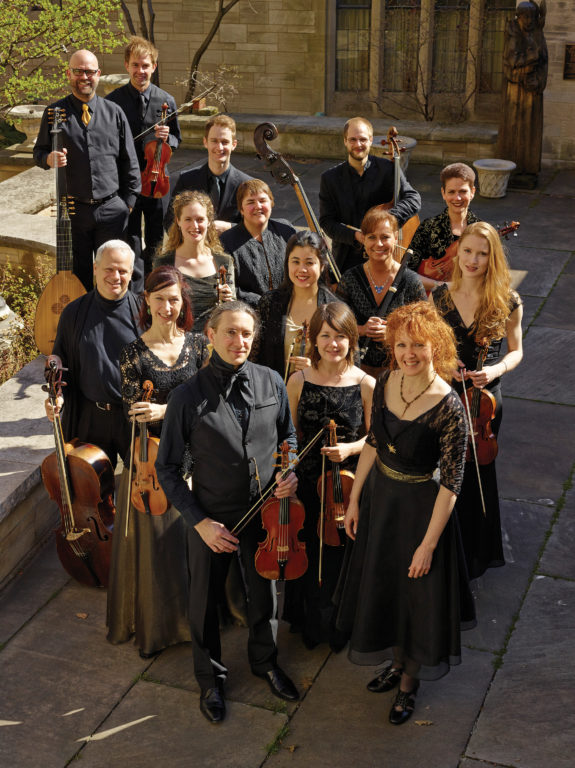
Polly said how she listened to The Four Seasons every day and Vivaldi’s other music a lot! She also remarked how she desired seeing live the Cleveland chamber music group called Apollo’s Fire who present Vivaldi’s La Folia in the video below:
‘I really want to see them in concert. Cleveland is only a few hours away from Buffalo ~ I can get there easily on bus or train. I used to live in Cleveland ~ I lived there for 5 years. I have some really good friends there.’
According to Wikipedia: Apollo’s Fire Baroque Orchestra is a period-instrument ensemble specializing in early music (Renaissance, Baroque, Classical, and early Romantic). The ensemble is based in Cleveland, Ohio and, since 2021, also in Chicago. The ensemble is composed of early music specialists from throughout North America and Europe, and led by conductor/harpsichordist Jeannette Sorrell. Apollo’s Fire and Jeannette Sorrell won a GRAMMY Award in 2018, shared with tenor Karim Sulayman.
Founding and Early History
The Cleveland Orchestra’s was searching for an assistant conductor, and Roger Wright – the Artistic Administrator invited Sorrell to an interview for the position. The interview was conducted by Cleveland Orchestra Music Director Christoph von Dohnányi along with Roger Wright. During the interview, Dohnányi told Sorrell that there was “no point in finding time with the orchestra for her to audition, as the audience in Cleveland would never accept a woman as a conductor.” Sorrell replied that she had not applied for this job, and her true goal was to work with a period-instrument orchestra. Following this encounter, Wright decided to help Sorrell launch a period-instrument orchestra.
Now onto today’s musical piece La Folia, the BBC argue that it may well be the most popular tune in the history of all music.
La Folia has a long history. Its distinctive chords first developed out of the folk music of late 15th-Century Portugal, where it was used in popular festivals. Its name – ‘folly’ or ‘madness’ in Italian – refers to the frenzied way peasants twirled to the music. In Santiago de Murcia’s Codice Saldivar No 4, Renaissance writer Covarrubias describes La Folia as ‘very noisy’ while another highlights its ‘vivacity and fire’, its dancers ‘making gestures that awaken voluptuousness’.
How popular was La Folia at its peak in the 18th Century? It’s hard to say for sure. Online statistics were still a way off and composers often referenced La Folia without naming it. Even today, you have to hunt around to learn that a cantata by Bach and a keyboard piece by Handel both used the theme. Simply searching for ‘La Folia’ is not enough.
Still, there are clues that the theme was a genuine phenomenon. One hint is its vast geographical spread. Between 1670 and 1700 alone, pieces borrowing La Folia were printed everywhere from Zaragoza to Berlin to Oxford. By 1760, it had reached Mexico and Bolivia. Musicians themselves were just as enthusiastic. In the decade to 1710, around 20 composers tried taming La Folia, from Antonio Vivaldi to Arcangelo Corelli.
References:
1. Apollo’s Fire – Wikipedia
2. Could La Folia be history’s most enduring tune? – BBC

“The more I live, the more I learn. The more I learn, the more I realize, the less I know.”- Michel Legrand


 Observation Blogger
I really think it’s something that audiences in Cleveland won’t accept a female conductor ~ if that’s even true. Here in Buffalo, our award-winning Buffalo Philharmonic has been headed by JoAnn Falletta since 1998. BTW, they recorded Vivaldi’s The Four Seasons in 2021.
When you initially told me she about the female conductor fiasco, I had to look it up to confirm for myself. And there it is in the Apollo’s Fire Wikipedia page. Extraordinary. That’s good to read about JoAnn Falletta’s success with the Buffalo Philharmonic.
On the subject of female conductors, have you seen the movie, ‘Tar’? I reviewed it here in Feb ’23.
Yes, I have seen the movie “Tar”. I’d rather see JoAnn Falletta LOL
I loved ‘Tar’. I wrote in the article: ‘To my mind Tár also sits in the centre, but of a triangular prism with movie spokes of ‘Kubrick, Tarkovsky and Bergman’’ because there is a linear structure to the madness. As a movie aficionado I was enthralled watching this prism bend and warp in Tár.