
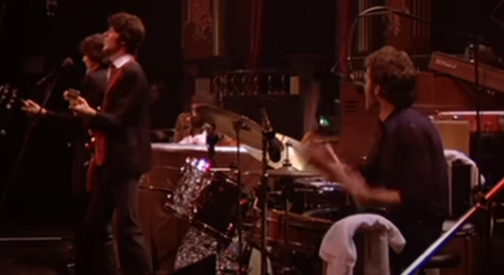
The Night They Drove Old Dixie Down is drawn from the final concert by The Band – The Last Waltz – held on Thanksgiving Day, 1976, at San Francisco’s Winterland Ballroom. Superlatives are scarcely suffice when describing The Band’s performance that evening. You know you’re in the presence of true artistic greatness when your only honest response is: How on God’s earth did they do that? I remain in awe of this spellbinding concert, and of how one of America’s finest directors, Martin Scorsese, managed to capture and preserve its full majesty on film.
Today’s featured song stands as one of the evening’s crowning achievements – and that’s no small feat considering the brilliance on display throughout the show. Old Dixie is already the ninth performance to appear here from The Last Waltz.
It’s hard to find a song more steeped in the roots of old Americana, and Levon Helm’s rugged, time-worn voice feels inseparable from its soul and story. It has that ring of truth and the whole aura of authenticity. In fact the performance in The Last Waltz below is last time the song was performed by Helm. He refused to play the song afterwards.

The Night They Drove Old Dixie Down was written in 1969 by Robbie Robertson. Through the voice of Virgil Caine, a destitute Southern farmer, the song chronicles the harrowing toll of the Civil War – marked by shattered livelihoods, hunger, and heartbreaking personal loss. It is set during the last days of the American Civil War, when George Stoneman was raiding southwest Virginia. Dixie is the historical nickname for the states making up the Confederate States of America.
Creation (from Wikipedia)
Robbie Robertson spent about eight months working on the song. He said he had the music to the song in his head and would play the chords over and over on the piano but had no idea what the song was to be about. Then the concept came to him and he researched the subject with help from the Band’s drummer Levon Helm, a native of Arkansas. In his 1993 autobiography, This Wheel’s on Fire, Helm wrote, “Robbie and I worked on ‘The Night They Drove Old Dixie Down’ up in Woodstock. I remember taking him to the library so he could research the history and geography of the era and make General Robert E. Lee come out with all due respect.”
The Night They Drove Old Dixie Down is considered one of the highlights of The Band, the group’s second album, which was released in the fall of 1969. The album has been viewed as a concept album, with the songs focusing on the peoples, places and traditions associated with an older version of Americana. The Band have frequently performed the song in concert, and it is included on the group’s live albums Rock of Ages (1972) and Before the Flood (1974) featuring Bob Dylan and was the first record I procured of him or The Band.
Although it has long been believed that the reason for Helm’s refusal to play the song after The Last Waltz was a dispute with Robertson over songwriting credits, according to Garth Hudson the refusal was due to Helm’s dislike for Joan Baez’s version.
Joan’ Baez’s version peaked at No. 3 on the Hot 100 on October 2, 1971. Baez later said she initially learned the song by listening to the recording on the Band’s album, and had never seen the printed lyrics at the time she recorded it, and thus sang the lyrics as she had (mis)heard them. In more recent years in her concerts, Baez has performed the song as originally written by Robertson.
[Verse 1]:
Virgil Caine is the name and I served on the Danville train
‘Til Stoneman’s cavalry came and tore up the tracks again
In the winter of ’65, we were hungry, just barely alive
By May the tenth, Richmond had fell
It’s a time I remember, oh so well
[Chorus]:
The night they drove old Dixie down
And the bells were ringing
The night they drove old Dixie down
And the people were singing
They went, “La, la, la”
[Verse 2]:
Back with my wife in Tennessee
When one day she called to me
“Virgil, quick, come see, there goes Robert E.Lee”
Now I don’t mind choppin’ wood
And I don’t care if the money’s no good
Ya take what ya need and ya leave the rest
But they should never have taken the very best
[Verse 3]
Like my father before me, I will work the land
And like my brother above me, who took a rebel stand
He was just eighteen, proud and brave
But a Yankee laid him in his grave
I swear by the mud below my feet
You can’t raise a Caine back up when he’s in defeat
References:
1. The Night They Drove Old Dixie Down – Wikipedia

“The more I live, the more I learn. The more I learn, the more I realize, the less I know.”- Michel Legrand


 Observation Blogger
I used to love this song. I actually heard it first in 1973 sung by Joan Baez.
But I hate the Lost Cause & anything that glorifies the old South & especially Robert E Lee. He’s responsible for the deaths of more Americans than any other person. He enjoyed watching his slaves being whipped. He was a rotten human being.
The Confederates were traitors & they deserved to be crushed. Just like Nazi Germany. It really bothers me that the myth of the Lost Cause & southern bells & cavaliers & happy slaves singing in the fields has persisted. This is why the US is in such a mess now.
I can understand why Robertson said about Baez’s version that it was “a little happy-go-lucky for me,” but he was thankful that it introduced many listeners to The Band.
Regarding the Civil War – it’s definitely not my strong suit as far as world history is concerned. But I loved the movie ‘Glory’ starring Matthew Broderick which was a masterstroke in terms of demonstrating effective leadership. Also Spielberg’s Lincoln was fantastic for the same reasons.
I remember also some interesting etymology about how the word ‘Hooker’ came into being via – General ‘Fighting Joe’ Hooker approving of women involved as camp morale boosters.
I won’t encroach on the political aspects and ramifications because frankly I’m hardly in a position to discuss it with people better-versed on it, such as your good self. I’ll only add by saying one can read about the controversy which still exists today re.’Old Dixie’ in the corresponding reference.
“Glory” was great. Spielberg’s “Lincoln” was a masterpiece.
One of my blogger friends who lives in Chicago says that the US needs a Civil War novel/movie that takes place in the North ~ “Little Women” is kinda that ~ since the father is away at the war ~ “Gangs of NY” is also that, showing the riots in NY during the war.
I’m surprised that no one has ever made a movie of Louisa May Alcott’s “Hospital Sketches”, a true account of when she went to Washington to be an Army nurse during the Civil War. Again, my friend in Chicago is correct ~ there are a LOT of stories that could be told from the Union side but most of the stories we hear are from the Confederate side. Which makes sense, when you consider that the war was fought down there. The Confederates never made it into Union territory, except for the Battle of Gettysburg & they lost that one.
“Gone With The Wind” which I love ~ the novel, not the movie ~ I can’t stand the movie, although the actors were perfect & some of the scenes were really great ~ but it really sucked & just perpetuated the myth of cavaliers & southern belles & happy slaves ~ but the novel doesn’t do that. The novel is quite honest about the racism of the white people ~ even as they profess to care for their “people” ~ their slaves ~ when people say that it’s a racist novel, they obviously haven’t read it.
It also shows how many of the southerners were against succession & the Confederacy & how they knew that they were going to lose. They were following the lead of their state, which was following the lead of a few hotheads. It was the MAGA of their day.
Growing up, we were told in school that the Civil War was about freeing the slaves but most people up North didn’t give a rat’s ass about the freeing of the slaves. The abolitionist movement was just a few Northern hotheads who were Christian loudmouths & businessmen & manufacturers hated them. In places like Lowell, MA, which depended on textiles, the war stopped manufacturing because they couldn’t get cotton from the south & some factories went out of business. There were riots there & free black people were demonized. This is a Civil War story that’s never been told.
The War was about to preserve the Union. With the way our country is going, I now think it would have been to let those states go their own way. They never would have made it & the North would have been a great place. & no MAGA. MAGA is totally a southern thing. & now it’s everywhere.
Yes, Daniel Day Lewis’s portrayal of Lincoln was iconic. Not unlike Gary Oldman’s as Churchill.
Can you believe I’ve never seen Gangs of NY! I don’t know how not, since I’ve seen almost every other movie by the protagonists and Scorsese. I know the reviews weren’t particularly favourable except for DDL’s performance which earn’t him yet another gong.
I’m unfamiliar with the account of Louisa May Alcott’s “Hospital Sketches”. But I hope they realize a film version as you suggest they should. Moreover thanks for the Civil War lesson and I’m not being facetious – on the contrary I found your take very informative. So thanks for taking the time Polly.
A true classic I would call one of my all-time favorite roots rock songs.
I agree 110% with your personal classification of this.
It just occurred to me all these guys are all dead. If that doesn’t put things things into perspective I don’t know what does. Life is short!
Yep, it looks like Garth Hudson was the last member who passed away in January. At least he reached a decent age of 87. By comparison, Richard Manuel and Rick Danko were only 42 and 55, when they passed in 1986 and 1999, respectively.
I didn’t know Richard and Rick had passed away so prematurely. Wow!
Nice, I’ve recently been viewing The Last Waltz…I am always mesmerized…
Above all, I don’t know how Robertson continued to run this procession of A1 entertainers as if he’d been doing it all along.
He was so under appreciated, absolutely a genius….
I LOVE Daniel Day Lewis as Bill the Butcher! In fact, in one scene, he misses when he’s throwing a knife at someone & says “Oopsie doopsie” & I’ve been saying that EVER SINCE when I drop something or something like that.
DDL is a method actor who stays in character for the entire time a movie is being made. Which is difficult for everyone in his personal life. There are many other actors who do this, but he’s probably the most famous for this.
I was so saddened when he laid down tools after PTA’s ‘Phantom Thread’ which remains one of my favourite films btw and criminally underrated. It’s so Ingmar Bergman that movie and I love Ingmar’s movies. While PTA’s other ‘There Will Be Blood’ is kind of an Orson Welles ‘Citizen Kane’ homage.
I hope DDL makes a comeback, but it seems unlikely he could ever top what he has already done and giving it what he did previously. He deserves his retirement or entry into other pursuits like shoemaking? The consummate artist.