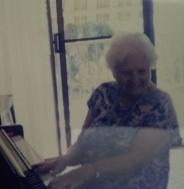
As I get older, my appreciation for classical music only grows stronger. The spark that set it off when I was young came from my grandmother, Dorothy Walton (pictured), who was a classical pianist. Her love for the music – sitting at the piano just as you see here – was really the reason I started my music library project back in 2019. It’s something that’s shaped my life more than I ever expected.
Dot, as everyone called her, was always reading. She borrowed books from the library every week and tore through them until it was time to return them and get more. And when she wasn’t reading, she was at the piano. Writing this now makes me get teary. My Nan and I were completely in sync; there was nothing she could do wrong in my eyes, and nothing I could do wrong in hers. When you love someone like that… the little things become everything.
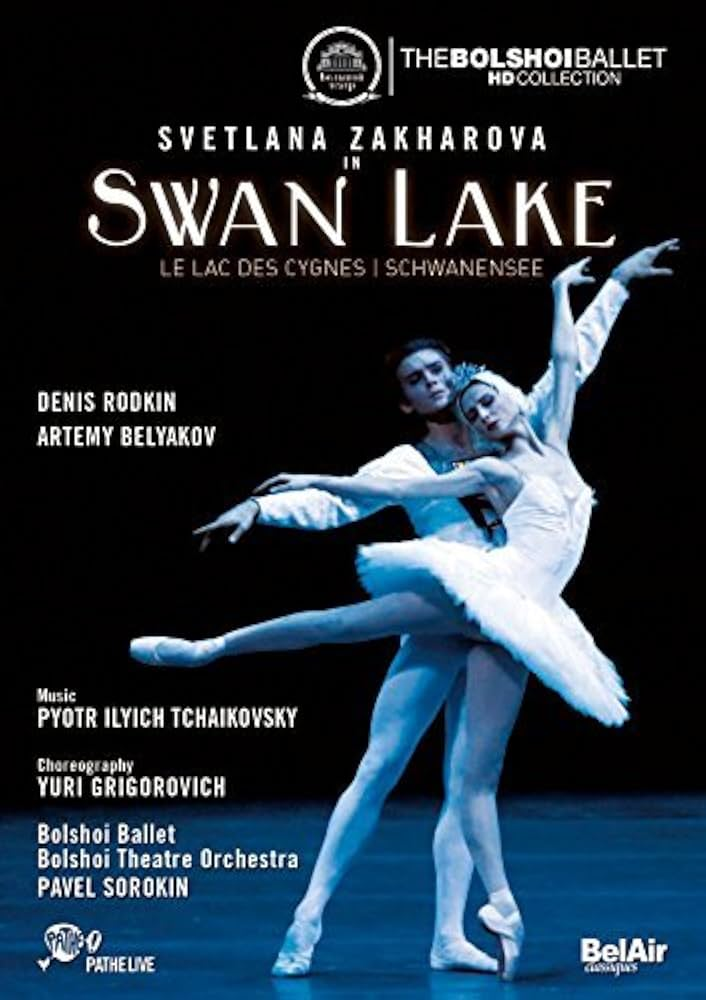
Today we have a Swan Lake special, spotlighting three stand-out moments from Tchaikovsky’s immortal ballet – perhaps the most instantly recognisable in the classical canon. In order of their appearance, they are: the Swan Lake Waltz (Act I, No. 2), the Dance of the Little Swans (Act II, No. 13), and the storm-tossed Scene Finale (Act IV, No. 29).
The ballet’s hold on western culture remains very strong. Two recent cinematic touchstones spring to mind: Black Swan (2010), which refracts the ballet’s obsession with duality and desire, and Billy Elliot (2000), where the film’s climax erupts into the very same Scene Finale older Billy leaping high onto the stage.
Tchaikovsky wrote Swan Lake in 1875–76, using old Russian and European stories about women who turn into swans. The first performance in 1877 at the Bolshoi Theatre didn’t go well. Critics said the dancing and staging were messy. The basic story, though, is very clear: Prince Siegfried falls in love with Odette, who has been turned into a swan by the sorcerer Rothbart. Their love is challenged by lies, sadness, and the appearance of Odile – the Black Swan – who looks like Odette but isn’t anything like her. In modern versions, the ending changes: sometimes the couple dies, sometimes they’re reunited. It depends on what the director wants.
Swan Lake Waltz (Act I, No. 2)
This waltz shows up early during the prince’s birthday party. There are lights, fancy outfits, and everyone trying to look their best. The music feels light and social, almost like a warm-up before the story really gets going.
Dance of the Little Swans (Act II, No. 13)
This is one of the scenes most people know: four dancers linked together, moving in quick little steps. It happens by the lake where Siegfried first meets Odette. The “little swans” bring a bit of fun and tight teamwork to the moment. The music is fast and neat, almost like Tchaikovsky wanted to test how well the dancers could stay together.
Scene Finale (Act IV, No. 29)
This is where everything hits its peak. The music grows loud and tense as the lovers face their final moment. Some versions end sadly, others more hopeful, but the music makes it clear that this is the big emotional punch. It’s easy to see why Billy Elliot used it for such a powerful ending.
Swan Lake wasn’t a big hit at first and only became famous after Tchaikovsky died. The 1895 version by Marius Petipa and Lev Ivanov fixed many of the earlier problems and turned it into the classic we know today. Since then, it’s been performed by almost every major ballet company and keeps showing up in movies, TV, and all sorts of places in popular culture.
References:
1. Swan Lake – Wikipedia

“The more I live, the more I learn. The more I learn, the more I realize, the less I know.”- Michel Legrand


 Observation Blogger
I love Swan Lake. I wanted to take ballet when I was little & my parents wouldn’t let me ~ they said I had piano lessons & that was enough. I would have gladly traded piano lessons for ballet classes! I got books out from the library & taught myself the 5 positions & other basic ballet steps. To this day, I do the 5 positions daily.
I like Romeo & Juliet better than Swan Lake but it’s barely known. This time of year, the Nutcracker is EVERYWHERE.
That’s rough that your parents didn’t allow you to take ballet classes. I’m glad you found ways around it, became self-taught, and still practice to this day. That’s what you call passion and dedication.
I really liked the film Billy Elliot, which is about a young boy’s passion for dance—especially ballet—and how he had to sneak behind his father’s back to take classes.
I’ve never seen a ballet live, but when I was listening to those three pieces from Swan Lake yesterday, I kept thinking how magnificent it would be to experience it in person. And yes, The Nutcracker around Christmas would be incredible. I was actually listening to the “Pas de Deux, 14th scene in Act II” yesterday! I love that piece.
I’ve seen several ballets in person. The Nutcracker, of course. I’ve seen the Red Shoes, which is a story I love. When I was a dancer, I wore red shoes ~ it’s a theme in my life. I’ve also seen The Firebird, which was AWESOME.
That’s awesome, you’ve seen so many. I’m envious lol I hadn’t heard of Firbird before.
While on the subject of red shoes. I just saw the rerelease of ‘Wizard of Oz’ with my daughter on the big screen! Spectacular.
I bet that was spectacular! When I was little, it was on TV once a year & we didn’t have a color TV, so we saw the whole thing in black & white. My mother had seen it in the theater when she was a child & told us about how the OZ section was in color ~ but we had to imagine that.
My grandparents got a color TV in 1966 & we went over to their house to see the movie that year. Seeing how the door of the black & white house opens up the color of OZ the first time was so fabulous! I’ll never forget it.
Back then, all the TV shows advertised that they were now programming in “Living Color”. Until all TV shows were in color & that was dropped.
Excuse my delay in responding. When I read about your first time seeing it in black and white, I honestly felt a bit heartbroken for you. The film’s whole magic hinges on that burst of colour when Dorothy opens the door to Oz—the moment cinema changed forever as you mentioned. At least you had your mum’s memories to lean on, though hardly a perfect substitute. Still, you eventually caught it properly at your grandparents’ place—yippy indeed! It was lovely to read your early recollections.
When I found out about the re-release, I grabbed the earliest session my daughter and I could make—11:30 a.m. on a Saturday. I kid you not: it was just Katherine and me, plus a young couple a few rows back. That’s it. I genuinely thought parents would turn up in force to show their kids this on the big screen, but nope—and that’s a pretty bleak realisation on where we’re at culturally. And to add insult to injury, my little post on Swan Lake barely scraped any likes, even by my own crappy standards.
Most people aren’t into classical music ~ they’re too “cool” for that. I was raised listening to classical music ~ I was given a classical education, music & reading & everything.
But we also listened to all kinds of jazz, show tunes, Americana, folk, rock, everything. Most people aren’t exposed to any of this stuff.
Thanks Polly, I decided to disband with the comments that I let get derailed into Politics and what-not. That was my fault. Cheers
That’s OK. You were quite polite about it. Unlike so many here in the States. HUGS