

‘Hi-fi shops played it as an example of state-of-the-art music. I didn’t tell them I made it with Sellotape in my kitchen’
– Jean Michel Jarre
You know you’re onto something when a director like Peter Weir picks your music for one of his films – which he did with today’s featured piece, Oxygène, Pt. 2, in the classic Australian war film Gallipoli. This includes fragments of the scene where I first heard this immense track as a youngster, and it’s stayed lodged in my music memory ever since. If I want to get a bit trippy, I imagine this piece as a small, bending triangulum prism, with its centre holding that airy atmosphere of oxygen and space. One point connects it to a war film, another to a young French musician tinkering in his kitchen, and the third to the 1968 student uprisings that helped shape it.

It was in those uprisings where Jarre recalled the years of him drifting between rock bands, odd tape experiments, and trying to rebel in whatever way felt honest. Many laughed at the strange sounds he was pulling from his gear, but he kept trying to mix the experimental with something people could actually enjoy.
He says he built his kitchen studio from small savings, using only a few pedals, a Revox tape machine, and an EMS VCS3 synth. He realised that delaying the signal from one speaker made the room feel huge. His Mellotron barely worked, but it was enough to sketch out the melody for Oxygène, Pt. 2. Even his humble Korg Mini Pops drum machine only became interesting after he taped together two presets to make a new rhythm.
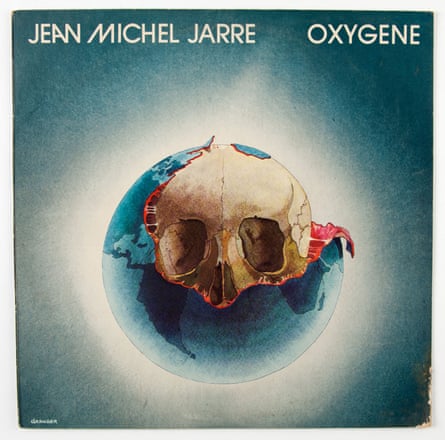
Jarre has said he wanted electronic music without vocals, tied somehow to nature and the environment. When he first saw Michel Granger’s painting of Earth peeling open to reveal a skull, he knew instantly: that’s the cover (image inset).
Record labels didn’t see the vision. They rejected the album for having no singer, no drummer, long tracks, and “being too French.” But Francis Dreyfus took the risk and pressed an initial 50,000 copies. Some buyers returned it, thinking the white noise was a defect. Then radio – especially in France and the UK – began playing full sides of the album, and things changed fast.
Oxygène went on to sell roughly 15 million copies worldwide. Jarre has made plenty of music since – big outdoor concerts, sequels to Oxygène, and new electronic experiments – but this album remains the one most closely tied to him.
References:
1. Jean-Michel Jarre: how we made Oxygène – The Guardian
2. Oxygène – Wikipedia

“The more I live, the more I learn. The more I learn, the more I realize, the less I know.”- Michel Legrand


 Observation Blogger
While I’m certainly not an all-out fan of electronic music, I absolutely love Jean-Michel Jarre’s “Oxygène.” It was Oxygène, Pt. 4, which became a hit and brought the album on my radar screen in Germany many moons ago. Ideally, we should listen to all music with headphones. In the case of “Oxygène,” it’s a must to get the true experience. This music makes me feel like I’m floating in space.
I do think listening to music through headphones reveals layers and textures you just can’t catch in open air. One such example – I was listening to Nathy Peluso’s ‘Aprender a Amar’ through headphones just yesterday and the way the beat and textures hit my ear – it felt like an event — it made everything I listened to earlier in the day sound second-rate. Oxygène is definitely one of those pieces that benefits from being heard that way. I also get that drifting-through-space sensation when I listen to it.