
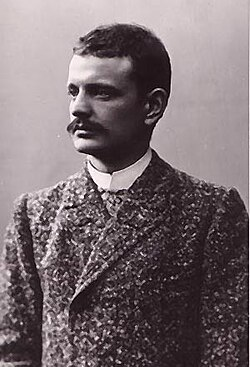

The Finnish composer and violinist – Jean Sibelius returns here with a buoyant, almost regal fanfare. The Intermezzo (Eng: Interlude) is a jaunty Allegro march-like theme, the orchestra portraying the atmosphere of marching contingents. May it set your day off in a bright, steady stride, just as it did for me when I heard it this morning.
It is just one of a subset of pieces from the longer Karelia Music (named after the region of Karelia) written by Jean Sibelius in 1893. The Intermezzo is the only original movement of the suite. Sibelius borrowed the brass theme from the middle of Tableau 3 and shaped it into its own movement. If you listen to this spectacular short piece (at the very bottom of this post), it’s easy to hear exactly where he drew his inspiration.
Jean Sibelius featured here previously with the magnificent Finlandia which was composed for the Press Celebrations of 1899, a covert protest against increasing censorship from the Russian Empire. He’s often credited with helping Finland shape a national identity during its struggle for independence from Russia. More broadly, he’s recognised as the country’s greatest composer.
Karelia Music was written in the beginning of Sibelius’s compositional career. The rough-hewn character of the Music was deliberate – the aesthetic intention was not to dazzle with technique but to capture the quality of naive, folk-based authenticity. Historical comments have noted the nationalistic character of the music.
References:
1. Karelia Suite – Wikipedia

“The more I live, the more I learn. The more I learn, the more I realize, the less I know.”- Michel Legrand


 Observation Blogger
Beautiful piece of music! And kudos for “tackling” classical music, which I’ve always generally enjoyed but for some reason rarely hear. It’s amazing to realize Sibelius composed this music about 132 years ago. If humankind hasn’t completely destroyed the planet, I wonder whether folks will still listen to some of today’s music.
I’m thrilled you liked the Intermezzo so much! The short piece that comes before it — Tableau 3, which inspired Sibelius to write the Intermezzo — is stunning in its own right. I’m glad my post included both pieces… two for the price of one, lol.
I like your thought experiment about which contemporary music people will still be listening to in 132 years (assuming – as you did – we haven’t gone extinct by then — and that’s a big if!). I imagine it’ll mirror what we see with older music now: a small slice of the truly great artists, maybe a few dozen rather than hundreds. What do you think?
In general, I agree it’s likely going to come down to a select group of bands and artists. I would hope The Beatles will be part of that group. I also think there’s a good chance folks will still listen to certain albums by Pink Floyd will, such as “The Dark Side of the Moon” and “Wish You Were Here.” Undoubtedly, there should be more, but The Beatles and Pink Floyd are the first two that came to my mind.
This is such a fascinating topic, and one I imagine you and I could riff on ’til the cows come home.
I think Dylan is today’s Shakespeare of music — and a bit of a modern prophet (and he’d hate me saying that, but he is). His music and stature will only keep growing as time passes. When I followed him in the ’80s, I was openly disparaged by family and friends. I remember him being mocked in comedy parodies left, right, and centre—for the marijuana jokes and that nasally voice. Three decades later he wins the Nobel, and you hardly hear a bad word about him. Quite the opposite. Plenty of people I knew who didn’t like him back then now think he’s the ant’s pants.
I also think more film projects will be made about the standout periods of his musical transformations—the kind of quality we saw in ‘A Complete Unknown’. And Leonard Cohen’s music, as a contemporary spiritual poet, will also keep being heard, discussed, and studied (alongside Dylan) a century from now.
I agree with you about the Beatles and Pink Floyd. I’d hope Dire Straits too — if only for Knopfler’s monumental guitar playing. And the Beach Boys, because their sound and harmony are unlike anyone else’s. I do think classical music will make a resurgence simply because of the sheer immensity of its sound and the abundant talent behind it — something you find lacking in a lot of neo-modern music.
I’d be interested to hear your thoughts on all this, if you want to meander down this path.
I agree you’d think extraordinary songwriters like Dylan and Leonard Cohen will remain relevant 130 years from now. Frankly, I would also hope Carole King and Joni Mitchell. It’s really hard to tell…
‘I agree you’d think..’ lol My gawd did that make me laugh.
But at least I got it off my chest. Thanks for recognising that. Haha
I think some of today’s music will be played but it will depend on how the ways we listen to music has evolved. In my mind, just the way that AI is heading, I can see music and visuals going more hand in hand. Think of synesthesia and chromesthesia in which you see different colors and patterns depending on the sound waves. Based on that, I can see the future music moving away from the “blander” pattern and repetitious nature of today’s modern music, is moving into more electronic or experimental. That way, it gives the listeners a better show so-to-say.
The fact that today’s small-form content has ruined our attention spans for anything longer than a few seconds, I can see the music industry going down the same path so it will have to be much more interesting in order for the mass public to find interest in it.
That being said, I see there being an uptick in strictly instrumental music, over lyrical. Looking at it from an industry perspective, the fact that singers will no longer have to get paid, that is a plus for the big wigs as well.
What really struck me when reading this—something I hadn’t considered before, and which I’ll admit I initially found almost absurd—is the idea that future enjoyment of music may not resemble how we listen to or experience it now. It genuinely bamboozled me, and I’m still getting my head around it. That said, your prognosis does seem to reflect how a future world might practically embrace the arts—where vision and music operate hand in hand. I can see that.
It connects to what I mentioned earlier about the simulated world becoming more attractive to live in than the real one. Your view of how music might be embraced in the future feels like part of that simulated realm—where you don’t just hear Mozart playing, but experience it as a fully realised visual and sensory environment. In that context, electronic and ambient music would naturally overlap with visual perception, becoming more fluid and immersive within a simulated space.
Am I anywhere in the ballpark here?
Yes! That is exactly where I was going with that.
I can see people getting almost bored with the typical music of today since who can guess how far technology will have gone by then. People will need more of an excuse to participate which is why I think there will be more of a drug like hypnosis to lure people in.
I could be way off but it reminded me of Ready Player One. In which people were virtually at their prefered concerts. VR will heavily play a roll in it I am sure.
Yeh, I get it.
Companies — big multinational stakeholder conglomerates — will take over the world. Much as they already do through government influence, music, the arts more broadly, and property (land).
And considering how AI is almost certain to do away with at least 95% of the human workforce, humanity (us individuals) will have no bucket left to piss in. So it’s inevitable that a Universal Basic Income will be introduced to satisfy basic human needs.
Our current circumstances could then be substituted with a new environmental substrate — a space to interact and acquire meaning outside the corporate, multi-global realm. A kind of technological re-foundation, you might call it, and one that seems almost inevitable: branching humans into another level of existence that can still be “worth something.”
That means simulating our former existence — without bots — and allowing us to enjoy the fruits of our former selves and the arts on a simulated level, one that doesn’t interfere with the main-player game. And we get paid to put the goggles on and turn a blind eye.
A bit like what happened during the COVID pandemic.
Yes lol
The entertainment sphere will just be a tool to get people to go along with everything.
Keep them distracted while their lives as they know it are ending, It is pretty insane to think about.
I love Sibelius. I played this in youth orchestra when I was a kid. & of course, we played Finlandia, which was ecstacy-producing.
Wow, what instrument did you play in youth orchestra?
Finlandia is absolutely stunning. I love how it changes course from about 6 minutes in – slows down and turns into something entirely new. Then it has one of the most satisfying endings to a classical piece I have heard.
I played trombone, mostly, but also baritone/euphonium. Baritones are generally bass-cleff & euphoniums are generally treble-cleff, I read both cleffs easily. I also read treble cleff & alto cleff ~ a lot of the trombone parts were written in those cleff.
I was also in concert band/wind ensemble, marching band & jazz ensemble, as well as brass choir & trombone choir.
Music was my life when I was in school. I don’t think I would have made it without band.
Most of what you wrote went way above my head, since I’m in no way musically trained. The only thing I could really latch onto was the treble clef, mainly because I’ve got one tattooed on my right shoulder blade.
It’s clear how much music meant to you at school – and of course in your family, as you’ve recalled so often – and I’m really glad you have such endearing memories of it, and that you shared them here.
Why do you have a treble clef tattoo if you’re not musically trained?
My father worked for the defense industry ~ we moved all the time. We were rather like a civilian version of “Army Brats”. He went where he was told to go ~ government contracts & all that.
So moving all the time, new girl in a new school, almost every year, the only constant was band, orchestra, etc. Of course there were always auditions ~ for your chair, for example ~ but I never felt I have to prove my worth when it came to music. I always knew I had IT.
I wrote a post about getting my tattoo. I’ll send it below – it might answer your question. I’ll reread it too, since I haven’t looked at it in years.
I moved with my family during my adult life as a military member, much like what you described about your youth. Yes, music was in your blood, and it was further shaped by your time with the band and by your family: