
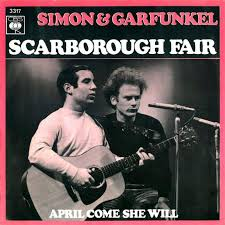
Simon & Garfunkel appealed strongly to a particular segment of the educated, middle-class youth culture that emerged on American university campuses in the 1960s. The duo projected introspection and intelligence, and their songs often felt literary, reflective, and contemplative, unlike the more rebellious energy of The Rolling Stones or the psychedelic experimentation of The Doors.
Simon & Garfunkel rarely produced overt protest songs in the mould of Bob Dylan, but there are strong parallels between today’s featured song Scarborough Fair/Canticle and Dylan’s Girl from the North Country.
While in London in 1962, Dylan met several figures in the local folk scene, including English folk singer Martin Carthy. Dylan later recalled: “I ran into some people in England who really knew those [traditional English] songs.” One such person was Carthy, who introduced him to his arrangement of Scarborough Fair, which Simon & Garfunkel would later make famous.
Before Paul Simon learned the song, Bob Dylan had already borrowed the melody and several lyrical phrases from Carthy’s arrangement to create Girl from the North Country – recorded several years before Simon & Garfunkel released Scarborough Fair/Canticle in 1966.
Scarborough Fair/Canticle lists a number of impossible tasks given to a former lover who lives in Scarborough, North Yorkshire. The song feels ages old, and for good reason, because it is. The ballad dates back centuries and belongs to a family of traditional British folk songs known as The Elfin Knight. The melody used by Martin Carthy was collected from singer Mark Anderson (1874–1953) and later appeared in collections of traditional folk music.
The song is often interpreted as a dialogue between former lovers, each setting the other impossible tasks as a condition of reconciliation. The repeated refrain, “parsley, sage, rosemary and thyme”, may simply serve as a traditional folk refrain, although various symbolic meanings have been suggested over the years. Some writers have linked the herbs to remembrance, love, strength, and courage, while others connect them to medieval healing traditions. Whatever the interpretation, the impossible tasks make it clear that reunion is unlikely, giving the song its wistful and haunting character.
From Wikipedia:
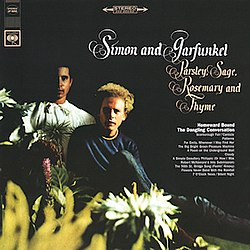
Scarborough Fair/Canticle appeared as the lead track on the 1966 Simon & Garfunkel album Parsley, Sage, Rosemary and Thyme in counterpoint with “Canticle”, a reworking of the lyrics from Simon’s 1963 anti-war song The Side of a Hill.
The song was released as a single after it had been featured on the soundtrack to The Graduate in 1968. The copyright credited only Simon and Garfunkel as the authors, which upset Carthy, who felt that the “traditional” source should have been credited.
[Verse 1: Art Garfunkel]
Are you going to Scarborough Fair?
Parsley, sage, rosemary, and thyme
Remember me to one who lives there
She once was a true love of mine
[Verse 2: Art Garfunkel & Paul Simon]
Tell her to make me a cambric shirt
On the side of a hill, in the deep forest green
Parsley, sage, rosemary, and thyme
Tracing of sparrow on snow-crested ground
Without no seams nor needlework
Blankets and bedclothes, the child of the mountain
Then she’ll be a true love of mine
Sleeps unaware of the clarion call
[Verse 3: Art Garfunkel & Paul Simon]
Tell her to find me an acre of land
On the side of a hill, a sprinkling of leaves
Parsley, sage, rosemary, and thyme
Washes the grave with silvery tears
Between the saltwater and the sea strands
A soldier cleans and polishes a gun
Then she’ll be a true love of mine
[Verse 4: Art Garfunkel & Paul Simon]
Tell her to reap it with a sickle of leather
War bellows, blazing in scarlet battalions
Parsley, sage, rosemary, and thyme
Generals order their soldiers to kill
And gather it all in a bunch of heather
And to fight for a cause they’ve long ago forgotten
Then she’ll be a true love of mine
[Verse 1: Art Garfunkel & Paul Simon]
Are you going to Scarborough Fair?
Parsley, sage, rosemary, and thyme
Remember me to one who lives there
She once was a true love of mine
References:
1. Scarborough Fair (ballad) – Wikipedia

“The more I live, the more I learn. The more I learn, the more I realize, the less I know.”- Michel Legrand


I think I might have shared this before ~ I learned this song in school as a poem ~ although the song was played for us on the record player ~ & we took it apart, line by line, & analyzed it. This had to be in third or fourth grade. I was pretty young. I think we had a student teacher who was teaching this class ~ we had a lot of student teachers in those days ~ they were all anti-war.
We sang “Scarborough Fair” in chorus as a round, too.
I don’t think I recall that story from you, but it’s pretty neat. I didn’t realise Scarborough Fair being so integrated in the school curriculum as it were. Very cool. It seems the students reflected the new left-leaning views of their professors, as you alluded to. Politically aware, sceptical of consumer capitalism, opposed to the Vietnam War, and engaged with the social issues of the era.
I’m so glad I was a kid in the 60s.
My mother owned the Graduate soundtrack and I became a Simon & Garfunkle fan through osmosis. I remember the lyrics to Sound of Silence being included in an English textbook in high school as an example of lyrics as poetry.
I’m pretty sure we had the soundtrack in our household as well. The movie was a staple too.
To think Paul Simon wrote the lyrics of ‘The Sound of Silence’ at just 21 years boggles the mind.
It’s interesting you mention its inclusion in an English textbook. The Catholic Church in Colombia adapted the melody for a song called Padre Nuestro.
This song can be found in many places — some of them quite unexpected.