
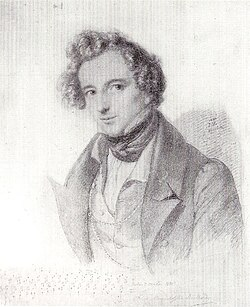
For some inexplicable reason, I’d overlooked this Mendelssohn piece for years. Having listened to it again recently, I can say it’s grown on me considerably. This second movement from his Symphony No. 3 is a brisk and chirpy piece, so dainty as it tiptoes and prances the listener into a delectable state. I also found that certain parts evoked such alluring and heartfelt memories of scenes from childhood. And it has a dazzling ending to die for. Truly spectacular!
As mentioned, the second movement of Symphony No. 3 scoots along at such a glorious pace. It has me bopping along in my chair as I listen to it right now. Interestingly, this movement has the Italian music direction – Vivace non troppo meaning “lively, but not excessively fast”. You learn something every day, huh?
The German composer Felix Mendelssohn composed it between 1829 and 1842, having set it aside in 1831 after struggling with it. It eventually premiered on 3 March 1842 at the Leipzig Gewandhaus.
This is the second piece by Mendelssohn to feature here, following his The Hebrides (Overture), which was inspired by his visit to the western coast of Scotland and the island of Staffa. Mendelssohn certainly had an affinity with Scotland, since this symphony was also inspired by the country, specifically his visit to the ruins of Holyrood Chapel at Holyrood Palace in Edinburgh on 30 July 1829.

He related the following to his family in a letter:
In the deep twilight we went today to the palace where Queen Mary lived and loved…The chapel below is now roofless. Grass and ivy thrive there and at the broken altar where Mary was crowned Queen of Scotland. Everything is ruined, decayed, and the clear heavens pour in. I think I have found there the beginning of my “Scottish” Symphony
I hope to visit Scotland one day with my children, since my paternal great-grandparents emigrated to Australia from there. My great-grandfather worked at one of the oldest golf courses in the world, the famous and illustrious St Andrews golf course. I’ve always been fascinated by the history, culture and music of Scotland, and feel so romantically drawn to the place.
Even when it comes to today’s musical piece, it’s said that audiences have found it hard not to hear it as evoking the wild Romantic landscapes of the north. I’m with that lot. A Scottish gent in the comments even wrote:
I’m Scottish and absolutely love this work. Completely encapsulates the feeling of the place .. amazing all round.
But I’m about to rain on everyone’s parade, thanks to Wikipedia, which states:
Intriguingly, despite describing the work as his ‘Scottish Symphony’ to his family in 1829, by the time the work was published in 1842 Mendelssohn never publicly called attention to the symphony’s Scottish inspiration, and it is debatable whether he intended the finished work to be considered ‘Scottish’.
Well, whatever, Wiki! I’m going with what Mendelssohn wrote in that charming and dreamy letter to his family -‘Everything is ruined, decayed, and the clear heavens pour in’. I’m declaring it ‘Scottish’, and that’s that.
References:
1. Symphony No. 3 (Mendelssohn) – Wikipedia

“The more I live, the more I learn. The more I learn, the more I realize, the less I know.”- Michel Legrand


Leave a Reply