
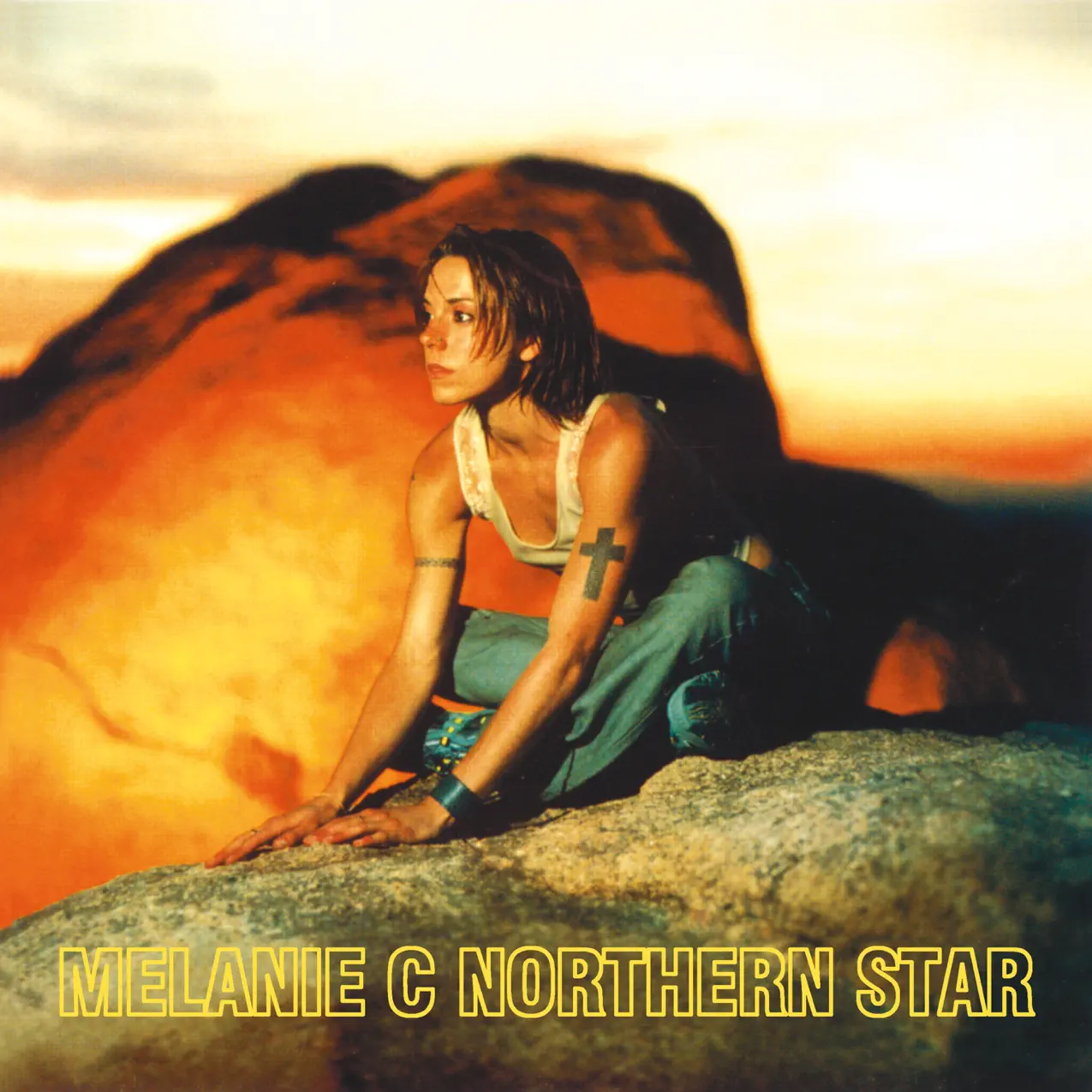
Let me just say from the outset – I’ve seen worse single covers than the one above. Wowee. If I’m hazarding a guess, I’d say Melanie C’s (from the British girl group Spice Girls) short-cropped hair and athletic look on her first solo record Northern Star (inset) had as much to do with me buying the record as anything else.
But hear me out… upon listening to the album, I soon learned there was much more behind that pretty face than I’d imagined. It actually contained some very good music, and I responded to it most agreeably as a newbie casual fan. Which brings us to today’s featured song.
Hip-hop music isn’t ordinarily my cup of tea, but what Mel does with Never Be the Same Again really drew me in. It oozes a sultry and delectable sound – even after more than two decades, it still feels as fresh and current as almost anything I hear today. What I also like is that it doesn’t try to be too showy or over the top; it just is what it is – a meandering yet cozy stroll of music that feels warm and congenial on the ears. The song also features (in the third verse) American singer and rapper Lisa “Left Eye” Lopes of TLC fame.
Lyrically and thematically, it reminds me a little of Alanis Morissette’s 1995 song Head Over Feet – an unassuming and restrained telling of unexpected affection between friends that turned into, to quote Alanis, “You’re my best friend / Best friend with benefits.”
Two other songs will appear here from Mel’s debut album, including the wonderfully poignant title track Northern Star.
Never Be the Same Again was the third single released from the record. It entered at the top of the UK Singles Chart, becoming Melanie C’s first solo single to reach number one. It sold 144,936 copies in its first week and was Britain’s 18th-best-selling song of 2000.
Melanie C was born Melanie Jayne Chisholm on 12 January 1974, which makes her just three days older than yours truly – very cool by my own reckoning, if I may say so. The music video below was filmed in Malibu, California – also pretty cool. Mel is also seen jogging on a treadmill with a changing foreground. She has been open about her experiences with clinical depression and an eating disorder.
She spoke of her eating disorder to Contact Music, stating:
“I’d hammered the gym for three hours a day. It was a way of running away, not thinking. I felt like a robot. When the papers started calling me ‘Sumo Spice’, I was only a size 10. But I was so upset by all the criticism, it got worse and I went up to a size 14.”
[Verse 1]
I call you up whenever things go wrong
You’re always there you are my shoulder to cry on
I can’t believe it took me quite so long
To take the forbidden step
Is this something that I might regret?
[Pre-Chorus]
Come on, come on
Nothing ventured, nothing gained
You are the one
The lonely heart that can’t be tamed
Come on, come on
I’m hoping that you feel the same (Yeah!)
This is something that I can’t forget
[Chorus]
I thought that we would just be friends
Things will never be the same again
It’s just the beginning it’s not the end
Things will never be the same again
It’s not a secret anymore
Now we’ve opened up the door
Starting tonight and from now on
We’ll never, never be the same again
(uh, never be the same again)
Never be the same again
(uh, never be the same again, come on)
[Verse 2]
Now I know that we were close before (before)
I’m glad I realized I need you so much more (yeah)
And I don’t care what everyone will say (uh, ha)
It’s about you and me (you and me)
And we’ll never be the same again (uh)
[Verse 3: Lisa “Left Eye” Lopes]
Uh, check it
Night and day
Black beach sand to red clay
The US to UK
NYC to LA
From sidewalks to highways
See it will never be the same, what I’m saying
My mind frame never changed so you came and rearranged
But sometimes it seems completely forbidden
To discover those feelings that we kept so well hidden
When there’s no competition
And you render my condition
Though improbable it’s not impossible
For a love that could be unstoppable, but wait
I find lines between fate and destiny
Do you believe in the things that were just meant to be?
When you tell me the stories of your quest for me
Picturesque is the picture you paint effortlessly
And as our energies mix and begin to multiply
Everyday situations they start to simplify
So things will never be the same between you and I
We intertwine our life forces
And now we’re unified (yeah)
References:
1. Never Be the Same Again – Wikipedia











 Observation Blogger