Yesterday I recorded a duo performing on the Transmilenio — Bogotá’s bus rapid transit (BRT) system. In the background of the video you can see the Bogotá Metro under construction: a 24 km (15 mi) elevated, driverless, automated rapid transit line. The inset image is a digital rendering showing how the Transmilenio below and the Metro above will look once the Metro opens, projected for March 2028.
One of the perks of being a regular TransMilenio passenger is getting to witness talented and sometimes unorthodox musical acts I’d never encounter otherwise. The duo I recorded yesterday was one such example. The passengers in attendance clearly enjoyed the performance, rewarding them generously with loose change.
The young man on the left of the video is playing a melodica, also known as a keyboard harmonica or Pianica. It’s a small, handheld, breath-powered keyboard instrument that produces sound when air is blown across thin metal reeds, much like a harmonica or accordion.
From the outset they sounded wonderful, and I felt compelled to capture the moment. It was hard to keep my phone steady – my legs wanted to bop along. They told us the second piece they performed (presented above) drew from Russian musical traditions, perhaps even Polka? – that lively, upbeat style rooted in frenzied folk dances. Any Russian or Balkan folk music experts in the house?
Of course, the video — obstructed by poles, barriers, and the limitations of a mobile mic – can’t quite replicate the live, in-person experience. Still, I hope you enjoy it. If you liked what you heard, I’ve also included below a longer clip of their first piece.
Anyway, signing off now from an overcast Saturday morning high up in the Andes. ‘Hooroo’ from your resident Aussie.
Apart from being one of the world’s most famous pieces of music, the Can-Can must also be one of the most joyfully mischievous. Its popularity became enduring when, 15 years after composer Offenbach’s death, the Moulin Rouge and the Folies Bergère adopted it as the regular accompaniment to their can-can dance. In case you were wondering like me, the can-can is a high-energy, physically demanding dance that became a popular music-hall dance in the 1840s, continuing in popularity in French cabaret to this day. Originally danced by couples, it is now traditionally associated with a chorus line of female dancers (see image inset).
Poster for Paris revival, 1878
The piece is the Galop Infernal from Act 2 of Jacques Offenbach’s Comic Opera – Orpheus in the Underworld.
Opera Overview (from Wikipedia) The opera is a lampoon of the ancient legend of Orpheus and Eurydice. In this version Orpheus is not the son of Apollo but a rustic violin teacher. He is glad to be rid of his wife, Eurydice, when she is abducted by the god of the underworld, Pluto. Orpheus has to be bullied by Public Opinion into trying to rescue Eurydice. The reprehensible conduct of the gods of Olympus in the opera was widely seen as a veiled satire of the court and government of Napoleon III, Emperor of the French.
Some critics expressed outrage at the librettists’ disrespect for classic mythology and the composer’s parody of Gluck’s opera Orfeo ed Euridice; while others praised the piece highly. The original 1858 production became a box-office success, and ran well into the following year, rescuing Offenbach and his Bouffes company from financial difficulty. The 1874 revival broke records at the Gaîté’s box-office. The work was frequently staged in France and internationally during the composer’s lifetime and throughout the 20th century. It is one of his most often performed operas, and continues to be revived in the 21st century.
This beautiful love song is one of the few Tracy Chapman pieces I regret leaving out when I first launched my Music Library Project back in 2019. Unlike much of Chapman’s work, which often leans toward social and political commentary, Baby Can I Hold You turns inward, exploring the fragility of personal relationships. Released in October 1988 as the third and final single from her debut album Tracy Chapman, the track surprisingly underperformed in the U.S., peaking only at No. 48 on the Billboard chart – though, curiously, it reached No. 1 in Brazil and Portugal. As an aside, I’ve noticed that Chapman’s music resonates strongly here in Colombia too.
When you listen to the words of Baby Can I Hold You along with the melody – it’s hard not to be swept up in it – where it makes your heart melt – and you end up craving for reconciliation on the narrator’s behalf. The song itself feels as vulnerable as a baby – one you just want to cradle and protect. Chapman is pleading for the simplest of gestures: words like “sorry” or “forgive me,” signals of repair for past wounds. It doesn’t have to be that, they can just say ‘Baby Can I Hold You Tonight‘ – serving as a heartfelt request for closeness and intimacy that may bridge the emotional gaps that words often fail to fill.
The song is so relatable as well – it inevitably stirs memories of a lost love or someone just out of reach. The irony is that the song carries with it a strange sense of hope: when love runs so deep, reconnection feels possible, even if only in spirit.
Tracy Chapman (b. March 30, 1964) is an American singer-songwriter renowned for her soulful voice, socially conscious lyrics, and understated acoustic style. Raised in Cleveland, Ohio, Chapman developed a passion for music early on, eventually studying at Tufts University where she began performing in coffeehouses. She rose to international fame with her self-titled 1988 debut album, which featured hits like Fast Car and Talkin’ ’bout a Revolution, earning her three Grammy Awards and cementing her as one of the most distinctive voices of her generation.
[Verse 1] Sorry Is all that you can’t say Years gone by and still Words don’t come easily Like sorry, like sorry
[Verse 2] Forgive me Is all that you can’t say Years gone by and still Words don’t come easily Like forgive me, forgive me
[Chorus] But you can say baby Baby can I hold you tonight Maybe if I told you the right words At the right time You’d be mine
[Verse 3] I love you Is all that you can’t say Years gone by and still Words don’t come easily Like I love you, I love you
[Chorus]
[Outro] Baby can I hold you tonight Maybe if I told you the right words At the right time, you’d be mine You’d be mine You’d be mine
When I was 14, I owned the Australian cassette release of today’s featured song (image above), Second Chance by 38 Special. I had completely forgotten both the song and the fact that I even owned it – until yesterday, when I was at a Bogotá shopping mall called El Parque Colina. The song came out over the loudspeakers, and I nearly spat out my coffee – suddenly being reunited with it after so many years. I quickly jotted down some lyrics in my “Quick Memo” app so I could track it down later. The real question was: would my 51-year-old self still find it as captivating as I did at 14? That’s where we are today.
The music video, for starters, couldn’t be more unapologetically ’80s in terms of fashion and hair. To me, Second Chance feels like the male counterpart to Heart’s Alone, which came out just a year earlier in 1987. The guys in 38 Special strutted around almost sporting ‘mullets’ – “business in the front, party in the back.” Meanwhile, in Heart’s video, the women were rocking hair so tall and lacquered…. enough hairspray to kill your ordinary cat. For the guys in 38 Special, their look was quite a departure from their earlier Southern Rock image in the Lynyrd Skynyrd vein. Some even argue they were the bridge between Southern Rock and ’80s rock – but no one really talks about it. May be because Southern Rock purists would rip you a new one if you did.
So, the answer to the $64,000 question of whether this song still holds up for me after 37 years? No, definitely not – but for nostalgia’s sake, it’s well worth the stroll down memory lane to my ’80s dumb-some-teen self and the laughs. Now onto the song (mostly abridged from the Wikipedia article below):
Second Chance was from American rock band 38 Special, and their eighth studio album, 1988’s Rock & Roll Strategy. The rock ballad was released as the album’s second single becoming the band’s highest-charting song in the United States. This song, of which Carl was the lead vocalist, showcases a stylistic departure from their signature Southern rock sound.
38 Special’s original frontman Don Barnes didn’t feel that it was really a 38 Special song.” When Max Carl replaced Don Barnes in 38 Special in 1988, Carlisi played the demo – originally titled “I Never Wanted Anyone Else But You” for Carl who remarked that “the guy in the song sounded like a real jerk“; Carlisi’s reply: “yeah, but a lot of people have been through this and want forgiveness” and Carl’s response: “yeah, maybe the guy needs a second chance” led to the song’s being reworked with a new lyric: “A heart needs a second chance” as its main hook line.
Second Chance entered the U.S. Billboard at No.78 in February 1989. The song was the highest-charting Hot 100 single of the band’s career, as it peaked at No.6 in May 1989 and spent 21 weeks on the chart. It was Billboard magazine’s “Adult Contemporary Song of the Year” for 1989. The single peaked at No.2 in Canada and No.14 in Australia, and was on the chart for 12 weeks.
Although Second Chance remains 38 Special’s top career record, Carlisi said in 2009, “To this day when the name 38 Special comes up nobody says ‘Second Chance’! It was our biggest hit but people always think of ‘Hold On Loosely’ or ‘Caught Up in You’ first.”
[Verse 1] Since you’ve been gone I feel my life slipping away I look to the sky And everything is turnin’ gray All I made was one mistake How much more will I have to pay Why can’t you think it over Why can’t you forget about the past
[Chorus] When love makes a sound, babe A heart needs a second chance Don’t put me down, babe Can’t you see I love you Since you’ve been gone, I’ve been in a trance This heart needs a second chance Don’t say it’s over, I just can’t say goodbye
[Verse 2] So this is love Standing in the pouring rain I fooled on you But she never meant a thing And I know I ain’t got no right To ask you to sympathize But why can’t you think it over Why can’t you forget about the past
[Chorus]
[Bridge] I never loved her I never needed her She was willing, and that’s all there is to say Don’t forsake me Please don’t leave me now A heart needs a second chance
Yeah, you’ve been gone, and I’ve been in a trance This heart needs a second chance Don’t say it’s over, I just can’t say goodbye
Please forgive me and forget it I was wrong and I admit it Why can’t we talk it over Why can’t we forget about, forget about the past
I was watching The Royal Tenenbaums a few weeks ago with my daughter Katherine, enjoying its superb soundtrack, which includes today’s featured song. But it’s not Jackson Browne’s original – it’s a version by Nico (pictured left). Today’s post will, in a sense, be a double billing of the same song, with both versions appearing at the end.
These Days might suggest it was the product of long experience, but it was actually written by Jackson Browne at the age of 16. Nico’s version, originally released on her 1967 Chelsea Girls album, was re-popularized on the acclaimed Royal Tennenbaums soundtrack as aforementioned along with her recording of Fairest of the Seasons, also written by Browne and featuring his guitar. Gregg Allman also recorded a new arrangement of These Days for his 1973 LP Laid Back.
From The New York Times article below:
When he was 16, Jack Browne sat down at his parents’ kitchen table in Fullerton, Calif., and started picking out a tune on an old Kay guitar. In 1965, the fledgling songwriter and high school junior — inspired by books, records and his own suburban disaffection — began weaving together an existential number about loss and regret called “These Days.” It would be a year until he finished the song, nearly a decade before he recorded it properly. By the time Jackson Browne, as he would be known professionally, cut it for his 1973 album “For Everyman”.
“These Days” has rambled through the decades, morphing musically, changing lyrically and taking on added layers of meaning. “In that regard, it’s sort of like a folk song,” Browne said on a late August afternoon, sitting in the control room of his Santa Monica recording studio, Groove Masters.
“I come from folk music, that was my school,” continued Browne, somehow still boyish and bright-eyed at 75. “You’d learn several versions of the same song and adapt the parts of it that you liked and it’d become something else. That’s what’s happened with ‘These Days.’”
While introducing the song live, Browne recalled recording the song with Nico and Andy Warhol, and his impressions of its later use in The Royal Tenenbaums:
I wrote this when I was about 16… and then several people recorded it before I had the chance to. But I think I did play on the first recorded version. It was a record made by a singer named Nico, who had been in the Velvet Underground and was making a solo record. I didn’t play acoustic guitar, even though I played this very thing, ‘cause Andy Warhol, who was sort of managing her, thought she should sound more modern, so I played an electric guitar. Then they put a string quartet on it, that was really modern.
Jackson Browne later said about the use These Days in The Royal Tenenbaums: I forgot that I’d licensed them to use this song. And this is one of those things that comes to you in the mail and you don’t know what they’re talking about and you simply give them their permission. You’re sitting in the movie theater and there’s this great moment when Gwyneth Paltrow is coming out of a bus or something like that. I’m thinking to myself, I used to play the guitar just like that. And then the voice comes on and it’s Nico singing ‘These Days’, which I played on.”
[Verse 1] Well, I’ve been out walking I don’t do that much talking these days These days These days I seem to think a lot About the things that I forgot to do For you And all the times I had the chance to
[Verse 2] And I had a lover But it’s so hard to risk another these days These days Now if I seem to be afraid To live the life that I have made in song Well, it’s just that I’ve been losing For so long
[Verse 3] Well, I’ll keep on moving Moving on Things are bound to be improving These days One of these days These days I’ll sit on cornerstones And count the time in quarter tones to ten My friend Don’t confront me with my failures I had not forgotten them
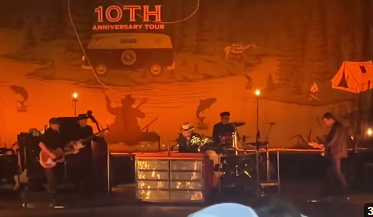
Two blogger friends – Max (PowerPop) and Christian (@Music Musings), had the good fortune to see Bob Dylan recently at the 10th anniversary Outlaw Music Festival. So naturally, I have been paying closer attention to performances from Dylan on the tour. Lo and behold, this fantastic performance of Positively 4th Street turned up – a song I wrote about here back in February last year. Max and I agreed this rendition comes pretty close to the original. Also, he pulls off some magic with his vocal intonations. Two other performances I love from the tour, both from the same show (20/6/25) which I added to my Music Library Project are the following:
Desolation Row I love his jangly saloon-bar piano playing. Just a fantastic sound from a bygone era. Despite being 84 years old he can always find a way to get something new out of a song, and
Under The Red Sky Bob’s vocals here are great. Wonderful performance of a very underrated song.
I’m not usually fond of clickbait news snippets of strange stories, but I found myself chuckling and downright baffled, wondering how this was legal in the first place.
Story description: When you think of emotional support animals, you may think of dogs or cats. But one Pennsylvania man has an alligator named Wally. Steve Hartman shares more in “On the Road.”
Someone wrote in response: How ironic that his alligator helps him with depression but causes anxiety to everyone who walks by.
I have always been fascinated by anything related to the legendary American writer Ernest Hemingway. In 2019, I wrote a four-part series about my favourite of his books, The Sun Also Rises. Hemingway was such an enigmatic, larger-than-life figure that his biography – captured in this PBS America documentary – is as engrossing and audacious as reading one of his novels. Not so uncanny, considering that much of his fiction drew directly from his own experiences in World War I, Paris and Spain (1920’s) as well as his time covering conflicts like the Spanish Civil War and World War II, where he reported from the front lines and often blurred the boundary between observer and participant.
Documentary Description: Hemingway, reeling from his split with Martha, attaches himself to the U.S. Army as it moves through Normandy and liberates Paris. After the war he tries to start a new life with Mary Welsh but is beset with personal tragedies and professional mishaps. He publishes The Old Man and the Sea and wins the Nobel Prize but eventually is overcome by addiction, physical trauma and depression.
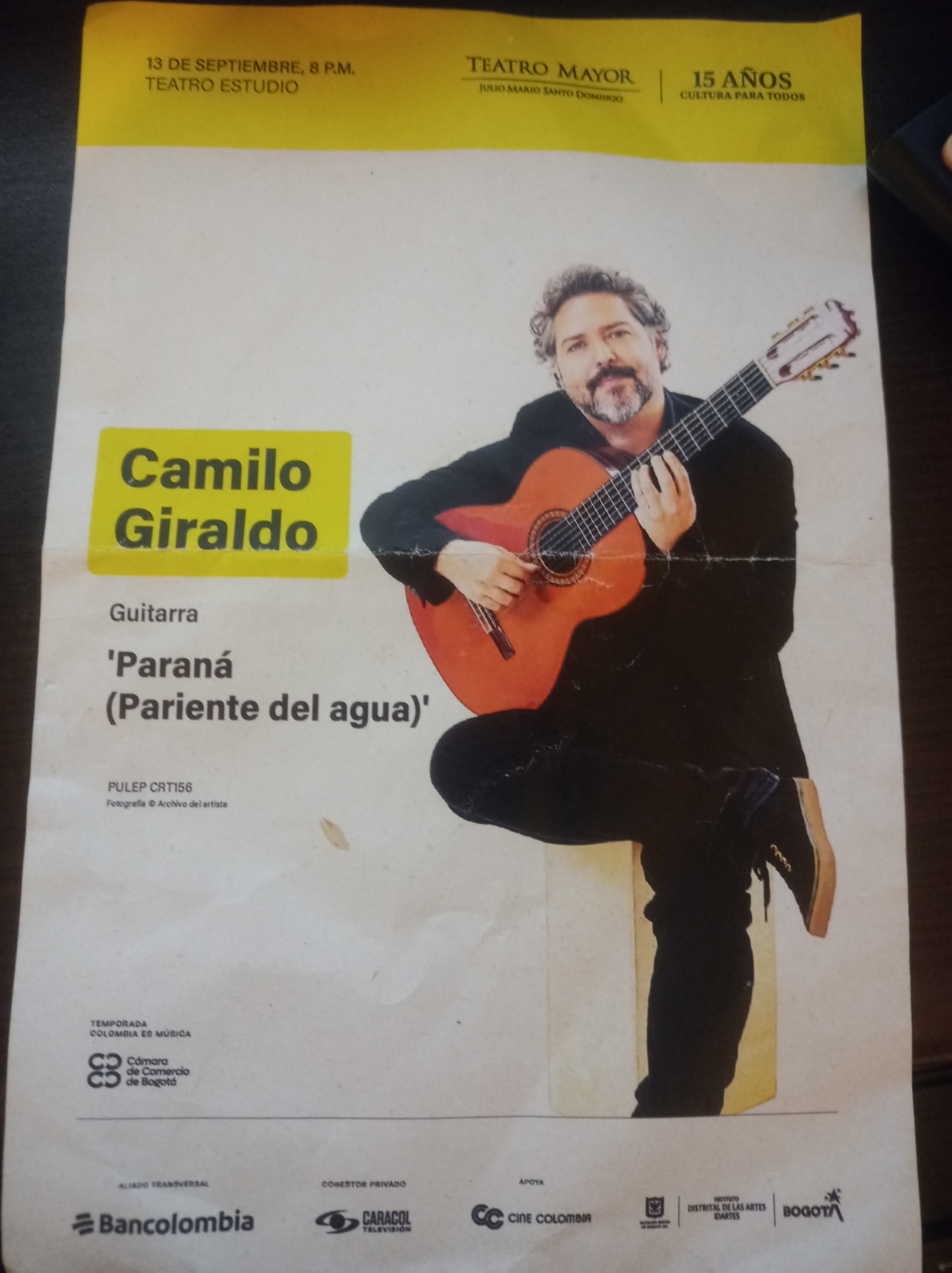
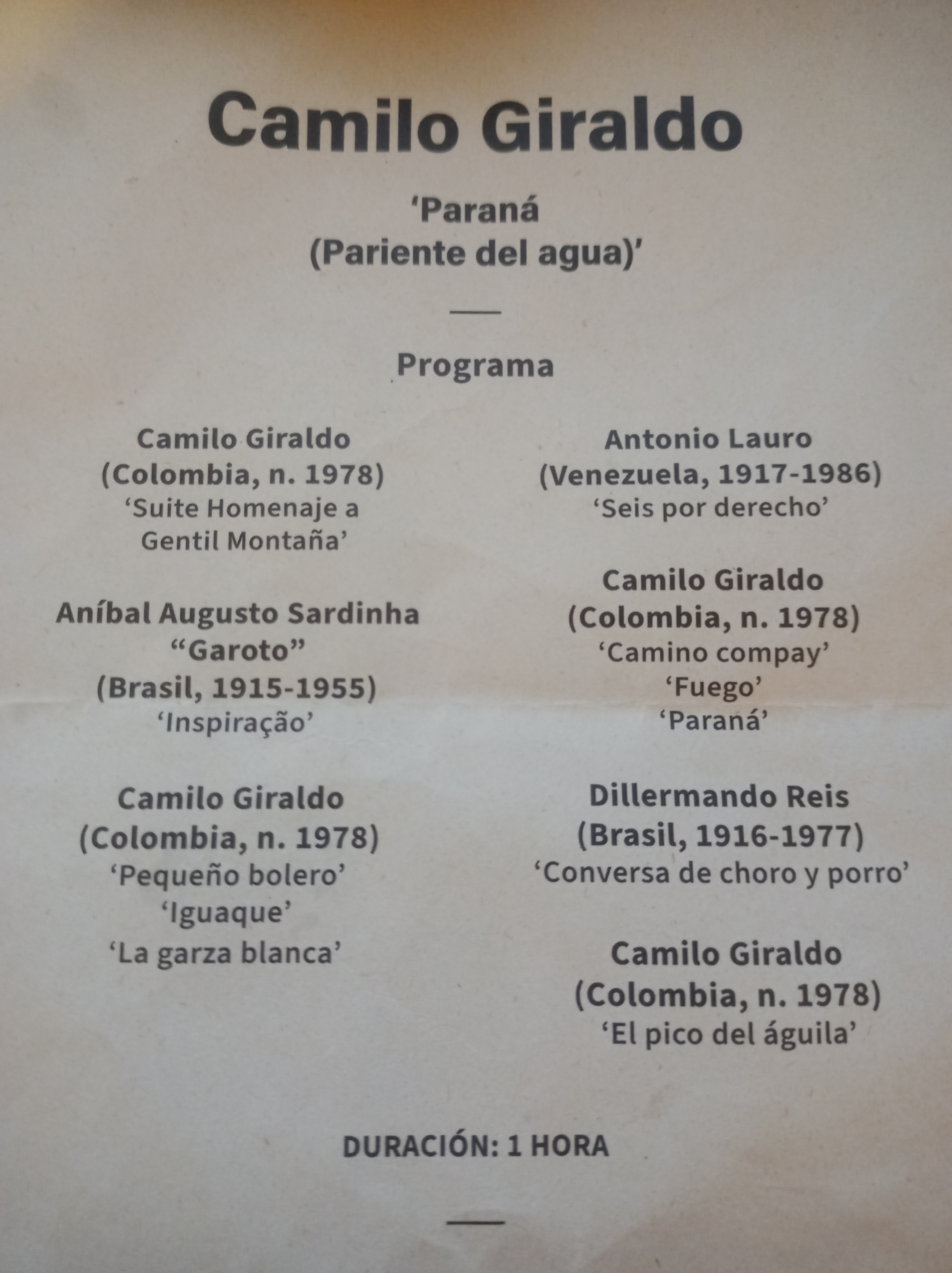
My new favourite place to frequent in my adopted home city of Bogotá, Colombia is the Cultural Centre – Julio Mario Santo Domingo, which houses both a massive library and mayor theatre. Last Saturday evening I had the good fortune of attending a recital by Colombian classical guitarist Camilo Giraldo at the Teatro Mayor. We received the above brochure/program just before the show was called to begin.
Today’s featured piece is Inspiração (Inspiration) by Brazilian composer Aníbal Augusto Sardinha (1915–1955), which Camilo performed second in the program. Since mobile phone use and recording were prohibited during the concert, I’ve shared another interpretation of the same piece by Camilo at the end of this post.
According to his biography, Camilo is a musician who stands out for his versatility in the field of composition, production, teaching and guitar performance. A graduate of ISA (Higher Institute of Arts, Havana, Cuba), where he studied composition with Leo Brouwer and Tulio Peramo, and instrumental studies with Jesús Ortega Rey Guerra and Alejandro González, he also received master classes with John Williams, Pepe Romero, Eliot Fisk, and Costas Cotsiolis, among others.
Upon completing his studies, he returned to Colombia, where he has given numerous classical guitar concerts. His work has been recognized with various incentives, such as concert series by the former IDCT (on several occasions he obtained the highest score in the professional category of academic music), and as a guitar soloist.
The composer of today’s piece – Inspiração was Aníbal Augusto Sardinha (1915–1955), better known by his stage name Garoto (“the boy”). He was a pioneering Brazilian guitarist, composer, and multi-instrumentalist whose work bridged the worlds of choro, samba, and early bossa nova. Born in São Paulo, he displayed extraordinary talent from a young age, mastering both guitar and cavaquinho before becoming a professional musician in his teens. Garoto gained national fame in the 1930s through radio performances and collaborations with leading samba and choro musicians, later performing internationally—including in the United States with Carmen Miranda’s band. Despite his early death of a heart attack at just 39, Garoto left behind a remarkable legacy, with compositions such as Inspiração, Desvairada, and Lamentos do Morro cementing his place as one of Brazil’s most important guitar innovators.
Simple Life is yet another great song from Elton John’s underrated 1992 album The One (image inset). It is more restrained and introspective than his high-energy, piano-driven music of his 1970s and 1980s peak. The song – the final single from The One was written during a period when John was actively rebuilding his life after overcoming drug addiction and bulimia in the early 1990s. It features a slower tempo, and understated piano, and a prominently featured yet plaintive harmonica that lends the song a rootsy texture. Overall, the song creates a quiet, determined energy and a sense of optimism.
This personal journey as represented in the song is an affirmation of a new, more grounded lifestyle, emphasizing independence and resilience after a history of dependency. Also the lyrics, penned by his longtime collaborator Bernie Taupin, are more directly autobiographical than many of their earlier works. The song’s message of seeking simplicity and inner strength after a turbulent past is similar to the reflective tone of Goodbye Yellow Brick Road.
The following was abridged from the Wikipedia article below:
Simple Life was John’s thirteenth number one on the US Billboard Adult Contemporary chart and reached number 30 on the Billboard. This song’s appearance in the US top 40 set a record, as John had achieved a top-40 hit for 24 consecutive years, breaking the old record of 23 years set by Elvis Presley in 1977. John regularly performed Simple Life at his concerts from 1992 to 1998. He often paired the song with The One.
[Verse 1] There’s a breakdown on the runway And the timeless flights are gone I’m a year ahead of myself these days And I’m locomotive strong My city spread like cannon fire In a yellow nervous state I can’t cut the ties that bind me To horoscopes and fate
[Chorus] And I won’t break and I won’t bend But someday soon we’ll sail away To innocence and the bitter end And I won’t break and I won’t bend And with the last breath we ever take We’re going to get back to the simple life again
[Verse 2] When we break out of this blindfold I’m gonna take you from this place Until we’re free from this ball and chain I’m still hard behind the eight My city beats like hammered steel On a shallow cruel rock If we could walk proud after midnight We’d never have to stop
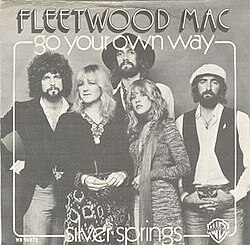
The classic break-up rock song Go Your Own Way by Fleetwood Mac had inexplicably flown under my radar for decades – until a friend put it on last weekend. Although I’m far from well acquainted with Fleetwood Mac’s full discography, Everywhere and Songbird remain favourites of mine, along with this track. It appears on the British-American rock group’s 11th studio album, Rumours (1977), and became their first top 10 hit in the United States. Over the years, it has stood out as one of their defining songs. Rolling Stone ranked it number 120 on their list of the 500 Greatest Songs of All Time, and second on their list of the 50 Greatest Fleetwood Mac Songs.
Lyrically, the song captures the bitterness and emotional fallout of a breakup. Lindsey Buckingham, the band’s co-lead vocalist and songwriter, wrote it about the end of his relationship with Stevie Nicks, expressing his anger and sense of rejection. He described it as “a stream of consciousness” that focused on his raw emotions – reflecting his perspective that Nicks was the one who ended the relationship and chose to “go her own way,”. The line “Packing up, shacking up is all you want to do,” were seen by Nicks as a personal attack, and she reportedly wanted the line removed, highlighting the intense personal conflict behind the music. Nicks’ own song Dreams, was written as a counterpoint to Buckingham’s message, making the two tracks a musical exchange between two people who were both hurt and angry.
Recorded in three separate studios, the track was developed over a period of four months. As with most tracks on the Rumours album, none of the instruments were recorded live together; the tracks were instead completed through a series of overdubs. Go Your Own Way was written at a house the band rented in Florida between legs of their Fleetwood Mac Tour and was the first song Buckingham presented to the band for the Rumours album. Mick Fleetwood, the band’s drummer, remembered that the house had a “distinctly bad vibe to it, as if it were haunted, which did nothing to help matters“.
Loving you isn’t the right thing to do How can I ever change things that I feel? If I could, maybe I’d give you my world How can I when you won’t take it from me?
[Chorus] You can go your own way, go your own way You can call it another lonely day You can go your own way, go your own way
Tell me why everything turned around Packing up, shacking up’s all you wanna do If I could, baby, I’d give you my world Open up, everything’s waiting for you
(Referring to the album – Nebraska) This is not about the charts. This is about Bruce Springsteen. And these are the songs that he wants to work on right now. Let me tell you a little story when Bruce was little he had a hole in the floor of his bedroom – the floor that’s supposed to be solid, that you are supposed to be able to stand on – Bruce, he didn’t have that. Bruce is a repairman and what he’s doing with this album is he is repairing that hole in his floor. He’s repairing that hole in himself. And once he’s done that, he’s going to repair the entire world.
I wrote in my last Monday News on the March segment about the upcoming biopic Springsteen movie – Deliver Me From Nowhere where the above quote appears. Springsteen and Jon Landau were both heavily involved in the project. The movie seems focused on one period of his life being the Nebraska record interspersed with childhood memories. In fact the trailer shows glimpses of how the recording process went down on Nebraska – just Springsteen, a guitar, and a harmonica.
‘It don’t need to be perfect. I want it to feel like I’m in the room by myself’
This album is argued by die hard fans as Springsteen’s most critically underrated. Like the title track here, it consists of very dark songs questioning society, and ends with “reason to believe”, a somewhat hopeful song that reflects on humanity’s determination to go on.
“I just hit some sort of personal wall that I didn’t even know was there. It was my first real major depression where I realized ‘Oh, I gotta do something about it.’”
The depression came in the aftermath of Springsteen’s professional high, as his chart-topping The River boasted what became his biggest hit at the time, “Hungry Heart.”
Springsteen tried to find inspiration from Johnny Cash by listening repeatedly to the singles and the albums Cash published for his first label, the Sun Records. Those records featured songs talking about the poors, the beaten down, and prisoners as is the case in today’s featured song – the title track.
Nebraska is sung as a first person narrative of Charles Starkweather, who along with his teenage girlfriend Caril Ann Fugate murdered 11 people over an eight-day period in 1958. Although the narrator describes the murders and his trial and impending execution, he sings in a flat, unemotional voice, which makes the events described seem all the more chilling.
Johnny Cash himself reacted enthusiastically to the record Nebraska, seeing shades of his younger self in this new, dark version of Springsteen, and in fact, he recorded two covers from Nebraska: Johnny 99 and Highway Patrolman.
“If I had to pick one album out and say ‘This is going to represent you 50 years from now,’ I’d pick Nebraska,”













 Observation Blogger