Telegraph Road (1982) – Dire Straits

I challenge you to read the lyrics of Telegraph Road as a standalone document and not be impressed by the vision and world-building in Mark Knopfler’s writing of this epic rock song. The music is amazing as well. Knopfler is in absolute control of mood and feel with nuanced chord progressions, textural changes and tempo changes, and amazing jams and solos. Telegraph Road first appeared as the opening track on Dire Straits‘ 1982 album Love over Gold and is the sixth song to appear here so far from the mega British rock group after their previous entry – Sultans of Swing.

Because today’s featured song is over 14 minutes long, most radio stations would have been reticent to play it despite it becoming one of the group’s most revered songs. The song was later cut down to 5:05 for a single release in 1983, with Twisting By The Pool as the B-side. While perhaps the big hits from the group’s catalogue like Walk of Life and Money For Nothing get less play from me over the years, Telegraph Road has definitely grown in my estimation where I much prefer to play it.

The following is from the Wikipedia reference below:
The Telegraph Road is a major north-south 70 mile thoroughfare in Michigan. Mark Knopfler was inspired to write this song while riding in the front of the tour bus, which made the journey down Telegraph Road. At the time, Knopfler was reading the novel The Growth Of the Soil by the Nobel Prize winning Norwegian author Knut Hamsun and he was inspired to put the 2 together and write a song about the beginning of the development along Telegraph Road and the changes over the ensuing decades. This was a metaphor for the development of America and the ruining of one man’s dreams in the wake of its decline, in particular focusing on unemployment.

Interestingly, the song was first played live at the opening concert of the band’s “Making Movies” Australian tour (Perth Entertainment Centre, 22 March 1981) as the final encore. It would later become a staple of Dire Straits and Mark Knopfler solo tours.

[Verse 1]
A long time ago came a man on a track
Walking thirty miles with a sack on his back
And he put down his load where he thought it was the best
He made a home in the wilderness
He built a cabin and a winter store
And he ploughed up the ground by the cold lake shore
And the other travellers came walking down the track
And they never went further, no, they never went back

[Chorus]
Then came the churches, then came the schools
Then came the lawyers, and then came the rules
Then came the trains and the trucks with their loads
And the dirty old track was the telegraph road

[Verse 2]
Then came the mines, then came the ore
Then there was the hard times, then there was a war
Telegraph sang a song about the world outside
Telegraph road got so deep and so wide
Like a rolling river

[Bridge]
And my radio says tonight it’s gonna freeze
People driving home from the factories
There’s six lanes of traffic
Three lanes moving slow

[Instrumental Break]

[Verse 3]
I used to like to go to work
But they shut it down
I’ve got a right to go to work
But there’s no work here to be found
Yes, and they say we’re gonna have
To pay what’s owed
We’re gonna have to reap
From some seed that’s been sowed

[Chorus]
And the birds up on the wires and the telegraph poles
They can always fly away from this rain and this cold
You can hear them singing out their telegraph code
All the way down the telegraph road

[Verse 4]
You know, I’d sooner forget
But I remember those nights
When life was just a bet on a race
Between the lights
You had your head on my shoulder
You had your hand in my hair
Now you act a little colder
Like you don’t seem to care

[Chorus]
But just believe in me, baby, and I’ll take you away
From out of this darkness and into the day
From these rivers of headlights, these rivers of rain
From the anger that lives on the streets with these names
Cause I’ve run every red light on memory lane
I’ve seen desperation explode into flames
And I don’t want to see it again
From all of these signs saying, “Sorry, but we’re closed”
All the way down the telegraph road

References:
1. Fang Bian on “Telegraph Road” by Dire Straits – Wikipedia
2. Telegraph Road (song) – Wikipedia

Tagged with: , ,
Posted in Music

17/2/25 – 23/2/25 – Swamp Creatures, English Football & A Thousand Years

news on the march

Welcome to Monday’s News on the March – The week that was in my digital world.

Swamp Creatures
Short Story by Bruce Goodman at Weave a Web

Fellow blogger Bruce Goodman and I go way back and I consider him a dear friend. His short stories at Weave a Web have appeared here a bunch at Monday’s ‘News on the March‘. He is my favourite ‘cuentista‘ (short-story writer) hands-down. So I present to you Bruce if you haven’t already had the pleasure:

‘(above) are some pictures to prove that pigeons can age one dramatically’ – Bruce Goodman

Today’s featurette is his recent short story called ‘Swamp Creatures‘. Before I indulge you, I have left y’all a video below Bruce’s story when my son and I got up close to a huge 4 metre Caiman alligator (nearly half a tonne) on our recent holidays. Thanks to wondrous timing and the generosity of a Zoologist, we were accompanied inside the ‘off limits’ part of the enclosure. I hope you all enjoy:

Swamp Creatures

They said the swamp was harmless. There would be a few harmless water snakes, but it was mainly the variety of water birds that Darren was there to see. There were all sorts of waders that he’d never seen in the real. Nor had he seen many species of fish-hunting birds. He was told “You will see it all”. By all means look at the water snakes, but try not to disturb them. This is a natural wildlife reserve. Humans are mere visitors.

So Darren began to wander the natural track around the lake, armed with a notebook and a camera. He had gone no further than quarter of an hour when he spied a flock of the most beautiful white herons preening themselves in a tree on the edge of the lake. He manoeuvred himself nearer the water to get a better picture. It was there that he spied an alligator.

He knew that the best way to avoid conflict was to stay well clear of alligators! He had no choice. He hadn’t been told there were alligators in this swamp. The fierce creature was only a few yards away. It was hissing and tail slapping and moving towards him. He knew from his reading that he had to back away slowly and not make any sudden movements or gestures.

Back he went. Back further. The pursuing alligator seemed more settled. It stopped moving towards him. Darren still backed slowly. There still wasn’t distance enough. He stepped back a little further. A little further. That was when he tripped backwards over another alligator.


Is this the worst stadium in English football?
Video presentations at StuntPegg

I am an unashamed English Football fan and watch matches galore on my Saturday and Sunday mornings, many times with my son who is also raving football nut. It was a refreshing change of pace from my daily BBC Sports read to find StuntPegg’s videos appear in my YT feed. Nieve Pegg, also known as StuntPegg on YouTube, is a British soccer enthusiast who gained success with her soccer-themed videos. She writes, hosts, and edits content for her channel, which has more than 420,000 subscribers.

The reason Nieve is so popular apart from being pretty, witty and humble is because she presents crafty and often ‘off the beaten track’ topics which amuse and titillate the English football enthusiast such as ‘yours truly’. You feel as a viewer that you are getting into the heart of where English football is at, but in a way that someone from across the ocean can feel privy to and enlightened by learning. I like what one astute viewer wrote about this featured presentation – Is this the worst stadium in English football?:

The 4th stand should just be a giant bouncy castle‘.

christina perri – a thousand years children’s book!!
Video presentation at Christina Perri

Recently Christina Perri my favourite female singer-songwriter after some hiatus in the family wilderness released a new video of her receiving a Children’s book ‘A Thousand Years‘ which she wrote about her daughters Pixie Rose and Camela Stanley. The last post where she appeared here was in my Top 10 Christmas countdown (2024) of Christmas Dream / Marshmallow World.

The music of Christina Perri has featured here more than twice as much as any other female music artist. I’ve always found her voice and music like a warm blanket. I never grow tired of listening to her and I listen ALOTT! If I go one day without a Perri song, a bit like how it is with Dylan, I feel in arrears and stagnant. Below I wrote in response to her beautiful video:

Christina looks as beautiful and radiant as I have ever seen her and I’m so thankful she shared this on her channel. By golly, I hope her next album isn’t too far away since ‘Lighter Shade of Blue‘ is easily the greatest ensemble of love ballads I have had the privilege to hear.

That is all. Thank you for reading.

news on the march the end
Tagged with: , , , , , ,
Posted in News, Reading, Sport and Adventure

Tears of Rage (1967) – Bob Dylan & The Band

To me Tears of Rage always seemed one of the most haunting and lamenting songs Bob and The Band had recorded. It captures in both the sorrowful lyric and mournful melody – a deep sense of betrayal, disillusionment, and mourning over lost ideals. During the time this song was written and first recorded (1967), America was in a state of turmoil and rapid change. There seems a sense here that America, once guided by noble principles, had fallen under the spell of charlatans who preach unity and justice while advancing their own agendas. The song could also be registering the pain of betrayal felt by many of America’s Vietnam war veterans.

We carried you in our arms on Independence Day
And now you’d throw us all aside and put us on our way

It also could be seen as a critique of a society increasingly obsessed with material wealth. The post-war economic boom and the rise of credit culture in America enabled people to acquire possessions more easily, but at what cost?

And now the heart is filled with gold as if it was a purse
Oh, but what kind of love is this which goes from bad to worse?

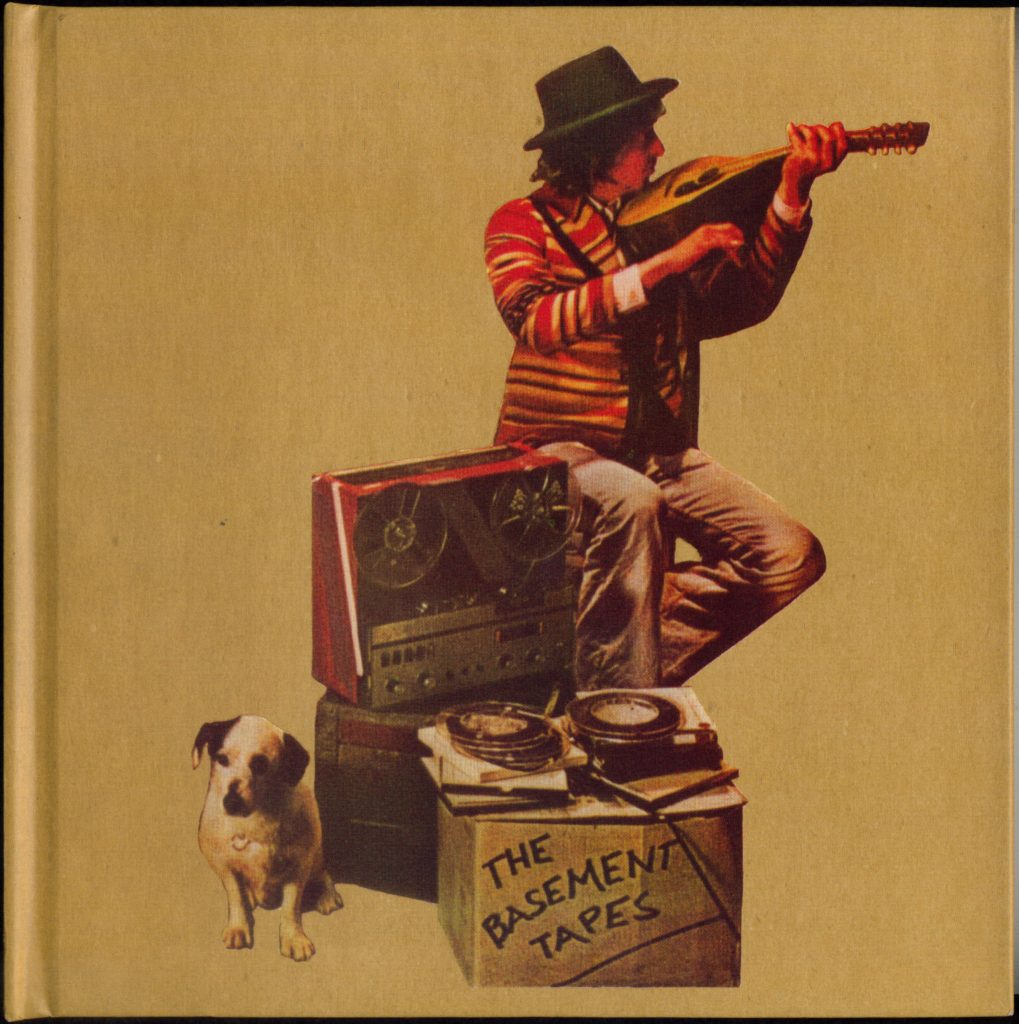
According to the Wikipedia article below: In an interview promoting the release of the complete Basement Tapes, Dylan cited the dropping of China’s first hydrogen bomb as an impetus for the song. Dylan further said: I looked for ideas and the TV would be on with “As the World Turns” and “Dark Shadows”. Any old thing would create a beginning to a song. These songs weren’t meant to be recorded by anybody. I just felt like writing”.

Tears of Rage with lyrics written by Bob Dylan and music by Richard Manuel was not released until 1975 on The Basement Tapes album.

Before his death, Robbie Robertson related what actually happened on a Facebook post. “When Bob Dylan typed out the words to ‘Tears of Rage,’ he handed it to Richard Manuel and said ‘See if you can do something with this.’ Richard nailed the perfect melody and chords to go with those heart-wrenching lyrics. He played it for Bob, who thought it sounded just right”

In 1968, the Band recorded it for their debut album Music from Big Pink. According to his official website, Dylan has played the song 81 times in concert total between 1989 and 2008. He also rehearsed the song for the Rolling Thunder Revue in 1975 but did not play it on the tour proper. 

We carried you in our arms on Independence Day
And now you’d throw us all aside and put us on our way
Oh, what dear daughter ‘neath the sun would treat a father so
To wait upon him hand and foot, yet always answer no?

Tears of rage, tears of grief
Why am I always the one who must be the thief?
Come to me now, you know we’re so alone
And life is brief

It was all pointed out the way to go and scratched your name in sand
Though you just thought that it was nothing more than a place for you to stand
Now I want you to know that while you were watched, discovered that there was no one true
That I myself really thought
It was just a childish thing to do

It was all very, very painless when you ran out to receive
All that false instruction which we never could believe
And now the heart is filled with gold as if it was a purse
Oh, but what kind of love is this which goes from bad to worse?

References:
1. Tears of Rage – Bob Dylan
2. For the Sake of the Song: Bob Dylan & The Band “Tears of Rage” (Bootleg Version) – Americana – UK

Tagged with: , , ,
Posted in Music

Team (2013) – Lorde

I first heard snippets of Lorde’s song Team in ESPN commercials promoting women’s sports. Its rousing, hypnotic rhythm and beat amplified the energy and appeal to me of both the individuals and their given pursuit. I just had to find the whole song and I’m grateful I did since I enjoy it so much. This is the second song to feature here from Lorde after her previous entry Liability. The New Zealand popstar born Ella Marija Lani Yelich-O’Connor (born 7 November 1996) gained attention performing at a talent show in her early teens. She signed with Universal Music Group in 2009 and later rose to stardom as a 16 year-old with her breakthrough single Royals.  

Team was the third single from her Debut LP Pure Heroine. It is is a hybrid of alternative pop and electropop featuring synthesiser, bass and snare drum instrumentation over a handclap based beat. The song was produced using the software Pro Tools. Lyrically, the track is a tribute to her friends and country. “I’m kind of over getting told to throw my hands up in the air. So there,” a lyric from Lorde’s song Team these raw but relatable lyrics reiterates a smell like teen spirit dirt on your shoe and chip on your shoulder angst. Lorde’s music proves difficult to categorize but its sonically atmospheric like Lana Del Rey‘s music.

Team peaked at No. 6 in the US and No.19 in Australia and No. 3 in New Zealand. By December 2014, Team had sold 2.45 million copies in the USA. The music video below was filmed in the abandoned Red Hook Grain Terminal in Red Hook, Brooklyn, the video’s content was inspired by Lorde’s dream of teenagers in their own world. On 12 November 2013, Lorde performed several songs from Pure Heroine during the Late Show with David Letterman to promote the album, including Team.

Wait till you’re announced
We’ve not yet lost all our graces
The hounds will stay in chains
Look upon Your Greatness and she’ll
Send the call out, send the call out

[Verse 1]
Call all the ladies out
They’re in their finery
A hundred jewels on throats
A hundred jewels between teeth
Now bring my boys in
Their skin in craters like the moon
The moon we love like a brother
While he glows through the room

[Pre-Chorus]
Dancin’ around the lies we tell
Dancin’ around big eyes, as well
Even the comatose
They don’t dance and tell

[Chorus]
We live in cities you’ll never see on-screen
Not very pretty, but we sure know how to run things
Livin’ in ruins of a palace within my dreams
And you know, we’re on each other’s team

[Post-Chorus]
I’m kind of over gettin’ told to throw my hands up in the air
So there

[Verse 2]
So all the cups got broke
Shards beneath our feet
But it wasn’t my fault
And everyone’s competing
For a love they won’t receive
‘Cause what this palace wants is release

References:
1. Team (Lorde song) – Wikipedia
2. Team Lorde – The Rider Online

Tagged with: , ,
Posted in Music

Professor Lazhar (2011) – Philippe Falardeau (Friday’s Finest)

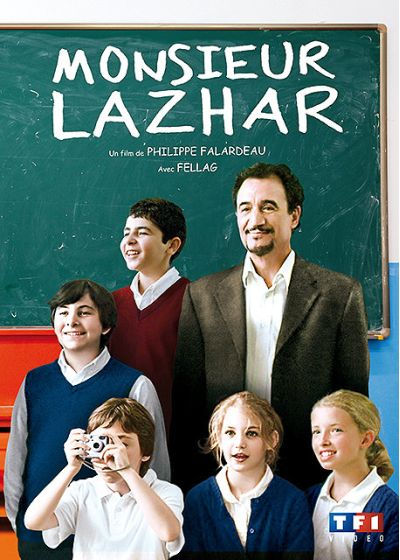
A month ago in my Friday’s Finest segment I presented an article about The Book Thief – a movie about a young girl living with her adoptive German family during the Nazi era. It’s a wonderful family film which my children and I enjoyed twice over the Christmas holidays. I wrote how the young actress Marie-Sophie Nélisse (at the bottom – centre in the above image) was stellar in that film and low and behold just a week or so later I saw her again in today’s featured film – the Canadian French-language drama film called Monsieur Lazhar.

Monsieur Lazhar (English title: Professor Lazhar) tells the story of an Algerian refugee in Montreal who steps in to teach at an elementary school after the former full-time teacher dies by suicide. Professor Lazhar is like the antithesis of the ludicrousness and unrealism of the more popularly known School of Rock, offering a sobering and deeply human portrayal of the teacher-student relationship. While School of Rock thrives on exaggerated rebellion and comedic chaos, Professor Lazhar delves into the emotional complexities of education, grief, and resilience. The film was nominated for Best Foreign Language Film at the 2011 Academy Awards.

IMDB Storyline:
Bachir Lazhar, an Algerian immigrant, is hired to replace an elementary school teacher who died tragically. While the class goes through a long healing process, nobody in the school is aware of Bachir’s painful former life; nor that he is at risk of being deported at any moment. Adapted from Evelyne de la Cheneliere’s play, Bachir Lazhar depicts the encounter between two distant worlds and the power of self-expression. Using great sensitivity and humor, Philippe Falardeau follows a humble man who is ready to transcend his own loss in order to accompany children beyond the silence and taboo of death.

The following two paragraphs were extracted from the Wikipedia reference below:
The source material Bachir Lazhar is a one-character play, making it a challenge to adapt for the screen. However, the producers attended a performance with director Philippe Falardeau, and Falardeau expressed excitement about making a film version. Bachir Lazhar author Évelyne de la Chenelière suggested Falardeau cast comedian Mohamed Fellag as the protagonist. Falardeau learned how to contact Fellag by researching the comedian’s YouTube videos. Falardeau said he continuously consulted de la Cheneliere, allowing her to review screenplay drafts.

It was shot in Le Plateau-Mont-Royal, Montreal. There were 28 days of shooting, about an average time for a film to be shot in Quebec. The principal filming occurred in the summer so the production could use the school and so the educations of the child actors were not disrupted. Four of the shooting days occurred in the winter. Child actress Sophie Nélisse turned 10 shortly before shooting began.

Monsieur Lazhar is a heart-warming, but at the same time, heart-wrenching story of how people (whether it be children or adults) trying to come to terms with the loss of a family member (albeit for the children it was a teacher, but school, at that young age, can be something like a second home). Mohamed Fellaq puts in a superb performance as the new incumbent ‘teacher’, and we share in his earnest efforts at doing his best despite not being fully open about what he truly is or which his past contains.

This movie has a documentary feel when dealing with scenes involving the classroom, with a myriad of student characters performed by very charismatic young actors and actresses boasting naturalness in their delivery, that it makes it seem like a real class rather than a rehearsed one. What I find fascinating about this film is that it chose not to be too ambitious in finding a good conclusion, but introduces all the elements of restraint and helplessness by the characters. I forwarded a trailer of the movie below.

References:
1. Monsieur Lazhar – IMDB
2. Profesor Lazhar – Wikipedia

Tagged with: , , , ,
Posted in Movies and TV

Te Va a Doler (2003) – Maelo Ruiz

Te Va a Doler (You are Going to Hurt) was one of the first songs that made such a big impression on me after my arrival in Colombia. I still love hearing it when it comes on the radio here and my goodness is that often. The smoothness and profundity of Maelo Ruiz’s voice is impressive and the trumpeting and percussion is exquisite. I definitely recommend his live version performance at the end of this post which demonstrate those musical aspects in all its splendid glory including the audience reactions and interactions on stage.

So much fantastic music has featured here from the island Puerto Rico mainly of the ‘Salsa Rosa’ variety including today’s featured track. Well technically Ruiz is a New York City-born Puerto Rican Salsa singer who is identified within the Salsa romántica genre. Also, Te Va a Doler was written by the Salvadorean singer Alvaro Torres and you can listen to his ballad version here. So in short, El Salvador and Puerto Rico carry this song to us today.

Te Va a Doler at least lyrically is of the form ‘Despecho‘ which means out of spite and jealousy and remains a quite common theme in Latin music in general. The song expresses regret and a warning towards an ex-partner who made the wrong decision by leaving the narrator for someone else.

Maelo Ruiz, born Ismael Ruiz Hernández on October 22, 1966, in New York, USA moved to Puerto Rico with his family at the age of four. He began his formal music education at the age of 16, singing at the Antonio Paoli Free Music School in Caguas under the direction of Juan Pacheco.

Maelo Ruiz started his professional career at the age of 19 as the lead singer for Pedro Conga y Su Orquesta Internacional, where he recorded four albums and achieved significant success with hits like “No Te Quites la Ropa,” which sold over 50,000 units. In 1995, he released his first solo album, “Solo,” which spent four consecutive weeks at number one throughout Latin America.

I have presented below both the original studio version of Te Va a Doler from Maelo Ruiz’s 2003 album – En Tiempo De Amor (In the time of Love) and a live version.

A loose English translation follows:

[Verse 1]
It’s a shame that you’re like this
That you don’t like being led by the good
I don’t understand how you pretend to be happy
With that idiot who treats you like a nobody

[Pre-Chorus]
I know that one day you’ll need my love
And I’m not saying it out of spite even though it may seem like it
You made a mistake choosing between him and me
But you’re going to regret it for the rest of your life

[Chorus]
It’s going to hurt you
Sooner or later you’ll see what happens to you
When your skin no longer excites him and he abandons you
Or when you bitterly discover that he has someone else
It’s going to hurt you
As it’s hurting me now that you’re leaving me
But this love won’t last forever
And I’m warning you right now, better not come back

[Refrain]
(And I know it’s gonna hurt)
Sooner or later you’ll see what you get
When your skin no longer excites him when he kisses your mouth
(And I know it’s gonna hurt)
As it hurts me now
That you’re leaving me, that you’re leaving me
And so you don’t It matters
(And I know it’s going to hurt you)
I know that one day I’m going to miss you, my love

[Refrain]
(And I know it’s going to hurt you)
You made a mistake in choosing, you’re going to regret it
And so you won’t be able to live knowing that the pain is drowning you
(And I know it’s going to hurt you)
Because this love has to last forever

References:
1. Maelo Ruiz – Wikipedia
2. Álvaro Torres – Wikipedia

Tagged with: , ,
Posted in Music

Te Quiero Igual (1999) – Andrés Calamaro

Te Quiero Igual (I Love You the Same) is another gem from my favorite Latin rock artist, Andrés Calamaro. I was introduced to the music of the Argentine rock-great a few years ago by my daughter, Katherine, and I’ve been a fan ever since. Like a woman possessed, she played his phenomenal track Flaca (Skinny) on repeat – and I can’t blame her, as it has since become one of my favourite Latin rock songs too. Kat also introduced me to today’s featured track, Te Quiero Igual.
I’ll never forget the first time I watched the video below and realized that Calamaro was pulling off a pretty sweet Bob Dylan tribute, even incorporating the iconic signage imagery from Subterranean Homesick Blues. Also, when Calamaro sings repeatedly ‘Te Quiero‘ (I Want You) he’s channelling yet another Bob staple – yes you guessed it – I Want You.

Beyond its unmistakable Dylan-esque vibe, Te Quiero Igual stands out to me as a masterfully crafted song. Much like its sister track Cuando No Estás (When You Are Not Here), it encapsulates nearly everything I cherish about contemporary music, seamlessly blending poetic lyricism, raw emotion, and a wonderful production into a single alluring piece. It is a great testament to the complexity of love, acknowledging the pain of absence while still celebrating the love that remains. 

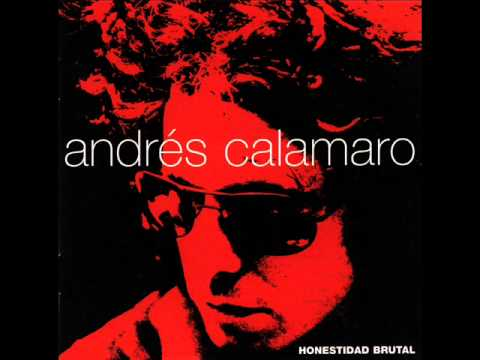
Te Quiero Igual comes from his double album Honestidad Brutal (Brutal Honesty), see image inset, which is considered one of his most acclaimed works. With 37 songs in total – one for each year of life that its author had at that time – positioned Calamaro at the top of the Spanish-speaking music scene, but not before working on it for a whole year.

During 1998 and early 1999, Calamaro went from recording studio to recording studio in Miami, Madrid, New York and Buenos Aires with the musicians who accompanied him on his tour. Among them were his brother Javier and Coti Sorokin. For 9 months, they recorded every day, spontaneously and as they came, around 100 songs that were later reduced to the final 37. Figures such as Pappo, Maradona, Mariano Mores, Daniel Melingo and Moris, among many others, participated in the sessions. This double CD was created after the breakup with his girlfriend, which is reflected in the songs. 

Calamaro added: “We were ready to record this album, even to never finish it. Much gratitude to all those involved in this unusual recording, ready for anything, in fifteen studios, in different countries, without stopping.

In 2000, he recorded 103 songs in his five-CD album El Salmón.

A loose English translation follows:

I love you but you took the flower
And you left me the vase
I love you, you left me the ashes
And you took the ashtray
I love you but you took March
And you gave up in February
First, I love you the same

I love you, you took my head
And you left me my hat
I love you but you forgot April
In the closet but I love you the same
I don’t like to wait
But I wait for you anyway
First, I love you the same

I don’t know if I’m awake or my eyes are open

[Verse 2]
I love you, I don’t know if I’m awake
Or my eyes are open
I know that I love you and that they’re waiting for me
More airports
I love you, you took the candle
And you left me the burial
First, I love you the same

References:
1. Andrés Calamaro recordó “Honestidad Brutal” a 20 años de haberlo lanzado – Filo.news

Tagged with: , ,
Posted in Music

Tarota (1979) – Mike Batt and Friends

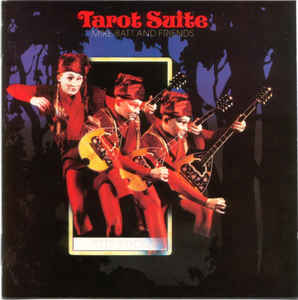
Tarota marks the sixth song I’ve featured from Tarot Suite by Mike Batt and Friends – one of my all-time favorite albums. Inspired by tarot card imagery, the record masterfully blends orchestral elements with progressive rock and folk influences. No other album was played more in our house during my youth. My father adored it like no other, insisting it be played whenever my parents entertained friends. I, too, felt a deep urge to share it, introducing songs from Tarot Suite to my school friends, hoping they’d recognize its brilliance. And sure enough, during a makeshift camping trip, they confided that it was, indeed, the bee’s knees. To sum it up, I’d be lost without this record.

Mike Batt is a British composer, songwriter, and producer known for his eclectic musical style, blending classical orchestration with pop, rock, and folk influences. Tarot Suite was his traditionally difficult follow-up second album of which he had the following to say:

The success of my first solo album, Schizophonia had spurred me on, and I wanted to make a truly cohesive album that had a dramatic concept on which to hang the ideas. I had always been fascinated by the artwork and the tradition of Tarot Cards. I wasn’t really that interested in the occult, – I suppose I was curious like anyone else, but I got to know the various Tarot packs and read a lot about them. I decided to write an album (“Tarot Suite”) which would once again combine my more experimental combination of rock and symphonic instruments and ideas with songs, some of which could be quite simple. Looking back, I think it was the most cohesive of my solo albums.

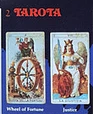
This spectacular instrumental Tarota continues to impress me after all these years. The tarot cards of Justice and The Wheel of Fortune were presented on the album insert and linear notes to represent this song. The cinematic song is driven by an energetic, medieval-flavored melody that showcases Batt’s signature orchestration. The track features a fusion of rock elements, with prominent use of various electric guitar solos (even a country flavoured one towards the end) that sometimes overlap each other, lively string arrangements and a galloping percussion. Tarota like the rest of the record evokes a sense of adventure, mystery, and destiny – fitting themes for an album centred around tarot.

Tagged with: , ,
Posted in Music

Take This Waltz (1988) – Leonard Cohen

How Leonard Cohen weaves poetry into music so seamlessly is on full display in today’s track – Take This Waltz. Inspired by the Spanish poet Federico García Lorca, the lyrics of Take This Waltz are a loose translation, into English, of the poem “Pequeño vals vienés” (Little Viennese Waltz). It was originally issued as part of the 1986 Federico García Lorca tribute album Poets in New York – to commemorate the 50 years anniversary of the assassination of the poet by the Fascists in Spain in 1936.

Leonard Cohen’s rendition retains Lorca’s surreal vision, where “there’s a lobby with nine hundred windows” and “death comes in through a fiddle’s moan.” The result is a hypnotic waltz infused with an almost cinematic sense of nostalgia and longing. In fact the video below was filmed in Spain, in the city of Granada in 1986, famous for the Alhambra Castle. Leonard Cohen is shown in the house of Federico Garcia Lorca.

Two years after his 1986 original release, Cohen revisited Take This Waltz for his album I’m Your Man. This later version (which I have included below the 1986 video) added Raffi Hakopian’s violin and Jennifer Warnes’ vocals in overlayers. A longtime Cohen collaborator, Jennifer Warnes also included her own version of Take This Waltz in her 1987 Cohen tribute album, Famous Blue Raincoat which you can read more about in my friend Christian’s post – First We Take Manhattan. You may remember Warnes had big chart successes with Up Where We Belong and (I’ve Had) The Time of My Life.

According to Wikipedia Cohen’s eighth studio album I’m Your Man was received as follows:
I’m Your Man was hailed by critics as a return to form. It was number 1 in Norway for 16 weeks. The album went silver in the UK and gold in Canada. In the original Rolling Stone review, David Browne called it “the first Cohen album that can be listened to during the daylight hours.” Also interestingly, Tom Waits named it one of his favourite albums.

Now in Vienna there’s ten pretty women
There’s a shoulder where Death comes to cry
There’s a lobby with nine hundred windows
There’s a tree where the doves go to die
There’s a piece that was torn from the morning
And it hangs in the Gallery of Frost

Ay, Ay, Ay, Ay
Take this waltz, take this waltz
Take this waltz with the clamp on it’s jaws

Oh I want you, I want you, I want you
On a chair with a dead magazine
In the cave at the tip of the lily
In some hallway where love’s never been
On a bed where the moon has been sweating
In a cry filled with footsteps and sand

Ay, Ay, Ay, Ay
Take this waltz, take this waltz
Take its broken waist in your hand

This waltz, this waltz, this waltz, this waltz
With it’s very own breath of brandy and Death
Dragging it’s tail in the sea

There’s a concert hall in Vienna
Where your mouth had a thousand reviews
There’s a bar where the boys have stopped talking
They’ve been sentenced to death by the blues
Ah, but who is it climbs to your picture
With a garland of freshly cut tears?

Ay, Ay, Ay, Ay
Take this waltz, take this waltz
Take this waltz it’s been dying for years

There’s an attic where children are playing
Where I’ve got to lie down with you soon
In a dream of Hungarian lanterns
In the mist of some sweet afternoon
And I’ll see what you’ve chained to your sorrow
All your sheep and your lilies of snow

Ay, Ay, Ay, Ay
Take this waltz, take this waltz
With its “I’ll never forget you, you know!”

This waltz, this waltz, this waltz, this waltz …
With its very own breath of brandy and death
Dragging its tail in the sea

And I’ll dance with you in Vienna
I’ll be wearing a river’s disguise
The hyacinth wild on my shoulder
My mouth on the dew of your thighs
And I’ll bury my soul in a scrapbook
With the photographs there, and the moss
And I’ll yield to the flood of your beauty
My cheap violin and my cross
And you’ll carry me down on your dancing
To the pools that you lift on your wrist

Oh my love, Oh my love
Take this waltz, take this waltz
It’s yours now. It’s all that there is

{Instrumental}

(Ay, Ay, Ay, Ay)

References:
1. Take This Waltz (song) – Wikipedia

Tagged with: , , ,
Posted in Music

A Real Pain (2024) – Jesse Eisenberg (Friday’s Finest)

The latest Academy award nominated movies are starting to come out here; so over the next month or so I will be frequenting the cinema as I did this week seeing Companion and today’s featured movie – A Real Pain. Next week, I have The Brutalist and I’m Still Here lined up. Thereafter Conclave and A Complete Unknown. They will also be relaunching Se7en which I am looking forward to seeing with my son since he hasn’t seen it.

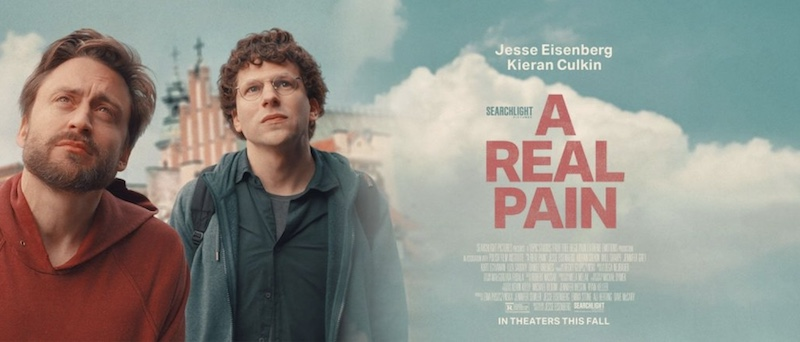
I wasn’t sure what to expect from Jesse Eisenberg’s directorial debut, A Real Pain, but the premise intrigued me. It also felt like a refreshing change of pace – a grounded, nuanced drama – after the explosive sci-fi spectacle of Companion, which I had just seen. A Real Pain turned out to be a smart, funny, and deeply emotional film that resonated with me on every cinematic level. As the credits rolled, I felt as though my companion and I had embarked on our own journey through Poland, honoring the Jewish experience during World War II. I had never seen a film that so vividly transported me to a place, making me feel as if I had been exploring the sights and absorbing the history alongside the protagonists – all for the price of a movie ticket.

IMDB Storyline:
“A Real Pain” follows mismatched cousins David (Jesse Eisenberg) and Benji (Kieran Culkin) as they reunite for a tour through Poland to honor their beloved grandmother, but their adventure takes a dark turn when the odd couple’s old tensions resurface against the backdrop of their family history.

The movie demonstrates Eisenberg as a thoughtful filmmaker, devoted to showing his characters as multi-dimensional, flawed human beings. Benji and David feel like real people, not cardboard cut-outs with one aspect to their personalities. The film is taut with unhappiness but allows itself to be funny. Each conversation in A Real Pain feels organic, almost improvised, yet carries an unusual, sometimes absurd, but never dull rhythm. There’s a darkly comic undercurrent to the dialogue that had me laughing out loud – even when the rest of the audience remained silent. But I didn’t mind; few films make me feel so present, so willing to let the seemingly trivial expressions, awkward pauses, and offbeat detours take me wherever they lead.

From one scene to the next, there’s no predicting how the protagonists will react or what unexpected remark will surface, yet every interaction crackles with authenticity. The film thrives on this unpredictability, toeing the line between discomfort and engagement, making even the most mundane moments feel oddly profound. Eisenberg masterfully captures the raw, messy nature of family connection, proving that sometimes, the most meaningful conversations are the ones that meander without a clear destination.

Beyond Jesse Eisenberg’s direction, the real revelation in A Real Pain is Kieran Culkin’s remarkable performance. It’s easy to see why he’s been nominated for Best Supporting Actor at the upcoming Academy Awards – his portrayal is nothing short of mesmerizing. The film’s title is no exaggeration, and Culkin carries that emotional weight masterfully, though it’s often masked by a facade of humor, impulsivity, and manic outbursts that can shift the mood of a scene in an instant.

What makes his performance so compelling is the delicate balance he strikes between deep, lingering pain and an almost frenetic charm. His interactions with the tour group oscillate between hilarity and heartbreak, leaving the audience in a constant state of intrigue. At times, he’s disarmingly tender; at others, he’s an unpredictable force of nature. This emotional duality is one of the most fascinating elements, inviting viewers to peel back the layers of his character long after the credits roll.

There is a lot more I admired about this movie, including the beautiful cinematography by Director of photography Michal Dymek captures some haunting imagery, from Poland’s cobble-stone streets and grim, post-Soviet architecture to the cold cruelty of a concentration camp. In addition, the music of Frédéric Chopin (who is Polish of course) is interwoven cleverly into the film, becoming a character in itself, his melancholy melodies seeming to heighten the drama and power of proceedings. Further, Robert Nassau’s editing ensures the film has a good pace, never wanting for momentum.

I highly recommend A Real Pain to the conscientious cinema goer. I hope it hits all your right buttons as it did for me. If you have already seen it I would love to know what you thought. Thank you for reading.

References:
1. A Real Pain (2024) – IMDB
2. A Real Pain – Wikipedia

Tagged with: , , , , , ,
Posted in Movies and TV

Follow Blog via Email

Enter your email address to follow this blog and receive notifications of new posts by email.

Join 780 other subscribers

← Back

Thank you for your response. ✨