
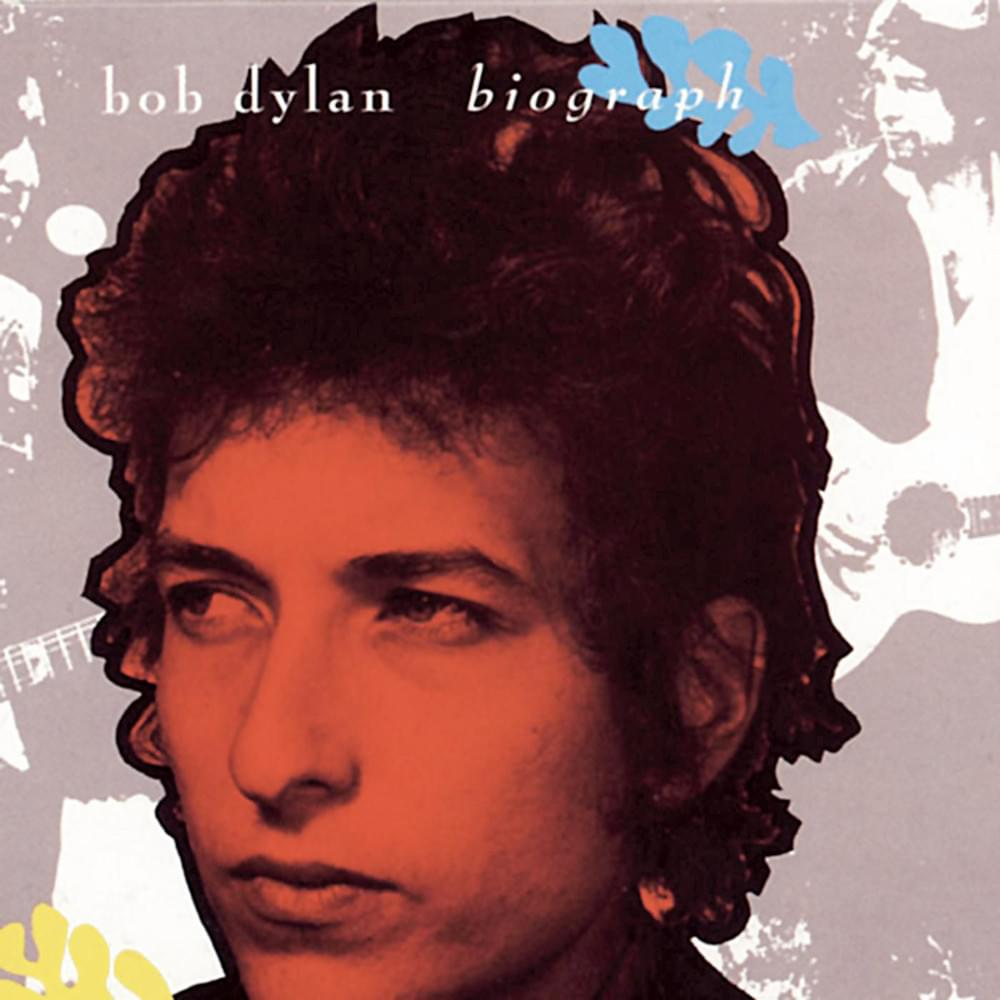
I remember procuring Bob Dylan’s Biograph (a 3 a three-cassette tape) when I was a young tacker. I devoured it as though I had found a treasure trove of lost musical artefacts although only 18 of the 53 tracks were previously unreleased including today’s featured track Lay Down Your Weary Tune. Over the years I had inexplicably let this one fall through the cracks (a sacrilege for a Dylanholic) and then one fine day it emerged from the recesses of my You Tube feed. Call me sentimental, but it was like having a dove return home from many years in foreign lands to rest her weary head. I also find myself just wanting to cradle up to it and rest as if my casket was going down.
Lay Down Your Weary Tune is one of Dylan’s earliest unreleased tracks, where you are left wondering – how on earth did he not give this one the green light. It was recorded for the studio sessions of 1963 album The Times They Are a-Changin’, but not released until more than two decades later on Biograph in 1985. To me the song sounds like a prelude to his later masterpiece Mr. Tambourine Man which is also a devotional piece to his musical muse.
Background (Mostly abridged from the Wikipedia article below)
In the album liner notes, Dylan claims that in the song he was trying to capture the feeling of a Scottish ballad he had just heard but identified, but speculation includes The Water Is Wide (which he sang with Joan Baez in the Rolling thunder Revue), O Waly, Waly and I Wish, I Wish. The folk rock group the Byrds recorded Lay Down Your Weary Tune for their 1965 album Turn! Turn! Turn!.
Dylan wrote the song at Joan Baez’s house in Carmel, California, in late 1963. During the same visit, he also wrote the song The Lonesome Death of Hattie Carroll which I posted in May 2025. Dylan had originally wanted to sing Lay Down Your Weary Tune with Baez at her October 12, 1963, concert at the Hollywood Bowl, but Baez was not yet comfortable with the song. Dylan recorded the song in a single take on October 24, 1963, during the sessions for The Times They Are a-Changin. However, he decided to replace it on the album with the song Restless Farewell, a song he wrote as an angry response to a Newsweek reporter who in late October 1963 published a story about Dylan of which Dylan did not approve. In the interim, Dylan played Lay Down Your Weary Tune at a concert at Carnegie Hall on October 26, which was eventually released on the album Live at Carnegie Hall 1963.
Sociologist Steven Goldberg said it’s a song where Dylan’s focus changed from politics to mysticism. Music critic Michael Gray interpreted the song as, “a vision of the world, that is, in which nature appears not as a manifestation of God but as containing God in every aspect“. Gray also described it as, “one of the very greatest and most haunting creations in our language“. Christian theologian Stephen H. Webb has linked many of the images of the song to the Bible and calls it “one of the greatest theological songs since King David composed his psalms.”
[Chorus]
Lay down your weary tune, lay down
Lay down the song you strum
And rest yourself ‘neath the strength of strings
No voice can hope to hum
[Verse 1]
Struck by the sounds before the sun
I knew the night had gone
The morning breeze like a bugle blew
Against the drums of dawn
[Chorus]
[Verse 2]
The ocean wild like an organ played
The seaweed’s wove its strands
The crashing waves like cymbals clashed
Against the rocks and sands
[Chorus]
References:
1. Lay Down Your Weary Tune – Wikipedia

“The more I live, the more I learn. The more I learn, the more I realize, the less I know.”- Michel Legrand


 Observation Blogger
Thanks for the intro. I didn’t know “Lay Down Your Weary Tune” and think it’s a great early Dylan song!
It’s one of my favourites of his early period and yet inexplicably unreleased at the time. To quote Dylan himself from ‘Sugar Baby’ – ‘Some of these bootleggers, they make pretty good stuff’.
really excellent Matt. Fascinating information. This song is just mystical and always means something different with each listening…
Thanks a lot Tom. I resonate a lot with it too since it seems as spiritually immersive as it is musically.
Thanks for this. A great song that perhaps revealed that even the greatest art cannot match the majesty of nature. Not an easy vision for a young man with a head full of a million ideas waiting to be birthed !
so no wonder he filed it away.
regards
Thom
Hi Thom, great to hear from you — it’s been a while. I was wondering how this post popped up on your radar and then, lo and behold, today’s stats showed a referral from Expecting Rain. I’m hugely grateful for Scott Miller’s links to the site.
I also appreciated your point about his vision and nature’s impact and then filing it away. This song as alluded to, marked one of Dylan’s early steps away from the strictly political and toward the mystical and spiritual. As Gray puts it, “nature appears not as a manifestation of God but as containing God in every aspect.” And it is fascinating how some of the songs that clearly ran deep in him — Abandoned Love, Blind Willie McTell, Caribbean Wind, to name a few — remained in the vault for so long before surfacing.
Thanks again for taking the time to comment — it really means a lot.
I will keep checking in. I was at the Killarney show .. he remains utterly magnetic and in a class of his own.
You’re the third acquaintance this year who’s caught Bob in the flesh, and I’m relieved to hear he’s still as enigmatic as ever. During the Outlaw Festival in the States, I dipped into a few fan-shot videos, and I was genuinely surprised by how strong his vocals sounded — and how tight the band was behind him. If you get a spare moment, have a look at this performance of “Positively 4th Street” from 2 August 2025. It’s a gem.