
‘With enough patience this elder and wiser Rachmaninoff’ will start whispering to you’
– Ben Laude (Rachmaninoff’s 4th Concerto is Criminally Underrated)
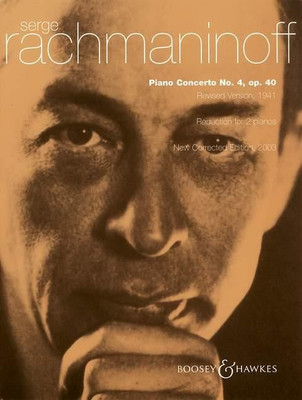
Piano Concerto No. 4 in G minor, Op. 40 is a concerto for piano and orchestra by Russian composer Sergei Rachmaninoff, completed in 1926. With today’s Rach 4 (many people affectionately call Rachmaninoff “the Rach” for short), we complete the set of his four piano concertos on this blog.
Rachmaninoff’s No. 4 is the least well known and least well received of the four, but I consider the first movement in particular to be some of the most stunning, exuberant, and dramatic music from any piano concerto I have heard. In fact, I’m not the only one singing its praises. The video at the end of this article calls the Rach 4 his unsung masterpiece and says it is criminally underrated.
It’s striking that the first movement – Allegro vivace (G minor) – opens almost like a climax. Oddly enough, it begins with a bold, commanding statement from the piano, which can sound like the ending of one of his earlier concertos. In the video at the end of this post, pianists give examples to support their views on the piece, including the powerful opening piano theme. The music moves into some dark and unsettled places. Many listeners did not respond warmly to Rachmaninoff’s Fourth at its premiere, which disappointed him.
I should admit that I am not a great fan of the repetitive and sometimes sour-sounding second movement. Some listeners have asked: where is the sweeping romantic second theme we expect from Rachmaninoff? For example Piano Concerto 2, Movement. 2 is about the most romantic music I’ve ever heard.
If you listen to the Fourth with “Rach 2 or 3 ears,” you may feel a little disillusioned. As suggested in the documentary below, the music can seem to be searching for a clear identity. He wrote it after settling in the United States, during a time when he struggled with homesickness. Some hear this tension and restlessness running through the concerto.
It may be more of an acquired taste than his other concertos. But the more you listen, the more the music begins to make sense and reveal its character.
From Wikipedia:
Following its unsuccessful premiere (1st version), the composer made cuts and other amendments before publishing it in 1928 (2nd version). With continued lack of success, he withdrew the work, eventually revising and republishing it in 1941 (3rd version, most generally performed today). Many have noted Rachmaninoff’s inspiration from George Gershwin’s Rhapsody in Blue, a piece for piano and orchestra completed in 1924, only three years before Rachmaninoff finished his own.
References:
1. Piano Concerto No. 4 (Rachmaninoff) – Wikipedia

“The more I live, the more I learn. The more I learn, the more I realize, the less I know.”- Michel Legrand


 Observation Blogger
Rachmaninoff – or “Rachy” as one of my brothers affectionately calls him, is one of my favourite classical romantic composers. There’s such a richness in his music. He was also a fave of my dear departed dad. Symphony No. 2 with the London Symphony conducted by André Previn is a personal fave, though really, there’s nothing I’d turn away from.
Excellent post, Matt, thanks for the reminder of this remarkable musical genius.
I came late to appreciating Rachmaninoff’s music. I first heard it in the wonderful Australian film Shine, which I mentioned in my Rach 3 article—his notoriously challenging concerto. His music is so distinctive that I can hear just a few notes and know instantly it’s Rachmaninoff.
I began to enjoy his work in small, gradual steps. It was an acquired taste for me. At first, I saw it as rather hard and heavy—almost a stale kind of Russian music. How wrong I was! Now my ears have adjusted, and I feel grateful, because it is such exquisite music. A real richness.
Thanks for sharing your family’s connection with Rach (or “Rachy,” hehe). Your father had great taste, and you must feel fortunate that he passed on his love of Rachmaninoff to you and your brother. I’m listening to that symphony performance now. Brilliant! Thanks, Steve.
My pleasure, Matt and thanks for warming that memory up. Yes indeed, I’m grateful for the enduring benefit of their shared loves of the composer and his work.
Glad you enjoyed that rendition! I’m due to spin it myself.