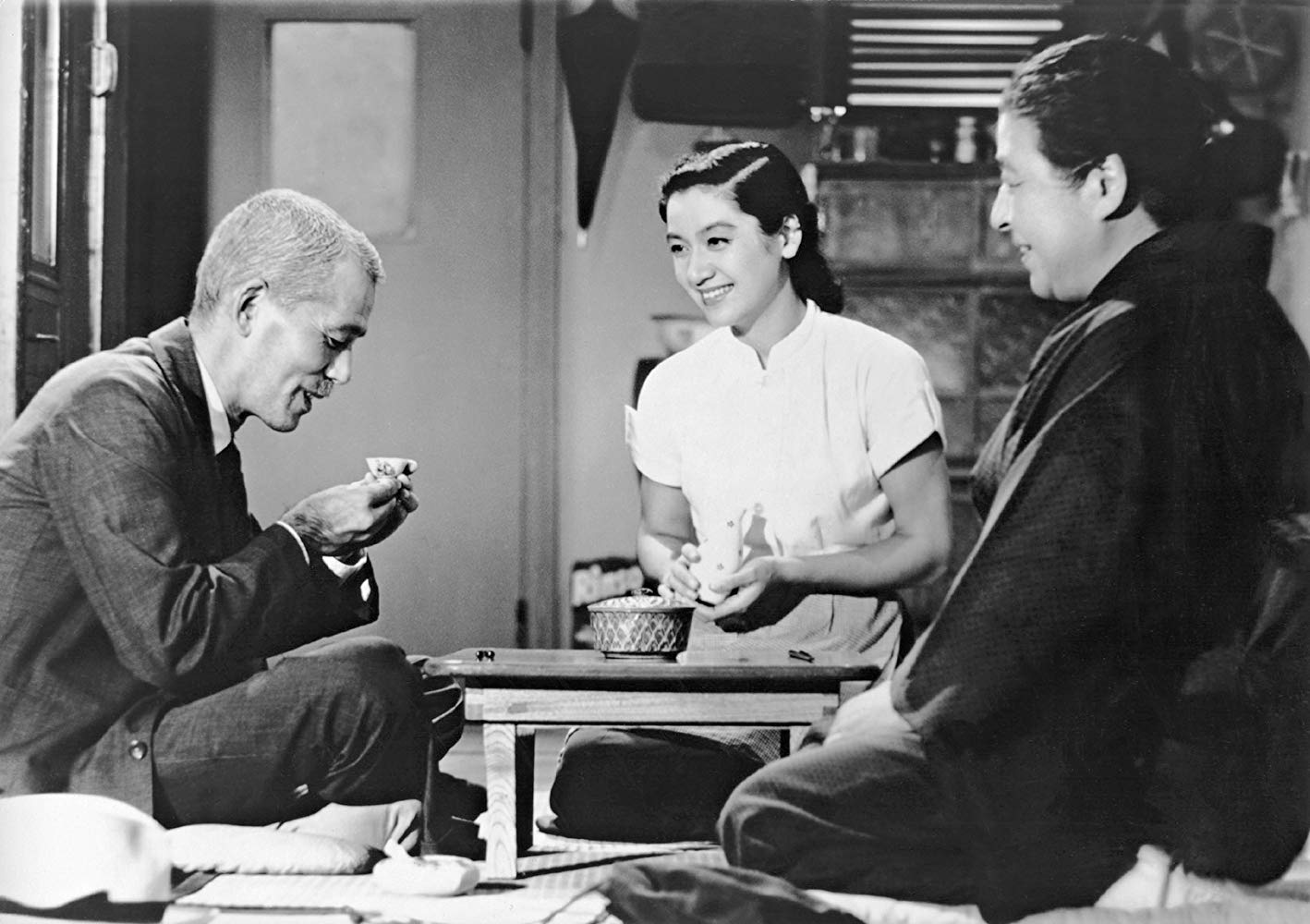
 There are few other movies whose legacy to the history of cinema are as substantial as Tokyo Story. It tells the simple story of an aging couple who travel to Tokyo to visit their grown children. All of their children treat their visit more as an obligation than a want, each trying to figure out what to do with their parents while they continue on with their own daily lives. Their children’s lack of genuine warmth is contrasted by their widowed daughter-in-law (Setsuko Hara pictured above) who treats them with kindness.
Tokyo Story seems to me different from any movie I have ever seen—as true to life. It sits at No 11 on my all time favourite movie list.
This excerpt of Spqrclaudius’ IMDB movie review of Tokyo Story reflects my own sentiments regarding the picture, but he expressed it more efficaciously than I could hope to:
The younger generation (and by extension the “new” Japan) turns its back on the family from which it arose- because of selfishness, because of necessity, or because it’s simply the way of the world. The movie provides no easy answers- its melancholy ambiguity is part of its charm. The film is founded upon such an obvious love and respect for the importance of real-world interactions that it’s hard not to be anything other than enthralled by it. Whatever the case, Ozu delights in portraying the details of everyday life. The emotional resonances of this movie are extraordinary, and some shots (a child picking flowers, an old couple framed by the sea, a woman sitting forlornly at her work desk) are enough to give a sensitive film-goer the shivers.
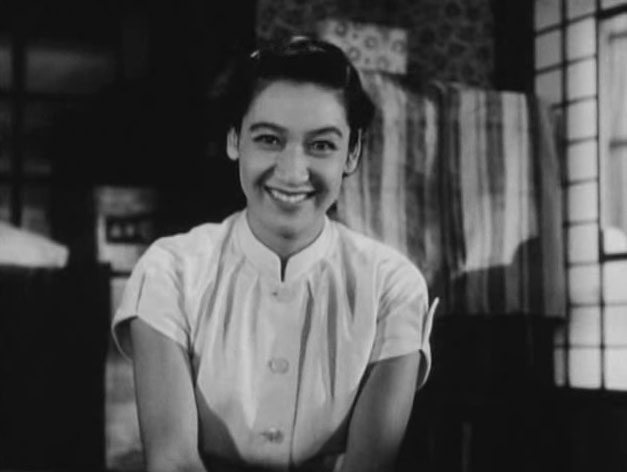
I would like to turn my attention now to the late great actresss Setsuko Hara (image inset) who plays the widowed daughter-in-law Noriko Hirayama. Her portrayal in this supporting role is probably my favourite (secondary part) in all of cinema. She passed away on September 5th 2015 at age 95. Robert Gottlieb wrote in this article ‘An Actress Like No Other‘ about her legacy:
‘There’s now no one left of this astounding constellation of talent; and that she was by far the most emblematic figure of the era makes her disappearance reverberate even more strongly.
In the West, most of us first encountered her in 1972 when Yasujirō Ozu’s 1953 masterpiece, Tokyo Story, was released here. I had never heard of Ozu, although I had seen and admired international award-winning Japanese films like Rashomon, Gate of Hell, and Ugetsu. Ozu had obviously been considered “too Japanese” for Western consumption, and it was greatly due to Dan Talbot, who ran the Upper-West-Side movie house the New Yorker Theater, as well as an important film-distribution company, that he finally emerged here. Beginning with the moment when Tokyo Story first reached us, Ozu’s fame and influence have grown and grown to their current towering stature.’
Some interesting IMDB Trivia details about Tokyo Story:
- The film is notable for its use of the “tatami-mat” shot, in which the camera height is low and remains largely static throughout.
- For a film that sides with the parents, it’s not so surprising to learn that Yasujiro Ozu never married and lived dutifully with his mother all his life.
- The original negative was lost soon after the film was completed, due to a fire at the vault of the lab in Yokohama city. The film had to be released using prints made from a dupe protective negative.
- Voted the greatest movie of all time in Sight & Sound’s 2012 director’s poll.