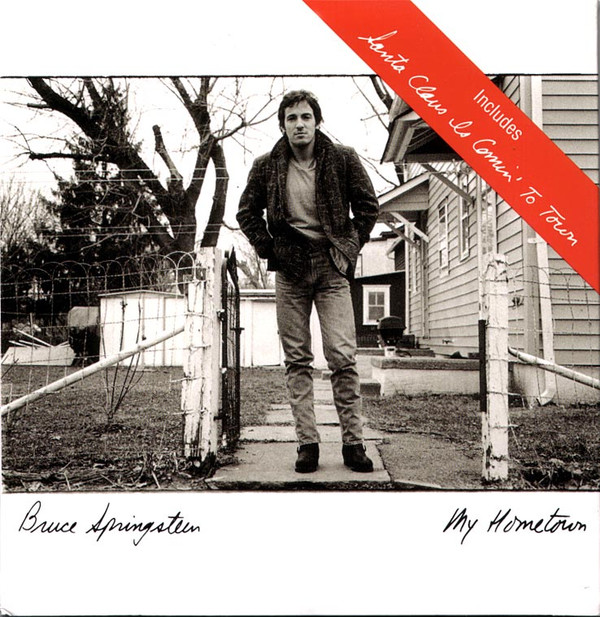
My Hometown showcases the panoramic view Bruce got from that big old Buick on his dad’s lap as he steered and drove through town. When you hear this synthesizer-based, low-tempo number you can’t help but reminisce of those ol’ times being a ‘youngen’. It seemed more tense in that era ’65 which Springsteen described, compared to my youth in Western Sydney in the 80’s. When I look back now, I know I took it all for granted. My brother Jonny and I won the jackpot; conceived by great parents and lovingly supported by extended family, lots of Australian bush to play around in, a fantastic school and sporting pursuits galore.
In my 30’s, I still hadn’t realised how good I got it when I wrote:
Our family always tried to achieve middle-class respectability, and never quite got there. The kids at my school had made up their minds. I was the ‘Trax boy’; the school kid who wore the cheapest sneakers. Most of the kids’ families had farms with parents who wore flannelettes – not the untucked Western Suburbs style which smelt of bourbon but the settled, crisp, happily country garb which reeked of ‘contented money’.
These rich come-ins lived on cheap land (well, modest for them) with newly built double-storey houses; driveways manicured by shiny white pebbles – not the sharp suburban asphalt ones which tore your legs to shreds.
I always liked this video of Bruce singing My Hometown on the street. Christina Perri did something similar with her masterpiece Jar of Hearts, but that song is projected towards another societal angle entirely. I like sometimes chilling and being voyeuristic and watching the reactions of the close-up shots of the public. Then, when I hear the crowd crying out ‘Your Hometown‘ it sends tingles down my spine. This is community.
My Hometown was the then-record-tying seventh and last top 10 single to come from Bruce’s Born in the U.S.A. album.
[Verse 1]
I was eight years old and running with a dime in my hand
Into the bus stop to pick up a paper for my old man
I’d sit on his lap in that big old Buick and steer as we drove through town
He’d tousle my hair and say “Son, take a good look around
This is your hometown
This is your hometown
This is your hometown
This is your hometown
[Verse 2]
In ’65 tension was running high at my school
There was a lot of fights ‘tween the black and white
There was nothing you could do
Two cars at a light on a Saturday night
In the back seat there was a gun
Words were passed, a shotgun blast
Troubled times had come
To my hometown
To my hometown
My hometown
To my hometown
My Hometown peaked at #6 on the Billboard Hot 100 singles chart. It also topped the U.S. adult contemporary chart, making the song Springsteen’s only #1 song on this chart to date.
Furthermore from Wikipedia:
‘While it first appears that the song will be a nostalgic look at the speaker’s childhood, the song then goes on to describe the racial violence and economic depression that the speaker witnessed as an adolescent and a young adult. The song concludes with the speaker’s reluctant proclamation that he plans to move his family out of the town, but not without first taking his own son on a drive and expressing the same community pride that was instilled in him by his father.
Some of the song’s images reference the recent history of Springsteen’s hometown Freehold Borough, New Jersey, in particular the racial strife in 1960s New Jersey and economic tensions from the same times (such as the “textile mill being closed” was the A & M Karagheusian Rug Mill at Center and Jackson Streets of Freehold).
Reference:
1. My Hometown – Wikipedia




 Observation Blogger