
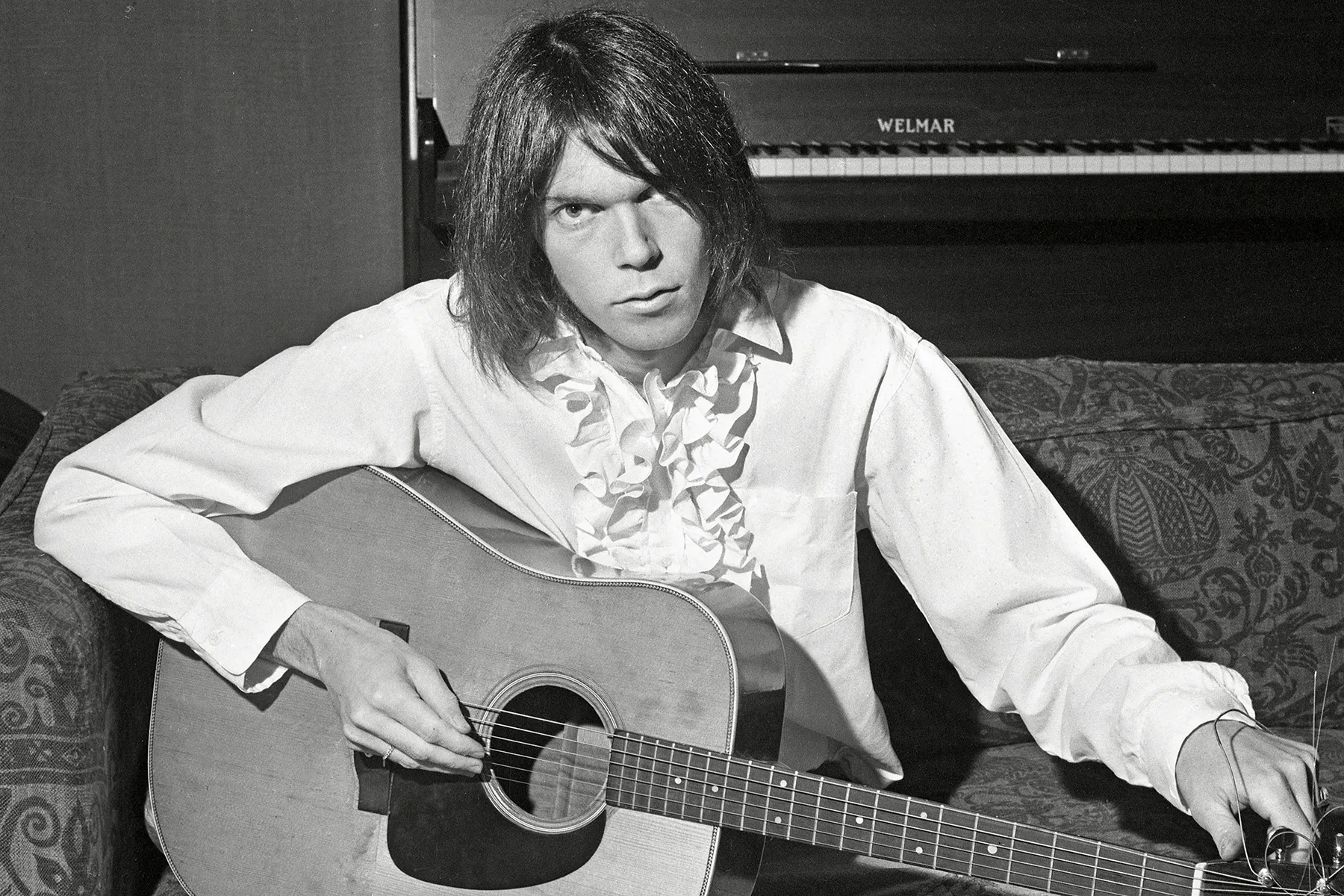
After the Gold Rush is a moving piano ballad and the title track from Young’s third studio album. Not to take anything away from some of Neil Young’s more epic and guitar-driven songs, but I have always found that when Young is simply alone with his guitar or piano, and able to work his magic with that light, raw, fragile-toned voice which carries the songs, that is when his music is most captivating.
After the Gold Rush is one such example of what is quintessentially intimate and folky Neil, and what brought audiences to his music in the first place. The song’s surreal imagery is worth noting because it leaves much open to the individual listener’s interpretation. Its beautiful and vivid images can even feel like a dream or a trip as you take in the words with the music.
(From Wikipedia) After the Gold Rush consists of three verses which move forward in time from the past (a medieval celebration), to the present (the singer lying in a burned out basement), and, finally, to the end of humanity’s time on Earth (the ascension process in which the “chosen ones” are evacuated from Earth in silver spaceships).
Young had previously said he did’t recall what After the Gold Rush was about. Even Dolly Parton, recalling a conversation while in the process of recording a cover of the song, along with Emmylou Harris and Linda Ronstadt, for their 1999 album Trio II – said she didn’t know what it meant even after asking Neil.
But Neil did open afterwards in his 2012 biography, as we’ll see below:
The following was abridged from the respective Wikipedia articles:
Neil did eventually shed light on its origen and meaning from his 2012 biogaphy. He described the inspiration was provided by a screenplay of the same name (never produced), which apocalyptically described the last days of California in a catastrophic flood. The screenplay and song’s title referred to what happened in California, a place that took shape due to the Gold Rush. Young eventually concluded that:
After The Gold Rush is an environmental song… I recognize in it now this thread that goes through a lotta my songs that’s this time-travel thing… When I look out the window, the first thing that comes to my mind is the way this place looked a hundred years ago.
After the Gold Rush was perhaps best known is the 1974 interpretation by the group Prelude, whose a capella version was a top 40 hit in numerous countries, especially the United Kingdom where it re-charted in the Top 40 in 1982, and in Canada where it reached number five in 1974.
(The album) After the Gold Rush peaked at No. 8 on the Billboard in October. Two of the three singles taken from the album, Only Love Can Break Your Heart and When You Dance I Can Really Love, made it to No.33 and No. 93 respectively on the Billboard. Despite a mixed initial reaction, the album has since appeared on a number of greatest albums of all time lists.
In 2014, the album was inducted into the Grammy Hall of Fame.
[Verse 1]
Well I dreamed I saw the knights in armor comin’
Sayin’ something about a queen
There were peasants singin’ and drummers drummin’
And the archer split the tree
There was a fanfare blowin’ to the sun
That was floating on the breeze
Look at Mother Nature on the run
In the 1970s
Look at Mother Nature on the run
In the 1970s
[Verse 2]
I was lyin’ in a burned out basement
With the full moon in my eyes
I was hopin’ for replacement
When the sun burst through the sky
There was a band playin’ in my head
And I felt like getting high
I was thinkin’ about what a friend had said
I was hopin’ it was a lie
Thinkin’ about what a friend had said
I was hopin’ it was a lie
[Verse 3]
Well, I dreamed I saw the silver space ships flyin’
In the yellow haze of the sun
There were children cryin’ and colors flyin’
All around the chosen ones
All in a dream, all in a dream
The loadin’ had begun
Flying Mother Nature’s silver seed
To a new home in the sun
Flying Mother Nature’s silver seed
To a new home
References:
1. After the Gold Rush – Wikipedia
2. After the Gold Rush (song) – Wikipedia

“The more I live, the more I learn. The more I learn, the more I realize, the less I know.”- Michel Legrand


 Observation Blogger
I always hated this song.
Neil Young is one of those artists ~ the tunes he wrote that are ~ IMHO, great ~ are REALLY GREAT ~ & the rest of them are barely mediocre. He’s also one of those artists that think he’s got to record every last tune he writes, even if they suck.
I’ve always said a little editing goes a long way & a lot of editing is priceless.
I love the prose in “After the Gold Rush.” I think it’s some of his best writing, at least from what I can recall. As a tune, I wouldn’t rank it as top-tier Neil, but I still enjoy it. I understand what you mean — there’s quite a bit of Neil’s music that I don’t connect with either, and perhaps he does need some limits, as you suggest. I’m not sure, though; I imagine his fans might disagree.
Of course his fans would disagree. LOL
I don’t think I’ve heard the Prelude cover before, and though the harmonies are full, I don’t feel they capture the soul or spirit of the song like Young’s original or the Trio II version – both of which are divine. (And both of the Trio albums are marvellous.) Couldn’t agree more with you about Neil on his own. And while he wasn’t born in my city, Winnipeg, Canada, he started his music career here so the city has a soft spot and a good touch of pride for this musical genius.
Also, I don’t think I ever knew the meaning of the lyrics; I suppose they always struck me as maybe inspired by psychedelics.
Thanks for a great write-up on this song, Matt, and happy weekend to you.
Yeah, I never really warmed to the Prelude cover that made the song a hit. I much prefer Neil’s original. I’ve always had a soft spot for his high, nasal, fragile voice — especially on slow ballads like “Philadelphia” (from the film Philadelphia), “It’s a Dream,” and “This Old Guitar,” just to name a few.
It’s interesting that he began his career where you are. I can understand how that would give you an added connection to his music and legacy.
As for the lyrics of “After the Gold Rush,” while drafting the article I had a proper crack at interpreting them myself — I ended up with four fairly long paragraphs. Later, when I checked the summary on Wikipedia, I realised my take more or less aligned with their abbreviated interpretation. In the end, I opted for the shorter version because it’s more concise and reader-friendly. Still, I was quietly pleased to see I’d landed in roughly the same place.
Thanks again, Steve, for your kind words and for sharing your personal connection to Neil and the song.
My pleasure, Matt.
That’s pretty cool that your interpretation was like the summary in Wikipedia. I’d be chuffed as well.
His “high, nasal, fragile voice” – on the surface, that might sound like a weakness but in fact it’s part of his charm. When Neil came through town in the late 2010s on of our sons bought tickets and I remember him saying, “This isn’t a purchase, it’s an investment.”
The only significant thing I missed (and it’s a big one) in my interpretation was in the third verse — “Flying Mother Nature’s silver seed.” I hadn’t seen it as representing silver spaceships ascending; instead, I interpreted it as a kind of nature-based ritual or ceremony honouring or saluting the sun.
I like that quote from your son ‘“This isn’t a purchase, it’s an investment.” Very nice.
Ah well, 9 out of 10 is a pretty great grade! I’d have given a point for your creativity.
Funny, all these years later, that quote comes to me immediately when Neil comes up.