
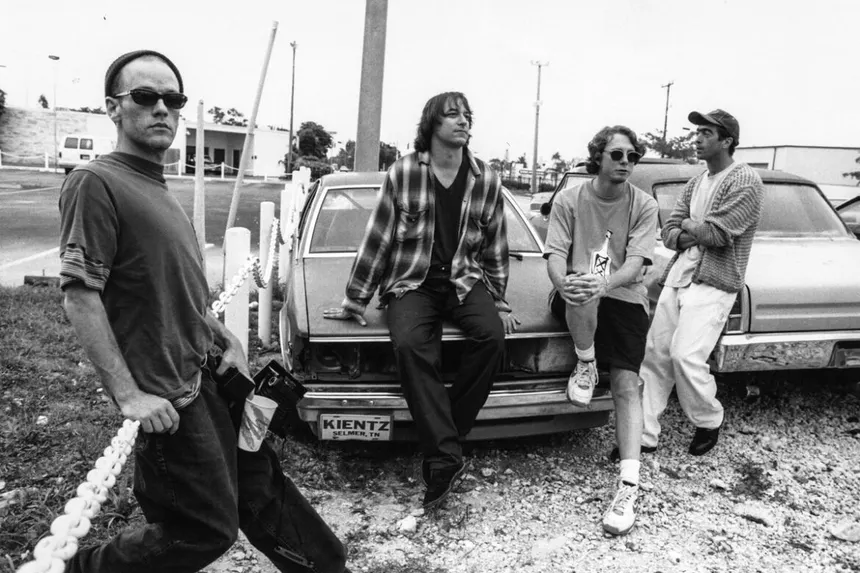
Electrolite, as the name suggests, sounds refreshing, replenishing, and effervescent on the ears. It’s very melodic, and I love the piano – it really is a piano-based ballad. This is a song that has grown on me over time. Michael Stipe also has such a cool voice here. Stipe initially objected to including the song on the album, but was convinced by his bandmates Peter Buck and Mike Mills.
The lyrics are pretty trippy too, but I like them — they feel spacey and liberating:
“Stand on a cliff, and look down there / Don’t be scared / You are alive,” and
“Your sun electric, outta sight / Your light eclipsed the moon tonight / Electrolite / You’re outta sight.”
There are many interpretations of the song’s meaning, including alien abductions, the rise of the digital information age, fame, and even a straight-up love song. Have at it. For me, the song brings to mind David Lynch (Mulholland Drive), as if it’s some kind of comment on L.A. and fame – a feeling of loss for old-time movies and actors. Some people also see it as a goodbye-to-the-20th-century song. In fact, in the liner notes, Peter Buck describes it as a farewell to the Millennium.
The following was abridged from the Wikipedia article below:

Below is an excerpts from an essay written by Stipe:
“Mulholland represents to me the iconic ‘from on high’ vantage point looking down at L.A. and the valley at night when the lights are all sparkling and the city looks, like it does from a plane, like a blanket of fine lights all shimmering and solid. I really wanted to write a farewell song to the 20th century…And nowhere seemed more perfect than the city that came into its own throughout the 20th century, but always looking forward and driven by ideas of a greater future, at whatever cost.”
During R.E.M.’s performance on VH1 Storytellers, Stipe introduced the song by saying:
“I had a dentist in Los Angeles, who was also a dentist to Martin Sheen, and Martin Sheen was in the dentist’s chair, getting his tooth drilled, when I went up to him and said, ‘We have a record coming out in a couple of weeks and you’re mentioned in one of the songs, and I just want you to know that it’s honoring you; I don’t want you to think that we’re making fun of you.’ And he was saying ‘Thank you very much!’. He was very nice about it.“
Electrolite is the last song from R.E.M.’s 10th studio album New Adventures in Hi-Fi which is a neat way a to end the album, on a high note.
[Verse 1]
Your eyes are burning holes through me
I’m gasoline
I’m burning clean
Twentieth century, go to sleep
You’re Pleistocene
That is obscene
That is obscene
[Chorus]
You are the star tonight
Your sun electric outta sight
Your light eclipsed the moon tonight
Electrolite
You’re out of sight
[Verse 2]
If I ever want to fly
Mulholland Drive
I am alive
Hollywood is under me
I’m Martin Sheen
I’m Steve McQueen
I’m Jimmy Dean
[Verse 3]
If you ever want to fly
Mulholland Drive
Up in the sky
Stand on a cliff, and look down there
Don’t be scared
You are alive
You are alive
[Verse 4]
Twentieth century, go to sleep
Really deep
We won’t blink
Your eyes are burning holes through me
I’m not scared
I’m out of here
I’m not scared
I’m out of here
References:
1. Electrolite – Wikipedia


















 Observation Blogger