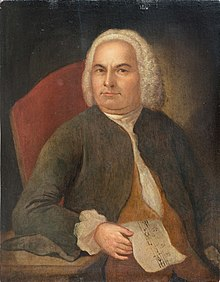
Concerto for Two Violins is the second composition presented here from Johann Sebastian Bach (1685 – 1750) after the previous entry I Call to You, Lord Jesus Christ. The concerto is from the late Baroque era and is caracterizad by a subtle yet expressive relationship between the violins throughout the work. It consists of three movements; the first two, namely Vivace and Largo ma non tanto are presented below. They are beautiful pieces; elegant and emotional. The performance time of the concerto ranges from less than 13 to over 18 minutes. He composed it as part of a concert series he ran as the Director of the Collegium Musicum in Leipzig. Also around 1736–1737 Bach arranged the concerto for two harpsichords, transposed into C minor, BWV 1062.
Bach was a German composer, and his compositions include secular and sacred music. In the 18th century he was valued primarily as an organist. His fifth child and second surviving son Carl Philipp Emanuel Bach performed the concerto in Frankfurt an der Oder after his father’s death in 1750. He inherited some of the original performance parts, likely doubles, of the concerto (surviving: parts for soloists and continuo), and likely also the composer’s autograph score (lost). The extant original parts were added to the Royal Library at Berlin (later converted to the Berlin State Library) in the 1840s. After the Second World War they were lost for several decades, eventually resurfacing in Poland.
Alsation Polymath Albert Schweitzer wrote in the 1911 English-language edition of his book on Bach: The concerto for two violins, in D minor, is perhaps more widely known still. It can be played at home, as its orchestral part can be easily transcribed for the piano. Every amateur should know the wonderful peace of the largo ma non tanto in F major.
Also, German musicologist Peter Wollny, wrote in 1999: “The Concerto for two violins in D minor BWV 1043 is today one of the best-known and most frequently performed works of the composer, above all by virtue of its soulful, song-like middle movement.”
References:
1. Concerto For Two Violins (Bach)







 Observation Blogger