Color Me Kubrick (1999) – Brian Cook (Friday’s Finest)

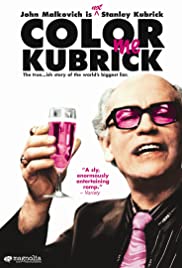
This film is scarcely known and I’m not sure why. It has just 35 reviews on the IMDB website. Geez Louise! I love the exuberance and frivolity of John Malkovich’s performance here. He seems to go all broke in his misinterpretation of the acclaimed, but secluded film director Stanley Kubrick. It’s based on true story of a man who posed as director Stanley Kubrick during the production of Kubrick’s last film, Eyes Wide Shut, despite knowing very little about his work and looking nothing like him.

IMDB Storyline:
In London in the 1990s, a balding alcoholic with an unsteady American accent introduces himself in pubs and other social settings as Stanley Kubrick. Drinks and meals are suddenly on the house or paid for by an admiring person, usually a man, whose costumes, band, acting abilities or what have you, Stanley finds fascinating. He’s actually Alan Conway (1934-1998): we watch him parlay a self-confident manner and a small amount of movie knowledge into a persona whom others immediately hang their dreams on. In exchange, Stanley asks only that they pay the bill. Will he be exposed? Do prosecution and prison await? Or has the National Health something else in mind?

The film received a very ordinary reception from critics and public alike, but I like watching it on the odd occasion mainly because of Malkovich’s accentuated acting and how he puts on false accents, not to mention the bizarre situations he finds himself by conning people and milking everything from them to satisfy his sexual and financial needs.

The fact that Malkovich and Kubrick look nothing like each other just adds to the deliciousness of the surreal situation. The manner in which the audience sees how Conway conned his victims was effective and convincing and often very funny. The special London vibe from that period came through strongly.

IMDB Trivia:

  • Director Brian W. Cook and writer Anthony Frewin both worked with Stanley Kubrick on several movies.
  • In reality, Stanley Kubrick himself was said to be fascinated by the idea that somebody was impersonating him.
  • Shot in eight weeks.
Tagged with: , , ,
Posted in Movies and TV

Clarinet Concerto in A Mayor K622 (1791) – Wolfang Amadeus Mozart

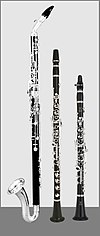
Basset horn, Basset clarinet, normal clarinet

Mozart’s Clarinet Concerto in A major, K. 622, was written in October 1791 just two months before his death. It was written for his friend – the clarinetist Anton Stadler and consists of three movements, in a fast–slow–fast succession. It is widely considered the first great piece written for that relatively young instrument, invented in the early 18th century. It’s his only concerto for that instrument.

The concerto was published posthumously and contains no autograph. The only relic of this concerto written in Mozart’s hand is an excerpt of an earlier rendition of the concerto written for basset horn in G. This excerpt is nearly identical to the corresponding section in the published version for A clarinet.

Mozart originally intended the piece to be written for basset horn, as Anton Stadler was also a virtuoso basset horn player, but eventually was convinced the piece would be more effective for clarinet. However, several notes throughout the piece go beyond the conventional range of the A clarinet; Mozart may have intended the piece to be played on the basset clarinet, a special clarinet championed by Stadler that had a range down to low (written) C, instead of stopping at (written) E as standard clarinets do.

Stadler played the concerto at its premiere in Prague on October 16, 1791, and his performance was favourably received. Stadler was quite familiar with Mozart’s music, and he had participated in many performances of his friend’s symphonies and operas.

The video presented below is from the Second movement called Adagio and performed by the Royal Philharmonic Orchestra.

Reference:

1. Clarinet Concerto (Mozart) – Wikipedia
2. Clarinet Concerto in A, K 622 – Britannica

Tagged with: , ,
Posted in Music

Learning a Second Language and AnkiDroid

On Wednesdays I typically present an extract from classic English literature, but today I venture a different route and a meandering one at that, so I beg your forgiveness for its long-windedness.
I was once a freelance writer and wrote about various subjects – books, tourism, movies and even documented 1000 interesting facts about Quinoa! I presented an article here Colombia’s 5 Best Secrets which stemmed from my freelancing days.
Also, during this contract phase I was tasked to write an essay about the most effective learning strategies when studying a second language.

If I remember rightly the three principal components I highlighted as integral to learning a second language were as follows:

  • Establishing Key relationship connections in the second language
  • Receiving sufficient comprehensible input, and
  • Immersing oneself into the culture and creating a new identity in the process.

Apart from those generic areas, I presented technological assists aiding in one’s learning. One of these tools reigns supreme in my estimation because it’s the most effective learning strategy I have incorporated into my life regarding my learning of Spanish and most recently English during the Pandemic.
Drum-roll please … Ankidroid!

Let me ask you… How many times have you been out and conversing with someone or been snuggled-up on your sofa watching your favourite program or podcast and heard a neat new word, story or new fact and thought to yourself I should remember that?
But because your memory is a sieve like mine and had to study twice as hard at school because of it, that it was inevitable it would escape your mental grasp in a matter of seconds. Well that was my experience and always had been until I became adept at utilising the AnkiDroid application to retain it.

I’ll break this down with personal experience so you can ascertain why I am so beholden to it and how you might find some purpose with it as well. When I arrived in Colombia my Spanish was pitiful and I hardly understood anyone, nor could I be understood. It was a shit-show to put it mildly. We did the whole Spanglish thang in the very beginning, but I remained resolute after a few days that I had to learn these new words and expressions like I was a new born and not resort to Gringo egocentrism to get by.

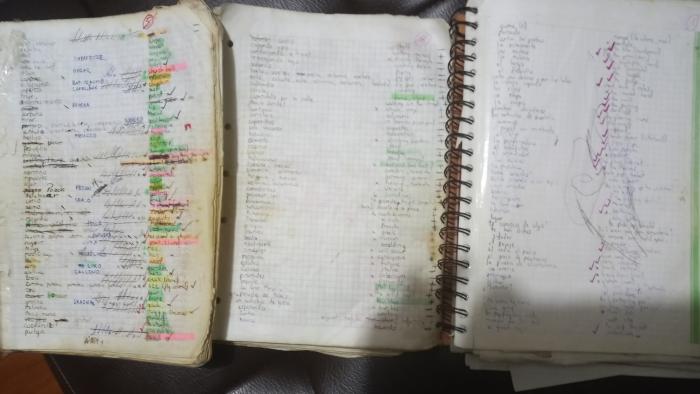
So I maintained journals where I would write new words and expressions that I heard (and their translations in English). Below is the result:

There are some people who possess a high level of linguistic intelligence. I am not one of them. I found it excruciating at times not being able to express myself in the new native language. There are entire populations more accustomed to learning new languages. For instance, Europeans are more proficient than Australians in learning a new language because they are mostly bilingual learners from infancy. So tackling a new language is something they are familiar and have learnt the cues on how to innately understand and adapt.

Many years ago, I had the good fortune to stumble across AnkiDroid and I converted those words from my journal to it. This program tests me daily on my memorisation of vocabulary. AnkiDroid sits on my mobile phone and remains the most indispensable learning tool for retaining and expanding my vocabulary in Spanish.
I also remember hearing a Sam Harris podcast where he mentioned he had a penchant for looking up new words in a dictionary and remembering them to enhance his command of the English language. I thought I could do the same thing on my AnkiDroid. I have since created a list of new English words or ideas on my Anki that I want to always keep coming back to. Below is one card example from my current list of English:

It is so practical. When I am reading a WhatsApp message or communicating with someone or watch a great podcast and I feel I should always know a new word, expression or fact then I add it in an instant to my AnkiDroid. Then the application tests my memory of it daily until I know it well enough and the time expands to test my recall ability. I’d be lost without it, especially as Colombia suffers another surge in the Pandemic and our lives have basically been confined to our homes. We have been like this since March last year so the daily brain-train of AnkiDroid has been all the more vital.

For further information and in case you might want to use the AnkiDroid I encourage you to sign up to Ankiweb.com and register. This is important because you can synchronise the information from your mobile to the site on line and in effect safeguard everything you add. Thanks for reading.

Tagged with:
Posted in Reading, Reflections

Civil War (1991) – Guns N’ Roses

Axl Rose and Slash in Rio 1991

Civil War is my preferred song from Guns N’ Roses. Sure, I liked Sweet Child of Mine, November Rain, and Knocking on Heaven’s Door when I first heard them, but they get played to death even to this day in Colombia. I don’t enjoy them like I once did. Civil War on the other hand I find has stood the test of time at least for me. Hard-Rock is probably not high up on my list of favored genres in music, but I certainly enjoy this gritty track. There are a lot of associations you can make between its content and the turbulent world we find ourselves in.

I don’t need your civil war
It feeds the rich while it buries the poor
Your power hungry sellin’ soldiers
In a human grocery store
Ain’t that fresh
I don’t need your civil war
Ow, oh no, no, no, no, no

Civil War originally appeared on the 1990 compilation Nobody’s Child: Romanian Angel Appeal and later on the band’s 1991 album, Use Your Illusion II. It’s the brainchild of band members Axl Rose, Slash, and Duff McKagan. Slash stated that the song was originally an instrumental he had written, and later Axl wrote lyrics and it was worked into a proper song at a soundcheck in Melbourne, Australia. Civil War reached number four on the Mainstream Rock chart in Billboard.

Allusions and sampling (wikipedia)

*The song samples Strother Martin’s speech in the 1967 movie, Cool Hand Luke: “What we’ve got here is… failure to communicate. Some men you just can’t reach. So you get what we had here last week, which is the way he wants it… well, he gets it. I don’t like it any more than you men.”

*It quotes a speech by a Peruvian Shining Path guerrilla officer saying “We practice selective annihilation of mayors and government officials, for example, to create a vacuum, then we fill that vacuum. As popular war advances, peace is closer”.

*The song also includes the American Civil War song, “When Johnny Comes Marching Home”, whistled by Axl Rose in the intro and outro.

Tagged with: ,
Posted in Music

19/4 – 25/4/21 incl. Our Box, Unchecked Anger, Scientism, & Vaccinations

news on the march

Welcome to Monday’s News on the March – The week that was in my digital world.

Poem at Intellectual Shaman

inside
we find
stuff
we know
our box
full of stuff
the wide world is waiting
waiting for us to share.….…(Read entire poem).

Audio podcast at Peter Attia MD:

Robert Abbott is a six-time Emmy award winner and the director of “The Last Days of Knight,” the behind-the-scenes documentary of legendary coach Bobby Knight, and the events that led to his termination from Indiana University. In this episode, Robert takes us through his investigative journey, which revealed cautionary tales of a winning at all costs environment—how pain often gets left in the wake of unchecked anger, ego, and perfectionism. Robert reflects on Knight’s legacy and extracts lessons in self-awareness and accountability that can be applied to ensure history doesn’t repeat itself. ..(Listen to podcast)

Blog article at selfawarepatterns

As someone who usually takes the scientific view on issues, I’ve occasionally been accused of scientism. And as someone also interested in the philosophy of science, I’m always interested in particular takes about what scientism might be. Midgley’s main beef seemed to be with people who turned science into an ideology. Broadly speaking, I can have some sympathy with that stance, although the devil usually turns out to be in the details. …(Read entire article)

  • DarkHorse Podcast with Geert Vanden Bossche & Bret Weinstein

    Video podcast at Bret Weinstein

    The issues raised here concerning the effect of vaccinations on mass during a Pandemic are real and like others, I commend Brett for courageously giving Geert a platform to discuss and educate us. This discussion contains some of the most important information about the crisis that I have heard. What was discussed is terrifying and worthy of further debate. (Watch video podcast)

news on the march the end

Posted in Health, News, Science, Sport and Adventure

City of Stars (2016) – Justin Hurwitz

City of Stars is the third song to appear here from my favourite musical La La Land. It won the Academy Award for Best Music (original Song). The music of the song was composed by Justin Hurwitz while the lyrics were provided by Benj Pasek and Justin Paul.

City of stars
Are you shining just for me?
City of stars
There’s so much that I can’t see

Who knows?
Is this the start of something wonderful and new?
Or one more dream that I cannot make true?

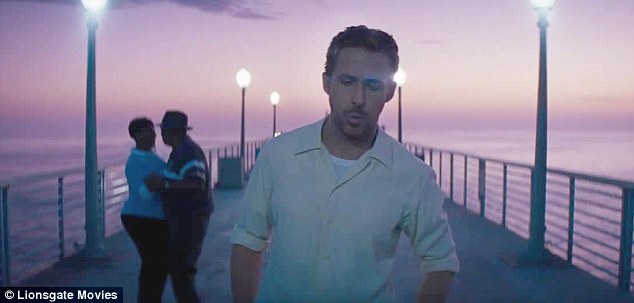
In the film, the song is first sung by Gosling alone as the character of Sebastian as he sings and dances on the Hermosa Beach Pier. (see video below).

Justin Hurwitz described the writing of the song: ‘…I was just composing it from an emotional place and thinking about the tone. I would say the tone is hopeful, but melancholy at the same time. And it kind of goes back-and-forth between cadencing in major and cadencing in minor, because I think that’s kind of what the song is about. You have these great moments and then you have these less great moments in life and in Los Angeles and we see it happen in the story….’

Interestingly, the song Hit Number 1 and 2 on Japan and South Korea’s billboard charts respectively.

Tagged with: , ,
Posted in Movies and TV, Music

Buena Vista Social Club (1999) – Wim Wenders (Friday’s Finest)

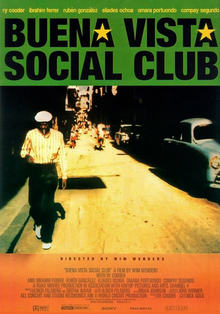
Director Wim Wenders and guitarist Ry Cooder team up again to present this marvellous music documentary Buena Vista Social Club. Cooder did the slide guitar soundtrack for Wender’s Paris, Texas 1984 which featured here recently on Friday’s Finest. Buena Vista (good view) is a celebration of the music of Cuba. I have lived in Latin America for 12 years and heard a great deal of Latina Music, but I would say my preferred music (at least the most reliable) here is Cuban music and in particular a style called Son Cubano (They are Cubans). The musical genius of the Cuban people is undeniable and that is what is shone in this film.

IMDB Movie Summary: Aging Cuban musicians whose talents had been virtually forgotten following Castro’s takeover of Cuba, are brought out of retirement by Ry Cooder, who travelled to Havana in order to bring the musicians together, resulting in triumphant performances of extraordinary music, and resurrecting the musicians’ careers.

The opening scene in Buena Vista which is presented at the end of this post with Ry Cooder and his son Joaquim riding through the streets of Havana and the sublime music of the Chan Chan in the background is something to behold. Anyone who is even remotely interested in musical heritage should find Buena Vista captivating. In 2020, the film was selected for preservation in the United States National Film Registry by the Library of Congress.

The film documents how Ry Cooder, long-time friend of Wenders, brought together the ensemble of legendary Cuban musicians to record an album (also called Buena Vista Social Club) and to perform two times with a full line-up: in April 1998 in Amsterdam (two nights) and the 1st of July 1998 in the United States (at the Carnegie Hall, New York City). Suffice to say the soundtrack of this film is exemplary and the movie received critical acclaim.

The film helped the musicians, some of them already in their nineties, become known to a worldwide audience, with some going on to release popular solo albums. These included Ibrahim Ferrer, Compay Segundo, Rubén González and Elíades Ochoa. The latter went on to support younger musicians making the same style of music beyond 2010 under the name “Buena Vista Social Club”.

Besides the sones, guarachas and boleros (basic styles of good-old Cuban music), the beauty of this documentary relies on Wim Wenders’ magnificent camera use. It is impossible not to feel the emotion of the crowded Carnegie Hall in the climax scenes, but there are also many other images that carry the viewer to more intimate experiences of La Habana, its music and musicians.

References:
1. Buena Vista Social Club – Wikipedia

Tagged with: , ,
Posted in Movies and TV, Music

Chelsea Hotel (1974) – Leonard Cohen

Leonard at the Chelsea Hotel

(Reader discretion is advised)
This is Leonard Cohen’s musical attempt of ‘Sex! Now I have your attention.’ Well, not really, but kind of. This infamous song of Leonard’s escapades with Janis Joplin at the Chelsea Hotel will be the discussion of today’s song.

He preluded a live performance of the song saying, ‘A thousand years ago I lived in this hotel in NY and I was a frequent rider of the elevator…I was an expert on the buttons of that elevator. One of the few technologies I ever mastered…I noticed a young woman in the elevator and she was riding it with as much delight as I was. Even though she commanded huge audiences, riding that elevator was the only thing she knew how to do. Finally I gathered my courage and I said to her: ‘Are you looking for someone?’ She said yes, ‘I’m looking for Kris Kristofferson’. I said ‘Little lady, you’re in luck, I’m Kris Kristofferson’. Those were generous times and even though she knew I was shorter than Kris, she never let on…A great generosity prevailed…Anyhow I wrote this song for Janis Joplin at the Chelsea Hotel.

I remember you well in the Chelsea Hotel
You were talking so brave and so sweet
Giving me head on the unmade bed
While the limousines wait in the street
Those were the reasons and that was New York
We were running for the money and the flesh
And that was called love for the workers in song
Probably still is for those of them left

I love this song because of its audacity and transparency although paradoxically he often contradicts himself. ‘I need you; I don’t need you’ we’ve all said that at some point and “I don’t even think of you that often”. Oh really, but you wrote a song about it and sing it in concert with preludes. Cohen tells a great story and often it’s humorous:

You told me again you preferred handsome men
But for me you would make an exception...
You fixed yourself, you said, "well, never mind
We are ugly but we have the music"
Chelsea Hotel

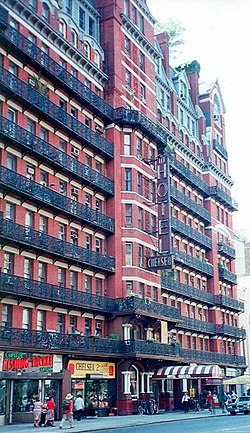
As Rolling Stone recalls: While Cohen’s gloomy, gritty and romantic mythology was still in its nascent phase, the Chelsea’s was fully formed. Situated at 222 West 23rd Street, the imposing redbrick ruled the block with a gothic grandeur. Its four hundred rooms had housed literary luminaries including Mark Twain, Charles Bukowski, William S. Burroughs, Jackson Pollock and Arthur Miller, who offered a succinct summation of the bohemian ambiance: “No vacuum cleaners, no rules, no shame.” Arthur C. Clarke wrote 2001: A Space Odyssey while in residence there, and Jack Kerouac pounded out On the Road in his room. Sid Vicious and girlfriend Nancy Spungen’s tragic visit was still more than a decade off, but poet Dylan Thomas entered his fatal coma during his Chelsea stay in 1953.

Below, I will relay Rufus Wainwright’s version of the song at Cohen’s dedication concert/dvd with Spanish subtitles and also with Cohen preluding it in his style.

Tagged with: , ,
Posted in Music

Circle of Life (1994) – Elton John

Elton John, Time Rice 1994

I was iffing and butting as to whether to include today’s song just because of how commercial – certainly for its time and mainstream it is. So I listened to it again and it pricked my ears as it has always done, so here goes…To be honest, I probably wouldn’t have included this song if I hadn’t heard recently the Jordan Peterson lecture he gave at Toronto University about the movie which this song was adapted. The movie, of course is The Lion King. Elton John composed this music and I think he did a wondrous job to capture the awe and allure of the story.

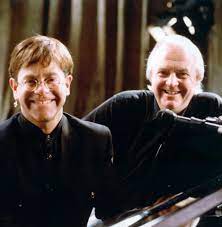
The lyrics were written by Tim Rice pictured above beside Elton. The song was performed by Carmen Twillie as the film’s opening song. In an interview, Rice said he was amazed at the speed with which John composed: “I gave him the lyrics at the beginning of the session at about two in the afternoon. By half-past three, he’d finished writing and recording a stunning demo.’ Circle of Life was nominated at 1994 Academy Awards for best song, but lost to another song composed by Elton John for The Lion KingCan You Feel The Love Tonight.

Due to the film’s universal impact on pop culture, the song is often referenced in other media. It’s powerful music and Elton although in the twilight phases of his songwriting prowess proved he was able to punch with the best of them. Below is the official version from Elton and even below that, the Peterson lecture about the Jungian archetypical significance which inspired me to give this article a go. Cheers.

Tagged with: , ,
Posted in Movies and TV, Music

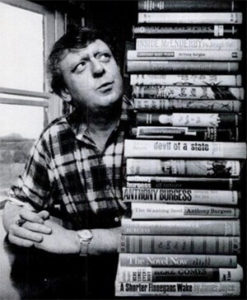
A Snorer is Outsnoored – Earthly Powers (Anthony Burgess)

This week on Wednesday’s literature piece we will continue with Anthony Burgess’s panamoramic saga novel of the 20th century Earthly Powers. The novel appeared on the shortlist for the Booker Prize in the year of its publication but lost out to William Golding’s Rites of Passage. In an October 2006 poll in The Observer, it was named joint third for the best work of British and Commonwealth fiction of the last 25 years.

On The International Anthony Burgess Foundation page Burgess wrote about his motivation to write Earthly Powers:

‘I’m no theologian. All I can do as a novelist is present situations which perhaps theologians can explain, although I doubt it. What I’ve tried to do is to invent characters typical of our age – British, American, Italian, German, black, white, brown – and show them in moral dilemmas damnably hard to resolve. At the same time I try to show the twentieth-century moral situation from the end of the Great War onwards. My Italian priest-bishop-pope believes that God is good, that God made man in his own image, that therefore man is good. Even the Jew-killing SS officer he captures and tries to bring back to the light is, according to his theology, good. It is the devil who causes evil: he gets into us and we have to exorcise him. But suppose a good act, a miraculous saving of life, produces great evil? This is not a question my pope character has to consider, since he is dead when it is asked about his own miracle, and he is on his way to becoming a saint. But what is a saint? There are saints in the story whom the world would call sinners.

I have, I see, said nothing about the novel. Certainly the above lame summary is no substitute for reading it. For me it is rather like trying to summarize the content of Beethoven’s Eroica Symphony. A novel is a novel, a work of craft or art, a structure, a big meal that can’t be turned into a vitamin capsule.’

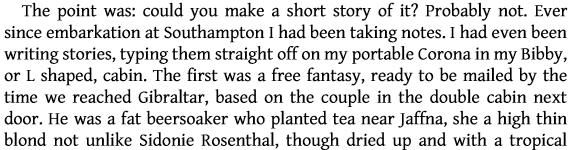
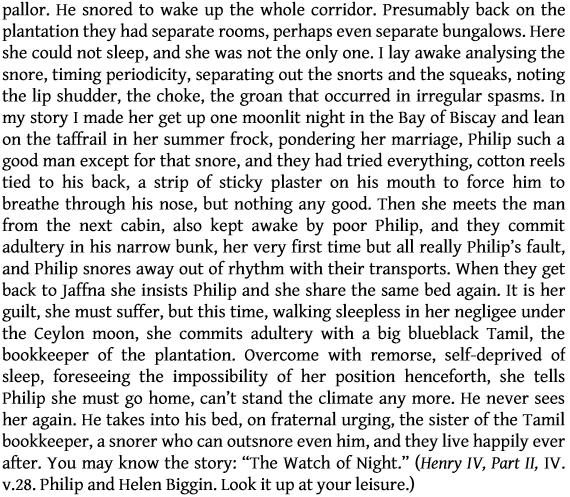
Today’s short, yet amusing excerpt which I pertly titled ‘A Snorer is Outsnoored‘ is from writer and protagonist Kenneth Toomey recalling a short story he has written. It’s a little on the cheeky side, but it made me chuckle. I hope you enjoy it likewise:

Tagged with: ,
Posted in Reading

Follow Blog via Email

Enter your email address to follow this blog and receive notifications of new posts by email.

Join 753 other subscribers

← Back

Thank you for your response. ✨