I haven’t read anything in the Elon Musk’s comments about his business incentives in this matter. Elon’s business is built on being more environmentally friendly and that is good – right?
We live in moderate neo-libertarian economies which on the whole have to compete at all costs. When sustainable costs go down to equal or better than those existing, then naturally the market will react more favourably for sustainable methods. I agree with him we will exit the fossil fuels era, but I have doubt about his alarmist words; like how climate sensitivity is extremely high or that it will kill more people than the World Wars combined. I think as the world undergoes the Pandemic and how the socialist-post modernist movement has gotten its strangle hold on nearly every institution especially the press and education, well… basically we have bigger fish to contend.
Not just that, but if the Western countries conceded to these current forces and implemented a carbon tax or something of that nature, we would see competing (carbon-based) industrial eastern countries with not so much democratic inclinations make huge headway in terms of global market demand. I think this has as much if not more negative impact on the quality of life of the average Western citizen than what climate change proponents could ever purport for their cause. Also, the conflicts that could occur as a result of this radical change in the world order could be catastrophic.
My message is, think twice before you espouse to what seemingly is progressive and has good moral intentions. Believe you me, I have been there.
Douglas Murray’s latest interview – as always ‘engaging’ but perplexing to say the least. This tops my favourite interview about the state of the world and mind-matters in general since COVID wreaked-havoc. Murray is one smart cookie and some have seen him as keeping to Christopher Hitchen’s spirit or taking his mantle in his absence; but whichever way I look at it, a voice like his, right now is so necessary.
In this interview Murray is captured in the foreground of London’s bridge wearing a long sleeve shirt – tight at the skin which shows us our boy Murray has been doing more than reading history and writing adnauseum during his Quarantine. Although gathering from what he brings to the discussion here you wonder if he does anything else.
Where this interview goes from the very good, to the obscenely… is when Murray makes this tranformational point at 33.00 – ‘There is a great difference of a critic who wishes you well and a critic who only wishes you ill.’ The ongoing discussion about that is priceless.
‘What has happened in America for 2 generations now; I would say; is that people have been taught that their country is uniquely bad…And that same thing has been creeping into Britain, and I would argue into every other Western Democracy and its got to be pushed back against….Anyone that says that the history of (insert country here – Britain in this case) is slavery and racism does not wish (insert country here) Britain well, and should not be listened to.‘
If you don’t raise your arm and fist at a US restaurant in support of BLM this is what could happen:
Discussing politics wasn’t part of my aim when I set up this blog. I even wrote how I would try to shun away from it alltogether if possible. But because a postmodern-neomarxist ideology has windswept the western-world the last 2 years (and most notably during the pandemic) I feel compelled to relay my thoughts about the dangerous times we live in.
I live in a Country called Colombia and a Continent called South America which has been gutted to the core by socialist ideological movements in recent history. The neo-marxist postmodernist movement currently underway in the Western World will undoubtedly do what it has done here and for a more extreme example – see Venezuela.
I have always said to outsiders and on this blog too, that Colombia should be the tourist Mecca of the world due to its unrivalled biological diversity and sightseeing destinations. However, a half a century of conflict between Farc (a Neo-Marxist politically armed group) and the authorities where eight million people died, disappeared or were displaced put an end to that.
The video above was forwarded in the latest ‘Bret and Heather 41st DarkHorse Podcast Livestream‘ and their discussion about it; as always compelling. I like Heather’s quotation from the Lutheran pastor Martin Niemöller who wrote the following about World War 2 with emphasis on the Nazi regime. It is about the cowardice of German intellectuals and certain clergy—including, by his own admission, Niemöller himself:
‘First they came for the socialists and I did not speak out because I was not a socialist, then they came for the trade unionists, and I did not speak out, because I was not a Trade Unionist, then they came for the Jews and I did not speak out because I was not a Jew…then they came for me..and there was noone left to speak for me’.
‘(41.20) Lack of Freedom is more probable than Freedom….(Freedom) is always under threat…I think the fact that many comedians now won’t perform on University campuses is a very good indication of that. That’s a canary in the coalmine scenario, that.’
I think this is my favourite interview of JBP and I have seen more than I care to admit. Right now, I can’t go to a news site without being inundated with far-left ‘moral crusading’ ideological propaganda. My only two news feeds that I consider something resembling impartial news is the biologist’s Brett Weinstein podcast and the inititial 10 or so minutes of a Ben Shapiro show.
Peterson like Dostevesky and Neitsche forsaw what was going to evelope the society ahead of time. The radical leftist narrative and direction is now like a cyclone destroying all before it. The COVID crises acts as their guise to dismantle all which the Western world in moderate market economies have accomplished since the enlightenment.
There are no words which can describe the extent of this political erosion and its coercion on the populace. And unfortunately those of us in the whereabouts between the extremes no longer have a voice in any instituition..ANYWHERE! The radical left have the Universities, Multi-nationals, Hollywood, and the Mainstram Press in their pockets.
So this video below remains to me very special because while the world remained asleep, one individual stood up and told it how it’s going and how it might end up if we don’t find as individuals the courage to stand up to this ideological movement which is engulfing the world. Unfortunately it appears we are failing to do that.
Caribbean Wind is another one of those immense Dylan songs one can find perplexing how he deemed it unreleasable material. When writing this post I was tossing up between this and Abandoned Love to declare my favourite. I realised I hadn’t accounted for Blind Willie Mctell and Series of Dreams which I’m also captivated. The legendary Biograph bootleg version of Caribbean Wind is outstanding and unfortunately cannot be forwarded here due to copyright restrictions. (edited: the biograph version has since been released and is below). Such is life, but I have relayed below the only other existing copy which I used to orchestral my family’s Caribbean trip to Cartagena.
What’s staggering considering Dylan’s musical influence and everything else, there is no wikipedia page of this song. And look… you can harp upon song meanings in typical songs but as Paul Robert Thomas implied with Carribean Wind, this isn’t a song with a straight-forward meaning rather it’s all to do with the context Dylan found himself in:
(Caribbean Wind is..) mostly as an indicator of the position of his soul, as a man who was now bereft of his family life following the embittered divorce proceedings and who had at first totally embraced Jesus Christ but was quickly falling out of His grasp – at least the dogmatic grasp of the Christian Vineyard Fellowship, and who would soon return to the religion of his forefathers, Judaism. Read entire article.
And Mr Thomas isn’t alone in his thoughts because this song was written during the sessions for the album Shot of Love which is a fairly devout Christian album, but after undergoing a mountain of rewrites Dylan decided that the task of seeing Caribbean Wind come to fruition alluded him. I have always felt it too, in listening to him, that Dylan was undergoing a struggle between Christianity and his Judaism hereditary. The track below is from one of those Shot of Love sessions which doesn’t hold a torch to the release on Biograph but it’s still plenty good. It’s extremely crude and demonstrates everything good and bad about Dylan but I like listening to him in both excesses.
The lyrics in this song differ significantly in the various versions, but whichever way you view them they are mind-blowing:
She looked into my soul through the clothes that I wore
She said “we got a mutual friend standing at the door
Yeah, you know he’s got our best interest in mind”
He was well connected, but her heart was a snare
And she had left him to die in there,
Eighty payments due and he was a little behind.
Well, I slip in a hotel where flies buzz my head
Ceiling fan was broken, there was heat in my bed
Street band playing “Nearer My God To Thee”
We met in secret where we drank from a spring
She said “I know what you’re thinking, but there ain’t a thing
We can do about it, so we might as well let it be”
Unlike others who have said they don’t know where he was going with this, and the same could be said for the reaction of his whole ‘Street Legal’ (78, which I regard his greatest accomplishment) I feel it’s some of his most transcendent output. Our minds are complicated beasts and in these works he seems to re wake the mythological and archetypal parts of our subconscious selves – in particular Caribbean Wind represents the Feminine versus Masculine pull and tug in archetypal mode. These stories go way deep and should not be discarded on a whim!
Thankfully Dylan just released the official release of the 1981 studio outtake:
Every new day, every passing minute presents another chance to turn it all around. As Nirvair Singh Khalsa said ‘it’s not the life you lead, but the courage you bring to it’.
The individual is supreme. The divinity of the individual is sacred. In essence it is only the individual who has the moral responsibility and conviction to harness the courage. We are ‘Jesus’ alone in the Mount of Olives. We can’t rely on anyone. There is noone else, because Jesus even felt God had abandoned him in his darkest moment.
If we forge ahead living our lives according to not what is easy, but according to our moral convictions (this is the courage) then the fruits of our labor will be plentiful. So we will no longer be dependent on the ‘grace’ which comes with each passing minute or new day rather we as individuals will be ‘The Logos’ incarnate – ‘Word made into Flesh’. (Gospel of John)
Life presents us hundreds if not thousands of opportunities to turn it all around. This is the grace. But only the individual can face this moral dilema and enact on it, by not walking the path most accustomed or wickedly desireable, but by walking that less taken.
I shall be telling this with a sigh Somewhere ages and ages hence: Two roads diverged in a wood, and I— I took the one less traveled by, And that has made all the difference – Robert Frost (The Road Not Taken)
If one foresakes ‘Grace’ too often, then the fire in one’s moral conviction and propensity to be couragous will turn to ember. That other passing minute or new day to turn it all around may be unassailable. For that reason while we still have breath we are blessed with ‘Amazing Grace’.
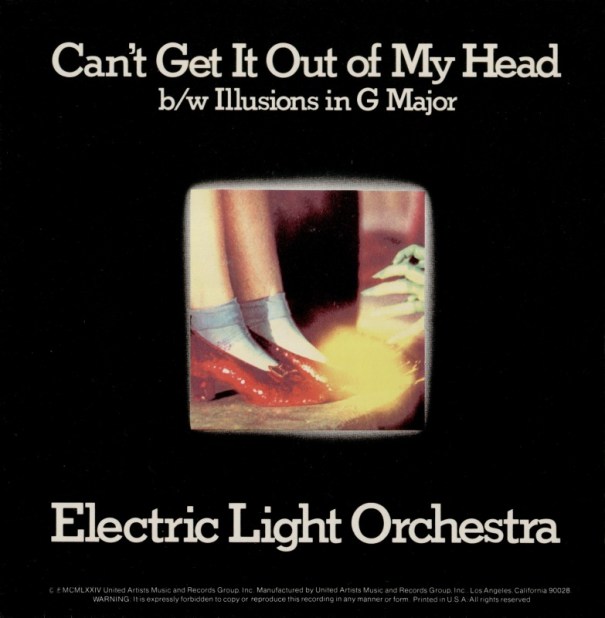
The next song to appear in my Music Library Project is ELO’s ‘Can’t Get It Out My Head‘. What entails the ‘Music Library Project’? My good blogger friend Max recently showcased this one, so I’ll relay his post instead. I listened a lot to ELO in my youth. Regarding my favourite ELO song, it’s between this and ‘Telephone Line‘, but I am hardly abreast of much of their discography. I like the story about Lynn showing his Dad how he could write a tune.
The song is appropriately named because it’s hard to get it out of your head after you listen to it. The song peaked at #9 in the Billboard 100 in 1975. The song was on the Eldorado album that peaked at #16 in 1975.
Jeff Lynne recalled that he found inspiration for the song in the unfulfilled duties of an everyday guy. “It’s about a guy in a dream who sees this vision of loveliness and wakes up and finds that he’s actually a clerk working in a bank,” he said. “And he hasn’t got any chance of getting her or doing all these wonderful things that he thought he was going to do.”
From Songfacts
This is one of several fan favorites from the Eldorado, considered by many to be Jeff Lynne’s best album. The album cover shows what appears to be the scene from the movie The Wizard…
As a young-en, I was so in awe of this, but after hundreds of listens I’m not as enamored as before. I still like it, lets say, on the odd occasion. This piece is one of the most admired and reproduced classical pieces in popular culture in the last 50 years, but interestingly the dates and circumstances of the composition of Pachelbel’s Canon is unknown. Suggested dates range from 1680 to 1706, and the oldest surviving manuscript copy of the piece dates from the 19th century.
The Canon was popular during Pachelbel’s lifetime, but the piece went out of style like it did with my tastes, where it remained in obscurity for centuries. A 1968 arrangement and recording of it by the Jean-François Paillard chamber orchestra gained popularity. From the 1970s to the late 2010s, elements of the piece, especially its chord progression, were used in a variety of pop songs. Since the 1980s, it has also been used frequently in weddings and funeral ceremonies in the Western world.
In his lifetime, Pachelbel was renowned for his organ and other keyboard music, whereas today he is also recognized as an important composer of church and chamber music. Pachelbel’s music enjoyed enormous popularity during his lifetime; he had many pupils and his music became a model for the composers of south and central Germany. Hans-Joachim Schulze, writing in 1985, suggested that the Canon may have been composed for Johann Christoph Bach’s wedding, on 23 October 1694, which Pachelbel attended. Johann Ambrosius Bach, Pachelbel, and other friends and family provided music for the occasion.
Today I have for you a musical jewel from the Caribbean Coast in Colombia. This folklore music from the group Los Gaiteros de San Jacinto (The Pipers from San Jacinto) is about as rich and pure as Colombian folklore music gets. It preserves the traditional rhythms and sounds of Colombian Cumbia music which is the musical and cultural mixture of indigenous and black slaves on the Caribbean Coast during the Spanish Conquest and Colony.
The group Los Gaiteros de San Jacinto formed in the Caribbean Region of Colombia which have been active since 1940. From the 1950s onwards, they began touring Colombia. As decades passed, the group began incorporating a second generation of musicians, among whom can be found some of the sons of the original line-up.
In 2007 the group won a Latin Grammy award in the category Folkloric Music.
Candelaria (4th verse)
Yo nunca podré olvidar (I could never forget) Esta mujer consentida (This spoilt woman) Que tiene mi alma batida (Who has my battered heart) Porque no me supo amar (Because she didn’t know how to love me) Candelaria, Candelaria, Candelaria vida mía (My life)
One of the first songs I remember hearing upon arriving in Colombia was Cancion de Otoño (Autumn Song) and it was love at first listen. This is my ‘Desert Island’ Spanish song. I made a Family DVD for my son’s 3rd birthday and the first song I showcased was this song accompanied with family photos. Suffice to say I have a very strong emotional connection with this song. Cancion de Otoño was released on the Perales’ 1982 record Entre el agua y el fuego (Between the Water and Fire).
José Luis Perales Morillas (born 18 January 1945) is a Spanish singer-songwriter. He has performed some of his extensive work at Carnegie Hall, New York. Perales has recorded 27 albums with 50 million copies sold worldwide. One of the main reasons I started this Music Library Project was it allowed me the opportunity to promote these classic contemporary songs otherwise unknown to English speaking audiences. In Latin countries or Spain where the song originated there are few people who haven’t heard of this masterpiece and frankly it deserves greater recognition worldwide. What entails the ‘Music Library Project’?
Below is a loose translation of the first 2 verses:
As the wind blows today
As it rains today
How empty the street is
As the sun dies
These grey Autumn days
Make me sad
Draws me to the warmth of my fireplace
I remember you today
I remember you today
To you, who is my whole life…
I don’t know how many times I have heard this song and each time how much I enjoy it more. This is easily in my top 5 favourite songs of all time. There are artists who are very good and then there are geniuses and José Luis Perales is one of those. To my mind, if romance could be bottled in just one song then Cancion de Otoño would be it.