Better Man (1994) – Pearl Jam

Pearl Jam 1994
Pearl Jam Vitalogy – 1994

Better Man is the third song to feature from Pearl Jam in this music project and possibly my joint favorite song with Nothingman. It is the eleventh track on the band’s third studio album, Vitalogy. Better Man was never commercially released as a single but reached the top of the Billboard mainstream charts and stayed at number 1 for a total of 8 weeks. Vitalogy became the second-fastest selling album in history, only behind the band’s previous release Vs., selling 877,000 copies in its first week and went multi-platinum quickly.

The song was written by Eddie Vedder when he was in High School. Vedder stated, “Sometimes I think of how far I’ve come from the teenager sitting on the bed in San Diego writing ‘Better Man’ and wondering if anyone would ever even hear it“. Extraordinarily, the song was omitted by the band from their previous album Vs.  When the band’s producer Brendan O’Brien heard the song in rehearsals he said “Man, that song’s a hit”, but Eddie just went “uhhh.” Al Weisel of Rolling Stone called the song a “haunting ballad about a woman trapped in a bad relationship.” When “Better Man” was performed on VH1 Storytellers in 2006, Vedder introduced it as a song about “abusive relationships.

Waitin’, watchin’ the clock, it’s four o’clock, it’s got to stop
Tell him, take no more, she practices her speech
As he opens the door, she rolls over
Pretends to sleep as he looks her over

She lies and says she’s in love with him, can’t find a better man
She dreams in colour, she dreams in red, can’t find a better man
Can’t find a better man

According to wikipedia: In Atlanta 1994 at the Fox Theatre, Vedder clearly said “it’s dedicated to the bastard that married my Momma.” He was referring to his stepfather, Peter Mueller, a California attorney whom Vedder had long believed to be his biological father and who divorced his mother in the early 1980s….

In Pearl Jam concerts, the slow opening verses and choruses of “Better Man” are frequently sung as much by the audience as by Vedder. The song is often performed live as a medley with The English Beat’s “Save It For Later”. At the last Vote for Change concert on October 13, 2004, in East Rutherford, New Jersey at Continental Airlines Arena, Vedder made a guest appearance with Bruce Springsteen and the E Street Band and sang “Better Man” upon Springsteen’s request.

Tagged with: , ,
Posted in Music

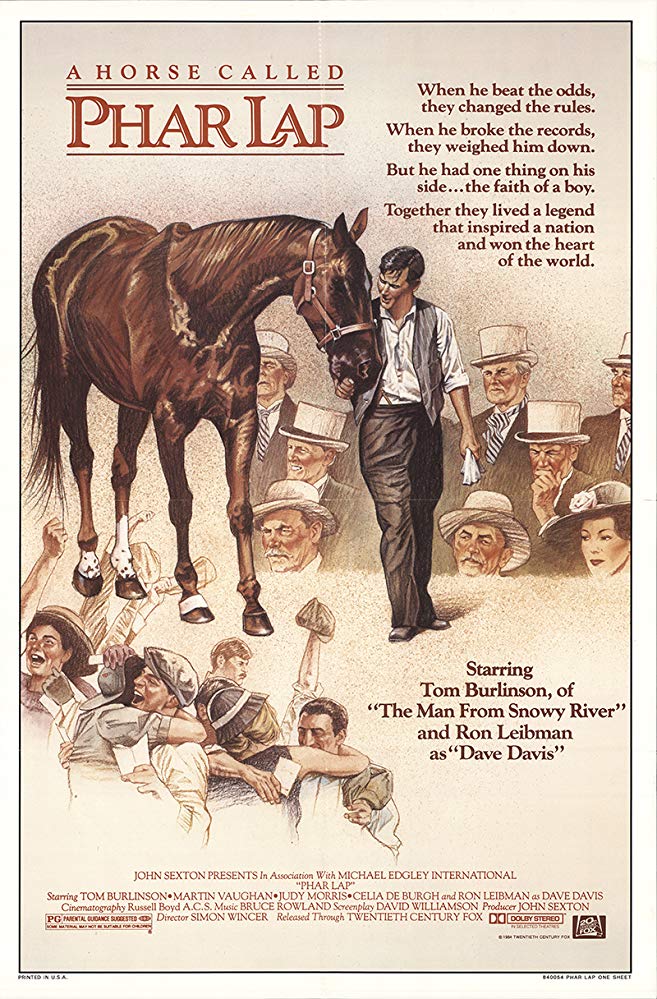
Phar Lap (1983) – Simon Wincer (Friday’s Finest)

Phar Lap

Sub Editor: We have two versions ready to go. If he wins, “Australian wonder horse beats the world.”

News writer: And if he loses?

Sub Editor: “New Zealand horse fails in Mexico.”

(Referring to Phar Lap’s last race in 1932 where he traveled to the United States to race against the best racehorses in the world at the Agua Caliente race track on the Mexican border.)

Phar Lap is an Australian movie based on the true story of legendary Australian racehorse Phar lap. I decided to showcase this movie in Friday’s-finest for mainly nostalgic reasons. You see, I watched Phar Lap more than any other movie when I was a child. The racing scenes made my hair stand up on end, no matter how many times I watched them. It’s a true ‘underdog’ and rags to riches story which occurred during the Depression era. The movie is a relatively accurate depiction of what took place and even the real strapper (stableboy) Tommy Woodcock appears in the film.

IMDB Storyline:
Phar Lap, the legendary Australian racing horse, is as well-known today for his mysterious death as for his fabulous accomplishments in life. Beginning at the end, the film flashes back to the day that Phar Lap, despite his lack of pedigree, is purchased on impulse by trainer Harry Telford. Phar Lap loses his first races, but Telford’s faith in the animal is unshakable. Suddenly the horse becomes a winner, thanks to the love and diligence of stableboy Tommy Woodcock. American-promoter Dave Davis arranges for Phar Lap to be entered in several top races, where his “long shot” status results in heavy losses for the professional gamblers. Just after winning an important race in Mexico, Phar Lap collapses and dies; though the film never comes out and says as much, it is assumed that the horse was “murdered” by the gambling interests.

My father was extremely fond of horses. Despite not owning one, he always enjoyed a flutter on the Saturday races. It was just part of our family routine on a Saturday afternoon, that we would put small wagers on the races, even us kids. Sometimes we went to the local Hawkesbury races which was a lot of fun. Later in my adult life I ended up living in a gorgeous cottage cabin alongside the Mornington racetrack in South-east Victoria, Australia. I remember one day attending the races there and as I walking up to the event the champion Australian jockey Damien Oliver passed me going the other way. That was a thrill. Interestingly another Australian movie was made about Damien Oliver’s Melbourne Cup winning ride called ‘The Cup‘ (2011).

If I was to choose just one Australian movie to take away with me on a Desert Island it would be this one. I still find it irrepressibly moving and charming. Phar Lap transports me to a time and place that I never grow tired of revisiting. The sights, smells and sounds of Australia and my youth all come flooding back. Tom Burlinson is excellent as Tommy Woodcock, the stable hand who was the only one who had any faith in the horse’s ability and brought the best out of Phar Lap even when everyone else gave up on him. Phar Lap is a remarkable story of heartbreak and triumph. Any horse or sports lover should watch and enjoy this movie. The cinematography, production and music in particular is outstanding. Also it remains one of the most popular Australian films.

IMDB Trivia:

  • Billy Eliot, Phar Lap’s jockey at Agua Caliente had been devastated by Phar Lap’s mysterious death, gave his saddle to George Woolf as a gesture of friendship. Woolf went on to become one of America’s greatest riders, using the saddle on his favourite mount, Seabiscuit (2003), who, like Phar Lap, captivated a nation in the midst of the depression. The saddle was Woolf’s lucky charm. From that date on until the time of his death he used it. Coincidentally, the only time he did not use it, from the time when Elliot gifted it to Woolf, was in his last race which he, unfortunately, was killed in.
  • After Phar Lap’s death, his stuffed hide was donated to the Melbourne Museum (where it is one of the main attractions), his skeleton to the Museum of New Zealand and his heart to the National Museum of Australia in Canberra. His heart was remarkable for its size, weighing 6.2 kg, compared with an average horse’s heart weight of 3.2 kg.

The clip from the movie I included below is when Phar Lap makes his late entrance for the Melbourne Cup. Below that is the 1930 Cup win sequence in the movie and the actual real footage.

Tagged with: ,
Posted in Movies and TV, Reflections

Best Laid Plans (2010) – James Blunt

James+Blunt+2010+Brit+Awards+8pNd_PtNwzcl

James Blunt 2010 – Brit Awards

Best Laid Plans is the first song to feature from James Blunt in the music library. James Blunt like fellow English pop artist Robbie Williams was born in the month of February 1974 – the 22nd to be exact and 9 days after Robbie and 37 days after yours truly. What’s this got to go do with the price of eggs I hear you ask. Well, because I’m their senior they would have to look up to me if we ever met and that’s that.

Just like with Robbie, I hopped onboard the James Blunt bandwagon when he broke through as a solo artist with his debut album Back to Bedlam which of course was a worldwide smash with the big hits ‘You’re Beautiful’ and ‘Goodbye My Lover’. The latter song was what got him his big breakthrough at the beginning of his career and discussed further below.

I always had a penchant for James because he’s an ex military officer like me, and he has made a very successful career post -military like me; he as a singer/songwriter and me as a blogger whose website sometimes scrape 50 views on any given day.

According to wikipedia: Blunt was a reconnaissance officer in the Life Guards, a cavalry regiment of the British Army, and served under NATO in the Kosovo War in 1999…… During Blunt’s Kosovo assignment he had brought along his guitar, strapped to the outside of his tank, and would sometimes perform for locals and troops….

While still in the army Blunt would write songs during his time off. A backing vocalist and songwriting collaborator suggested he contact Elton John’s manager, Todd Interland, with whom she used to share a house. Interland told HitQuarters that he listened to Blunt’s demo while driving home and, after hearing the track “Goodbye My Lover”, pulled over and called the mobile number written on the CD to set up a meeting.

Shortly after leaving the army he was signed to EMI music publishers. A record contract remained elusive, with recording label executives pointing to his posh speaking voice as a barrier in class-divided Britain…. Linda Perry, who was just launching her own Custard Records label in early 2003, heard Blunt’s promotional tape when visiting London, and soon after heard him perform live at the South by Southwest Music Festival. She made an offer to him the same night, and within a few days he signed a recording contract with her. A month later, he travelled to Los Angeles to meet producer Tom Rothrock.

SomekindoftroubleToday’s song Best Laid Plans is from James third album Some Kind of Trouble which despite mixed critical reviews sold more than 1 million copies. Unlike some other songs from Blunt, I haven’t grown tired of Best Laid Plans. He describes a relationship which despite one’s best efforts, the other doesn’t reciprocate or show genuine interest. I had that happen to me recently and when I finally understood that it’s me they couldn’t warm to, I felt disheartened.  I was very emotionally invested, but no matter how hard I tried I just couldn’t get her to feel anything anything for me. So this song seems to depict something which I can relate to.

You don’t like it in the shadows
You won’t let me shine the light
I would wash away your troubles
But it seems

The more that I hold on
The more that you let go
And I know, you better let somebody love you
Or find yourself, on your own

Tell me why all the best laid plans
Fall apart in your hands
And my good intentions never end,
The way I meant

Tagged with: , ,
Posted in Music

Breath (the Introduction) – Tim Winton

Tim Winton Reading
My original ticket stub of Tim Winton’s book reading of ‘Breath’ in Melbourne, 2008
Breath (Back insert)
Back cover insert of ‘Breath’

Today’s book excerpt is a continuation piece of a review I wrote of Tim Winton’s classic Australian novel ‘Breath’. Tim Winton is my favourite Australian author and Breath is one of my all-time favourite novels.

Readings, an independent Australian retailer of books, movies and film which sponsored Tim’s book reading stated about the event in anticipation:  ‘It’s been a long time since Tim visited Melbourne and we are delighted to have him available to talk about his new book Breath and why he has become the voice of Australian stories.‘

To recap I wrote about ‘Breath’: I have lived overseas a long, long time and of course I miss my home country, but if I ever want to get reacquainted with my island home then I will dive head-first into a Tim Winton novel. I have him to thank for that.

I had never before or ever since procured a book and read it as quickly as I did with Breath.  I would read it another 3 times that year before I eventually moved overseas. A week ago I dusted it off to rekindle that old flame and see if my obsession with it was justified. Part way through I realised I was reading from a master at work. I was just as mesmerized as I had been 10 years earlier. Every page I was gobsmacked by some outstanding literary prose thinking to myself, ‘How did he come up with that, that, and that?’. To put it bluntly, reading a Tim Winton book is a very humbling experience for any writing enthusiast. He sets the bar high’.

For information about the plot of Breath I encourage you to visit my original post. Today’s book excerpt is lifted from the Introduction stanza. Like the rest of the book Tim throws the reader headfirst into a very confronting situation, which makes you sit up and pay attention. If you get to read Breath you will understand only too well how this Introduction piece fits into the events which unfold. It is narrated by Bruce “Pikelet” Pike, a divorced, middle-aged paramedic. The rest of Breath takes the form of a long flashback in which he remembers his childhood.

WE COME SWEEPING up the tree-lined boulevard with siren and lights and when the GPS urges us to make the next left we take it so fast that all the gear slams and sways inside the vehicle. I don’t say a thing. Down the dark suburban street I can see the house lit like a cruise ship.

Got it, she says before I can point it out.

Feel free to slow down.

Making you nervous, Bruce?

Something like that, I murmur.

But the fact is I feel brilliant. This is when I feel good, when the nerve-ends are singing, the gut tight with anticipation. It’s been a long, slow shift and there’s never been any love lost between Jodie and me. At handover I walked up on a conversation I wasn’t supposed to hear. But that was hours ago. Now I’m alert and tingly with dread. Bring it on.

At the call address Jodie kills the siren and wheels around to reverse up the steep drive. She’s amped, I guess, and a bit puffed up with a sense of her own competence. Not a bad kid, just green. She doesn’t know it but I’ve got daughters her age.

When she hits the handbrake and calls in our arrival at the job I jump out and rip the side door back to grab the resus kit. Beneath the porch steps on the dewy grass is a middle-aged bloke hugging himself in silence and I can see in a moment that although he’s probably done his collarbone he’s not our man. So I leave him to Jodie and go on up to announce myself in the open doorway.

In the living room two teenage girls hunch at opposite ends of a leather couch.

Upstairs? I ask.

One of them points without even lifting her head, and already I know that this job’s become a pack and carry. Usually they see the uniform and light up with hope, but neither of them gives me as much as a glance.

The bedroom in question isn’t hard to find. A little mat of vomit in the hall. Splinters of wood. I step over the broken-down door and see the mother at the bed where the boy is laid out, and as I quietly introduce myself I take it all in. The room smells of pot and urine and disinfectant and it’s clear that she’s cut him down and dressed him and tidied everything up.

I slip in beside her and do the business but the kid’s been gone a while. He looks about seventeen. There are ligature marks on his neck and older bruises around them. Even while I’m going through the motions she strokes the boy’s dark, curly hair. A nice-looking kid. She’s washed him. He smells of Pears soap and freshly laundered clothes. I ask for her name and for her son’s, and she tells me that she’s June and the boy’s name is Aaron.

I’m sorry, June, I murmur, but he’s passed away.

I know that.

You found him a while ago. Before you called.

She says nothing.

June, I’m not the police.

They’re already on their way.

Can I open the wardrobe? I ask as Jodie steps into the doorway.

I’d prefer that you didn’t, says June.

Okay. But you know that the police will.

Do they have to?

The mother looks at me properly for the first time. She’s a handsome woman in her forties with short, dark hair and arty pendant earrings, and I can imagine that an hour ago, when her lipstick and her life were still intact, she’d have been erect and confident, even a little haughty.

It’s their job, June.

You seem to have made some kind of . . . assumption.

June, I say, glancing up at Jodie. Let’s just say I’ve seen a few things in my time. Honestly, I couldn’t begin to tell you.

Then you’ll tell me how this happened, why he’s done this to himself.

I’ve called for another car, says Jodie.

Yeah, good, I mutter. June, this is Jodie. She’s my partner tonight. Go ahead and tell me why.

Because your husband’s broken his collarbone, says Jodie. He broke down the door here, right?

So what do I tell them? the mother asks, ignoring Jodie altogether.

That’s really for you to decide, I say. But there’s no shame in the truth. It’s fairer on everybody.

The woman looks at me again. I squat in front of her beside the bed. She smooths the skirt down onto her knees.

I must be transparent, she murmurs.

I try to give her a kindly smile but my face feels stiff. Behind her I can see the usual posters on the wall: surfers, rockstars, women in provocative poses. The bookshelf above the desk has its sports trophies and souvenirs from Bali and the computer goes through a screensaver cycle of the twin towers endlessly falling. She reaches for my hand and I give it to her. She feels no warmer than her dead son.

No one will understand.

No, I say. Probably not.

You’re a father.

Yes, I am.

Car doors slam in the street below.

June, would you like a moment alone with Aaron before the police come in?

I’ve had my moment, she says, letting go my hand to pat her hair abstractedly.

Jodie? Will you just pop down and let the police know where we are?

Jodie folds her arms petulantly but goes with a flick of her little blonde ponytail.

That girl doesn’t like you.

No, not much.

So what do I do?

I can’t advise you, June.

I’ve got other children to consider.

Yes.

And a husband.

He will have to go to hospital, I’m afraid.

Lucky him.

I get to my feet and collect my kit. She stands and brushes her skirt down and gazes back at the boy on the bed.

Is there anyone else you’d like me to call?

Jodie and two cops appear at the door.

Call? says June. You can call my son back. As you can see, he’s not listening to his mother.

When we’re almost back to the depot for knock-off Jodie breaks the silence.

So when were you planning to let me know what all that was about?

All what?

With that poor woman. For a moment there I thought you were flirting with her.

Well, you can add that to your list of complaints.

Look, I’m sorry.

Arrogant, aloof, sexist, bad communicator, gung-ho. Obviously I missed a few things, coming in late. But for the record, Jodie, I’m not a Vietnam vet. Believe it or not, I’m not old enough.

I feel awful, alright?

So get a roster change. Be my guest. But don’t do your bitching at handover in the middle of the bloody shed with your back to the door. It’s unfriendly and it’s unprofessional.

Look, I said I was sorry.

When I look across at her I see in the lights of a passing truck that she’s almost in tears. She hangs on to the wheel as though it’s all that’s holding her together.

You okay?

She nods. I roll a window down. The city smells of wet lawns and exhaust fumes.

I didn’t think it would hit me that hard.

What?

That was my first suicide, she murmurs.

Yeah, it’s tough. But it wasn’t suicide.

Jesus, Bruce, they had to bust in the door and cut him down. The kid hanged himself.

Accidentally.

And how the hell do you know?

I’m a know-all. Remember?

She grimaces and I laugh.

God, you’re a strange man.

So I gather.

You’re not gonna tell me, are you? I can’t believe you won’t tell me.

I sit there a minute and think of those poor bastards sanitizing the scene before we showed up. The mother sitting there, trying to choose one shame over another. The other kids downstairs cold with shock. The father out on the grass like a statue. Maybe another time, I say.

Well, she says. I rest my case.

We ride back to the shed in silence.

I hurtle on too long through the pounding submarine mist. End over end in my caul of bubbles until the turbulence is gone and I’m hanging limp in a faint green light while all the heat ebbs from my chest and the life begins to leach out of me. And then a white flash from above. Someone at the surface, swimming down. Someone to pull me up, drag me clear, blow air into me hot as blood. He spears down and stops short and I recognize my own face peering through the gloom, hesitating an arm’s length away, as if uncertain of how to proceed. My own mouth opens. A chain of shining bubbles leaks forth but I do not understand.

So I wake with a grunt on the sofa in the empty flat where afternoon sun pours through the sliding door. Still in uniform. The place smells of sweat and butter chicken. I get up, crack the door and smell the briny southerly. I take a piss, put the kettle on and snatch the didj up off the seagrass matting of the floor. Out on the balcony my herbs are green and upright. I tamp down the beeswax around the pipe mouth and clear my throat. Then I blow until it burns. I blow at the brutalist condos that stand between me and the beach. I blow at the gulls eating pizza down in the carpark and the wind goes through me in cycles, hot and droning and defiant. Hot at the pale sky. Hot at the flat, bright world outside.
Tagged with: , ,
Posted in Reading, Reflections

Belfast Mill (1982) – The Fureys and Davey Arthur

When You Were Sweet Sixteen

When I was a preadolescent I bought the album by The Furey’s called ‘When You Were Sweet Sixteen‘. I listened and was charmed by these traditional Irish folk songs. Most of the songs from this album will feature in this music project since I still enjoy listening to them. The title track of the album When You were Sweet Sixteen became a worldwide hit. That and The Green Fields of France were their only hit singles. Two of their albums have charted in the UK. Despite their modest commercial success, the Fureys have been around a long time and released many albums. The group originally consisted of four brothers ‘Furey’. For a while in 1969–1970, two of them performed with The Clancy Brothers and appeared on two of the Irish folk group’s albums.

Today’s song ‘Belfast Mill‘ was adapted from the original song titled ‘Aragon Mill‘ and was written by Si Kahn which laments the loss of mill village culture in the small Georgia town. Recognizing the sad universality of its theme, the song was recorded and retitled “Belfast Mill” by The Fureys.

Si Kahn the original songwriter even wrote about the connection in his comment in the you tube video below:

FROM SI KAHN: Thanks to whoever posted this great version of my song “Aragon Mill” by Davey Arthur and the Fureys. I wrote it in 1970 after spending several days in the town of Aragon, Georgia, right after the company closed the mill and threw 700 hard working people out of their jobs, some never to work for pay again. I was working with the United Mine Workers of America (UMWA), the coal miners’ union, at the time, and asked to go there by the Textile Workers Union of America (TWUA) to see if anything might be done about the mill closing, since I was on that day the closest labor/labour organizer to Aragon. I recorded the song in 1974 for my first album “New Wood,” which was released on New Year’s Day 1974, 40 years ago. Check out also other great versions of this song by Andy Irvine & Planxty; the original Red Clay Ramblers; Hazel Dickens; Otto Groote (in Plattdeutsch); 4 Yn Y Bar (in Welsh); Renaud (in French); Dolores Keene; the Dublin City Ramblers; and Peggy Seeger. Last year I worked with Aragon’s Mayor Ken Suffridge to start the first Aragon Mill JamFest, in the hopes of bringing some attention and maybe even a few jobs to this town that was hit so hard by corporate greed, as are so many places all over the world today. Thanks to all of you who fight back! In solidarity, Si

Belfast Mill is another fine example of the Celtic tradition of storytelling through song.  Even though the Furey’s version is not original, it’s a great song none the less. The Banjo is superb in this and the singing oozes passion. Just a fantastic tune. The instrumentals even make you actually feel the wind, blowing through the town.

Tagged with: , , ,
Posted in Music

10/12 – 16/12/19 Quantum Physics, Roman Vineyards and an Alaskan Hunter

news on the march

Welcome to Monday’s News on the March – The week that was in my digital world.

 Real Truth Science Documentaries:

I have been binge watching these scientific documentaries by ‘Real Truth Science’. They are some of the most illuminating documentaries I have ever seen. Jim Al-Khalili’s communicates these complex theories in such a way that they can be understood by the Layman. The overall production and visual presentation is exemplary.

I was particularly invested in this episode about Quantum Physics because I wrote  an article ‘Is it too early to rule out the Copenhagen classic interpretation?‘ which purported what this video demonstrates. This video proves as John Stewart Bell’s Theorem seems to suggest that the nature of reality is that only as conscious observers do we conjure particles into their existence. Or better put, Einstein’s version of reality cannot be true. Photons only become real when we observe them. The experiments shown in this presentation only confirms this.  The significance of these results is enormous! ..….… (Watch entire episode).

Travel blog article by Bram at Notes From Camelid Country:

Standing on one of the vertigo-inducing narrow terraces that have been painstakingly carved into the hillsides of the Ribeira Sacra, hundreds of metres above the River Sil in the gorge below, gives you a tiny glimpse into what it takes to produce a bottle of wine in this mountainous region. These terraces are responsible for some of Spain’s most distinctive wines, and they all have to be worked by hand. Some mountain goats would think twice about clambering around these hillsides…..…Read Entire Article

Story at Intellectual Shaman:

Jimmy exited the 4th floor elevator, making his way to the vice president’s office. Writing for a men’s magazine was not what he envisioned. He believed he was a poet; he wanted to be a poet; at a time when most dream of money, Jimmy wanted to write words that couldn’t be unwritten. He was skinny; dressed in a cheap suit that was too big for him. Dress at Maximum Magazine was a part of company regulations and a way of measuring the worth of employees. He was worthless by their standards but he had words inside. He opened Mr. Bills’ office. It was shiny, the way mahogany and silver look when they’ve been polished. ...… (Read entire story).

Video podcast at Powerful JRE:

Glenn Villeneuve is a hunter, fisherman and TV personality, best known for appearing in the show “Life Below Zero”, which showcases the life of the Alaskan hunters particularly during the harsh winters.…..…..…. (Watch entire interview)

Poem by Mike Ennenbach at Mike’s Manic Word Depot:

she

threaded her way
in between
the nervous system
of impulse and adoration
wriggled her way
deep into the marrow..….(Read entire poem)

news on the march the end

Posted in News, Reading, Science, Sport and Adventure

Beds are Burning (1987) – Midnight Oil

Beds are burning

Beds are Burning is a modern-day Australian anthem. It was released just months before Australia marked on 26 January 1988, the 200th anniversary of the first fleet’s arrival in Sydney. The Guardian described Beds are Burning as arguably the most resonantly subversive artistic gesture ever made by Australians. It was essentially a powerful, pleading rattle of the national conscience and suggesting to non-Indigenous Australia that the country “Belongs to them/Let’s give it back”. It is the first track from Midnight Oil’s classic Australian album Diesel and Dust.

I remember this album vividly when it came out and I played the cassette tape to death. Before this landmark song / event came into being, there was scant regard or public discourse about the plight of indigenous Australia. Midnight Oil performed the song in front of a world audience of millions at the closing ceremony of the 2000 Sydney Olympics and played it dressed in black, with the word “Sorry” printed conspicuously all over their clothes.

Three decades after the original song release; on 13 February 2008, the then Prime Minister Kevin Rudd made a formal apology on behalf of the Australian Parliament to Australian Aboriginal and Torres Strait Islander peoples. In particular to the Stolen Generations that included Aboriginal singer/songwriter Archie Roach who will feature in this music library project. At the age of 4, Roach and his sisters, along with the other Indigenous Australian children of the stolen generations, were forcibly removed from their family by Australian government agencies and placed in an orphanage.

Remarkably, the lead singer of Midnight Oil Peter Garrett would be serving as Environment Minister for the Rudd Government at the time of Rudd’s historic speech.

Wikipedia: “Beds Are Burning” was released as the second single from the album. It reached No. 1 in New Zealand, South Africa and Canada, No. 3 in the Netherlands, No. 5 in France, No. 6 in the United Kingdom, Australia and Ireland, No. 17 in the United States and Sweden….It is one of The Rock and Roll Hall of Fame’s 500 Songs that Shaped Rock and Roll…In May 2001, Australasian Performing Right Association (APRA) celebrated its 75th anniversary by naming the Best Australian Songs of all time, as decided by a 100 strong industry panel. “Beds Are Burning” was declared third behind the Easybeats’ “Friday on My Mind” and Daddy Cool’s “Eagle Rock”.

Out where the river broke
The bloodwood and the desert oak
Holden wrecks and boiling diesels
Steam in forty-five degrees

The time has come to say fair’s fair
To pay the rent, to pay our share
The time has come, a fact’s a fact
It belongs to them, let’s give it back

How can we dance when our earth is turning?
How do we sleep while our beds are burning?

Tagged with: , ,
Posted in Music

Good Night, and Good Luck (2005) – George Clooney (Friday’s finest)

Good Night , and Good Luck

Edward R. Murrow: We have currently a built-in allergy to unpleasant or disturbing information. Our mass media reflect this. But unless we get up off our fat surpluses and recognize that television in the main is being used to distract, delude, amuse, and insulate us, then television and those who finance it, those who look at it, and those who work at it, may see a totally different picture too late.

If you like historical political dramas then look no further than George Clooney’s Good Night, and Good Luck. This movie is set in the era of McCarthyism in the United States when the threat of Communism created an air of paranoia. What I admire so much about this movie is the sense of realism it projects and the depth and nuance of the all performances. In my opinion Clooney has never been better on or off camera than he is here. This 7 million dollar project is handled with such deft hands and finesse by Clooney that it’s difficult not to feel a sense of awe with the ease as a viewer you slip into the strange events of this gritty drama. It feels flawlessly executed.

IMDB Storyline: In the early 1950’s, the threat of Communism created an air of paranoia in the United States and exploiting those fears was Senator Joseph McCarthy of Wisconsin. However, CBS reporter Edward R. Murrow and his producer Fred W. Friendly decided to take a stand and challenge McCarthy and expose him for the fear monger he was. However, their actions took a great personal toll on both men, but they stood by their convictions and helped to bring down one of the most controversial senators in American history.

The movie takes its title from the line with which Murrow routinely signed off his broadcasts. The film received critical acclaim for Clooney’s direction, the writing, cinematography, production design, and performances (particularly Strathairn’s). It was nominated for six Academy Awards, including Best Picture and Best Director for Clooney and Best Actor for Strathairn. In September 2005, Clooney explained his interest in the story to an audience at the New York Film Festival: “I thought it was a good time to raise the idea of using fear to stifle political debate.” Having majored in journalism in college, Clooney was well-versed in the subject matter. His father, Nick Clooney, was a television journalist for many years, appearing as an anchorman in many cities in the United States. Clooney and producer Grant Heslov decided to use only archival footage of Joseph McCarthy in his depiction. As all of that footage was black-and-white, that determined the color scheme of the film.

I find of nearly all my favourite political dramas Good Night, and Good Luck one of the most appealing to revisit. It is of comparative short duration and doesn’t get bogged down in the weeds to become wearisome, over sentimental or politically ideological. It finds this delicate balance and nuance to attract the viewer by its integrity and truthfulness.  The nostalgic music soundtrack of that era makes you feel you are literally being transported to that time and place.  The cinematography by Robert Elswit (Magnolia) is crisp and starkly lit in black and white to evoke the past. The production design and costumes are consistent with the period. This film succeeds on all levels.

Interesting Movie Trivia (IMDB):

  • George Clooney was paid one dollar each for writing, directing, and starring in the film. This helped keep the film’s costs low, coming in at a budget of just 7.5 million dollars.
  • Each morning, George Clooney would gather his cast members together and give them copies of the newspapers from that day in 1953. He’d then give them an hour and a half, working on old manual typewriters, to copy out the stories from the paper. He would then hold an improvised news conference with hidden cameras, in which the cast members would then pitch their stories to the editor, just like a real newsroom.
  • George Clooney was extremely nervous about showing the film to his father, Nick, a newsman himself. Nick Clooney got up after watching it, patted his son on the shoulder and said, “You got it right”.

I have attached below a song by Dianne Reeves ‘There’ll be another Spring’ which features in the soundtrack. In fact, precisely every 23 minutes (the standard running time of television shows from the 1950s), the film is punctuated by a jazz song performed by Dianne Reeves.

Tagged with: ,
Posted in Movies and TV

Be Mine (2003) – David Gray

Be Mine David Gray

Be Mine is the second song to appear in the music project from David Gray and it is also my favourite song of his. I don’t think there is any other song in his catalogue which demonstrates his passion and raw talent better than Be Mine.  I like how he doesn’t mince words in this and just comes out with what’s going on his heart. It’s his proclamation of adoration for someone he’s just met and fallen really heavy for and wishes they would ‘be his’.  Check out below how he unleashes into this:

From the very first moment I saw you
That’s when I knew
All the dreams I held in my heart
Had suddenly come true
Knock me over stone cold sober
Not a thing I could say or do
‘Cos baby when I’m walking with you now
My eyes are so wide
Like you reached right into my head
And turned on the light inside

Wikipedia: “Be Mine” is a song by David Gray. It was released on 7 April 2003 as the second and final single from his sixth studio album A New Day at Midnight. The single peaked on the UK Singles Chart at number 23. “Be Mine” is also included on the album The Best of David Gray released in October 2016.

As I mentioned in my previous post about his Babylon track, I think David Gray is just such a great live performer and why I have included another live performance below.  The official release video version proceeding it is a doozy. I love how he takes the piss out of his head bobbles. A proper Artist.
He winds the song up effortlessly because it feels like he’s just conveying his pure raw emotion. And then comes the strength of his vocals when he sings ‘be mine, be mine’ which is astounding and then ‘Jumpin’ Jesus, Holy Cow!..’

Oh, I meant to ask if David Gray reminded you of someone else famous. It kept niggling me how he reminded me of someone and then my dear friend revealed who it was. I’m wondering if it’s just the two of us of who find an uncanny resemblance (more so in the eyes and facial features) between David and this other famous individual (but recently departed). I’ll reveal it in the comments.

So without further to do, Ladies and Gentlemen I present to you Be Mine by David Gray:

Tagged with: , ,
Posted in Music

Don Quixote – At the Inn Which he Mistook as a Castle

Sanch leading Quixote after drubbing

Sancho leads the bruised and battered Don Quixote on his mule after their first real taste of a ‘drubbing’.

The illustrations which will be shown in this Don Quixote book series come from the hand of Gustave Dore. This french artist was a child prodigy by the age of 5 and the illustrations he made for Don Quixote editions including in English were originally a French commission. His renderings were so influential they determined the look of Quixote and Sancho Panza in many subsequent illustrated versions, stage and film productions, and of course readers’ imaginations.

Today’s second book excerpt from Don Quixote follows on from the Introduction post where our esteemed duo; the knight-errant ‘Don Quixote de la Mancha’ and his squire ‘Sancho Panza’ (formerly a simple farmer) continue in their courageous journey to revive chivalry and serve their nation. They are of course deluded in their quest since Spain at this time was a post-Chivalric world and therefore their fictional titles and quest were rendered useless by reality. You’ll understand after reading why Don Quixote was usually interpreted as a comic novel although more modern interpretations have looked upon it as a tragedy.

To set the scene for you today as the illustration above testifies Don Quixote and Sancho have just taken a drubbing. They had just stopped to rest and eat lunch, but Quixote’s horse Rocinante wanders off into a herd of mares owned by a group of Yanguesans and tries to mate with them. The Yanguesans then beat Rocinante. Don Quixote then attacks the numerous Yanguesans, and he and Sancho – to not put too finer point on it – lose the battle. Don Quixote blames their defeat on the fact that he drew his sword against non-knights, a clear violation of the chivalric code. The two quarrel about the value that fighting has in the life of a knight-errant. On Don Quixote’s orders, Sancho leads him to an inn on his donkey (see illustration). They arrive at the inn, which sure enough – Don Quixote mistakes for a castle.

This is a longish read, but extremely engaging if I may so –  so be sure to tuck-in with a strong coffee and strumpet on hand, oops ‘crumpet’ rather!

OF WHAT HAPPENED TO THE INGENIOUS GENTLEMAN IN THE INN WHICH HE TOOK TO BE A CASTLE

THE innkeeper, seeing Don Quixote slung across the ass, asked Sancho what was amiss with him. Sancho answered that it was nothing, only that he had fallen down from a rock and had his ribs a little bruised. The innkeeper had a wife whose disposition was not such as those of her calling commonly have, for she was by nature kind-hearted and felt for the sufferings of her neighbors, so she at once set about tending Don Quixote, and made her young daughter, a very comely girl, help her in taking care of her guest. There was besides in the inn, a servant, an Asturian lass with a broad face, flat poll, and snub nose, blind of one eye and not very sound in the other. The elegance of her shape, to be sure, made up for all her defects; she did not measure seven palms from head to foot, and her shoulders, which over-weighted her somewhat, made her contemplate the ground more than she liked.

This graceful lass, then, helped the young girl, and the two made up a very bad bed for Don Quixote in a garret that showed evident signs of having formerly served for many years as a straw-loft, in which there was also quartered a carrier whose bed was placed a little beyond our Don Quixote’s, and, though only made of the pack-saddles and cloths of his mules, had much the advantage of it, as Don Quixote’s consisted simply of four rough boards on two not very even trestles, a mattress, that for thinness might have passed for a quilt, full of pellets which, were they not seen through the rents to be wool, would to the touch have seemed pebbles in hardness, two sheets made of buckler leather, and a cover let the threads of which anyone that chose might have counted without missing one in the reckoning.

On this accursed bed Don Quixote stretched himself, and the hostess and her daughter soon covered him with plasters from top to toe, while Maritornes- for that was the name of the Asturian- held the light for them, and while plastering him, the hostess, observing how full of wheals Don Quixote was in some places, remarked that this had more the look of blows than of a fall.

It was not blows, Sancho said, but that the rock had many points and projections, and that each of them had left its mark. “Pray, señora,” he added, “manage to save some tow, as there will be no want of some one to use it, for my loins too are rather sore.” “Then you must have fallen too,” said the hostess.“I did not fall,” said Sancho Panza, “but from the shock I got at seeing my master fall, my body aches so that I feel as if I had had a thousand thwacks.” “That may well be,” said the young girl, “for it has many a time happened to me to dream that I was falling down from a tower and never coming to the ground, and when I awoke from the dream to find myself as weak and shaken as if I had really fallen.”

“There is the point, señora,” replied Sancho Panza, “that I without dreaming at all, but being more awake than I am now, find myself with scarcely less wheals than my master, Don Quixote.”

“How is the gentleman called?” asked Maritornes the Asturian.“Don Quixote of La Mancha,” answered Sancho Panza, “and he is a knight-adventurer, and one of the best and stoutest that have been seen in the world this long time past.” “What is a knight-adventurer?” said the lass. “Are you so new in the world as not to know?” answered Sancho Panza.“Well, then, you must know, sister, that a knight-adventurer is a thing that in two words is seen drubbed and emperor, that is today the most miserable and needy being in the world, and tomorrow will have two or three crowns of kingdoms to give his squire.”

“Then how is it,” said the hostess, “that belonging to so good a master as this, you have not, to judge by appearances, even so much as a county?”

“It is too soon yet,” answered Sancho, “for we have only been a month going in quest of adventures, and so far we have met with nothing that can be called one, for it will happen that when one thing is looked for another thing is found; however, if my master Don Quixote gets well of this wound, or fall, and I am left none the worse of it, I would not change my hopes for the best title in Spain.”

To all this conversation Don Quixote was listening very attentively, and sitting up in bed as well as he could, and taking the hostess by the hand he said to her, “Believe me, fair lady, you may call yourself fortunate in having in this castle of yours sheltered my person, which is such that if I do not myself praise it, it is because of what is commonly said, that self-praise debaseth; but my squire will in-form you who I am. I only tell you that I shall preserve for ever inscribed on my memory the service you have rendered me in order to tender you my gratitude while life shall last me; and would to Heaven love held me not so enthralled and subject to its laws and to the eyes of that fair ingrate whom I name between my teeth, but that those of this lovely damsel might be the masters of my liberty.”

The hostess, her daughter, and the worthy Maritornes listened in bewilderment to the words of the knight-errant; for they understood about as much of them as if he had been talking Greek, though they could perceive they were all meant for expressions of good-will and blandishments; and not being accustomed to this kind of language, they stared at him and wondered to themselves, for he seemed to them a man of a different sort from those they were used to, and thanking him in pothouse phrase for his civility they left him, while the Asturian gave her attention to Sancho, who needed it no less than his master.

The carrier had made an arrangement with her for recreation that night, and she had given him her word that when the guests were quiet and the family asleep she would come in search of him and meet his wishes unreservedly. And it is said of this good lass that she never made promises of the kind without fulfilling them, even though she made them in a forest and without any witness present, for she plumed herself greatly on being a lady and held it no disgrace to be in such an employment as servant in an inn, because, she said, misfortunes and ill-luck had brought her to that position.

Tagged with: ,
Posted in Reading

Follow Blog via Email

Enter your email address to follow this blog and receive notifications of new posts by email.

Join 779 other subscribers

← Back

Thank you for your response. ✨