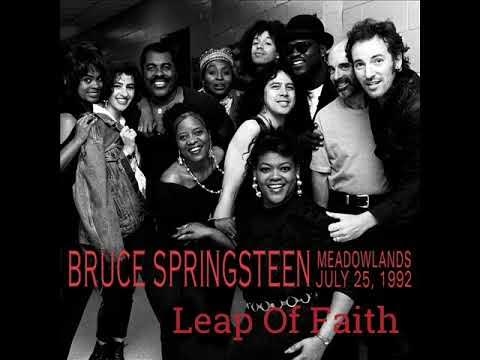
Bruce is in a spiritual frenzy on Leap of Faith which was released on the latter of his double release albums Human Touch / Lucky Town. He goes the extra yard and is in full -gusto as he celebrates entering a new phase of his life. I always agreed with the Rolling Stone‘s review of the double release which argued ‘the aims of the two albums would have been better realized by a single, more carefully shaped collection‘. There at least ten songs from both albums that could have been combined to form one classic Springsteen album to rival his best ever. Lucky Town on its own contains the following 6 songs (from 10) I have included in my Music Library Project; all but today’s song remains:
It would never have occurred to me when I undertook this project (and it seems revelatory to me now based on this 0.6 percentile inclusion of music from this record), that according to my musical appreciation, Lucky Town is a top-tier Bruce release. Also how the magnificent Happy was left off the record is anyone’s guess. And yet still, a lot of Bruce fans loath this era. Springsteen said in the 90’s ‘ I tried to write happy songs & the public just didn’t like it ‘ But I think Lucky Town has aged gracefully! The only other records (for mine) by Bruce which could rival that inclusion rate are:
[Verse 1] All over the world the rain was pourin’ I was scratchin’ where it itched Oh, heartbreak and despair got nothing but boring So I grabbed you, baby, like a wild pitch
[Chorus] It takes a leap of faith to get things going It takes a leap of faith, you gotta show some guts It takes a leap of faith to get things going In your heart, you must trust
[Verse 2] Now your legs were heaven, your breasts were the altar Your body was the holy land You shouted “jump,” but my heart faltered You laughed and said, “Baby, don’t you understand?”
[Bridge] Now you were the Red Sea, I was Moses I kissed you and slipped into a bed of roses The waters parted and love rushed inside I was Jesus’ son, yeah, sanctified
[Verse 3] Tonight the moon’s looking young, but I’m feelin’ younger ‘Neath a veil of dreams, sweet blessings rain Honey, I can feel the first breeze of summer And in your love, I’m born again
The other astounding little known Springsteen fact are that the ten songs on Lucky Town were derivatives of the initial Human Touch project. He shelved the project in early 1991 and came back to it in September of the same year intending to record one more song for the Human Touch album (“Living Proof“), but he ended up with 10 new songs. Once he completed the sessions, he decided to put the 10 new songs on a separate album, which became Lucky Town. Lucky Town peaked at number three on the Billboard 200 and was certified Platinum by the Recording Industry Association of America (RIAA), for over one million copies sold in the US.
I have chosen below the effervescent live MTV plugged version of today’s song Leap of Faith which demonstrates everything that is great about Springsteen, and a Springsteen concert – at least according to those I have spoken to here who have seen him live.
What did Alvvays say about Many Mirrors? That’s a hopeful song about getting through whatever obstacles and rough times together, and coming out of it on the other side, looking at each other, being amazed that we’re still there. It makes me feel good when I think about our band… It surprises me all the time, but here we are. – Molly Rankin, Rolling Stone
I don’t think I’ve heard a song I dislike from this Canadian group Alvvays. I’m a big fan of Alvvays’ instant-classic 2014 debut album, but this 2022 song is also some sweet indiepop. This is the fifth time they have appeared here, but today’s featured song Many Mirrors is the first from their latest album Blue Rev; their first album since Antisocialites in 2017. I find Alvvays music pleasantly infectious and they possess impressive musicianship too; just take a look at their various live performances on KEXP, like the video at the bottom of this post.
[Chorus] Now that we’ve passed through many mirrors I can’t believe we’re still the same Now that we’ve passed through many mirrors I can’t believe we’re still the same
[Refrain] Light years away and you’ve got So much life to offer in you Wild out of the place, you called me Someone figured it out before you Long time flame and you’ve got So much life to offer in you Wild out of the place, you called me
[Chorus] Now that we’ve passed through many mirrors I can’t believe we’re still the same
Rolling Stone described Molly Rankin as one of her generation’s most sparkling lyricists, tracing tender feelings with perfectly understated wit set to bittersweet indie-pop melodies. Underneath the humor and hum of Blue Rev are Rankin’s memories of Cape Breton, where she grew up as part of a celebrated musical family. “The culture there is very unique in that Kerri and I spent the majority of our youth at Celtic square dances with elderly people,” she says. “I don’t know. I guess I do miss Cape Breton a lot.” You can find more information about the Rankin family and Cape Breton at this fascinating post – Music representing the dissonance of loss: Molly Rankin and ‘Archie, Marry Me’
Blue Rev received widespread acclaim from music critics upon its release. At Metacritic, the album received an average score of 86, based on 15 reviews.
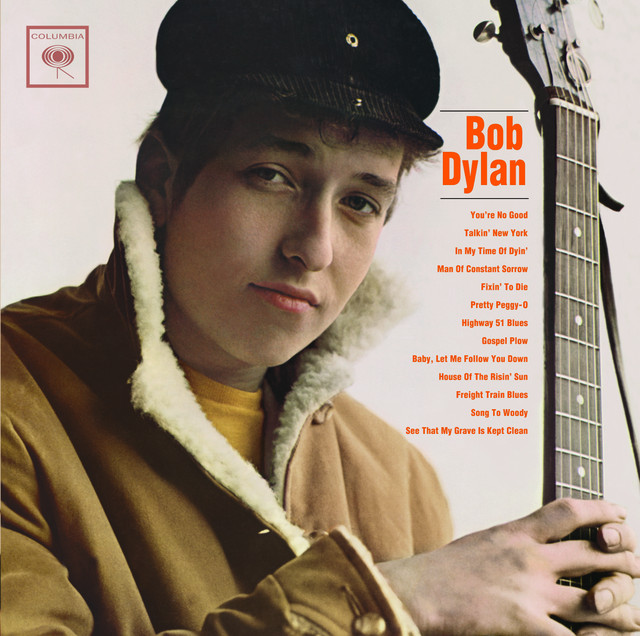
Pretty Peggy-O is the second song presented here from Bob Dylan’s debut record after the previous entry Baby, Let Me Follow You Down. For me Pretty Peggy-O was the surprise packet upon rehearing the record many years later. Understandably the songs like Song to Woody (an ode to his folk hero Woody Guthrie who was a significant influence in his early career) and his rendition of House of the Risin’ Sun may be more widely recognised but today I would like to focus on this lesser known traditional folk song. Pretty Peggy-O is perky and animated and I can’t help but admire Dylan’s brazen, but high-spirited harmonica playing here. There are also some amusing expressions which I get a buzz out of.
Peggy-O is a southern american version arranged for the harmonica of an unattributed Scottish folk song The Bonnie Lass o’ Fyvie. It is about a thwarted romance between a soldier and a girl. He starts off the song with the introduction “I’ve been around this whole country but I never yet found Fennario“, as a playful remark on the fact that the song has been borrowed and cut off its original “setting”. Dylan began playing the song live again in the 90s, using the lyrics and melody of the Grateful Dead version.
I’ve been around this whole country But I never yet found Fennario
Well, as we marched down, as we marched down Well, as we marched down to Fennerio’ Well, our captain fell in love with a lady like a dove The name that she had was pretty Peggy-O
Well, what will your mother say, what will your mother say? What will your mother say, pretty Peggy-O? What will your mother say to know you’re going away? You’re never, never, never coming back-io? (Read the remainder here)
The following is cherry picked from the second Wikipedia reference below:
Bob Dylan’s debut album was produced by John H. Hammond who had earlier signed Dylan to the label, a controversial decision at the time. Dylan met John Hammond at a rehearsal session for Carolyn Hester on September 14, 1961. Hester had invited Dylan to the session as a harmonica player, and Hammond approved him as a session player after hearing him rehearse, with recommendations from his son, musician John P. Hammond, and from Liam Clancy. Hammond later told Robert Shelton that he decided to sign Dylan “on the spot” and invited him to the Columbia offices for a more formal audition recording.
The album was ultimately recorded in three short afternoon sessions on November 20 and 22 at Columbia’s 7th Avenue studio. Hammond later joked that Columbia spent “about $402” to record it, and the figure has entered the Dylan legend as its actual cost. Despite the low cost and short amount of time, Dylan was still difficult to record, according to Hammond. “Bobby popped every p, hissed every s, and habitually wandered off mike,” recalls Hammond. “Even more frustrating, he refused to learn from his mistakes. It occurred to me at the time that I’d never worked with anyone so undisciplined before.” The album did not receive much attention at first, but it achieved some popularity following the growth of Dylan’s career, charting in the UK three years after its release, reaching No.13.
It’s Good Sunday. I have followed Jordan Peterson since the 2017 university fall-out and posted a lot about him. I like this video like I do the previous one from Ben Shapiro. He doesn’t seem like a false prophet nor a ferocious wolf. He’s a decent human whose being struggling with questions like many of us. It’s a good thing.
“I don’t think the world is made out of matter. I think it’s made out of what matters“
It reminds me of the post I wrote about the Vietnamese Buddhist Thich Nhat Hanh.
‘Seeing suffering in another will bring you to compassion as a power to heal you and then the other person. To meditate means to generate that energy of compassion‘.
‘When people create this at the same time we can create a collective mindfulness and compassion. When this goes to your heart, you get the compassion‘.
I’m sorry, but it’s a fact! – that there is such a thing as manners, a way of treating people. These fish have manners. These fish have manners. In fact, they’re coming with me. I’m starting a new company, and the fish will come with me. You can call me sentimental.
Ben Shapiro raised a point in his discussion at 3.20 (below) with Russell Brand about how Christians and Jews act out their faiths. Shapiro even admits before he goes on, that this is his Jewish interpretation. Personally, I feel so attuned with what he said and yet I imagine few people are cognisant of it. I’ll quote parts of Ben’s message below:
What Judaism says, you are a human being with a capacity for great good and great evil….These things a battling in you literally at all times. And what your job is to do, regardless of what you believe, you do the thing. The thing that is front of you is the thing that you do. So, we have these arcane set of rules to reify (?) the presence of God in your life. Even if you don’t recognise that is what it’s doing, by you doing these things over and over you are cultivating virtue through action. So it’s like you reach God by doing the thing.
I think Christianity comes at it from the other way. There’s reward in it and a risk in it. Christianity says you believe the thing, then you do the thing. Judaism says you do the thing therefore you believe the thing…. The access point for Christianity is a lot easier..you experience a transcendent moment and the moment is supposed to animate your life. The danger is transcendent moments disappear real fast…5 minutes from now you are not feeling God. That’s the book of Exodus. They receive the ten commandments and five minutes later they are building a golden cow.
But I think the gap has been sort of closed in the sense Christianity re-ritualised a lot of things. Christians still go to church even if they are not feeling it that day. They are still going to give charity even if they are not feeling it that day…all discipline is this.
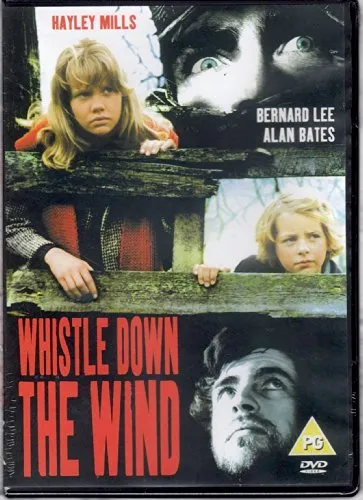
Whistle Down the Wind is an apt movie to present here on Good Friday. It is also my first recalling of a movie which impacted me as a youngster. As someone as curiously engaged as the young actors, I found myself wanting to believe. This movie didn’t seem to have a trounce of adult sensibility impinging it which led Whistle Down the Wind to feeling like a real and enchanting childhood adventure where the stakes couldn’t be higher even for a naive viewer such as myself.
IMDB Storyline: Little Kathy (Hayley Mills) discovers a man wanted for murder hiding in her family’s barn. When she asks him who he is, he says Jesus Christ just before he goes unconscious. Kathy and her siblings are convinced that he is Jesus, and try to hide him from grown-ups.
I remember seeing the magnificent childhood actress Hayley Mills play Pollyanna way back when and it was a terrific film. Whistle Down the Wind also seemed to me to be a great film as it dealt with the deepest questions of my little human existence up to that point, like belief, faith, and the meaning of love. I loved the photography of the bleak Lancashire countryside and the facial expressions of the actors interacting naturally, curious and questioning. In many ways the film is an elegy for a lost part of a former youth where we roamed the lands freely and the nearest telephone was back at your house which could be miles away. You lived in relative material poverty but with strong familial love, and the simple pleasures of life are enjoyed – playing in the open air.
The film has since been broadcast for the general public as seen below. I admit my rewatching of the film as an adult four decades later was a sobering and a detached experience since it didn’t correlate with my fascination of it in my youth. It was a sad realisation in all because I couldn’t recall that allure and mystique in my psyche of the children having found a criminal in their barn. I could only think Kathy, you silly girl.
Young Kathy like I once felt, needed to believe in him, even after the police come to cart him away. He even drops a picture of the Savior, which seems to symbolize not only the prisoner’s fall from grace but one more sign for Kathy that, yes, this mysterious man might be Him. Whistle Down the Wind is a hard-shelled movie that says we lose hope and faith as we mature.
Referring to her induction into the Canadian Music Hall of Fame on the 18th of May, 2023 alongside the likes of Gordon Lightfoot, Joni Mitchell, Neil Young, and Anne Murray, Terri Clark recalled ‘There’s not a lot of country artists in there. The last one was Shania Twain in 2011‘.
Today’s featured track I’m Alright is the final in the trilogy of songs (in fact the first 3 songs on the record) I added to the Music Library Project from Terri Clark’s 1998 record How I Feel. For more information on Terri Clark’s personal history and music backstory I refer you the first two song articles presented here: Now That I Found You and Everytime I Cry and her recent interview at the end of this post. Nostalgic Italian wrote in response to my first song article on Terri Clark:
‘I have loved her stuff for a long time. I had the chance to interview and meet her and she is so down to earth. She’s a fantastic songwriter and singer. Great song.’
I wore out her album How I Feel after I procured it and I still like hearing these songs. Also I found out years later, my brother also remains very fond of it. How I Feel, the third studio album by Terri Clark achieved two top 10 places on the US Billboard Country Charts and was certified platinum in both Canada and the US.
After all was said and done There was nothing left to do The hardest mile I ever walked Was the one I walked away from you So maybe I’m a little ragged around the edges And I’ve been keeping a little more to myself these days but
Chorus I’m alright Shot down but I’m still standing I’m alright A little banged up from the fall But I’m alright Still shaky from the landing I’m alright, after all
You know it’s really not that bad No matter how bad it might feel Cause there ain’t nothing time won’t fix This ain’t nothing that some time won’t heal So maybe I’ve been walking a little wounded I move a little bit slower now but that’s okay cause…
Terri Clark’s albums have accounted for more than twenty singles, including six Number Ones. In 2004, Clark gained one of country music’s crowning achievements when she became a member of the Grand Ole Opry. She was inducted into the Canadian Country Music Hall of Fame in 2018 and as aforementioned a member of the Canadian Music Hall of Fame on May, 18 2023.
At the end of this post you can find a very recent interview (Jul 7, 2023) with Terri Clark. She talked with On the Record about the journey to Nashville, playing on Broadway, and catching her big break after eight years.
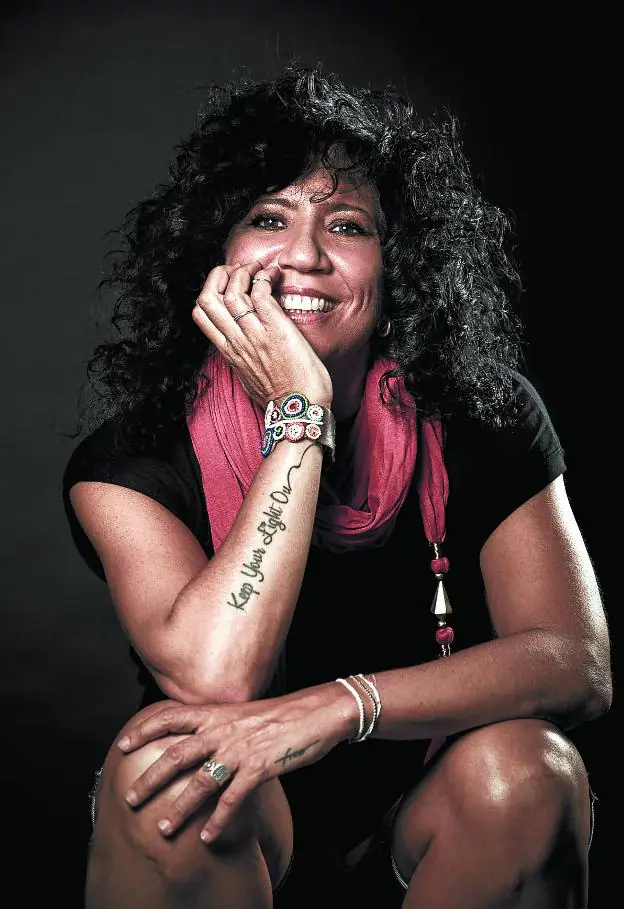
Contigo (With You) was the first song by the Spanish singer songwriter Rosana recommended to me, but it is the third so far presented here after Llegaremos a Tiempo and Pa´ ti no Estoy. It comes from Rosana’s second album Luna Nueva (New Moon) where it is said most the songs emerged from ‘magical nights’. This pop/acoustic genre album is a mature and deep album that maintains the freshness, naturalness and feeling which characterise Rosana. It was recorded in Miami, Spain and Italy. The album entered directly at number 1 in sales in Spain and Latin America, and sold 1,600000 copies.
As you can read from the lyrics below, this song has an alluring essence and great romanticism. Rosana has never abandoned this authentic yet simple style or been corrupted by new trends. Also, what a beautiful voice, so sweet, so tender. Contigo (With You) is a heartfelt song which describes the pure love we all long for and dream of, even if it never comes to us.
A crude English translation follows:
all the salt all the sugar all the wine all my life, I only wish to live it with you all the light all the dark everything I write All the way, I burn with desires to walk it with you
With your love, I feel calm And on the river bank Your heat grabs me and fills me The soul of light and dew With your love I feel like In the five senses And you take me so far, that I barely remember where we come from all the heat all the clouds All the cold All the rain, I burn with desires to get wet with you All the love all the memory Everything I forget All the silence become songs
sleeping with you All the flavor All the perfume Everything I long for All the seas, I only wish Browse them with you Everything without more I also ask for eternity Life or punishment, I only wish to have it with you Life or punishment, I only wish to drink it with you Life or punishment, I only wish to die with you!
Rosana (Rosana Arbelo Gopar) was born in Lanzarote, Canary Islands. She is the youngest in a family of eight siblings. At 5 years old her father gave her her first guitar and at 8 she composed her first song. At age 20 she moved to Madrid where she studied harmony and guitar. At the beginning of 1996 and encouraged by her friends, she decided to sing her own compositions herself and sent a demo to MCA, where she got a record contract. Her natural talent for composing and performing songs made her one of the most successful Spanish music artists of the 90’s.
My good friend Sharon from London is becoming a regular guest here at News on the March. I consider her recent short story publication A Boy And A Horse – A Tale of Magic! one the most enchanting fictional short stories and creative writing feats I have encountered on WordPress. It reminded me so much of my favourite Oscar Wilde short-stories including The Happy Prince and The Selfish Giant. A lot of writers would give up their first-born to write like Sharon did here.
‘Please, please Dad, can we keep him?’ young Frank Campbell pleaded with his father.
Joe Campbell rubbed his chin before speaking, ‘hmm, I don’t know son, he must belong to someone else,’ he replied softly staring at the large brown horse standing docilely at the back gate. ‘He’s a beauty though isn’t he,’ Joe Campbell continued, ‘and huge!’
The horse peered at them through melting brown eyes.
If Joe didn’t know better he would have thought the stallion was also pleading with them to take him in.
‘What do you say Dad?’ Frank piped up again pulling on the hem of his dad’s checked shirt, ‘look at him, he likes us.’
‘I wonder where he came from?’ Joe asked looking the horse over again, ‘there are no farms around here for miles.’
Just then the horse bobbed his head up and down, stepped towards Frank and allowed himself to be petted. Frank rubbed him gently on the neck.
‘You see Dad.’
‘OK, let me talk this over with mum, see what she says.’
Later that evening Joe explained the mystery to Rose Campbell, ‘we dohave a large shed, he could stay there in the meantime. Someone is bound to come looking for him.’
‘This is true,’ Rose Campbell added sagely.
At that very moment Frank ran into the kitchen where his parents were discussing the fate of the horse.
‘Well son,’ Joe announced brightly, ‘he can stay in the shed for now, but you’ll have to look after him when you get back from school.’
‘Thanks Dad, thanks Mum that’s great!’ Frank said excitedly, ‘I’ve named him Eric.’ With that Frank turned and promptly ran through the back door and all but skidded into the shed. He told the horse who neighed delicately as Frank stroked his face.
One week later Frank and Eric were inseparable. The horse would trot alongside Frank on his walk to school, along the winding country lanes and would gallop and clomp from nowhere on Frank’s walk home. Frank would talk about his day with Eric, who proved to be an avid listener, with his tail swishing from side to side.
‘Don’t forget to do your homework,’ Rose Campbell instructed her son some weeks later.
‘I will mum, I’ll do it in the shed with Eric.’
‘OK,’ Rose replied shaking her head from side to side.
Frank petted Eric before sitting down with his maths homework spread out on the hay. Frank was never good at maths, in fact he was hopeless at it. He did some sums and was about the write down the answer when suddenly Eric neighed and clomped his hooves. Eric knew what the horse was trying to tell him and changed his answer.
And so it was that one ten-year-old Frank Campbell got top marks in his class for maths, much to his parents’ delight.
The next day in Geography lesson Frank was sitting at the back of the class struggling to answer the teacher’s question. He thought and thought but could come up with nothing. Just then a brown horse appeared at the window pushing his face close to the glass. ‘Eric!’ Frank mouthed alarmed, before glancing round nervously to check if any of the other kids had seen him. They continued to look at the teacher and had not noticed anything out of the ordinary. And just like that Frank Campbell knew the answer to the question and his small hand shot up with pride.
That afternoon Frank walked home feeling elated about his good results. He looked for Eric but didn’t see him. When he got home he would tell Eric his good news knowing the horse would listen like the best friend he was. Frank was feeling so chuffed he didn’t hear the footfalls behind him.
The first shove almost sent him tumbling to the ground. He steadied himself and was struggling to stand when another hand pushed him and grabbed his rucksack.
‘Poor boy! How comes you are so clever now?’ Danny the class bully asked menacingly. A punch landed on Frank’s shoulder and the tirade continued, helped by two other boys. Frank gulped and did the best he could to defend himself. ‘You never get anything right,’ Danny continued as he quickly looted Frank’s rucksack before flinging it to the ground. ‘And how come your Mum and Dad are so old?’
Frank didn’t know what to do as he toppled to the ground, if only there wasn’t three of them!
And just then he heard a familiar clomp! From out of nowhere a large brown stallion charged dangerously towards the melee. He stopped short of the four boys bearing angry white teeth, and reared up onto his hind legs. Frank looked up and despite himself, grinned.
‘Watch out! It’s some crazy big horse!’ All three bullies screamed before running the fastest they could away from the scene.
Frank Campbell scrambled to his feet and dusted himself down as Eric stood by protectively. ‘Phew, that was close,’ Frank sighed, ‘thanks pal!’
That was the last time Frank was ever beaten up and bullied again.
*
It was the end of July and the school summer holidays had finally arrived. Frank was super excited because he could spend all day with Eric. Frank skipped to the end of the garden with the horse’s favourite red apple in his hand, but when he pushed open the door, the shed was empty. The boy looked everywhere for the horse. He searched and searched until nightfall. And no Eric. He looked for him the following day and the day after that, but there was no trace of him.
‘Maybe he has simply gone back to where he came from,’ Rose Campbell said to her son two weeks later.
‘He wouldn’t do that!’ Frank wailed.
‘Sorry son,’ Joe Campbell said, ‘you never know, he might come back one day.’
And the horse did come back. It was September and Frank Campbell was trudging back home from school when he heard a gentle neighing and a clatter of hooves behind him. He turned around slowly and rushed to the brown stallion, patting him and grinning gleefully.
‘Where have you been?’ Frank cried, ‘I was really sad without you.’
Boy and horse walked companionably for a short while along the winding lane and in that time Frank Campbell understood everything. Eric had gone to help a little girl in Sussex the way he had been helped.
Frank knew his best friend would have to go again. He hugged him and let Eric go slowly. He stood at his back gate and watched as the brown horse simply melted into the distance.
The End
**********
The inner child that is in all of us can always use a little magic!
‘Nancy is a storyteller, music blogger, humorist, quasi poet, curveballer, dreamer‘
I have been a recent follower of Nancy’s wonderful blog. She is clearly a very gifted writer who frequently responds to various writers challenges such as what she did here – meeting two of his prompts: an eight-sentence post based on the word “respect”. Nancy’s ‘About‘ page is a fascinating read, so check that out if you can. The reason I relayed her true account here is because rarely do you read of ‘first-hand’ acts of courage so nervy, brassy and inspirational in the face of abuse towards a minor in a public place.
Not too long ago I brought my car to the dealer for routine maintenance and since it was going to be a quick appointment, I opted to wait in the customer’s lounge rather than go home and come back when the car was ready; apparently, quite a few other people had the same idea because the waiting area was quite full.
Sometimes I’ll find myself engaged in conversation with an interesting person but most times I prefer to wait in quiet, reading my emails or making notes for a story; this particular day, since the waiting area was full, I had no choice but to sit next to a woman and her little boy, approximately 3 years old.
The first thing I noticed about the woman was the hostility and impatience that shot out of her like a machine gun and the primary recipient of her nasty temperament was her little boy; she seemed to take great pleasure in taunting and teasing him and reprimanding him, both verbally and physically.
I was very uncomfortable with her behavior and found it extremely difficult to stay out of the situation but if I expect people to respect my boundaries, I need to show the same respect to them, however, this woman seemed to be inviting someone to say something; obviously no one wanted trouble so everyone kept their eyes averted, heads down and mouths shut, but the atmosphere in the room was tense.
The final straw came when the woman reached into her purse, pulled out a granola bar and began eating while her little boy stood at her knees whining because he wanted something to eat, too; the woman told him that was too bad because he already had his snack and the granola bar was HERS, and, of course, the child threw himself onto the floor and began crying at which point the woman bent over in her seat and slapped the boy several times on the side of his head, causing him to scream out.
That was it for me and while the other people tsk’d and muttered and winced, I turned to the woman and said in a tone as matter-of-factly as if I was asking what time it was, “Please don’t hit your child” to which she yelled “Shut up, bitch, and mind your own fucking business!”, which wasn’t entirely unexpected but I was prepared.
I got up and left the room, fully aware of eyes on me, glaring at me and I could feel their resentment as if I was the wrongful party in this scenario who let that little boy down while they all sat mutely by and allowed the poor child to be mistreated; what’s more, I could feel that horrible woman’s eyes boring a hole in my back, acting the fool and flaunting her victory over a defenseless child.
When I returned a minute later with a policewoman to show her what was going on in front of people who chose to remain silent, the mood in the room immediately shifted and I was suddenly the hero with people actually applauding for me as if this was some kind of performance for their entertainment; I wanted to scream “Live by example, you fucking bastards!”, but I wouldn’t lower myself to their level and couldn’t get out of that room fast enough .… a room reeking of the stench of cowards with no self-respect.
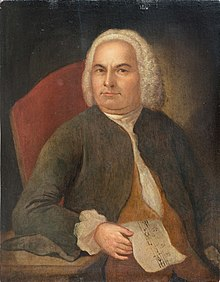
Concerto for Two Violins is the second composition presented here from Johann Sebastian Bach (1685 – 1750) after the previous entry I Call to You, Lord Jesus Christ. The concerto is from the late Baroque era and is caracterizad by a subtle yet expressive relationship between the violins throughout the work. It consists of three movements; the first two, namely Vivace and Largo ma non tanto are presented below. They are beautiful pieces; elegant and emotional. The performance time of the concerto ranges from less than 13 to over 18 minutes. He composed it as part of a concert series he ran as the Director of the Collegium Musicum in Leipzig. Also around 1736–1737 Bach arranged the concerto for two harpsichords, transposed into C minor, BWV 1062.
Bach was a German composer, and his compositions include secular and sacred music. In the 18th century he was valued primarily as an organist. His fifth child and second surviving son Carl Philipp Emanuel Bach performed the concerto in Frankfurt an der Oder after his father’s death in 1750. He inherited some of the original performance parts, likely doubles, of the concerto (surviving: parts for soloists and continuo), and likely also the composer’s autograph score (lost). The extant original parts were added to the Royal Library at Berlin (later converted to the Berlin State Library) in the 1840s. After the Second World War they were lost for several decades, eventually resurfacing in Poland.
Alsation Polymath Albert Schweitzer wrote in the 1911 English-language edition of his book on Bach: The concerto for two violins, in D minor, is perhaps more widely known still. It can be played at home, as its orchestral part can be easily transcribed for the piano. Every amateur should know the wonderful peace of the largo ma non tanto in F major.
Also, German musicologist Peter Wollny, wrote in 1999: “The Concerto for two violins in D minor BWV 1043 is today one of the best-known and most frequently performed works of the composer, above all by virtue of its soulful, song-like middle movement.”






 Observation Blogger