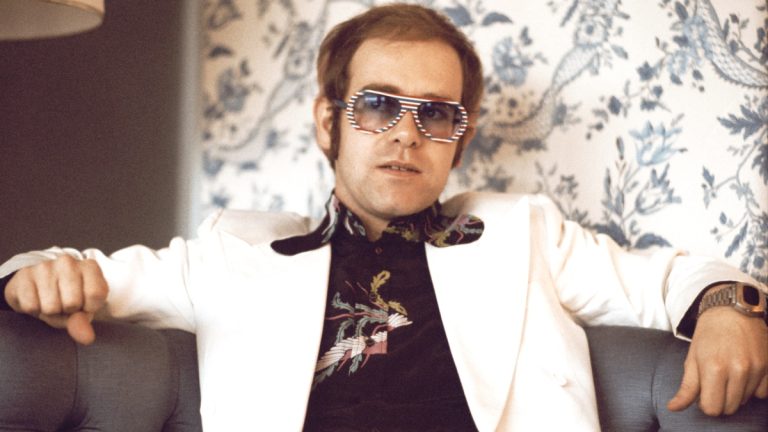
Goodbye Yellow Brick Road is one of the greatest contemporary music records ever made. Funeral for a Friend introduces the record in no uncertain terms and blasts the ears with an organ like synthesizer tune (performed on an ARP synthesizer by Engineer David Hentschel) and it converts into a musical track, no words just a mini-opus. Then at 5:50 Elton starts to sing. Outside of critic and fan-base circles, this introductory record piece is scantily known, but it’s a keeper.
In the documentary, Classic Albums: Goodbye Yellow Brick Road, John said the two songs were not written as one piece, but fit together since “Funeral for a Friend” ends in the key of A, and “Love Lies Bleeding” opens in A, and the two were played as one elongated piece when recorded.
Rolling Stone readers picked this song as number three in a list of “deep cuts” by Elton John, songs that only a true fan would know, even though it has received significant exposure over the years. Interestingly the song had a strong influence on the Guns N’ Roses Use Your Illusion albums and, in particular, the song “November Rain“.
The roses in the window box Have tilted to one side Everything about this house Was born to grow and die
Oh it doesn’t seem a year ago To this very day You said I’m sorry honey If I don’t change the pace I can’t face another day
And love lies bleeding in my hand Oh it kills me to think of you with another man I was playing rock and roll and you were just a fan But my guitar couldn’t hold you So I split the band Love lies bleeding in my hands
Today’s Wednesday literature excerpt continues with Jordan Peterson’s 12 Rules For Life book. For more information about the book and references to Jordan in my blog, you can read the first extract from his book here. In today’s piece Jordan makes a reference to Fyodor Dostoevsky who has also featured prominently here in Wedenesday’s literature excerpt. Dostoevsky is one of Peterson’s most influential literature figures and one of the greatest writers of all time.
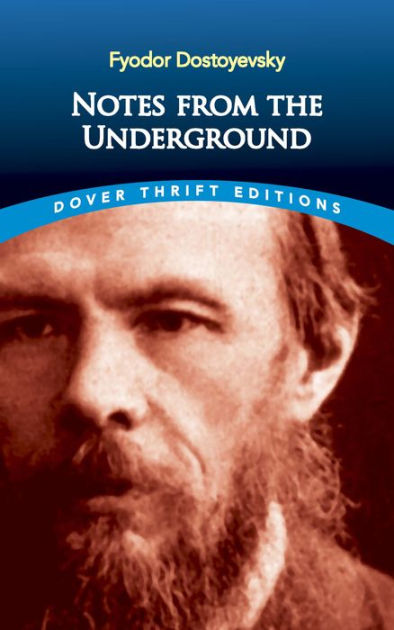
Today’s extract comes from Peterson’s rule No 3 – ‘Make Friends with people who want the best for you‘. In the section below – Rescuing the Damned – he hones in on those individuals who are unreachable and depraved in their attempts to rescue someone because they are fuelled by vanity and narcissism. He associates this with one story in Russian author’s Dostoevsky’s bitter classic, Notes From Underground. I can attest that I have done this all too often in my life, which is Choosing friends so I can rescue them. I was perhaps caught in this highest virtue of the desire to help, but was I truly desiring to help and did they truly desire to be helped? Perhaps it wasn’t a conscious effort on my part, but if I dive deep into the murky waters of my soul and reassess what drove me towards these people and to eventually abandon them, it wasn’t because I was a good person, that’s for certain.
As Peterson wrote in another section in 12 Rules and entirely relevant to the above discussion:
‘You must be receptive to that which you do not want to hear. When you decide to learn about your faults, so that they can rectified, you open a line of communication with the source of all revelatory thought. Maybe that’s the same thing as consulting your conscience. Maybe that’s the same thing, in some manner, as a discussion with God.’
I forewarn you the following excerpt is dark, but I found it one of the most challenging and timely-reads; at least for me. Writings from Dostoevsky and Peterson have forced me to hold a mirror up to my soul and see the shameful results of what truly lurks beneath. Here is one such example:
Excerpt from the Chapter – Rescuing the Damned:
Notes From Underground begins with the famous lines: ‘ I am a sick man…I am a spiteful man. I am an unattractive man. I believe my liver is diseased.’ It is the confession of a miserable, arrogant sojourner in the underworld of chaos and despair. He analyses himself mercilessly, but only pays in the manner for a hundred sins, despite committing a thousand. Then imagining himself redeemed, the underground man commits the worst transgression of the lot. He offers aid to a genuinely unfortunate person. Liza, a woman on the desperate nineteenth- century road to prostitution. He invites her for a visit, promisng to set her life back on the proper course. While waiting for her to appear, his fantasies spin increasingly messianic:
One day passed, however, another and another; she did not come and I began to grow calmer. I felt particularly bold and cheerful after nine o’clock, I even sometimes began dreaming, and rather sweetly: I, for instance, became the salvation of Liza, simply through her coming to me, and my talking to her….I develop her, educate her. I notice that she loves me, loves me passionately. I pretend not to understand (I don’t know however, why I pretend, just for effect, perhaps). At last all the confusion, transfigured, trembling and sobbing, she flings herself at my feet and says that I am her saviour, and that she loves me better than anything in the world.
Nothing but the narcissism of the underground man is nourished by such fantasies. Liza herself is demolished by them. The salvation he offers to her demands far more in the way of commitment and maturity than the underground man is willing or able to offer. He simply does not have the character to see it through – something he quickly realizes, and equally quickly rationalizes. Liza eventually arrives at his shabby apartment, hoping desperately for a way out, staking everything she has on the visit. She tells the underground man that she wants to leave her current life. His response?
‘Why have you come to me, tell me that, please?’ I began, gasping for breath and regardless of logical connection in my words. I longed to have it all out at once, at one burst; I did not even trouble how to begin. ‘Why have you come? Answer, answer,’ I cried, hardly knowing what I was doing. ‘I’ll tell you, my good girl, why you have come. You’ve come because I talked sentimental stuff to you then. So now you are soft as butter and longing for fine sentiments again. So you may as well know that I was laughing at you then. And I am laughing at you now. Why are you shuddering? Yes, I was laughing at you! I had been insulted just before, at dinner, by the fellows who came that evening before me. I came to you, meaning to thrash one of them, an officer; but I didn’t succeed, I didn’t find him; I had to avenge the insult on someone to get back my own again; you turned up, I vented my spleen on you and laughed at you. I had been humiliated, so I wanted to humiliate; I had been treated like a rag, so I wanted to show my power…That’s what it was, and you imagined I had come there on purpose to save you. Yes? You imagined that? You imagined that?’ I knew that she would perhaps be muddled and not take it all in exactly, but I knew too, that she would grasp the gist of it, very well indeed. And so, indeed, she did. She turned white as a handkerchief, tried to say something, and her lips worked painfully; but she sank on a chair as though she had been felled by an axe. And all the time afterwards she listened to me with her lips parted and her eyes wide open, shuddering with awful terror. The cynicism, the cynicism of my words overwhelmed her…
LONDON, ENGLAND – SEPTEMBER 14: David Gray performs on stage at The Roundhouse on September 14, 2009 in London, England. (Photo by Andy Sheppard/Redferns)
Fugitive released in 2009, is the third song to appear here from British singer-songwriter David Gray. I was introduced to his music by a friend on a road trip to Hanging Rock in Victoria, Australia – not long before I came to Colombia. I like the repetitive – stompy piano chords in this, as well as Gray’s usual gritty voice. It is the first single of his eighth album Draw The Line.
Gray stated in an interview that the title and lyrics of the track were inspired by an image he had of Saddam Hussein being pulled out of his spider hole, but he also said the song was “about hiding from life, from yourself. It’s saying don’t forsake it all because there’s something keeping you upright and keeping you walking down the street.”
Is the answer none of the above Crouched in a whole like a mud-streaked fugitive And everyday a different version of Pourin’ it away like a water through a sieve
Hey better realize my friend Love in the end now you can’t take it well Gotta live
This single failed to crack the top 100 in the UK within 2 weeks after its release and only entered the Swiss charts at 84 charting for only one week. Gray recorded the album while unsigned to a record label in his own studio – The Church Studios since he had parted with long time collaborator Craig McClune. Gray told the Irish Times, “It’s the end of one thing and the start of another. Because there was a chapter and it’s ended and now there’s a new one. But also it’s like, ‘don’t cross this line!’ It’s confrontational, which is intentional. That’s how I feel.”
Gray was born in Cheshire, England, but his family moved to Wales where his parents took over a gift shop and started a clothing business.“I had an amazing time growing up there … My imagination could run wild … It was that which gave me the kind of insane self-belief I have, and had even then, that I could do something as unlikely as play music for a living.” After hanging in folk-rock circles in the 1990’s, his first two albums achieved no commercial success. It wasn’t until his release of White Ladder in 2000 that brought him critical and commercial success.
Maajid Nawaz is a former Islamist turned counter-extremism activist, author of multiple books, and public speaker. I had seen Maajid on Sam Harris’ podcast before, but I was struck by his take on the current political-world climate in a recent Rogan podcast. I would recommend watching the entire presentation if you are unfamiliar with Maajid’s personal-history, but his comments about Chinese-Rule (watch from 2:49:00 in video) aligned so closely with my ‘Opinion Piece’ on December 26, 2021 – ‘We are now governed under Chinese-Rule‘ in particular how the World Economic Forum initiative The Great Reset has infiltrated leaders of Government and Multinationals. Below I will forward quote-excerpts from Maajid about this subject:
‘I believe our elite have come under the undue influence of Chinese Intelligence agencies….MI-5 (See BBC article 13th January, 2021) have warned about this…. (Regarding COVID policies) – Michael Singer who has written an extensive book on this tracing step by step..these influence operations; the way the CCP (Chinese Communist Party) have been encouraging a draconian response to COVID and all of the technocracy that will arise in the form of Check-point Charlie society and central banking digital currencies….with the agenda coming from other non-state actors such as the World Economic Forum and their teams penetrating cabinets across the world as Klaus Schwabb said…’
Their are some super interests here that exist above the nation-state working to define the future in a certain direction and that is to make sure that decentralisation doesn’t happen. The mother of centralisation is the CCP. So we at the crossroads; we can work towards decentralisation and people-power, local Governments, community, family and separation of powers or we move in the CCP direction…What we should be worried about is the idealogical country. Idealogies pedal soft-power and they influence minds with their agenda and they influence narratives. We in the West are not attuned with Idealogical warfare. ‘(Watch entire video podcast here)
I don’t have a Netflix account, but my dear friend left her account on my Smart TV. I was browsing a documentary to watch and I came across 14 Peaks: Nothing is Impossible. This is the story of Nepalese mountaineer Nimsdai Purja who embarked on a seemingly impossible quest to summit all 14 of the world’s 8,000-meter peaks in seven months. My kids and I were captivated by the cinematogrpahy, story and characters. I couldn’t recommend it more highly to those inspired by seemingly impossible human feats. Kudos to Netflix who produced Nims story when Hollywood and the big studios never had interest.
Coincidently, Nims was recently interviewed by Joe Rogan on his podcast which I also enjoyed seeing. He served in the British Army with the Brigade of Gurkhas followed by the Special Boat Service (SBS). There are tough cookies in the world, but I have seen few if any, that are as animated, tenacious, fit and resilient as Nims Purja. (Watch trailer here)
I recently saw an interview with Jimmy Carr on The Jordan Peterson podcast called ‘Carr on Comedy‘. I’m afraid to admit I hadn’t heard of this comedian before, so I looked him up and saw his show – Making People Laugh performed in Glasgow. I was impressed to say the least despite having quite picky tastes about comedy. JBP podcast states: Jimmy Carr is an award-winning comedian, author, and TV host. Carr recently came under fire for the career-enders subsection in His Dark Material, a Netflix special that’s deemed “deeply offensive” or “faithful to its title,” depending on who you ask. Carr’s latest book, Before & Laughter, is part memoir, part life advice, and mostly funny. …..(Watch concert video here)
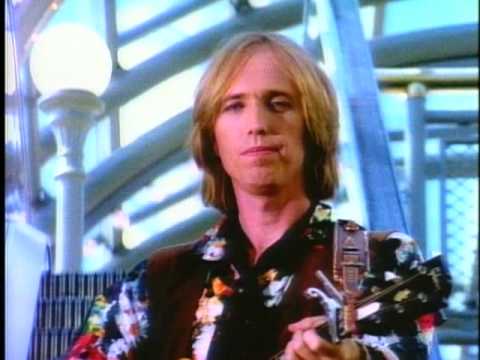
Who can forget when Jerry Maguire thought he’d secured the NFL’s biggest signing and he’s searching a channel with music matching his elation and he stumbles on today’s track by Tom Petty Free Fallin‘. See the scene here. I had heard Free Fallin‘ years before I saw it used in Jerry Maguire, but it’s masterclass how Cameron Crowe (director) fuses music with film.
She’s a good girl, loves her mama Loves Jesus and America, too She’s a good girl, crazy ’bout Elvis Loves horses and her boyfriend, too
And it’s a long day livin’ in Reseda There’s a freeway runnin’ through the yard And I’m a bad boy, ’cause I don’t even miss her I’m a bad boy for breakin’ her heart
And I’m free, free fallin’ Yeah I’m free, free fallin’
I was a fan of Petty since listening to him in the Travelling Wilburys whose music has featured here plenty of times already. I was always impressed how Tom Petty music seems to get somewhere to the core of Americana-rock. There’s probably no better example of that than Free Fallin‘. Jeff Lyne also one of the Wilburys and former E.L.O. leadsinger was Petty’s co-writer for the record Full Moon Fever and backing vocal and played bass guitar.
Free Fallin is one of Petty’s most famous tracks as well as his highest- and longest-charting. Let’s not forget his other great Americana hits – Learning to Fly and I Won’t Back Down.
In a 2006 interview, Petty said he knew he wanted to be in a band the moment he saw the Beatles on The Ed Sullivan Show. “The minute I saw the Beatles on the Ed Sullivan Show—and it’s true of thousands of guys—there was the way out. There was the way to do it. You get your friends and you’re a self-contained unit. And you make the music. And it looked like so much fun. It was something I identified with. I had never been hugely into sports“ In 2017 Petty died of an accidental drug overdose one week after the end of the Heartbreakers’ 40th Anniversary Tour.
Mozart completed the Piano Concerto No. 22 in E-flat major on December 16, 1785 as he was approaching the height of his popularity in Vienna. Almost simultaneously, he had been working on the score to The Marriage of Figaro. This is the second concerto to feature here from Mozart released in the same year. The previous article was Piano No 20 Concerto in D Minor.
Wolfgang Amadeus constantly composed during this successful period in Vienna. Symphonies, songs, sonatas, piano concertos, arias, quintets, quartets, trios and horn concertos. Financially, he was now very well off. He was even able to afford the rent for an apartment in Schulerstrasse, right behind St. Stephen’s Cathedral in Vienna, for 460 guilders per year – more than his father earned in an entire year.
Though opera like The Marriage of Figaro was the most prestigious genre of music, piano concertos formed the bread and butter of Mozart’s career at the time, and his performances of his own works were in high demand. Today’s concerto piece which features prominently in the Film Amadeus is the final stanza (Allegro) of the entire Piano Concerto No 22.
Michael Kelly, an Irish tenor who originated the roles of Basilio and Don Curzio in The Marriage of Figaro, left a vivid description of Mozart’s piano technique from this time: “His feeling, the rapidity of his fingers, the great execution and strength of his left hand particularly, and the apparent inspiration of his modulations, astounded me.”
As far as we know, Mozart likely performed this particular concerto at least three times during his life: twice within a few weeks of its completion and again during a series of subscription concerts the following Lent.
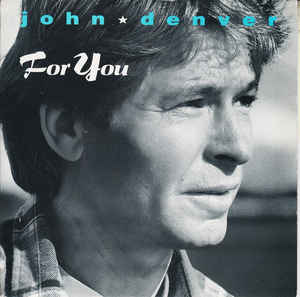
I grew up on John Denver music since my parents owned some of his records and this was one of his later songs I was enamoured with. Denver wrote this for his Australian wife Cassandra Delaney who he met in a bar when he went out with friends. He wrote For You in 1986 and debuted it on his tour that year. The song always got tremendous ovations and there were times John actually stopped singing to let the applause die down.
Just to look in your eyes again Just to lay in your arms Just to be the first one always there for you Just to live in your laughter Just to sing in your heart Just to be everyone of your dreams come true
The song was released on Denver’s 20th studio album Higher Ground. Unlike the rest of the album (done in Colorado), For You was recorded in Sydney. Denver married Delaney in 88, but they divorced in 93 and it wasn’t a pretty time for both parties. Delaney alleged it was due to Denver’s alcoholism and Denver said, “..she managed to make a fool of me from one end of the valley to the other“.
Denver began his music career with folk music groups during the late 1960s.Starting in the 1970s, he was one of the most popular acoustic artists of the decade and one of its best-selling artists. Denver died on October 12, 1997, when his light homebuilt aircraft, crashed into Monterey Bay, California.
Beyond music, Denver’s artistic interests included painting, but because of his limiting schedule he pursued photography, saying once, “photography is a way to communicate a feeling“. Denver was also an avid skier and golfer, but his principal interest was in flying. As usual, the associated wikipediareferences.
I wanted to relay this unforgettable, but hugely educative interview on the Ukraine conflict and Russian history. This interview with Stephen Kotkin is one of the most impressive interviews about relations between the ‘Western World and Russia’ in this fragile time facing Russia’s recent invasion of Ukraine. I guarantee you will be suprised by a lot of what he discusses including Russia’s possible intentions going for the subterreanean oceanic cables to inflict chaos on Western stability. Moreover, this interview is up-there with my favourite political commentaries I have heard since the Howard Years documentary by the Australian Broadcasting Corporation.
I heard Steven Kotkin interviewed before and had always been impressed with his no-nonsense, incisive approach about Russian – West relations especially his pet-project on Stalin. And now he is about to complete his third book in the trilogy about him. Kotkin is a Professor in History and International Affairs at Princeton University, where he is also co-director of the program in history and the practice of diplomacy and the director of the Princeton Institute for International and Regional Studies.
I feel it a pleasure, and in some sense honoured to hear this presentation by Kotkin about more recent events in Ukraine. In a sense, it encapsulates why I studied politics in the first place; to hear and be informed from the best political-historians about today’s most delicate subjects. I hope you enjoy it as well.
This is the second song to appear here and title track from Hillsong’s record For All You’ve Done. You can find more information about the record in the article Evermore which came out Jan 6 this year. This evangelical Christian album album peaked at No1 on the mainstream music charts in Australia and the media were interviewing the Hillsong leaders and lead-singer Darlene Zschech (singer of today’s song) to know what all the fuss was about.
For All You’ve Done is the thirteenth album in the live praise and worship series of contemporary worship music by Hillsong Church. The album was recorded at the Sydney Entertainment Centre with production by Darlene Zschech, Raymond Badham, Joel Houston and Reuben Morgan. The latter singer-songwriter I had the good fortune to meet for dinner at the Mornington Baptist church and operate the Computer powerpoints during his show. More songs will appear from both Hillsong and Reuben Morgan as a solo performer.
My Savior, Redeemer Lifted me from the miry clay Almighty forever I will never be the same ’cause You came near From the everlasting To the world we live The Father’s only Son
You lived and You died You rose again on high You opened the way For the world to live again Hallelujah For all You’ve done
Somehave called it the golden era of Hillsong the early 2000’s with so many beautiful tracks. Someone mentioned in the you tube comments: ‘I don’t get it; where did this style go? Why did it go away? What happened‘? This album For All You’ve Done hasn’t got a mediocre track on it. I can account that these concerts have a strong social atmosphere and a dynamic religious service with upbeat music that emulates a secular music concert.
The Fader web site stated: Hillsong is one of the largest evangelical Christian churches in the world. What began as a small pentecostal church in a suburb of Sydney now holds services on all six habitable continents, with 30 locations and more than 80 affiliated campuses. More than 100,000 people are estimated to attend Hillsong church services every week, including Justin Bieber, Selena Gomez, Nick Jonas, and the Jenner sisters. According to the church, for every person attending in person three more watch online.
This is one of the very few cover versions of a Bob Dylan song which I think superseded the original and I don’t say that lightly. Lou Reed sung this at Bob Dylan’s 30th Anniversary concert in 1993 and I love it. I listen to it frequently unlike the unreleased Dylan version which was an out-take from the ’83 Infidels session and released on the first Bootleg record.
Lou seems to get under this song with a blues riff and a rugged vocal delivery which converts the song into some other beast. The only criticism I have with it, is its hefty duration. Dylan said, that his best songs were always written and dusted off in no time, like Blowing in the Wind, and the longer, wordier tracks he felt weren’t right. The conversation Dylan and Cohen had about this is in a Parisian cafe is priceless. Like today’s song you could say Caribbean Wind is long-winded and the studio out-takes from Shot of Love were reviewed here already.
Lou Reed said about this song: “That’s the song I picked to do at Bobfest (in New York in 1992). I’d been listening to it almost every day for two months. It’s so fucking funny: ‘Did he make it to the top? Well, he probably did and dropped.’ There are so many verses, it was impossible to learn. G.E. Smith, who was playing with me, turned the pages. There is a lot of anger here. It’s not the Three Stooges.”
Like the lion tears the flesh off of a man So can a woman who passes herself off as a male They sang “Danny Boy” at his funeral and the Lord’s Prayer Preacher talking ’bout Christ betrayed It’s like the earth just opened and swallowed him up He reached too high, was thrown back to the ground You know what they say about bein’ nice to the right people on the way up Sooner or later you gonna meet them comin’ down
The 30th Anniversary Bob-fest was a four hour concert and sold out to 18000 lucky basterds. The roster of artists included: Johnny Cash and June Carter Cash, Lou Reed, The Clancy Brothers, Ritchie Havens, Johnny Winter, Roger McGuinn, Tom Petty & the Heartbreakers, Stevie Wonder, Willie Nelson, Kris Kristofferson, Neil Young, Eric Clapton, Ron Wood, Chrissie Hynde, The O’Jays, Eddie Vedder, Sinéad O’Connor, Tracy Chapman, George Harrison.