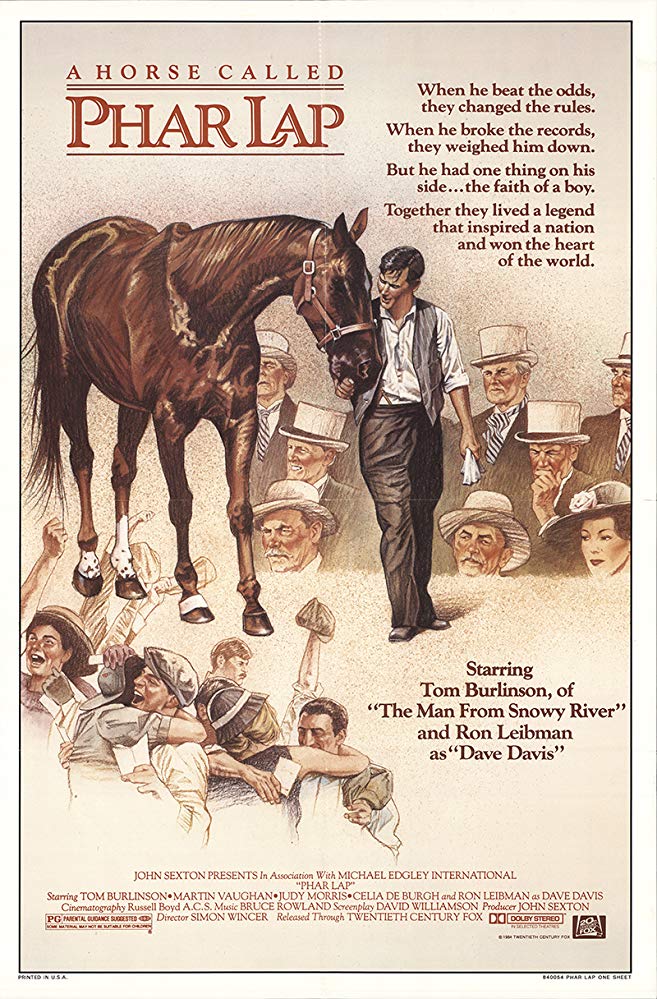
If I was to choose just one Australian movie to take away with me on a Desert Island it would be Phar Lap. It is based on the true story of legendary Australian racehorse Phar lap which I showcased on Friday’s-Finest back in 2019. Phar Lap transports me to a time and place that I never grow tired of revisiting. The sights, smells and sounds of Australia and my youth all come flooding back. Any horse or sports lover should watch and enjoy this movie. The cinematography, production and music in particular is outstanding. It still remains one of the most popular Australian films.
Phar Lap (4 October 1926 – 5 April 1932) was a champion Thoroughbred racehorse whose achievements captured the public’s imagination during the early years of the Great Depression. Foaled in New Zealand, he was trained and raced in Australia by Harry Telford. Phar Lap dominated Australian racing during a distinguished career, winning a Melbourne Cup, two Cox Plates, an AJC Derby, and 19 other weight for age races. He then won the Agua Caliente Handicap in Tijuana, Mexico, in track-record time in his final race despite racing under duress with a injured hoof,and not used to racing on dirt tracks.
The subject of today’s post is the movie soundtrack by Bruce Rowland. The music throughout is fantastic but unfortunately the original music as ‘stand-alone’ pieces do not appear on YT. The best I can do is present these two videos below. The first one: Phar Lap – The Movie : Phar Lap’s last race before he died has disallowed playback from ‘other websites’. The music I wanted to highlight is the culminating minute of the film which starts at 7:19. I would like this as the final elegy at my funeral. The second video is an ensemble of melodies from Phar Lap, but unfortunately it is not the music as it appears in the film.
Bruce Rowland (born 9 May 1942 in Melbourne) is an Australian composer. Rowland received his education at Caulfield Grammar School, Melbourne in his hometown. He learned piano and was a keyboard player for Australian music groups, and singers.
Archie, Marry Me is surely a masterpiece of musical and lyrical dissonance which I tried to analyse in a recent post on mialondonblog:
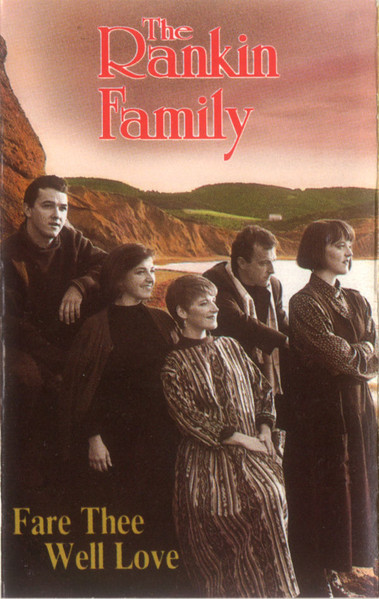
Alvvays was formed in 2011 by the charismatic singer-songwriter and rhythm guitarist Molly Rankin, the daughter of John Morris Rankin, the multi-instrumentalist and musical arranger for The Rankin Family, an influential electric folk band of the 1980s and 90s, which incorporated many of her aunts and uncles. The family’s Celtic cultural heritage derives from Scottish emigres to the rugged island of Cape Breton exposed to the vagaries of the Atlantic gales on Nova Scotia’s eastern flank. Sadly, in 2000 Molly lost her father who was killed when his car left a coastal road in treacherous conditions and crashed into the sea. For me, this backstory has a significant bearing on the song’s form and its emotional impact.
Written at time of uncertainty about her future while her peers were making fairly conventional life choices in their 20’s, Archie has a gloriously bittersweet vibe flagged humorously in its opening two lines which ominously rhyme “matrimony” with “alimony”. This dissonant emotional contrast is among this song’s most appealing features and it is mirrored in the musical dissonance that arrives in the opening eight bars of the second verse with the mournful, pitch bending of Alec O’Hanley’s Fender Jazzmaster accompaniment clashing sonically with the sweetness of the Molly’s soaring vocals. The guitar line makes a gearshift at the mid point of the verse switching back to the cheerful chiming of jangle pop and the contrast creates a joyous lift. I am totally hooked on this song and its two versions on Youtube, a live CBC festival recording and an inventive official music video where the use of Super8 film and thoughtful reflective editing creates visuals that offer a witty complement to the song’s ingenious lyrics. (Read the remainder of this article here)
This profound article at mialondonblog makes mine pale into insignificance. This is the pinnacle of musical appreciation and interpretation.
In this episode, Michael explores the evolutionary backdrop that molded human beings, a setting characterized by scarce food, limited information, and few possessions. He contrasts that with the modern era, marked by abundance and comfort, and the ensuing repercussions on our physical and mental well-being. Michael introduces the concept of the “scarcity loop,” a three-part behavior cycle which helps explain modern challenges such as overeating, addiction, gambling, and materialism, and offers practical strategies to break free from its cycle. The episode culminates in a thought-provoking exploration of happiness, drawing on Michael’s experiences with monks and underscoring the value of boredom, exploration, and discomfort as transformative elements that elevate awareness, presence, and the will to live.
Only two weeks ago I reviewed The Father (2020) starring Anthony Hopkins, then this Critical Drinker recommendation appears in my YT feed.
Normally January is the dumping ground for terrible movies that nobody wants to see, but One Life, starring Anthony Hopkins and Helena Bonham Carter, might be the exception. A gripping and poignant true story about the man who helped rescue hundreds of children from German-occupied Europe, its definitely a recommendation from me.
The Bible can be divided into several categories: the Pentateuch, the historical books, the wisdom books, the major prophets, the minor prophets, the gospels, the acts of the apostles, the epistles, and the apocalypse. Each of these has a distinct purpose and can be enjoyed for different reasons.
Which do you like best, and why? Take this survey, then consider adding your reasons to the comments at the bottom of this blog post!
About: At Joyful Moments in Christ, you will follow one Christian woman as she follows Jesus and journeys to find joy and contentment in her Christian life…Jennifer is the founder of the Joyful Moments in Christ website. She enjoys discussing and thinking about various Bible topics. Her hobbies include swimming, cooking, crocheting, traveling, and writing.
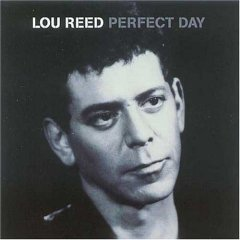
This Lou Reed gem was recommended to me by Blogger friend Tom (ala dylan6111). I had heard Perfect Day in my young adulthood but I let it slip from memory like so many other songs. Thanks mainly to you kind folk, I am often reunited with great music which I add retrospectively to the music library project.
Perfect Day featured on Transformer; Reed’s second post-Velvet Underground solo album and as B-side of his major hit, Walk on the Wild Side. Its fame was given a boost in the 1990s when it was featured in the 1996 film Trainspotting. The original recording, as with the rest of the Transformer album, was produced by David Bowie and Mick Ronson (who also wrote the string arrangement and played piano on the track). The song was written after Reed and his then fiancée (later his first wife), Bettye Kronstad, spent a day in Central Park.
[Verse 1] Just a perfect day, drink Sangria in the park And then later, when it gets dark, we go home Just a perfect day, feed animals in the zoo Then later, a movie too and then home
[Chorus] Oh, it’s such a perfect day I’m glad I spent it with you Oh, such a perfect day You just keep me hanging on You just keep me hanging on
[Verse 2] Just a perfect day, problems all left alone Weekenders on our own, it’s such fun Just a perfect day, you made me forget myself I thought I was someone else, someone good
The dichotomy in interpretation of Perfect Day as explained in the Wikipedia reference below:
The lyric is often considered to suggest simple, conventional romantic devotion, possibly alluding to Reed’s relationship with Kronstad and Reed’s own conflicts with his sexuality, drug use and ego. Some commentators have further seen the lyrical subtext as displaying Reed’s romanticized attitude towards a period of his own addiction to heroin. This popular understanding of the song as an ode to addiction led to its inclusion in the soundtrack for Trainspotting.
The above interpretation, according to Reed himself, is “laughable“. In an interview in 2000, Reed stated, “No. You’re talking to the writer, the person who wrote it. No that’s not true. I don’t object to that, particularly…whatever you think is perfect. But this guy’s vision of a perfect day was the girl, sangria in the park, and then you go home; a perfect day, real simple. I meant just what I said‘.
This song I wrote is about a friend of mine..it’s called Percy’s Song and I took the tune from a song that a folk-singer by the name of Paul Clayton sings called ‘The Wind and the Rain‘
– Bob Dylan at Carnegie Hall, October 26, 1963
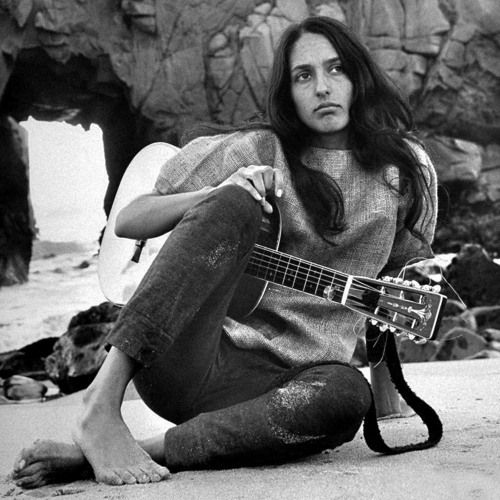
I first heard Joan Baez perform Bob Dylan’s song Percy’s Song in the 1967 documentary of Bob Dylan’s 1965 tour of England – Don’t Look Back. It’s what made the song known to the general public. Just like her sister song on tour – Love is Just a Four-Letter Word, I always preferred Joan’s raw delivery of Percy’s Song on the tour over other versions including Bob’s released (live / outtake) versions. I can’t believe she recorded Love is Just a Four-Letter Word but didn’t record Percy’s Song on one of her albums. It’s so beautiful. It is one of her best renditions from Bob’s song catalogue at least from what I’ve heard. She is casually performing it while Bob types. It really should have been put on an album.
Percy’s Song is a song written by Bob Dylan and recorded during the October 1963 sessions for Dylan’s third album, The Times They Are A-Changin‘, but ultimately not included on that album. Dylan performed the song on stage at his Carnegie Hall concert on October 26, 1963 which you can find at the end of this post. Paul Clayton had played “The Wind and the Rain” to Bob, a variant of “The Twa Sisters“, Child ballad 10.
[Verse 1] Bad news, bad news Come to me where I sleep Turn, turn, turn again Sayin’ one of your friends Is in trouble deep Turn, turn to the rain And the wind Tell me the trouble Tell once to my ear Turn, turn, turn again Joliet prison And ninety-nine years Turn, turn to the rain And the wind
[Verse 2] Oh what’s the charge Of how this came to be Turn, turn, turn again Manslaughter In the highest of degrees Turn, turn to the rain And the wind I sat down and wrote The best words I could write Turn, turn, turn again Explaining to the judge I’d be there on Wednesday night Turn, turn to the rain And the wind
Read the remainder of the lyrics to Percy’s Song here.
Dylan wrote the song from the point of view of a narrating character. The song relates the story of a fatal car crash and a subsequent manslaughter conviction and 99-year sentence in Joliet Prison that is handed down to the driver (a friend of the first-person narrator). The narrator goes to ask the sentencing judge to commute his friend’s sentence which he considers too harsh, but the sentence stands. The story of the hard-hearted judge is reminiscent of the Child ballad Geordie.
For back story about Joan Baez’s relationship with Bob Dylan, I point you to my article about Diamonds and Rust. That song is regarded by a number of critics and fans as one of her best compositions and it is my favourite song by her. Baez was a sensation at the inaugural 1959 Newport Folk Festival; she blew up well before Dylan. Their romance was legendary. Less famously, Baez dated Steve Jobs.
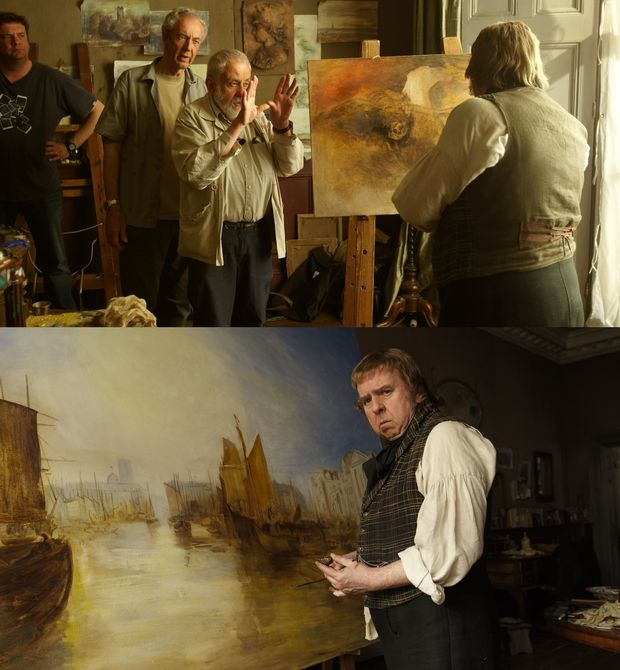
Mr. Turner is the second movie to feature here from English writer / director Mike Leigh (pictured above directing Timothy Spall) after his previous entry Naked (1993). This is another movie I saw recently on the Film & Arts channel. I had seen snippets of it before when channel hopping, but I never had the good fortune for its commencement to coincide with my zapping. Mr. Turner won’t appeal to everyone, that’s for certain. Many will find the painter’s behaviour and mannerisms as peculiar, irritating and perhaps offensive. A large segment of modern ‘need for speed’ audiences could also find this period drama more broadly as dull, perverse and pretentious. This might explain why critics and audiences didn’t see eye to eye on it. The critics gave it 97% approval rating at Rotten Tomatoes and the audience just 56%. I can’t remember having seen more disparate opinions between critics and audience about a movie.
IMDB Storyline: Mr. Turner explores the last quarter century of the great if eccentric British painter J.M.W. Turner (1775-1851). Profoundly affected by the death of his father, loved by a housekeeper he takes for granted and occasionally exploits sexually, he forms a close relationship with a seaside landlady with whom he eventually lives incognito in Chelsea, where he dies. Throughout this, he travels, paints, stays with the country aristocracy, visits brothels, is a popular if anarchic member of the Royal Academy of Arts, has himself strapped to the mast of a ship so that he can paint a snowstorm, and is both celebrated and reviled by the public and by royalty.
I have to side with the critics on this one; which by the way, doesn’t occur nearly as often as it did back when this film was released. I can assure you if Mr. Turner was released today in this ideological possessed and conscientized captured culture it wouldn’t have received such overwhelming positive feedback due to a perceived phallocentristic portrayal of historical events including its depiction of women in many scenes. It doesn’t matter if such goings-ons and riff-raff were common-place back then because today’s ‘woke culture’ would have found it contrarian and in conflict with their ‘pseudo – reality’, moral high-ground and virtue seeking.
There are so many aspects of Mr. Turner that I found delectable to the senses that they are too cumbersome to detail here. But to name but a few: Firstly, it’s attention to detail. Take for example the working replica of Robert Stephenson’s 1830 Planet locomotive from the Manchester Museum Of Science And Industry. It ran on an old railway track in North Wales, which, crucially, ran east-west. They wanted the sun setting behind the train – the conditions Turner had painted and had only one chance to get the shot right, because the train had to be returned the next day. That night there was a glowing sunset. Also consider at the request of Mike Leigh, Timothy Spall spent almost two years learning how to paint in preparation for his role. Secondly, the exquisite performances. Even the small roles seemed big. Every character in Mr. Turner is indeed a compelling, three-dimensional character. Most certainly not a ‘caricature’. No-one puts a foot wrong, (including Leigh regulars Ruth Sheen and Lesley Manville), but one must really single out Dorothy Atkinson as the unfortunate and much maligned Danby and Marion Bailey as Mrs Booth. Both women are superb, giving us characters that are much more than mere historical sketches. There is something deeply moving in their silent acceptance of Turner’s foibles, (and while Leigh’s dialogue is splendidly ‘of the period’, it’s often in the silences that the film is most effective).
The film excerpt I have included below is a compelling scene of Mr. Turner having his photo taken just after the first photographic process had come into being with the image made on a light-sensitive silver-coated metallic plate. It’s interesting to note Turner’s seemingly acquiescent and ambivalent resignation to the future, and the photographer’s naivety. The new overtaking the old.
People Like You is yet another spectacular song from my favourite balladeer Christina Perri. It is a form of art-music in its minimalist and modest approach, but elicits profound emotions which few music artists even with the luxury of employing big studio materials could ever hope to emulate. I sent the lyrics from today’s featured track to a friend whose opinion I regard highly, and I asked them: ‘Who do you think wrote this song‘? They responded – ‘Leonard Cohen‘. No… this 30 something year-old American Christina Perri wrote it.
People Like You is from her third studio album Lighter Shade of Blue which I consider the most enriching album of ballads and transcendental love songs I’ve ever had the privilege to listen to. It encapsulates Christina Perri’s artistry in a way that reflects her journey in life and motherhood and is also a compelling reflection on grief. Lighter Shade of Blue feels more organic than her previous records.
Giving up on the life and career she’d fought so hard to build following the devastating loss of her daughter Rosie in 2020 simply wasn’t an option. “It’s not that I’ve recovered, it’s that I’m recovering and I always will be.…There’s a real honesty to be found in walking through your pain.…’ There’s a freedom in the freefall,” sings Perri.. “Wanna scream, but I whisper.”
Despite feeling crippled by such distressing and debilitating waves of grief, Perri says she purposefully chose to turn away from the dark, and vowed only to look towards the light.
[Verse 1] I wish I could love you like Wish I could love you like I’ll stay I keep makin’ promises I keep makin’ promises I’ll break If I’m bein’ honest Do you want me to be honest? Do you want me to pretend that we’re okay? I wish I could love you like Wish I could love you like I’ll stay
[Chorus] People like me don’t get people like you ‘Cause people like you get hurt People like you don’t get people like me ‘Causе people like mе get worse So I keep you holdin’ on Just in case I got it wrong And I know your perfect heart is gonna break But you love me anyway
[Verse 2] I wish I could love just like Wish I could love just like you do I build walls around my heart The kind of walls you don’t get through Should we turn this ship around Before we both go down? Should we just float here forever in the blue? I wish I could love just like Wish I could love just like you do
“When Rosie passed away I just thought: ‘well, surely I’m going to move away to Hawaii and live in a hut somewhere’ because in that moment of being consumed by such strong feelings of sadness and grief, I didn’t see how I could continue to live the same life I did before – I truly couldn’t imagine the future. It’s like you want everything to go back to how it was before, and to feel at peace, and protected from ever having to experience anything so painful again. But unfortunately, that’s not how life works is it? And so you have somehow figure out a way to move forward and adjust to your new normal.”
Think of Christina’s words above when she brings this immense song home at 2:49 singing:
You love me anyway You love me anyway Love me anyway
Ankidroid additions related to Science, History and Philosophy. More information about Anki can be found in this article.
Gadfly
gadfly \ ˈgad-ˌflī \ noun
A gadfly is an irritating person, a nuisance who will often ask too many questions or lob lots of criticisms in order to get his or her way. See example of the use of gadfly below:
In 399BC., after a lifetime of seeking the truth and educating his countrymen, Socrates faced a trial for crimes against the city – state of Athens, his hometown. He was accused of corrupting the youth of Athens and of impiety and heresy. His accusers provided him with plenty of opportunity to simply leave, and avoid the trouble. But the great sage had already considered and rejected this course of action. rather than present himself as wrongly accused, Socrates declared he fulfilled an important role as gadfly, one who provides an important service to his community…Socrates suggested he be honoured by the city for his contribution to their enlightenment and be paid for his services…The jury was not amused and sentenced him to death by drinking a mixture of poison hemlock. Read further here – The Case of Socrates (Final – 12 Rules For Life) – Jordan B Peterson
Gadfly can also refer to an actual fly. The next time you see a cow swatting at the air with her tail, look closer because she might actually be shooing away an annoying gadfly. This is any kind of fly that likes to pester, and even bite, livestock.
Acquiescence
What percentage of adults do you think could spell acquiescence correctly let alone describe what it means?
Acquiescence is an agreement, usually a willingness to go along with what someone else suggests. “Sure, I don’t mind,” “That sounds like a plan,” and “Good idea” — these are all ways to show your acquiescence.
The word acquiescence, pronounced “ack-we-ESS-sense,” comes from the French word of the same spelling. The first record of its meaning as “silent consent” occurred in the 1640s. Acquiescence, in addition to “agreement,” can also mean “acceptance without protest.” Often when you offer acquiescence, you give in to another person’s plan, perhaps because you are afraid to object or you don’t have a better idea of your own.
Demisexual
A Demisexual is someone that feels sexual attraction to another only once they’ve emotionally bonded (regardless of gender and sexuality).
He’s gotta be a heartbeatin’, fine treatin’ Breathtakin’, earthquakin’ kind
This song is undeniably catchy especially when Shania sings the above lines. Any Man of Mine was a 1995 monster hit for Shania Twain and is considered a country classic by many. In it, she details the qualities she seeks in a man–from his habits to his behaviour around her. This song still receives considerable airplay on country stations nationwide and is spun often at country dance clubs and honky-tonks. Shania even gives instructions on the line dance in the song:
Kick, turn, stomp, stomp, then you jump Heel to toe, do-si-do
Any Man of Mine is the second song to feature here from Shania after her previous entry [If You’re Not in It for Love] I’m Outta Here!. My blog features a bit of 90s country music from Canadian stars Terri Clark and Shania Twain whom broke down national borders and stylistic barriers. I have watched a couple of documentaries on Shania Twain and admired the Canadian’s fortitude and passion despite great personal setbacks at a vulnerable age. You can read more about her plights in my previous post. Can you believe, she is the best-selling female artist in country music history!
[Intro] This is what a woman wants
[Verse 1] Any man of mine better be proud of me Even when I’m ugly, he still better love me And I can be late for a date—that’s fine But he’d better be on time Any man of mine’ll say it fits just right When last year’s dress is just a little too tight And anything I do or say better be okay When I have a bad hair day
[Pre-Chorus] And if I change my mind A million times I wanna hear him say “Yeah, yeah, yeah, yeah, yeah, I like it that way!”
[Chorus] Any man of mine better walk the line Better show me a teasin’, squeezin’, pleasin’, kinda time I need a man who knows how the story goes He’s gotta be a heartbeatin’, fine treatin’ Breathtakin’, earthquakin’ kind Any man of mine
Any Man of Mine was the second single from her 1995 album The Woman in Me and her first No1 hit on country radio topping the charts for 2 weeks. it was nominated for both Best Country Song and Best Female Country Vocal Performance at the 1996 Grammy Awards. It won Single of the Year at both the Canadian Country Music Awards and Country Music Radio Awards in 1995.
“It is a very powerful singalong style song, with heavy syncopated drums – a la We Will Rock You“ – Alan Jones – Music Week
As a music blogger, I’m exposed to a tremendous amount of new music over the course of a year, both from the literally thousands of artists and bands I follow, as well as all the music I learn about from my fellow bloggers. Despite this, I’m fully aware that I’ve heard only a fraction of all the music released in 2023 (I get enough proof of this just by reading other bloggers’ year-end best-of lists, where in some cases I’m not familiar with very many of their song or album picks.) Consequently, my list includes only songs I know, and I’m certain there are likely many great ones that should be included, except that I’ve never heard them. Among the thousands of songs I did hear in 2023, there were many outstanding ones, and it frustrates me to have to cull my favorites down to only 100, omitting quite a few that I really like. It’s also a challenge ranking them, because a song at No.40 isn’t necessarily any better than a song at No.70. Perhaps it’s a pointless exercise to even rank them at all, except for the fact that I love making lists!
I feel grateful to have been a ‘fly on the wall’ during Jeff’s 2023 musical journey. Below are the tracks I like most from his top 10 which I have added to my musical project during the course of the year:
1. Not Strong Enough – boygenius 2. One More Time – blink – 182 3. Tropic Morning News – The National, and 4. Essence – Refeci feat. Shimmer Johnson
I look forward to what 2024 brings us especially with Jeff’s brand of content.
I resolve to get back to writing—to get back to writing like I used to write!
To do that, there are some old writing lessons that I need to relearn. The first problem I’ve encountered is the temptation of info-dumping. I’m sure we’ve all come across books like the book pictured below, especially those of us who read fantasy and science fiction.
As a Sci-Fi writer, I’ve developed a vast and complicated new universe for my fiction. This vast and complicated new universe includes new science, new technology, new political institutions, new economic systems, new environmental hazards, new cultural norms, new fashions of clothes, new styles of art and literature and music—and it really seems like I ought to explain all these new things to my readers before I can expect them to understand what’s going to happen in my story… right?
But I don’t. I have to keep reminding myself that I don’t have to explain everything up front. The Hobbit didn’t explain everything up front. Neither did Dune, and neither did the first Star Wars movie. Next time you watch Star Wars: A New Hope, take note of how long the movie waits to tell you about the Jedi and the Force.
When I first heard Angel Baby at Max’s web site PowerPop I was left stumped. I wondered, ‘where have you been all my life’? I can see why John Lennon adored it so. Listening to this felt like being reacquainted with a lost lover. The fact that Rosie and the Originals didn’t make money from this makes this song even more alluring. It definitely gives Earth Angel a run for its money or even supersedes it. Max truly made my day on November 3, 2023 when he posted about Angel Baby so I’ll turn it over to him:
Rosie Hamlin wrote “Angel Baby,” her and the Originals’ lone hit, when she was just 14, with her first boyfriend and the Penguins’ “Earth Angel” serving as her primary inspiration. After penning the song over a couple hours in the afternoon, Hamlin and some instrument-playing San Diego friends laid down the first version of the track.
They had trouble landing a record deal. No appointments with any of the labels. They eventually found a private studio and recorded the song themselves…all teenagers. After that, they took one of their 45’s to Kresge’s Department Store in San Diego. They had listening booths in their music section where you could preview records before you bought them. Rosie asked the manager to play their record and see if he could sell it in his store.
A distributor from Highland Records heard “Angel Baby” and, without officially signing the group to a record contract, took control of the single’s master take and gave songwriting credit to the Originals’ eldest member. The single eventually found its way to famed DJ Alan Freed, who played “Angel Baby” numerous times a day in November 1960; two months later, the single peaked at Number Five on the Hot 100.