Last Wednesday, I discussed how I came in touch with AnkiDroid and the wonders it has done for bolstering my daily learning of Spanish and English. Today I present just 3 cards that I added to my Anki. It requires a lot for me to add a new expression or word. It depends on who is talking, what they are saying, and how its impacts my psyche. If it’s a word I should already know but haven’t grasped, then I’ll add it, and sometimes revealing expressions/ideas hit me deep and I feel compelled to record them. Below are just 3 I’d like to present for now:
This card came from my reading Oscar Wilde’s The Picture of Dorian Gray which I have written about here. Lord Henry said “I can sympathize with everything,” he remarks at one point, “except suffering.”
I was watching the movie ‘Pay It Forward‘ with Kevin Spacey and he in character as the school teacher said ‘Euphemism’ and I had to look it up.
‘Malinchism‘ was alluded to me by a Soccer Dad from Mexico when our son’s were playing. He explained how some persons become fascinated with other countries but disregard their own and denigrate their heritage. I have seen that here in Colombia, so I wanted to look it up.
I could write a 10 thousand word essay about this song, but I’m a lazy tard. It incorporates Dylan’s Love Minus Zero in the concert version below and I find it captivating. I have written before and I’ll say it again, if you want to hear what Australian culture is like in sound, then just put on the Go-Betweens. They remain one of the most influential bands in Australia despite their mediocre attention in the mainstream. They are a cruelly overlooked band.
The clouds are here They aren’t up in the sky. I cupped them with my hands And reached up high.
I said to these clouds, “No more am I blind. I have to see straight And that will make me unkind”.
In a 1988 NME interview, McLennan said: “I maintain that the Go-Betweens write about love better than anybody else in the world.” The Go-Betweens became something accessible, yet still out of reach. They were praised by the critics, but fans seemed sceptical and the breakthrough didn’t happen.
Clouds showcased that juxtaposition: its uplifting tone is undercut by a deep sadness. Like many Go-betweens songs, it feels like a subtle loss of innocence, being both angry and wise, living under cloudy skies. A love lost, yet so close by.
The version below of Clouds is from one of my favourite concerts: The Go-Betweens Live at the Live at the Tivoli 8/6/05.
The slogan of my blog is the quote from Michel Legrand “The more I live, the more I learn. The more I learn, the more I realize, the less I know.” This presentation seems to align with that sentiment. They discuss what our universal Meaning 3.0 might look like.
Let me explain. If by historical analogy Meaning 1.0 is church and religious faith and Meaning 2.0 is The Enlightenment (separation of church and state) and God is Dead (rational materialism), then what will Meaning 3.0 entail?
The Western World is suffering a crises of meaning or a meaning recession (a hollowed vacuum of meaning). As a result we are seeing extreme fundamentalism, which could be religious fundamentalism or more scientific fundamentalism or it could be made up of radical ideologies and extreme certainties of world-views. If you are not part of this, then that could lead one to Nihilism, where none of this matters. Burn it all down.
As Wheal describes it, (words to the effect) ‘How do we park the long pole back in the tent which can allow the community to whether the storm of Meaning 3.0? Can we create inclusive salvation? A form of Super Altruistic-Humanism to combat extreme tribalism and polarisation between world views’.
He references Gandhi’s ‘Satyagraha (Satya – Truth, Graha – Insistence) and the Stockdale Paradox of maintaining unwavering faith that you can and will prevail in the end, regardless of the difficulties and at the same time have the discipline to confront the the most brutal facts of your current reality whatever they might be. Admiral Stockdale was in a Vietcong prisoner of war camp for 9 years...…(Watch entire podcast)
The simulation hypothesis is mostly associated with Nick Bostrom and his paper Are You Living in a Computer Simulation? Bostrom argues that we likely are living in a simulation and Elon Musk agrees with him. Frankly I think it is unlikely we are living in a simulation in the way Bostrom’s means it, but at any rate, it is impossible to prove or know and, as far as I can tell, would make no practical difference. In the end, if reality is a simulation, then being in a simulation or not being in one becomes for all practical purposes the same. There is a different way from Bostrom’s that we might be living in a simulation. This way could account for the occasional unreality of things most of us sometimes experience. It could account in a deeper way for why Bostrom might have thought about arguing we are living in a simulation. ..….…(Read entire article).
‘Paul Rossi and I discuss the controversy surrounding a recent article Paul wrote. It has become apparent that an anti-racism curriculum is being instituted in schools across the United States and that doesn’t initially sound like anything but a positive change. I had Paul on to share his concerns after working in one of these schools that are implementing new ways of thinking about how our western society is structured. We spoke about many of the flaws that we see with the current direction of teaching’.…(Watch entire podcast)
Philosopher Matthew B. Crawford: Science has Become Corrupted
Video podcast at UnherdFollowing the science’ is a phrase that we have heard a lot of this year, but what does it actually mean? Over the past year, science has shifted from a mode of inquiry to a form of authority that you are not allowed to question in fear of being labelled ‘anti-science’. To understand how and why this has occurred, we spoke to philosopher and writer Matthew B. Crawford, who has a full-length piece in UnHerd on this very subject.. (Watch video podcast)
Closing Time is the second song to feature in the Music Library Project from Cohen’s critically acclaimed The Future album. The other song already discussed was Anthem. What entails the ‘Music Library Project’? The Future was the ninth album written by Canadian singer-songwriter Leonard Cohen and was the longest of his up to that point, almost an hour. The album was recorded with a large cast of musicians and engineers in several different studios; the credits list almost 30 female singers. The album built on the success of Cohen’s previous album, I’m Your Man.
Both the fall of the Berlin Wall and the 1992 Los Angeles riots took place while Cohen was writing and recording the album, which expressed his sense of the world’s turbulence. “I was living in L.A. through the riots and the earthquakes and the floods, and even for one as relentlessly occupied with himself as I am it is very hard to keep your mind on yourself when the place is burning down, so I think that invited me to look out of the window.“
According to Ira Nadel’s 1996 Cohen memoir Various Positions, Closing Time took two years to write with Cohen even starting over from scratch on the song as late as March 1992. Cohen explains that it takes him so long to finish songs because “Nothing works. After a while, if you stick with the song long enough it will yield. But long enough is way beyond any reasonable estimation of what you think long enough may be…’Anthem’ took a decade to write.
Closing Time is certainly an enjoyable listen. On my music appreciation gauge I would consider it a mid-tier Cohen track.
The following information about Closing Time is from SongFacts: It starts off as an euphoric track about a wild party.
The fiddler fiddles something so sublime All the women tear their blouses off And the men they dance on the polka-dots
As the song goes on, the scene evolves from the closing of the bar, to the concluding of a relationship, to the end of life.
I loved you when our love was blessed and I love you now there’s nothing left but sorrow and a sense of overtime And I missed you since the place got wrecked and I just don’t care what happens next Looks like freedom but it feels like death it’s something in between, I guess It’s closing time
Cohen based “Closing Time” on a violin sample that came with a Casio keyboard. “When he first started recording it, the sample was slowed down,” engineer Leanne Unger told Uncut magazine. “It was very moody, with six string bass, very vibey. I loved it.”
She added: “He came in for next weekend and said, ‘It’s all wrong, I’m starting over.’ I was like, ‘Noooooo!’ Devastated. He brought it back in a week later and it was uptempo, jumping, and he had a giant hit with it in Canada. So what do I know?”The song peaked at #70 in Canada. It was Cohen’s second-biggest hit in his native country after “Hallelujah.”
The music video for Closing Time presented below won the Juno Award for Best Music Video in 1993.
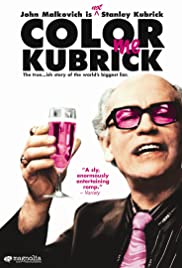
This film is scarcely known and I’m not sure why. It has just 35 reviews on the IMDB website. Geez Louise! I love the exuberance and frivolity of John Malkovich’s performance here. He seems to go all broke in his misinterpretation of the acclaimed, but secluded film director Stanley Kubrick. It’s based on true story of a man who posed as director Stanley Kubrick during the production of Kubrick’s last film, Eyes Wide Shut, despite knowing very little about his work and looking nothing like him.
IMDB Storyline: In London in the 1990s, a balding alcoholic with an unsteady American accent introduces himself in pubs and other social settings as Stanley Kubrick. Drinks and meals are suddenly on the house or paid for by an admiring person, usually a man, whose costumes, band, acting abilities or what have you, Stanley finds fascinating. He’s actually Alan Conway (1934-1998): we watch him parlay a self-confident manner and a small amount of movie knowledge into a persona whom others immediately hang their dreams on. In exchange, Stanley asks only that they pay the bill. Will he be exposed? Do prosecution and prison await? Or has the National Health something else in mind?
The film received a very ordinary reception from critics and public alike, but I like watching it on the odd occasion mainly because of Malkovich’s accentuated acting and how he puts on false accents, not to mention the bizarre situations he finds himself by conning people and milking everything from them to satisfy his sexual and financial needs.
The fact that Malkovich and Kubrick look nothing like each other just adds to the deliciousness of the surreal situation. The manner in which the audience sees how Conway conned his victims was effective and convincing and often very funny. The special London vibe from that period came through strongly.
Mozart’s Clarinet Concerto in A major, K. 622, was written in October 1791 just two months before his death. It was written for his friend – the clarinetist Anton Stadler and consists of three movements, in a fast–slow–fast succession. It is widely considered the first great piece written for that relatively young instrument, invented in the early 18th century. It’s his only concerto for that instrument.
The concerto was published posthumously and contains no autograph. The only relic of this concerto written in Mozart’s hand is an excerpt of an earlier rendition of the concerto written for basset horn in G. This excerpt is nearly identical to the corresponding section in the published version for A clarinet.
Mozart originally intended the piece to be written for basset horn, as Anton Stadler was also a virtuoso basset horn player, but eventually was convinced the piece would be more effective for clarinet. However, several notes throughout the piece go beyond the conventional range of the A clarinet; Mozart may have intended the piece to be played on the basset clarinet, a special clarinet championed by Stadler that had a range down to low (written) C, instead of stopping at (written) E as standard clarinets do.
Stadler played the concerto at its premiere in Prague on October 16, 1791, and his performance was favourably received. Stadler was quite familiar with Mozart’s music, and he had participated in many performances of his friend’s symphonies and operas.
The video presented below is from the Second movement called Adagio and performed by the Royal Philharmonic Orchestra.
On Wednesdays I typically present an extract from classic English literature, but today I venture a different route and a meandering one at that, so I beg your forgiveness for its long-windedness. I was once a freelance writer and wrote about various subjects – books, tourism, movies and even documented 1000 interesting facts about Quinoa! I presented an article here Colombia’s 5 Best Secrets which stemmed from my freelancing days. Also, during this contract phase I was tasked to write an essay about the most effective learning strategies when studying a second language.
If I remember rightly the three principal components I highlighted as integral to learning a second language were as follows:
Establishing Key relationship connections in the second language
Receiving sufficient comprehensible input, and
Immersing oneself into the culture and creating a new identity in the process.
Apart from those generic areas, I presented technological assists aiding in one’s learning. One of these tools reigns supreme in my estimation because it’s the most effective learning strategy I have incorporated into my life regarding my learning of Spanish and most recently English during the Pandemic. Drum-roll please … Ankidroid!
Let me ask you… How many times have you been out and conversing with someone or been snuggled-up on your sofa watching your favourite program or podcast and heard a neat new word, story or new fact and thought to yourself I should remember that? But because your memory is a sieve like mine and had to study twice as hard at school because of it, that it was inevitable it would escape your mental grasp in a matter of seconds. Well that was my experience and always had been until I became adept at utilising the AnkiDroid application to retain it.
I’ll break this down with personal experience so you can ascertain why I am so beholden to it and how you might find some purpose with it as well. When I arrived in Colombia my Spanish was pitiful and I hardly understood anyone, nor could I be understood. It was a shit-show to put it mildly. We did the whole Spanglish thang in the very beginning, but I remained resolute after a few days that I had to learn these new words and expressions like I was a new born and not resort to Gringo egocentrism to get by.
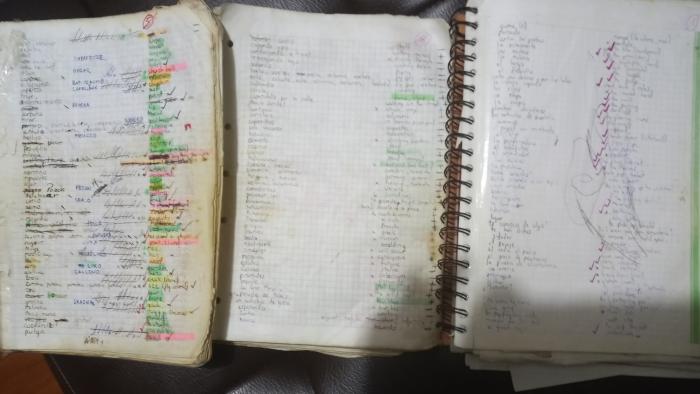
So I maintained journals where I would write new words and expressions that I heard (and their translations in English). Below is the result:
There are some people who possess a high level of linguistic intelligence. I am not one of them. I found it excruciating at times not being able to express myself in the new native language. There are entire populations more accustomed to learning new languages. For instance, Europeans are more proficient than Australians in learning a new language because they are mostly bilingual learners from infancy. So tackling a new language is something they are familiar and have learnt the cues on how to innately understand and adapt.
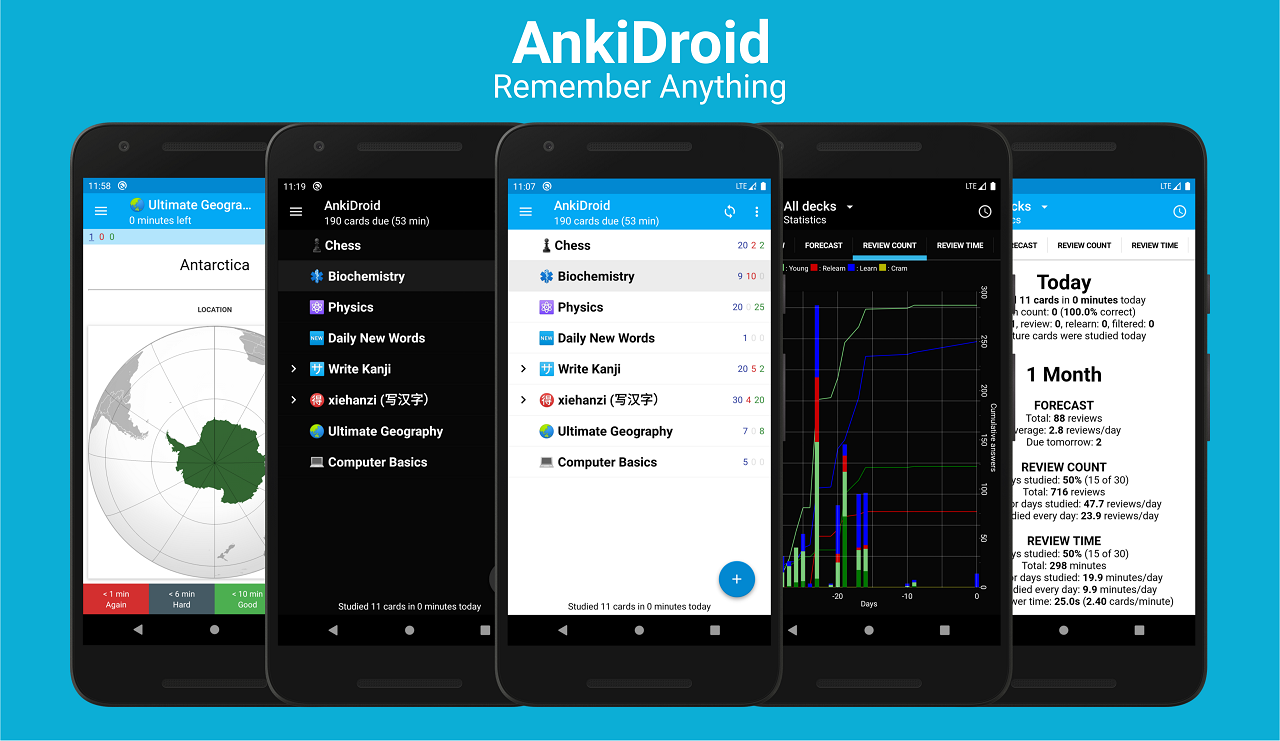
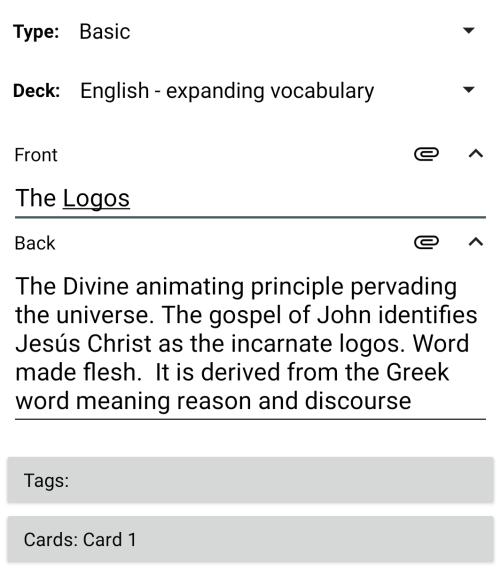
Many years ago, I had the good fortune to stumble across AnkiDroid and I converted those words from my journal to it. This program tests me daily on my memorisation of vocabulary. AnkiDroid sits on my mobile phone and remains the most indispensable learning tool for retaining and expanding my vocabulary in Spanish. I also remember hearing a Sam Harris podcast where he mentioned he had a penchant for looking up new words in a dictionary and remembering them to enhance his command of the English language. I thought I could do the same thing on my AnkiDroid. I have since created a list of new English words or ideas on my Anki that I want to always keep coming back to. Below is one card example from my current list of English:
It is so practical. When I am reading a WhatsApp message or communicating with someone or watch a great podcast and I feel I should always know a new word, expression or fact then I add it in an instant to my AnkiDroid. Then the application tests my memory of it daily until I know it well enough and the time expands to test my recall ability. I’d be lost without it, especially as Colombia suffers another surge in the Pandemic and our lives have basically been confined to our homes. We have been like this since March last year so the daily brain-train of AnkiDroid has been all the more vital.
For further information and in case you might want to use the AnkiDroid I encourage you to sign up to Ankiweb.com and register. This is important because you can synchronise the information from your mobile to the site on line and in effect safeguard everything you add. Thanks for reading.
Civil War is my preferred song from Guns N’ Roses. Sure, I liked Sweet Child of Mine, November Rain, and Knocking on Heaven’s Door when I first heard them, but they get played to death even to this day in Colombia. I don’t enjoy them like I once did. Civil War on the other hand I find has stood the test of time at least for me. Hard-Rock is probably not high up on my list of favored genres in music, but I certainly enjoy this gritty track. There are a lot of associations you can make between its content and the turbulent world we find ourselves in.
I don’t need your civil war It feeds the rich while it buries the poor Your power hungry sellin’ soldiers In a human grocery store Ain’t that fresh I don’t need your civil war Ow, oh no, no, no, no, no
Civil War originally appeared on the 1990 compilation Nobody’s Child: Romanian Angel Appeal and later on the band’s 1991 album, Use Your Illusion II. It’s the brainchild of band members Axl Rose, Slash, and Duff McKagan. Slash stated that the song was originally an instrumental he had written, and later Axl wrote lyrics and it was worked into a proper song at a soundcheck in Melbourne, Australia. Civil War reached number four on the Mainstream Rock chart in Billboard.
*The song samples Strother Martin’s speech in the 1967 movie, Cool Hand Luke: “What we’ve got here is… failure to communicate. Some men you just can’t reach. So you get what we had here last week, which is the way he wants it… well, he gets it. I don’t like it any more than you men.”
*It quotes a speech by a Peruvian Shining Path guerrilla officer saying “We practice selective annihilation of mayors and government officials, for example, to create a vacuum, then we fill that vacuum. As popular war advances, peace is closer”.
*The song also includes the American Civil War song, “When Johnny Comes Marching Home”, whistled by Axl Rose in the intro and outro.
Robert Abbott is a six-time Emmy award winner and the director of “The Last Days of Knight,” the behind-the-scenes documentary of legendary coach Bobby Knight, and the events that led to his termination from Indiana University. In this episode, Robert takes us through his investigative journey, which revealed cautionary tales of a winning at all costs environment—how pain often gets left in the wake of unchecked anger, ego, and perfectionism. Robert reflects on Knight’s legacy and extracts lessons in self-awareness and accountability that can be applied to ensure history doesn’t repeat itself. ..…(Listen to podcast)
As someone who usually takes the scientific view on issues, I’ve occasionally been accused of scientism. And as someone also interested in the philosophy of science, I’m always interested in particular takes about what scientism might be. Midgley’s main beef seemed to be with people who turned science into an ideology. Broadly speaking, I can have some sympathy with that stance, although the devil usually turns out to be in the details. …(Read entire article)
The issues raised here concerning the effect of vaccinations on mass during a Pandemic are real and like others, I commend Brett for courageously giving Geert a platform to discuss and educate us. This discussion contains some of the most important information about the crisis that I have heard. What was discussed is terrifying and worthy of further debate. (Watch video podcast)
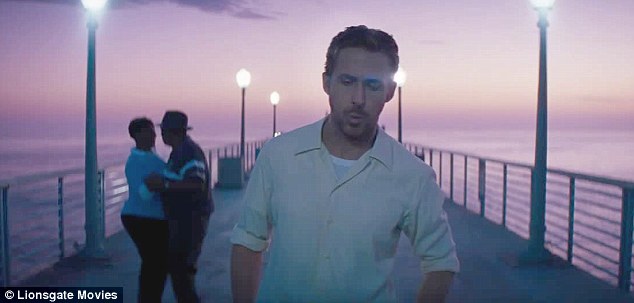
City of Stars is the third song to appear here from my favourite musical La La Land. It won the Academy Award for Best Music (original Song). The music of the song was composed by Justin Hurwitz while the lyrics were provided by Benj Pasek and Justin Paul.
City of stars Are you shining just for me? City of stars There’s so much that I can’t see
Who knows? Is this the start of something wonderful and new? Or one more dream that I cannot make true?
In the film, the song is first sung by Gosling alone as the character of Sebastian as he sings and dances on the Hermosa Beach Pier. (see video below).
Justin Hurwitz described the writing of the song: ‘…I was just composing it from an emotional place and thinking about the tone. I would say the tone is hopeful, but melancholy at the same time. And it kind of goes back-and-forth between cadencing in major and cadencing in minor, because I think that’s kind of what the song is about. You have these great moments and then you have these less great moments in life and in Los Angeles and we see it happen in the story….’
Interestingly, the song Hit Number 1 and 2 on Japan and South Korea’s billboard charts respectively.