Coronavirus & Curb Your Enthusiasm (Random Thoughts on Both)

Curb Your Enthusiasm

COVID-19

I hope this message finds everyone well as we enter ‘Lockdown’ mode. It feels to me like we are living in our very own Science Fiction movie. Certainly we haven’t lived in times comparable to the these. Perhaps psychologically you could draw connections to 9-11, but COVID 19 seems particularly more menacing not just in terms of threats to global health (physical and mental), but because the economy as we know it will be trashed. I just hope anarchy and violence isn’t a consequence of extended quarantining.

Hopefully this virus is just a dress rehearsal and Governments and Organizations can learn to prepare and prioritise (stockpile resources) for such emergencies in the future. The ‘just in time’ minimal Government neo-liberal economies are going to get a big wake up call from this. Despite Bill Gates and other tech guru’s warning about epidemics and virus’ years ago nobody heeded the warning. I know it blindsided me too. Did you see the 4 corners episode on the origin and spread of the virus? Scary stuff, but very informative.
The continual propagation of these viruses from Chinese wet markets cannot continue. How that has been allowed to persist by Chinese authorities is perplexing.

Curb Your Enthusiasm Final Episode 10 (season 10)

Regarding the Curb episode I thought there were some funny moments, but it was fairly weak and predictable finale. Overall, IMHO the story arc this season wasn’t as interesting or as strong as other seasons. There was so much potential given the ‘spite store’, sexual harassment allegations and Larry’s fling with Cheryl. In the beginning of the final episode I was wondering if they were setting up ‘Late Larry’s’ to become a viable, real-life franchise, but I suppose given what occurred that’s not going to happen. I still enjoyed watching it and I’m grateful for that.

One thing’s for certain Marty Funkhouser is a huge loss to the show. Vince Vaughn had just one good line the whole series (you got to break a couple of watches to know how to handle a big cock). Where I think earlier seasons and episodes were more effective is when Larry concentrated on fewer scenarios, but built them up to intertwine and culminate to a fantastic gotcha finale. Here there seemed an over abundance of ideas and places it could go, but didn’t amount to a hill of beans, excuse the pun. Each episode had too many plotlines and the payoff wasn’t always strong.

Overall, I enjoyed the season, but the show was beginning to parody itself and the stakes didn’t really feel authentically high like it did in other seasons. I might be being too critical given how much I found myself chuckling each episode. Larry when it’s all said and done is a comedic genius and his observational humour is nothing but enriching to a society dummed down by formulaic Hollywood storytelling, social media and PC hysterics.

I’ll probably delve into earlier seasons as we enter ‘Lockdown’. I’ve already chosen many movies from my collection to see through this quarantine period. I started last night with Casablanca. ‘Here’s looking at you, kid’.

Tagged with: ,
Posted in Movies and TV, News, Reflections

Both Sides, Now – Joni Mitchell

Joni Mitchell 1966

Joni Mitchell in 1966

The title of Joni Mitchell’s 1966 album ‘Clouds‘ comes from today’s song Both Sides Now. It is one of her most adored tracks and for good reason – it’s simply a classic. ‘The lyrics explore dualities ― “give and take,” “win and lose,” “up and down” ― the anthem has come to mean different things in different contexts. Universality is its appeal, and perhaps its curse: It can be melancholic or hopeful, sticky or sweet, a dreamer’s optimism or a realist’s heartache’.(1)

I’ve looked at clouds from both sides now
From up and down and still somehow
It’s cloud’s illusions I recall
I really don’t know clouds at all…..

I’ve looked at love from both sides now
From give and take and still somehow
It’s love’s illusions that I recall
I really don’t know love
Really don’t know love at all

It’s also been popping up more in popular culture and been covered by a plethora of great artists including Frank Sinatra and Willy Nelson. ‘It has also soundtracked or provided fodder for umpteen films and TV classics, starting long before 2018: two episodes of “The Wonder Years,” “Sesame Street,” “You’ve Got Mail,” “Life as a House,” “Love Actually,” the 2010 Winter Olympics opening ceremony, “Mad Men,” “Steve Jobs,” the 2017 Oscars’ “In Memoriam” segment’. (1)

Joni Mitchell said this about how the song came to be: “I was reading Saul Bellow’s Henderson the Rain King on a plane, and early in the book Henderson the Rain King is also up in a plane,” Mitchell later explained. “He’s on his way to Africa and he looks down and sees these clouds. I put down the book, looked out the window and saw clouds too, and I immediately started writing the song. I had no idea that the song would become as popular as it did.” 

Mitchell herself re-recorded the song, with an orchestral arrangement, on her 2000 album Both Sides Now. In 2004, Rolling Stone ranked “Both Sides Now” at number 170 on its list of The 500 Greatest Songs of All Time. (2)

References:
1. The Agony And Ecstasy Of Joni Mitchell’s ‘Both Sides Now,’ – Huffpost
2. Both Sides, Now – wikipedia

Tagged with: , ,
Posted in Music

3/03 – 9/03 incl. Peter, Paul, Mary Magdalene, Andy Kaufman, Melbourne and Pornography

news on the march

Welcome to Monday’s News on the March – The week that was in my digital world.

Audio interview at Faith Reason:

I have read many of Bart Ehrman’s books and watched many of his debates online. Bart Ehrman is an American New Testament scholar focusing on textual criticism of the New Testament, the historical Jesus, the origins and development of early Christianity. I also studied the Bible at University, so naturally I find these discussions fascinating. I think this audio interview offers a good introduction to anyone unfamiliar with Ehrman. He’s in form here and less condescending than you might find him in other presentations.

Bart Ehrman, author of the highly popular Truth and Fiction in The Da Vinci Code and Lost Christianities, here takes readers on another engaging tour of the early Christian church, illuminating the lives of three of Jesus’ most intriguing followers: Simon Peter, Paul of Tarsus, and Mary Magdalene. ..….… (Listen to entire interview).

Poem by Chris Wallace-Crabbe at the Poetry library:

I lived in Melbourne for many years. It feels more like home to me than Sydney where I was born. Below is the second poem presented on this blog from Chris Wallace-Crabbe about the place I hold such fond memories.

Not on the ocean, on a muted bay
Where the broad rays drift slowly over mud
And flathead loll on sand, a city bloats
Between the plains of water and of loam.
If surf beats, it is faint and far away;
If slogans blow around, we stay at home

And, like the bay, our blood flows easily,
Not warm, not cold (in all things moderate).…Read entire poem

Video at AndyOnLetterman:

I remember watching Jim Carrey’s Golden Globe winning portrayal of Andy Kaufman in Man on the Moon, but I had hardly seen any footage of Kaufman in real person. So this was a pleasant surprise.

Andy appearing on Letterman’s show for the second time. This is the day after his first appearance on the same morning show….(Watch entire video)

Video podcast at Eric Weinstein:

In this episode, Eric sits down with the business woman who created the enduring character of the unlikely top pornstar Riley Reid….Ashley, in the role of the Riley Reid character, has defied all pornographic convention by embracing body positivity, forgoing plastic surgery and opting for natural body hair at times. Additionally she has made a social statement by doing a popular artistic scene which makes a political and business case for greater transsexual acceptance.…(Watch entire podcast)

news on the march the end

Posted in Movies and TV, News, Reading

Born to a Family (2005) – The Go-Betweens

The Go-Betweens

Born to a Family is the B side off the Go-Betweens single Finding You taken from their 9th studio album Oceans Apart (see image above). Finding You peaked at Number 17 on the Australian music charts and will feature later in this music project. Grant McLennan described Born to a Family as a “sort of knees-up, 2/4 kind of jump song.” It has a chanty, jangly chime. I can’t help but think of The Smiths when I hear it.

Born to a family
a family of workers
Born to a family
of honest workers
Then I came along
golden boy who belonged
And changed the system

I first heard Born to a Family from The Go-Betweens Live at the Tivoli concert below. I copied the video link at the time of the song commencement 10:51. I like how the band  sounds on-stage just a little more immediate than in the studio. There are no pretensions on display here, just an honest look at what makes them tick.

Tagged with: , ,
Posted in Music

Match Point (2005) – Woody Allen (Friday’s Finest)

Match Point

Match Point is a Woody Allen film which hardly gets a mention when people recite Woody films off the top of their heads. It’s no wonder since Match Point is a major departure from Woody’s accustomed routes and ‘brand’ such as the romantic comedy genre. Instead Match Point is a slick psychological (Hithcockesque) thriller. It contains many subtle references to Dostoevsky’s Crime and Punishment and for anyone who has been following this blog will know I’m in awe of that book. So naturally a movie which does that has already got me by the short and curlies.

IMDB storyline: From a humble background and with traditional values, Irish Chris Wilton (Jonathan Rhys Meyers) is still struggling financially despite being a recently retired high ranked tennis pro. He has taken a job as a tennis instructor at an upscale London tennis club, although he knows there is a better life for him somewhere down the road. He is befriended by one of his students, wealthy Tom Hewett (Matthew Goode). Chris starts to date Tom’s sister, Chloe Hewett (Emily Mortimer), a girl-next-door type who is immediately attracted to Chris. Chloe quickly knows she wants to marry Chris, and through her businessman father, Alec Hewett (Brian Cox), tries to help Chris and their future by getting him an executive job in Alec’s company. In his life with the Hewetts, Chris begins to enjoy the finer things in life.

Where I think Woody Allen is at his finest in the dramatic realm is when he explores conflicts and tension between social classes. His most intriguing film dealing with ‘classes’ is Blue Jasmine for mine, but Match Point is also highly engaging with respect to the interplay between characters of different classes. Match Point is geared towards  someone trying to conform to a social class that will secure him a better life, where as Blue Jasmine is about the complete opposite; a high society woman who is unwilling to enjoy positive,and meaningful social interactions with people she considers lower down on the social ladder.

Like the protagonist Raskolnikov in Crime and Punishment, Irishman Chris Wilton in Match Point is a very clever and manipulative rationalist. He says in one scene: ‘I think Faith is the path of least resistance.’ He also draws analogies of life being like a game of tennis. When the ball hits the net, it’s only a matter of luck whether it drops on the far side or lands back on your own. As an audience member when I was perplexing over the macabre ending, these words I found came back to haunt me as it might do you.

My own thoughts about Match Point aligns with mstomaso: (It) draws its audience in quietly and slowly at first, defining its territory as a smart, hip, and sophisticated character study early on (in no way unexpected for Mr. Allen), but then it takes an irreversibly sinister turn…. The story line of Match Point is powerful, disturbing, and exceedingly clever. Philosophical folks will likely want to talk about it afterward. Some will find it frustrating and others will find it pretentious. Well, from my perspective, it is simply damn good story-telling.

IMDB Trivia:

  • This is Writer and Director Woody Allen’s favorite movie of his own.
  • Because it was filmed in Britain, Writer and Director Woody Allen had to have a certain percentage of British cast and crew. Apparently, he made his quota before casting Kate Winslet. After she backed out to spend more time with her family, Allen cast American Scarlett Johansson.
  • In a nod to Sir Alfred Hitchcock, a playbill showing Woody Allen’s face in deadpan is briefly seen as Chris Wilton (Jonathan Rhys Meyers) arrives at the Tate museum to meet Nola Rice (Scarlett Johansson).
  • This was Woody Allen’s first movie since Hannah and Her Sisters (1986) to make a profit in the United States.
  • The “Crime and Punishment” elements were also used in Woody Allen’s Crimes and Misdemeanors (1989), which was heavily compared by movie critics with this project at the time of its release.
Tagged with: ,
Posted in Movies and TV

Born in Time (1990) – Bob Dylan

Born in Time 1990

Bob Dylan 1990 Hamburg

Born in Time is the second song to appear here off Dylan’s widely scorned 1990 album Under The Red Sky. If you would like more information about this album you can visit my 2 x 2 song post. Born in Time is by far and away my favourite song from the record. Rarely a week goes by I don’t hear this song. I mentioned in the comments of another Dylan post how I feel like I have been dropped into another time and place where the images are so thick I almost have to brush them away from my face. Born in Time is one such song where I feel like I’ve been dipped in magic waters.

In the lonely night
In the blinking stardust of a pale blue light
You’re comin’ through to me in black and white
When we were made of dreams.

You’re blowing down the shaky street,
You’re hearing my heart beat
In the record breaking heat
Where we were born in time….

Born in Time is a reworking of the original material recorded at the previous year’s Oh Mercy sessions. Two versions of this outtake can be heard on The Bootleg Series Vol. 8: Tell Tale Signs. Clinton Heylin points out there are at least 6 versions around and they were mostly rewritten. Other outtakes from the Oh Mercy sessions, included the sublime Series of Dreams and Dignity, which were eventually left out since Dylan was satisfied with the recorded results.  The producer of Oh Mercy – Daniel Lanois told Chicago Tribune that Series of Dreams was his pick for the opening track, but ultimately, the final decision was Dylan’s.

Eric Clapton covered Born in Time and released it as a single in 1998. Since the original release is unavailable online I have added below a Bob And Eric duet (Edited: the original studio version is below). And note Dylan’s guitar playing holds up pretty damn well compared to Eric’s. It’s of course nice to see such an event as a Dylan aficionado, but this will be another one of many occasions where I wished the original was available especially for those unaccustomed to Dylan.

Additional Reference:

Tagged with: , , ,
Posted in Music

Bolero Falaz (1995) – Aterciopelados

AterciopeladosThis song by Aterciopelados (The Velvet Ones) topped the 1000 most important songs of Colombian rock, but I would class Bolero Falaz more as alternative rock. It’s extremely groovy and bohemian in character and beholds a catchy melody that should titillate the ears of most music enthusiasts. It is said, Bolero Falaz has since the 1990’s represented Colombia in the history of Latin rock. It was the band’s first big hit and soaked the radio waves in México, España, Venezuela, Argentina and Chile. What even makes it more special to me is the band are from my adopted home city – Bogotá.

Wikipedia: Their music fuses rock with a variety of Colombian and Latin American musical traditions. Time magazine wrote that “Aterciopelados’s true skill lies in its ability to take north-of-the-border musical styles…and breathe new life into them, all while giving them a distinctly Colombian sheen.” 

Bolero Falaz is a story of disappointment, but with touches of humor that comes the band’s second studio album, El Dorado, which consecrated the sound of the Bogota people with their mixture of traditional rhythms, national folklore and 90’s rock. This album earned them their first gold record, in 1996. Andrea Echeverri and Héctor Buitrago, the duet who formed Aterciopelados, opened one of Bogotá’s only rock clubs, and their relationship is one of Latin rock’s most successful artistic partnerships. They said that nothing was planned when Bolera Falaz was released. There were no communication or marketing strategies; things were just done in the moment.

Below is a loose English translation of the first segment of the song:

Bolero Falaz (Bolero Fallacious)

And it goes…

You search in my pocket proof of another love
Hairs on the lapel, this smile gives me away
Lipstick on the shirt, my alibi is thrashed
I’m in evidence, cheating has its science

I have it up to here
You’re not my other rib
Nor the eight wonder

Damned if I do, Damned if I don’t, don’t even ask
I’m not me anymore, you’ve got me outside of character

The video below is shot on one of the most emblematic routes of Bogotá, ‘the Caracas’ and is a faithful portrait of Bogota in the 90s.

Tagged with: , , ,
Posted in Music

Boléro (1928) – Maurice Ravel

Maurice Ravel

Boléro is a very famous musical composition composed by Maurice Ravel which premiered in 1928. It was composed as a ballet commissioned by Russian actress and dancer Ida Rubinstein. It is said the Boléro epitimizes Ravel’s preocupation with restyling and reinventing dance movements. It was also one of the last pieces he composed before illness compelled him to retire.

Ida Rubinstein wanted Ravel to write an orchestral transcription from Isaac Albéniz‘s set of piano pieces, Iberia. However Ravel ended up creating an entirely new piece on the musical form and Spanish dance Bolero. He went to the piano and played a melody with one hand and said to his friend, ‘Don’t you think this theme has an insistent quality? I’m going to try and repeat it a number of times without any development, gradually increasing the orchestra as best I can.” 

The composition was a sensational success when it was premiered at the Paris Opéra. Ravel preferred the stage design of an open-air setting with a factory in the background, reflecting the mechanical nature of the music. Ravel presumed that most orchestras would refuse to play it, but much to his surprise it became his most famous composition. It is said that during the premiere performance a woman screamed that Ravel was ‘mad’. When he was told about this he replied that she had understood the performance.

References: Bolero – Wikipedia

Tagged with: ,
Posted in Music

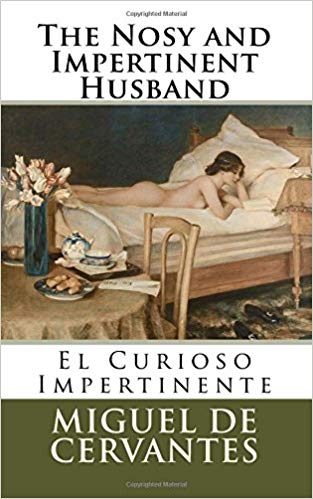
The Story of an Impertinent Curiosity (Part 3 Final) – Don Quixote

The nosy and impertinent Husband

This week in Wednesday’s literature piece we conclude ‘The Story of an Impertinent Curiosity‘ with Part 3 (Chapter XXXV). In Chapter 34 we read how Anselmo received letters from his wife Camilla pleading for him to return. Despite her anguish Anselmo thought it was marvelous news that apparently his plan was working and the seduction of his wife by his best friend Lothario was well underway. He answered his wife that he would return ‘with all speed’. Meanwhile Camilla put her faith in God and through good thoughts would resist all Lothario’s words. Lothario assaulted her with praises of beauty. It is said that ‘he wept, entreated, promised, flattered, persisted and feigned so feelingly’ that he eventually triumphed and Camilla eventually rendered herself.

After Anselmo returned and confronts Lothario and just as before Lothario purports that the words he spoke ‘were spent on the air’ and that Camilla is ‘garland of all good women’. Lothario offers all of Anselmo’s money back since he never had occasion to employ it. Anselmo was more than satisfied with Lothario’s discourse although Lothario and Camilla had continued their affair since his return. Anselmo wants to end the game and asks that Lothario pretend to be in love with a young Florentine woman and to write her sonnets. Lotario tells Camilla in private his verses are meant to praise Camilla alone because ‘she would have fallen into a desperate web of jealousy’ if he had read them meant for another woman.

At this point in the plot we meet Leonela the maid to whom Camilla confesses everything. Camilla admits to Leonela – ‘at having lowered my self-esteem, because I didn’t even make Lothario suffer time before taking complete possession of my will which I so quickly surrendered.’ Leonela supports her mistress telling her that love is mutable and impossible to control adding that ‘someday I’ll tell you everything my lady, for I too am made of the flesh and blood of a girl’. She then lists ‘a complete and entire alphabet’ of praise for Lothario. Leonela informs her that she too is involved in a love affair’ with a well-born young man of the same city. With these mutual confessions the main crises arises. Leonela lets her lover visit her in a room of Anselmo’s house and Camilla feels compelled to facilitate these unions. Lothario sees Leonela’s young lover leaving at the break of dawn not knowing who he was, at first he thought he was a ghost, but when he saw him walk he realised it was a young man. He hit on an impression that the young man must have been another lover of Camilla’s. If that impression had lingered it would have been the end of them all, if Camilla had not remedied the situation. Lothario becomes blind with jealous rage and prepares his revenge, informing Anselmo that Camilla had finally succumbed to his advances and that they had arranged to meet the next time Anselmo was absent. Lothario tells Anselmo to pretend to leave for a few days but to hide behind some tapestries in the room where the lovers meet. Soon thereafter Camila confesses to Lothario the troubles she is having with Leonela. So in turn Lothario confesses that instigated by the furious rages of jealousy he has told Anselmo about them and he begs her for advice on how to ‘safely escape from a twisted labyrinth’.

Camilla and Lothario then create a plan to be rid of Anselmo, once and for all. When Camilla and Lothario meet, Camilla pretends that she does not know that Anselmo is watching. When the time comes for her to kiss Lothario, Camilla states that she would rather die than commit infidelity. Camilla eloquently states “since fortune denies a complete satisfaction to my just desires, it shall not, however, be in its power to defeat that satisfaction entirely.” No one, not a character in the story, not the narrator and not even the reader knows Camilla’s true intentions when she attacks: ‘with incredible strength and agility she lunged at Lothario with the unsheathed dagger, giving such signs of wanting to drive it into his chest that even Lothario was almost in doubt regarding whether these maneuvers were true or false.  Camilla struggles to keep her dagger away from Lothario and ultimately, she stabs herself in the chest and falls to the ground.

Lothario is immediately shocked because Camilla was only to pretend to stab herself, but when he looks closely he sees that Camilla has only wounded herself slightly. Lothario then begins to grieve loudly and with Leonela’s help, he carries Camilla’s body away. Anselmo is now convinced of Camilla’s honesty. He believes that his wife is a veritable ‘simulacrum of chastity’.  Chapter 34 ends ominously.

The relatively short Chapter 35 below concludes this remarkable novel within a novel. Ultimately, the narrative structure combines Don Quixote’s story with Anselmo’s. The “Conclusion of the Novel of the Curious Impertinent” is integrated with Don Quixote’s “battle.” Don Quixote and Anselmo are both tempting fate and looking for trouble. Often, the distance between the story and the story-within is used to create a foil, a character whose contrasts to the main character offer more clarity and distinction to the main character. Here, Anselmo is not a foil for Quixote; he is a parallel, a co-definer. We realize that Quixote is also a “curious impertinent.” Both men become rejected outsiders; Quixote will suffer sadness and confusion just as Anselmo has. Both men adhere to a strict and private ideology. Their ideas are different from the ideas held by their friends. As ideological purists, these men are too stubborn to enjoy positive, meaningful social interactions.

For those who had the patience and nerve to read along, I hope you found ‘The Story of an Impertinent Curiosity’ as compelling and entertaining as I did.

CHAPTER XXXV: Wherein is ended the History of the Curious-Impertinent: And likewise recounted the Rough Encounter and Conflict passed between Don Quixote and certain Bags of Red Wine
A little more of the novel did rest unread, when Sancho Panza, all perplexed, ran out of the chamber where his lord reposed, crying as loud as he could, ‘Come, good sirs, speedily, and assist my lord, who is engaged in one of the most terrible battles that ever mine eyes have seen. I swear that he hath given such a blow to the giant, my lady the Princess Micomicona her enemy, as he hath cut his head quite off as round as a turnip.’

‘What sayst thou, friend?’ quoth the curate (leaving off at that word to prosecute the reading of his novel). ‘Art thou in thy wits, Sancho? What a devil, man, how can that be, seeing the giant dwells at least two thousand leagues from hence?’ By this they heard a marvellous great noise within the chamber, and that Don Quixote cried out aloud, ‘Stay, false thief! robber, stay! for since thou art here, thy scimitar shall but little avail thee.’ And therewithal it seemed that he struck a number of mighty blows on the walls. And Sancho said, ‘There is no need to stand thus listening abroad, but rather that you go in and part the fray, or else assist my lord; although I think it be not very necessary, for the giant is questionless dead by this, and giving account for the ill life he led; for I saw his blood run all about the house, and his head cut off, which is as great as a great wine bag.’ ‘I am content to be hewn in pieces,’ quoth the innkeeper, hearing of this, ‘if Don Quixote or Don devil have not given some blow to one of the wine-bags that stood filled at his bed’s  head, and the shed wine must needs be that which seems blood to this good man.’ And saying so, he entered into the room, and all the rest followed him, where they found Don Quixote in the strangest guise that may be imagined. He was in his shirt, the which was not long enough before to cover his thighs, and it was six fingers shorter behind. His legs were very long and lean, full of hair, and horribly dirty. He wore on his head a little red but very greasy nightcap, which belonged to the innkeeper. He had wreathed on his left arm the coverlet of his bed; on which Sancho looked very often and angrily, as one that knew well the cause of his own malice to it: and in his right hand he gripped his naked sword, wherewithal he laid round about him many a thwack; and withal spake as if he were in battle with some giant. And the best of all was, that he held not his eyes open; for he was indeed asleep, and dreaming that he was in fight with the giant. For the imagination of the adventure which he had undertaken to finish, was so bent upon it, as it made him to dream that he was already arrived at the kingdom of Micomicon, and that he was then in combat with his enemy, and he had given so many blows on the wine-bags, supposing them to be giants, as all the whole chamber flowed with wine. Which being perceived by the host, all inflamed with rage, he set upon Don Quixote with dry fists, and gave unto him so many blows that if Cardenio and the curate had not taken him away, he would doubtlessly have finished the war of the giant; and yet with all this did not the poor knight awake, until the barber brought in a great kettle full of cold water from the well, and threw it all at a clap upon him, and therewithal Don Quixote awaked, but not in such sort as he perceived the manner wherein he was. Dorothea, seeing how short and how thin her champion was arrayed, would not go in to see the conflict of her combatant and his adversary.

Sancho went up and down the floor searching for the giant’s  head, and seeing that he could not find it he said, ‘Now I do see very well that all the things of this house are enchantments, for the last time that I was here, in this very same room, I got many blows and buffets, and knew not who did strike me, nor could I see any body; and now the head appears not, which I saw cut off with mine own eyes, and yet the blood ran as swiftly from the body as water would from a fountain.’ ‘What blood, or what fountain dost thou tattle of here, thou enemy of God and His saints?’ quoth the innkeeper. ‘Thou thief, dost thou not see that the blood and the fountain is no other thing than these wine-bags which are slashed here, and the wine red that swims up and down this chamber? And I wish that I may see his soul swimming in hell which did bore them!’ ‘I know nothing,’ replied Sancho, ‘but this, that if I cannot find the giant’s  head, I shall become so unfortunate, as mine earldom will dissolve like salt cast into water.’ And certes, Sancho awake was in worse case than his master sleeping, so much had his lord’s  promises distracted him. The innkeeper, on the other side, was at his wits’ end, to see the humour of the squire and unhappiness of his lord, and swore that it should not succeed with them now as it had done the other time, when they went away without payment; and that now the privileges of chivalry should not any whit avail him, but he should surely pay both the one and the other— yea, even for the very patches that were to be set on the bored wine-bags.

The curate held fast Don Quixote by the hands, who believing that he had achieved the adventure, and was after it come into the Princess Micomicona her presence, he laid himself on his knees before the curate, saying, ‘Well may your greatness, high and famous lady, live from henceforth secure from any danger that this unfortunate wretch may do unto you; and I am also freed from this day forward from the promise that I made unto you, seeing I have, by the assistance of the heavens, and through her favour by whom I live and breathe, so happily accomplished it.’ ‘Did not I say so?’ quoth Sancho, hearing of his master. ‘Yea, I was not drunk. See if my master hath not powdered the giant by this? The matter is questionless, and the earldom is mine own.’ Who would not laugh at these raving fits of the master and man? All of them laughed save the innkeeper, who gave himself for anger to the devil more than a hundred times. And the barber, Cardenio, and the curate, got Don Quixote to bed again, not without much ado, who presently fell asleep with tokens of marvellous weariness. They left him sleeping, and went out to comfort Sancho Panza for the grief he had, because he could not find the giant’s  head; but yet had more ado to pacify the innkeeper, who was almost out of his wits for the unexpected and sudden death of his wine-bags.

The hostess, on the other side, went up and down whining and saying, ‘In an ill season and an unlucky hour did this knight-errant enter into my house, alas! and I would that mine eyes had never seen him, seeing he costs me so dear. The last time that he was here, he went away scot-free for his supper, bed, straw, and barley, both for himself and his man, his horse and his ass, saying that he was a knight-adventurer (and God give to him ill venture, and to all the other adventurers of the world!) and was not therefore bound to pay anything, for so it was written in the statutes of chivalry. And now for his cause came the other gentleman, and took away my good tail, and hath returned it me back with two quarters of damage; for all the hair is fallen off, and it cannot stand my husband any more in stead for the purpose he had it; and for an end and conclusion of all, to break my wine-bags and shed my wine: I wish I may see as much of his blood shed. And do not think otherwise; for, by my father’s  old bones and the life of my mother, they shall pay me every doit, one quart upon another, or else I will never be called as I am, nor be mine own father’s  daughter.’

These and such like words spake the innkeeper’s  wife with very great fury, and was seconded by her good servant Maritornes. The daughter held her peace, and would now and then smile a little. But master parson did quiet and pacify all, by promising to satisfy them for the damages as well as he might, as well for the wine as for the bags, but chiefly for her tail, the which was so much accounted of and valued so highly. Dorothea did comfort Sancho, saying to him, that whensoever it should be verified that his lord had slain the giant, and established her quietly in her kingdom, she would bestow upon him the best earldom thereof. With this he took courage, and assured the princess that he himself had seen the giant’s  head cut off; and for a more certain token thereof, he said that he had a beard that reached him down to his girdle; and that if the head could not now be found, it was by reason that all the affairs of that house were guided by enchantment, as he had made experience to his cost the last time that he was lodged therein. Dorothea replied that she was of the same opinion, and bade him to be of good cheer, for all would be well ended to his heart’s  desire. All parties being quiet, the curate resolved to finish the end of his novel, because he perceived that there rested but a little unread thereof. Cardenio, Dorothea, and all the rest entreated him earnestly to finish it. And he desiring to delight them all herein and recreate himself, did prosecute the tale in this manner:

‘It after befel that Anselmo grew so satisfied of his wife’s  honesty as he led a most contented and secure life. And Camilla did for the nonce look sourly upon Lothario, to the end Anselmo might construe her mind amiss. And for a greater confirmation thereof, Lothario requested Anselmo to excuse his coming any more to his house, seeing that he clearly perceived how Camilla could neither brook his company nor presence. But the hoodwinked Anselmo answered him that he would in no wise consent thereunto; and in this manner did weave his own dishonour a thousand ways, thinking to work his contentment. In this season, such was the delight that Leonela took also in her affections, as she suffered herself to be borne away by them headlongly, without any care or regard, confident because her lady did cover it, yea, and sometimes instructed her how she might put her desires in practice, without any fear or danger. But finally, Anselmo heard on a night somebody walk in Leonela’s  chamber, and, being desirous to know who it was, as he thought to enter, he felt the door to be held fast against him, which gave him a greater desire to open it; and therefore he struggled so long and used such violence, as he threw open the door, and entered just at the time that another leaped out at the window; and therefore he ran out to overtake him, or see wherein he might know him, but could neither compass the one nor the other, by reason that Leonela, embracing him hardly, withheld him and said, “Pacify yourself, good sir, and be not troubled, nor follow him that was here; for he is one that belongs to me, and that so much, as he is my spouse.” Anselmo would not believe her, but rather, blind with rage, he drew out his poniard and would have wounded her, saying, that she should presently tell him the truth, or else he would kill her. She, distracted with fear, said, without noting her own words, “Kill me not, sir, and I will acquaint you with things which concern you more than you can imagine.” “Say quickly, then,” quoth Anselmo, “or else thou shalt die.” “It will be impossible,” replied Leonela, “for me to speak anything now, I am so affrighted; but give respite till morning, and I will recount unto you things that will marvellously astonish you; and in the meantime rest secure, that he which leaped out of the window is a young man of this city betwixt whom and me hath passed a promise of marriage.” Anselmo was somewhat satisfied by these words, and therefore resolved to expect the term which she had demanded to open her mind; for he did not suspect that he should hear anything of Camilla, by reason he was already so assured of her virtue. And so, departing out of the chamber, and shutting up Leonela therein, threatening her withal that she should never depart thence until she had said all that she promised to reveal unto him, he went presently to Camilla, to tell unto her all that which his maiden had said, and the promise she had passed, to disclose greater and more important things. Whether Camilla, hearing this, were perplexed or no, I leave to the discreet reader’s  judgment; for such was the fear which she conceived, believing certainly (as it was to be doubted) that Leonela would tell to Anselmo all that she knew of her disloyalty, as she had not the courage to expect and see whether her surmise would become false or no. But the very same night, as soon as she perceived Anselmo to be asleep, gathering together her best jewels and some money, she departed out of her house unperceived of any, and went to Lothario’s  lodging, to whom she recounted all that had passed, and requested him either to leave her in some safe place, or both of them to depart to some place where they might live secure out of Anselmo’s  reach. The confusion that Camilla struck into Lothario was such as he knew not what to say, and much less how to resolve himself what he might do. But at last he determined to carry Camilla to a monastery wherein his sister was prioress; to which she easily condescended: and therefore Lothario departed, and left her there with all the speed that the case required, and did also absent himself presently from the city, without acquainting anybody with his departure.

‘Anselmo, as soon as it was day, without heeding the absence of his wife, arose and went to the place where he had shut up Leonela, with desire to know of her what she had promised to acquaint him withal. He opened the chamber door, and entered, but could find nobody therein, but some certain sheets knit together and tied to the window, as a certain sign how Leonela had made an escape by that way. Wherefore he returned very sad to tell to Camilla the adventure; but when he could neither find her at bed nor in the whole house, he remained astonied, and demanded for her of his servants, but none of them could tell him anything. And as he searched for her, he happened to see her coffers lie open and most of her jewels wanting; and herewithal fell into the true account of his disgrace, and that Leonela was not the cause of his misfortune, and so departed out of his house sad and pensive, even as he was, half ready and unapparelled, to his friend Lothario, to recount unto him his disaster: but when he found him to be likewise absented, and that the servants told him how their master was departed the very same night, and had borne away with him all his money, he was ready to run out of his wits. And to conclude, he returned to his own house again, wherein he found no creature, man or woman, for all his folk were departed, and had left the house alone and desert. He knew not what he might think, say, or do; and then his judgment began to fail him. There he did contemplate and behold himself in an instant, without a wife, a friend, and servants; abandoned (to his seeming) of Heaven that covered him, and chiefly without honour; for he clearly noted his own perdition in Camilla’s  crime. In the end he resolved, after he had bethought himself a great while, to go to his friend’s  village, wherein he had been all the while that he afforded the leisure to contrive that disaster. And so, shutting up his house, he mounted a-horseback, and rode away in languishing and doleful wise. And scarce had he ridden the halfway, when he was so fiercely assaulted by his thoughts, as he was constrained to alight, and, tying his horse to a tree, he leaned himself to the trunk thereof, and breathed out a thousand pitiful and dolorous sighs; and there he abode until it was almost night, about which hour he espied a man to come from the city a-horseback by the same way, and, having saluted him, he demanded of him what news he brought from Florence. The citizen replied, “The strangest that had happened there many a day; for it is there reported publicly that Lothario, the great friend of the rich man, hath carried away the said Anselmo’s  wife Camilla this night, for she is also missing: all which a waiting-maid of Camilla’s  hath confessed, whom the governor apprehended yesternight as she slipped down at a window by a pair of sheets out of the said Anselmo’s  house. I know not particularly the truth of the affair, but well I wot that all the city is amazed at the accident; for such a fact would not be as much as surmised from the great and familiar amity of them two, which was so much as they were called, ‘The Two Friends.’” “Is it perhaps yet known,” replied Anselmo, “which way Lothario and Camilla have taken?” “In no wise!” quoth the citizen, “although the governor hath used all possible diligence to find them out.” “Farewell, then, good sir,” said Anselmo. “And with you, sir,” said the traveller. And so departed.

‘With these so unfortunate news poor Anselmo arrived, not only to terms of losing his wits, but also well-nigh of losing his life; and therefore, arising as well as he might, he came to his friend’s  house, who had heard nothing yet of his disgrace; but perceiving him to arrive so wan, pined, and dried up, he presently conjectured that some grievous evil afflicted him. Anselmo requested him presently that he might be carried to his chamber, and provided of paper and ink to write withal. All was done, and he left in bed, and alone, for so he desired them; and also that the door should be fast locked. And being alone, the imagination of his misfortune gave him such a terrible charge, as he clearly perceived that his life would shortly fail him, and therefore resolved to leave notice of the cause of his sudden and unexpected death; and therefore he began to write it; but before he could set an end to his discourse, his breath failed, and he yielded up his life into the hands of sorrow, which his impertinent curiosity had stirred up in him. The gentleman of the house, seeing that it grew late, and that Anselmo had not called, determined to enter, and know whether his indisposition passed forward, and he found him lying on his face, with half of his body in the bed, and the other half leaning on the table whereon he lay, with a written paper unfolded, and held the pen also yet in his hand. His host drew near unto him and, first of all, having called him, he took him by the hand; and seeing that he answered not, and that it was cold, he knew that he was dead; and greatly perplexed and grieved thereat, he called in his people, that they might also be witnesses of the disastrous success of Anselmo; and after all, he took the paper and read it, which he knew to be written with his own hand, the substance whereof was this:

‘“A foolish and impertinent desire hath despoiled me of life. If the news of my death shall arrive to Camilla, let her also know that I do pardon her, for she was not bound to work miracles; nor had I any need to desire that she should work them. And seeing I was the builder and contriver of mine own dishonour, there is no reason”—

‘Hitherunto did Anselmo write, by which it appeared that his life ended in that point, ere he could set an end to the reason he was to give. The next day ensuing, the gentleman his friend acquainted Anselmo’s  kinsfolk with his death; the which had already knowledge of his misfortune, and also of the monastery wherein Camilla had retired herself, being almost in terms to accompany her husband in that forcible voyage; nor for the news of his death, but for grief of others which she had received of her absent friend. It is said that although she was a widow, yet would she neither depart out of the monastery, nor become a religious woman, until she had received within a few days after news how Lothario was slain in a battle given by Monsieur de Lautrec, to the great Captain Gonzalo Fernandez of Cordova, in the kingdom of Naples; and that was the end of the late repentant friend, the which being known to Camilla, she made a profession, and shortly after deceased between the rigorous hands of sorrow and melancholy: and this was the end of them all, sprung from a rash and inconsiderate beginning.’

‘This novel,’ quoth the curate, having read it, ‘is a pretty one; but yet I cannot persuade myself that it is true, and if it be a fiction, the author erred therein; for it cannot be imagined that any husband would be so foolish as to make so costly an experience as did Anselmo; but if this accident had been devised betwixt a gentleman and his love, then were it possible; but being between man and wife, it contains somewhat that is impossible and unlikely, but yet I can take no exception against the manner of recounting thereof.’


Tagged with: , ,
Posted in Reading

Blue Eyes (1982) – Elton John

Elton John 1982

It’s strange this is the first song to appear in the Music Library Project by Elton John considering how many of his songs will feature here in the Music Library Project.
I listened to Elton more than any other music artist before I reached the age around 13. To say his early records did the rounds on our family turntable would be an understatement. All of my family adored his music.

Come to think of it he seemed the biggest superstar I can remember when I was growing up. One of my biggest regrets as far as my musical longings go is not seeing him in concert. I’m sad to read about him recently cutting short a New Zealand concert after falling ill with walking pneumonia. I have a lot more to say about Elton from a personal perspective, but I’ll leave that for other Elton music posts. I did write a review here of the recent bio-pic film Rocketman which I was pleasantly surprised by.

Now onto today’s track Blue Eyes. I doubt most of my readers will not be familiar with this tune. Elton John has always had a strong affiliation with Australia and that will be the subject for another time, but it’s interesting to note here that the video below for the song was filmed in Australia, on Sydney’s famous Bondi to Bronte walk. You know you have made it when you can put your white grand piano right in the middle of a turret overlooking the Tasman Sea!

It was a huge hit and spent 2 weeks at Number 1. According to wikipedia the song and video was in dedication to Elizabeth Taylor. When it pops onto my player I always love hearing it. It’s just a simple beautiful song although wiki claims harmonically, the song is complex, with the verses in the key of B flat, and the chorus in the key of D minor.

Not only have I included the original video below but also the sublime solo performance on Michael Parkinson’s show.

Tagged with: ,
Posted in Music

Follow Blog via Email

Enter your email address to follow this blog and receive notifications of new posts by email.

Join 779 other subscribers

← Back

Thank you for your response. ✨