Theme from Harry’s Game (1982) – Clannad

The enormity of the ‘Harry’s Game’ moment was not lost on Moya, who told The Guardian: 
“It was unreal for a small Irish folk band from Donegal. I was the first female Irish folk singer to break abroad. People started calling me the First Lady of Celtic Music, a title I’m really proud of.”

– Máire (Moya) Brennan

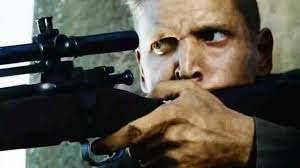
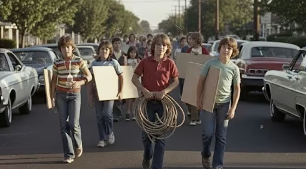
Upon reflection of yesterday’s senseless and cowardly assassination of freedom activist and conservative Charlie Kirk, the hauntingly beautiful Theme from Harry’s Game by the Irish folk group Clannad feels all the more timely. The vocalist Máire (Moya) Brennan told The Guardian: “The Irish Gaelic lyrics, derived from a saying in a book of old Irish proverbs that our grandfather had given Ciarán: ‘Everything that is and will be, will cease to be. The moon and the stars, youth and beauty’. There’s no solution to war, just people killing each other”. Ever since I first heard the theme in this scene from the 1992 movie Patriot Games adapted from the Tom Clancy book, it foraged its way somewhere deep-down.

It was commissioned as the theme for Harry’s Game, a Yorkshire Television miniseries adapted from a 1975 novel set in the Troubles in Northern Ireland. The song catapulted Clannad to international superstardom, with a Grammy and a Billboard Music Award to follow. Peaking at No.2 in Ireland and No.5 in the UK, it remains the only hit single in the UK ever to be sung entirely in the Irish language. The sound would become Clannad’s signature, and they would go onto to sell 20 million albums.
You may have heard of the famous Irish new-age Celtic singer Enya, well she began her music career (as the younger sister) with her family band Clannad, but left in 1982 with their manager and producer Nicky Ryan to pursue a solo career.

The influence of Gregorian chant was an important strand in the musical mix. The lyrics laced the verse of a Connacht Irish Proverb with a chorus of ancient mouth music, conjuring the wilds of Ireland. The hymn-like song famously took just hours to write, but the sound had been years in the making. Brennan said “We wrote it in a couple of hours and thought, great, it’s a nice tune and everything,” she added, “but we didn’t realise the sound we created had developed over the six albums before, with all the experimentation we did with words and voices and harmonies.”

She compared the chorus to an aural fiddle: “Fol de liddle, taddle do, diddley idle oh.” Nonsense sounds like these are often inserted into Irish folk songs, as a free-form play or an expression of verbal dexterity.

The translation below from Irish Gaelic to English was made by retired editor Tom Thomson and his interpretation is below that.

East and west will go away
As has happened before
The moon and the sun

Fol lol the doh fol the day
Fol the day fol the day

The moon and the sun will go away,
The young people, and later their fame

Fol lol the doh fol the day
Fol the day fol the day

Fol lol the doh fol the day
Fol the day fol the day

A going away that has happened before,
The young man and later his fame

Fol lol the doh fol the day
Fol the doh fol the day

Author’s comments:

Rather sad and pessimistic and absolutely true – the civil war, the troubles, the current unwillingness of politicians in the North to even try to work all go together to suggest that it will indeed all happen again and be forgotten and then happen again.

References:
1. Theme from Harry’s Game – Wikipedia
2. Theme From Harry’s Game – Great Irish Songbook

Tagged with: ,
Posted in Music

It Must Be Him (1967) – Vikki Carr

When I was a teenager, Moonstruck was one of my family’s favourite movies. We watched it together so often. The film borders on art-house because it’s steeped in cultural content and a style distinct from that seen in mainstream film. It’s quirky and certainly brash in terms of performance delivery and writing and the music therein is a spectacular reflection of its capriciousness. I purchased the soundtrack on cassette and listened to it to death. That’s where I relished in today’s featured song —It Must Be Him by Vikki Carr. Her impeccable singing on The Ed Sullivan Show, featured at the end of this post, is one for the ages. Pure class. As someone in the comments noted: “Singing live and totally on key…a lost art!”

It Must Be Him was originally a French song called Seul Sur Son Étoile and then the English version recorded by Vikki Carr, with lyrics by Mack David, was a hit around the world, reaching No. 3 in the United States, No. 2 in the UK, and No. 1 in Australia. The singer describes anxiously waiting by her telephone, desperately hoping that her former boyfriend will call, although they had separated. Carr went on to record it in Spanish and Italian, as well.

Vikki Carr (born Florencia Bisenta de Casillas-Martinez Cardona in 1941, El Paso, Texas) is an American singer whose soaring vocals and emotional intensity made her one of the most distinctive pop balladeers of the 1960s and 70s. Her breakthrough came with “It Must Be Him”. Its success catapulted her into international fame, particularly in the U.S. and the U.K., and it remains the defining song of her career, emblematic of her flair for passionate, theatrical delivery.

[Verse 1]
I tell myself, “What’s done is done”
I tell myself, “Don’t be a fool”
Play the field, have a lot of fun
It’s easy when you play it cool
I tell myself, “Don’t be a chump
Who cares? Let him stay away”
That’s when the phone rings and I jump
And as I grab the phone I pray

[Chorus]
Let it please be him, oh, dear God
It must be him, it must be him
Or I shall die, or I shall die
Oh, hello, hello, my dear God
It must be him, but it’s not him
And then I die, that’s when I die

[Verse 2]
After a while, I’m myself again
I pick the pieces off the floor
Put my heart on the shelf again
You’ll never hurt me anymore
I’m not a puppet on a string
I’ll find somebody else someday
That’s when the phone rings
And once again, I start to pray

[Chorus]

[Outro]
Let it please be him, oh, dear God
It must be him, it must be him
Or I shall die, or I shall die

References:
1. It Must Be Him (song) – Wikipedia

Tagged with: ,
Posted in Music

The Hebrides (Overture) 1833 – Felix Mendelssohn

I had left Mendelssohn’s The Hebrides out of my music project, perhaps because I’d heard its opening so often in popular culture that I dismissed it as just another overplayed classical motif – much like his famous Wedding March. But when it unexpectedly came on my music player the other day and I listened through to the end, I was swept up like a feather in its whirlwind serenade and completely captivated. An overture is an orchestral introduction to a larger work, but in this case Mendelssohn wrote it as a stand-alone concert piece rather than as a prelude to a theatre work.

Most of the following was abridged from the 2 references at the end of this post:

The piece was inspired by Felix Mendelssohn‘s 1829 visit to the Hebrides islands off Scotland’s west coast, which he made at age 20 while traveling with his childhood friend Carl Klingemann. The two roved among the lakes and moors of the Scottish Highlands, and Mendelssohn wrote colourful letters home about their adventures. He described the “comfortless, inhospitable solitude,” which stood in contrast to the entrancing beauty and wildness of the countryside. Here was a place very different from Berlin, where the young composer had grown up. Mendelssohn loved Scotland, and he was stimulated by its sights and sounds. (His Symphony No. 3 in A Minor, Op. 56, was also known as the Scottish Symphony.)

Sketch of a landscape in Scotland by Felix Mendelssohn, in his letter of 1 August 1829 to his sister Fanny

The Hebrides was inspired specifically by the Scottish island of Staffa, with its basalt sea cave known as Fingal’s Cave. In an exuberant letter, he described the experience to his sister Fanny, and, wishing to convey to her how deeply he was moved, he wrote down for her a few bars of the melody that he later used at the beginning of his overture. It was later dedicated to Frederick William IV of Prussia, then Crown Prince of Prussia (a German state centred on the North European Plain). The final revision was completed by 20 June 1832 and premiered on 10 January 1833 in Berlin under the composer’s own baton. The original handwritten score for the overture was purchased by the Bodleian Library on the 400th anniversary of its founding in 2002 for £600k.

Felix Mendelssohn (1809–1847) was a German composer, pianist, and conductor who became one of the leading figures of early Romantic music. Born into a wealthy, cultured family in Hamburg, he showed great talent from a young age, writing symphonies, concertos, chamber music, and piano works that combined classical balance with Romantic feeling. Mendelssohn is best known for works like the Overture to A Midsummer Night’s Dream, the Italian Symphony, and his Violin Concerto in E minor. He also revived interest in Johann Sebastian Bach by conducting a landmark performance of the St. Matthew Passion in 1829. Though he enjoyed fame across Europe and founded Germany’s first music conservatory in Leipzig, his life was cut short at just 38, leaving behind a legacy of elegance, melody, and inspiration.

References:
1. The Hebrides (overture) – Wikipedia
2. The Hebrides, Op. 26 – Britannica

Tagged with: ,
Posted in Music

The Wrestler (2008) – Bruce Springsteen

I won’t be spending too much time on today’s track from the movie of the same name, because it featured prominently in my Friday’s Finest instalment of the The Wrestler movie where I wrote:

Rourke told Springsteen about his upcoming film and asked if Springsteen could write a song for it. Springsteen subsequently did, played it for Rourke and director Darren Aronofsky before a concert. When they liked it, Springsteen gave them the song for no fee. The song was widely expected to receive a nomination for the Academy Award for Best Original Song where Springsteen would perform it on the awards show, but in what Rolling Stone termed “shocking news”, it was denied a nomination when the Academy nominated only three songs in the category rather than the usual five.

So, the winner of Best Song at the Golden Globes is snubbed from even a nomination at the 81st Academy Awards – and to make matters worse, Mickey Rourke delivers a career-defining, physically and emotionally grueling performance in independent cinema, only to be snubbed by the Academy as well. My friend Bernie at Reely Bernie couldn’t have described it any better:

Talk about yet another example of the gray-haired traditionalists denying smaller films and stunning performances for bigger names like Sean Penn. I’m a huge Rourke/underdog fan. He’s made some lousy decisions in his life, but onscreen, he makes you want to hug him.

Springsteen is, of course, no stranger to writing songs for films which include Streets of Philadelphia for the 1993 film of the same name, which was written for the story of a lawyer with AIDS and earned him an Academy Award for Best Original Song. He also wrote Dead Man Walkin‘ for the 1995 film Dead Man Walking, which earned him an Oscar nomination.

Further from Wikipedia – The origins of the song (The Wrestler) are based in a lost and resumed friendship between Springsteen and Wrestler lead actor Mickey Rourke. Springsteen recorded it at his Thrill Hill Recording studio in New Jersey, played all the instruments, and produced it himself.

[Intro]
Two, three, four

[Verse 1]
Have you ever seen a one-trick pony in the field, so happy and free?
If you’ve ever seen a one-trick pony, then you’ve seen me
Have you ever seen a one-legged dog making its way down the street?
If you’ve ever seen a one-legged dog, then you’ve seen me

[Chorus]
Then you’ve seen me
I come and stand at every door
Then you’ve seen me
I always leave with less than I had before
Then you’ve seen me
Bet I can make you smile when the blood, it hits the floor
Tell me, friend, can you ask for anything more?
Tell me can you ask for anything more?

[Verse 2]
Have you ever seen a scarecrow filled with nothing but dust and weeds?
If you’ve ever seen that scarecrow, then you’ve seen me
Have you ever seen a one-armed man punching at nothing but the breeze?
If you’ve ever seen a one-armed man, then you’ve seen me

[Chorus]

[Bridge]
These things that have comforted me I drive away
This place that is my home I cannot stay
My only faith’s in the broken bones and bruises I display

[Outro]
Have you ever seen a one-legged man trying to dance his way free?
If you’ve ever seen a one-legged man, then you’ve seen me

References:
1. The Wrestler (song) – Wikipedia

Tagged with: , ,
Posted in Music

Together (2025) – Michael Shanks (Friday’s Finest)

IMDB Storyline:
Years into their relationship, Tim and Millie find themselves at a crossroads as they move to the country. With tensions already flaring, an encounter with an unnatural force threatens to corrupt their lives, their love and their flesh.

I recently wrote a review for Friday’s Finest on Wes Anderson’s The Phoenician’s Scheme, which was my No. 1 film of the year so far – until I saw Together, a film so darn relatable that I absolutely revelled in it. Oddly enough, the pull of the movie felt analogous to the magnetic attraction between the partners themselves. I found myself laughing and scared at the same time, completely invested in the couple, played with honesty and ease by real-life married duo Dave Franco and Alison Brie. And – call me a morbid peeper – but the sex scenes really did it for me.

I actually wanted to see it again, but I couldn’t – its run here in Colombian cinemas was cut surprisingly short, clearly not gelling with audiences. Meanwhile, another horror movie, Weopons (released here as The Hour of the Disappearance), is still going strong on the listings. I saw that one twice, the second time with my son, and it only got better on repeat viewing. That’s another smart, taut, and oddly funny horror film I’d highly recommend.

If there’s a movie that captures, through supernatural metaphor, what’s going wrong in modern society and relationships, it’s Together. It works as a mirror of our times: a surreal but recognisable reflection on gender fluidity, empathy turned inward, and love tipping into obsession. The first issue it dramatizes is blurred gender identity – men becoming more like women and vice versa – which is echoed in the couple’s gradual physical and emotional merging. The second is a kind of “fashionable empathy,” where standing in another’s shoes is pushed to extremes. Instead of genuine compassion or objectivity, the film shows empathy warped into control and self-erasure. The third is toxic dependency, which my friend Bernie nailed in his own review: “this midnight movie examines you need me more than I need you, but I can’t live without you’… Metaphor for codependency becomes a treacherously entertaining ordeal.

⚠️ Huge spoiler alert ahead: if this movie intrigues you, stop reading here. The less you know, the better, because it’s bonkers. This part is for those who’ve already seen it.

It wasn’t until about 30 seconds after the end credits rolled that it hit me: the neighbour, like our central couple and their newly merged selves, was in fact androgynous too – the product of Plato’s “together-ness” taken to its unnerving extreme. Regarding the film’s focus on toxic relationships, the couple ultimately joins the cult of sad marriages, where partners lose their individuality and fuse into one, choosing fear and comfort over truth. Ingenious.

I’ve avoided giving scores in previous Friday’s Finest instalments, but I’ll do something different: Together gets 4.5 out of 5 stars from me.

References:
1. Together – IMDB
2. Together (2025 Film) – Wikipedia

Tagged with: , , , , ,
Posted in Movies and TV

The Words (2014) – Christina Perri

Now to the cream of the crop. Christina Perri released the delectable ballad The Words in 2014 on her album Head or Heart, after first promoting the singles Human and Burning Gold, both of which have already featured here. To give the song an international push, a music video was released starring Colin O’Donoghue – better known to many as Captain Hook in Once Upon a Time. Christina confirmed the song was dedicated to Hook and Emma, a couple in the series. Of course, Perri is no stranger to tying her music to big-screen love stories – her song A Thousand Years, written for the Twilight saga, remains her signature hit.

I mentioned in my earlier article about the Brokeback Mountain theme that The Words bears a striking musical resemblance to it, and that still rings true for me today. Longtime readers will also know Christina Perri is my favourite female artist. I could watch the video for The Words until the cows come home, not just for the song, but because how beautifully the story unfolds – and then the unexpected ending where everything suddenly clicks. Few songs and videos feel as seamlessly entwined as this one, and it’s wonderfully filmed.

A spoiler alert here: if you haven’t seen the video, do yourself a favour, watch it first, and then come back for a breakdown of what on earth is going on (and your own two bob is welcome since it’s all up for interpretation).

Video story breakdown

Perri haunts O’Donoghue’s character like a ghost drifting through his country house. She appears and disappears, as if she might be the memory of a love he’s lost, her presence hanging around him in silence. This gives weight to the line: “’Cause love is a ghost you can’t control.” His tending to orchids is an important detail – we see later how this connects. Orchids, after all, are a striking metaphor for love: rare, delicate, and requiring patience and care to truly bloom.

Towards the end, we see him take the orchids into town and step into a florist. That’s where the real Perri appears as a shop assistant. When their eyes meet – clearly not for the first time – she delivers the killer line: “And I know / The scariest part is letting go.” From O’Donoghue’s reaction, it’s obvious they’ve both been thinking of each other all along. She’s lingered in his thoughts, which explains why her presence felt so near to him. For me, the song captures that hopeful moment of taking a chance on love again.

The following was extracted from the Wikipedia article below:
The Words comes from Head or Heart, the second studio album by American singer-songwriter. The first song that she wrote for the album was “Trust”, according to Perri, which inspired the rest of the album. She wrote it by herself for three months and then along with other songwriters for another three months, and recorded a total of 49 songs that she had to choose from for the album by May 2013. Perri says that these 13 songs that she has chosen for the album “were what I think are pure songs, where I wasn’t trying.

Head or Heart debuted at number four on the US Billboard, selling 40,000 copies in its first week.

[Verse 1]
All of the lights land on you
The rest of the world fades from view
And all of the love I see
Please please say you feel it too
And all of the noise I hear inside
Restless and loud, unspoken and wild
And all that you need to say
To make it all go away
Is that you feel the same way too

[Chorus]
And I know
The scariest part is letting go
‘Cause love is a ghost you can’t control
I promise you the truth can’t hurt us now
So let the words slip out of your mouth

[Verse 2]
And all of the steps that led me to you
And all of the hell I had to walk through
But I wouldn’t trade a day for the chance to say
“My love, I’m in love with you”

[Chorus]

[Bridge]
I know that we’re both afraid
We both made the same mistakes
An open heart is an open wound to you
And in the wind of a heavy choice
Love has a quiet voice
Still your mind, now I’m yours to choose

References:
1. Head or Heart – Wikipedia

Tagged with: , , ,
Posted in Music

Brown Eyed Girl (1967) – Van Morrison

Van Morrison on American Bandstand 1967

When released, the song about a former lover was too explicit for radio airplay. In the third verse, the lyrics, “making love in the green grass,” were edited out, and replaced with a combination of lyrics from the first verse — most often it was heard as, “laughin’ and a-runnin’, hey hey,” instead. Thankfully, most classic rock stations now play the original “Brown Eyed Girl.”

Who Was Van Morrison’s “Brown Eyed Girl”? – American Blues Scene

No TV show tugged harder at my teenage heartstrings than the 80s classic The Wonder Years. Back then, I practically wore out the soundtrack, which included today’s featured track – Brown Eyed Girl. Funnily enough, I heard this gem again just this morning on my way back from an appointment and couldn’t help bopping along and singing with a grin. If there’s one song almost guaranteed to spark a smile, it’s Brown Eyed Girl – Van Morrison’s best-known tune, though ironically, he never earned a cent in royalties from it (more on that below).

Most of the following was abridged from the above American Blues Scene article:
Van Morrison had left Ireland and his band by the spring of 1967, and recorded Brown Eyed Girl for A&R Studios in New York. The 22nd take captured the sound producer Bert Berns was looking for. Bart Berns was a gifted songwriter too, having written for Morrison’s band Them the hit – “Here Comes the Night“. As an independent producer Berns convinced Morrison to go solo and join Berns new label – Bang. Berns had spent time in Havana, exposing himself to intense, burning, Afro-Cuban rhythms, which he brought with him back to New York, and into rock ‘n’ roll and infused in Brown Eyed Girl.

Originally titled, “Brown-Skinned Girl,” the rhythms closely resemble those of Bahamian guitarist Joseph Spence’s Brownskin Gal, from 1958. Morrison, however, changed the title to “Brown Eyed Girl” when he finished recording it.

Van Morrison had a stellar lineup of session artists backing it. Eric Gale, Al Gorgoni, and Hugh McCracken lay down what are quite possibly the best rhythm guitar tracks ever. Russ Savakus played bass, Paul Griffin played piano, and Gary Chester played drums. Those heavenly back-up singers were none other than The Sweet Inspirations, made up of Myrna Smith, Estelle Brown, Sylvia Shemwell, and Emily “Cissy” Houston (mother of Whitney Houston and auntie to Dee Dee and Dionne Warwick).

Brown eyed Girl which peaked at No. 10 on the Billboard was not even Morrison’s highest charting song which goes to Domino in 1970. But, it is one of the most played songs in history. Morrison even referred to it as “the money song”, but shockingly because of the contract he had with Bang Records, Morrison never saw a penny of royalty money for writing or recording the song. Furthermore, it became the lead track on the album, Blowin’ Your Mind, which Berns released without Morrison’s knowledge or consent, in September of 1967.

Adding insult to injury, Morrison claims it’s not even among his favorite songs. In a 2009 interview with Time Magazine, he is quoted as saying,

It’s not one of my best. I mean I’ve got about 300 songs that I think are better.

Brown Eyed Girl been inducted into the GRAMMY Hall of Fame, listed as one of the “500 Songs That Shaped Rock and Roll” by the Rock and Roll Hall of Fame, and reached number 110 on Billboard Magazine‘s “500 Greatest Songs of All Time.”

So who is Morrison’s Brown Eyed Girl? He has never definitively identified who the “Brown Eyed Girl” is, and he has expressed that he does not know the song’s meaning himself, stating, “A lot of times I have no idea what I mean“. While some speculate the song was about an interracial relationship or a specific woman like his first wife Janet Rigsbee or Julie, the subject of “T.B. Sheets,” Morrison has not confirmed any of these theories.

[Verse 1]
Hey, where did we go?
Days when the rains came
Down in the hollow
Playin’ a new game
Laughin’ and a-runnin’, hey, hey
Skippin’ and a jumpin’
In the misty morning fog with
Our, our hearts a thumpin’

[Refrain]
And you, my brown-eyed girl
You, my brown-eyed girl

[Verse 2]
Whatever happened
To Tuesday and so slow?
Going down the old mine
With a transistor radio
Standing in the sunlight laughing
Hiding behind a rainbow’s wall
Slipping and sliding
All along the waterfall


[Refrain]
With you, my brown-eyed girl
You, my brown-eyed girl

[Chorus]
Do you remember when we used to sing
Sha-la-la-la-la-la-la-la-la-la-la-tee-da?
Just like that
Sha-la-la-la-la-la-la-la-la-la-la-tee-da
La-tee-da

[Verse 3]
So hard to find my way
Now that I’m all on my own
I saw you just the other day
My, how you have grown
Cast my memory back there, Lord
Sometimes I’m overcome thinking about
Making love in the green grass
Behind the stadium

References:
1. Brown Eyed Girl – Wikipedia
2. Who Was Van Morrison’s “Brown Eyed Girl”? – American Blues Scene

Tagged with: ,
Posted in Uncategorized

The Wicked Flee (2010) – Carter Burwell (True Grit)

“The wicked flee when none pursueth. But the righteous are as bold as lion.”

– Proverbs 28:1

The True Grit soundtrack is so wonderful, and The Wicked Flee, today’s featured piece, stands as its central musical theme. Rightly so – it is beautiful and charming, yet at the same time sombre and reflective. This is the second piece from the film to appear here, following Iris DeMent’s haunting rendition of the hymn Leaning on the Everlasting Arms. In fact, The Wicked Flee is directly based on that same gospel hymn by Anthony Showalter and Elisha Hoffman, which forms the backbone of about a quarter of the score. True Grit also marks the 15th Coen brothers film scored by their long-time collaborator, Carter Burwell (pictured inset).

The Coens discussed the idea of using 19th-century church music, “something that was severe (sounding). It couldn’t be soothing or uplifting, and at the same time it couldn’t be outwardly depressing. I spent the summer going through hymn books,” Burwell said Other hymns are also referenced in the score, including “What a Friend We Have in Jesus“, “Hold to God’s Unchanging Hand“, and “The Glory-Land Way“. Because the hymns are considered pre-composed music, the score was deemed ineligible to be nominated for Best Original Score in the 2010 Academy Awards.

Carter Burwell is an American film composer best known for his long collaboration with the Coen brothers as stated above, scoring movies like Fargo, Miller’s Crossing, and No Country for Old Men. Born in 1954, he has a distinctive style that blends minimalism, folk influences, and emotional depth, often creating music that feels both intimate and haunting. Beyond the Coens, he has worked with directors such as Spike Jonze, Martin McDonagh, and Todd Haynes. Burwell’s music is often praised for its subtlety, shaping the mood of a film without overpowering it.

Nothing is free, except the grace of God.

References:
1. True Grit (2010 soundtrack) – Wikipedia

Tagged with: , , ,
Posted in Music

The Weight (1968) – The Band (The Last Waltz)

The Band’s The Weight, released in 1968, only reached No. 63 on the US charts, yet it has endured as one of their defining songs. It is also considered one of folk-rock’s most iconic tracks, shaping American popular music and earning lasting rock airplay. The song appeared as a single from their debut album Music from Big Pink– their first release under the name “The Band,” following earlier recordings as the Canadian Squires and Levon and the Hawks.

The Weight also found its way into The Last Waltz – the Band’s grand farewell concert that many call the best concert film ever made. Most of the show was staged at San Francisco’s Winterland Ballroom, which was transformed thanks to designer Boris Leven who borrowed lavish sets from the San Francisco Opera’s production of La Traviata, even chandeliers that once appeared in Gone With the Wind. Months later, United Artists gave Robertson and Scorsese the chance to polish things up, so the group reassembled on a soundstage to film a few extra numbers – including The Weight.

The Band’s soulful version, joined by the Staple Singers, stands out even among the countless shining moments of the concert. Beyond the fantastic performance, it’s the way it was filmed that makes it sublime. The camera slowly drifts away from Robbie’s double-neck guitar, glides between the singers as they trade verses, and then lands on that thrilling triple hand-off – Helm, Danko, and Robertson hitting their parts in perfect sync. Scorsese understood how to film rhythm.

From the beginning, the song mentions Nazareth, however, it is not the Nazareth everyone immediately thinks of in Israel. The Weight was written by Robbie Robertson, who found the tune by strumming idly on his guitar, a 1951 Martin D-28, when he noticed that the interior included a stamp noting that it was manufactured in Nazareth, Pennsylvania (C. F. Martin & Company is situated there). He began shaping the lyrics as he played, sketching a hazy picture of the wandering vagabond life. The result carries an almost ironic, relaxed anxiety – the melody feels pleasant, yet the words don’t quite align with that ease.

The inspiration for and influences affecting the composition of The Weight came from the music of the American South, the life experiences of band members, particularly Levon Helm, and movies of filmmakers Ingmar Bergman and Luis Buñuel.

[Verse 1]
I pulled in to Nazareth
Was feeling ’bout half past dead
I just need someplace
Where I can lay my head
“Hey, mister, can you tell me
Where a man might find a bed?”
He just grinned and shook my hand
“No” was all he said

[Chorus]
Take a load off, Fanny
Take a load for free
Take a load off, Fanny
And (And, and)
You put the load right on me (You put the load right on me)

[Verse 2]
I picked up my bag
I went looking for a place to hide
When I saw Carmen and the Devil
Walking side-by-side
I said, “Hey Carmen
Come on, let’s go downtown”
She said, “I gotta go
But my friend can stick around”

[Verse 3]
Go down, Miss Moses
There’s nothin’ you can say
It’s just ol’ Luke, and
Luke’s waitin’ on the Judgement Day
“Well, Luke, my friend
What about young Anna Lee?”
He said, “Do me a favor, son
Won’t ya stay and keep Anna Lee company?”

[Verse 4]
Crazy Chester followed me
And he caught me in the fog
He said, “I will fix your rack
If you’ll take Jack, my dog”
I said, “Wait a minute, Chester
You know I’m a peaceful man”
He said, “That’s okay, boy
Won’t you feed him when you can?” (Yeah)

[Verse 5]
Catch a cannonball, now
To take me down the line
My bag is sinkin’ low
And I do believe it’s time
To get back to Miss Fanny
You know she’s the only one
Who sent me here with her
Regards for everyone

References:
1. Why the Band’s ‘The Last Waltz’ Is the Greatest Concert Movie of All Time – Rolling Stone
2. The Weight – Wikipedia

Tagged with: , ,
Posted in Music

Dancing in the Street (1964) – Martha Reeves & the Vandellas

Martha Reeves, lead singer of the Vandellas, was responsible for reshaping the song from its early form. She felt it was too repetitive and recalled Marvin Gaye singing it as though serenading a lover. Reeves, instead, envisioned block parties and Mardi Gras, and asked the producers to let her interpret it her way. The result was captured in just two takes.

If this Motown song is good enough for David Gilmour’s Desert Island Discs list, then it’s certainly good enough for my Music Library Project. Dancing in the Street has to be one of the best “get-up-and-go” starters to kick off the day on the right foot. It’s effervescent, jubilant, and communal—binding music lovers’ hearts together like links in a beautiful golden chain. Despite the song starting with the lyrics ‘Calling out around the world‘ the remainder of the song only names U.S. cities. Of course its spirit extends far beyond, and exalts how music’s rhythm and dance can create one universal, animated force among us.

Most of the following was abridged from the Wikipedia reference below:
Dancing in the Street is a song written by Marvin Gaye, William Stevenson, and Ivy Jo Hunter for Martha and the Vandellas in 1964, whose version reached No. 2 on the Billboard chart for two weeks, behind Do Wah Diddy Diddy by Manfred Mann. Dancing in the Street is one of Motown’s signature songs and is the group’s premier song. Marvin Gaye was on drums for this banger too.

I was also familiar with the 1985 duet cover by David Bowie and Mick Jagger which charted at No. 1 in the UK and No. 7 in the US and their version starts with TokyoSouth America, Australia, France, Germany, UK, Africa. Other versions by the Mamas & the Papas and Van Halen were minor hits as well.

Martha and the Vandellas’ version of Dancing in the Street was inducted into the Grammy Hall of Fame in 1999. In 2006, this version was inducted into the National Recording Registry by the Library of Congress. Lead singer Martha Reeves said she was thrilled about the song’s perseverance, saying “It’s a song that just makes you want to get up and dance“.

[Verse 1]
Calling out around the world
Are you ready for a brand new beat?
Summer’s here and the time is right
For dancing in the street
They’re dancing in Chicago (Dancing in the street)
Down in New Orleans (Dancing in the street)
In New York City (Dancing in the street)

[Pre-Chorus]
All we need is music, sweet music
(Sweet, sweet, sweet, sweet music)
There’ll be music everywhere (Everywhere)
There’ll be swinging, swaying
And records playing
Dancing in the street, oh

[Chorus]
It doesn’t matter what you wear
Just as long as you are there
So come on, every guy, grab a girl
Everywhere around the world
They’ll be dancing (Dancing in the street)
They’re dancing in the street
(Dancing in the street)

[Verse 2]
This is just an invitation across the nation
A chance for folks to meet
There’ll be laughing, singing, and music swinging
Dancing in the street
Philadelphia, PA (Dancing in the street)
Baltimore and D.C., now (Dancing in the street)
Can’t forget the Motor City (Dancing in the street)

[Outro]
Way down in L.A., every day (Dancing in the street)
They’re dancing in the street (Dancing in the street)
They form a big strong line, get in time (Dancing in the street)
We’re dancing in the street (Dancing in the street)
Across the ocean blue, me and you (Dancing in the street)
We’re dancing in the street, yeah (Dancing in the street)…

References:
1. Dancing in the Street – Wikipedia

Tagged with: , ,
Posted in Music

Follow Blog via Email

Enter your email address to follow this blog and receive notifications of new posts by email.

Join 753 other subscribers

← Back

Thank you for your response. ✨