I was first introduced to David Gray’s music by a friend during a car trip to Hanging Rock, just outside Melbourne, around 2007. Man, do I owe that person a high five – and on the flip side – because the more I explore Gray’s music, the deeper my appreciation becomes. He’s still going strong too. At the time of writing this, David is about to embark on a two-night stint (9th and 10th of November) in Melbourne for his Past & Present Tour (both shows sold out) at the Palais Theatre – a venue I hold close to my heart. I’d have seen that show in a heartbeat if I still lived in my favourite city.
You can tell from his live performance of Now and Always in London what makes him such a special artist. The song is instrumentally rich, layered, and atmospheric – and his voice, as always, feels as comfortable as a well-worn jacket. His music resonates across generations too – from young dreamers to older romantics – anyone really who’s ever been touched by love. All in all – David Gray is the gift that keeps on giving: a consummate artist who keeps chiselling away at his craft.
As alluded to, ‘Love’ is often at the heart of Gray’s songwriting, and in Now and Always he delves deep into what it means to surrender completely to another person – to love without half measures. It’s about the willingness to lose oneself in a relationship, to give all you have even when it feels risky:
Hey, easy boy, giving it all away And nothing left for your own protection
Here he reflects on how love can turn shadowy – how devotion can blur into vulnerability when we face our inner demons. Would that these demons would let me rest / They’re with me Lord ’til the day that I die. The immersion can feel like wading through once-clear waters that have grown murky, a love that once gleamed like a treasure chest but now shows its rust and wear. Yet it’s precisely this stirring, scarred love that gives his music its haunting power – that paradox of feeling both lost and found, of surrendering completely despite the fear:
The swans are ghosts on the jet-black water… We’ll glide like ghosts on the starry water
Now and Always appears on Gray’s seventh studio album, Life in Slow Motion, released on 12 September 2005. The album marked something of a return to form, recalling the emotional depth and melodic brilliance that brought him international acclaim with White Ladder. It debuted at No. 1 on the UK and Irish album charts, later reaching No. 16 on the U.S. Billboard 200 and No. 8 in Australia.
You’re in my mind, baby, now and always You’re in my mind, baby, now and always The road I’m walking might fall away You’re in my mind, baby, now and always
A bonfire smoking into a low sky The sparks they fly up into a low sky Would that these demons would let me rest They’re with me Lord ’til the day that I die
Feast my eyes on sacred lies
Ill wind that blows from all directions Ill wind that blows in from all directions Hey, easy boy giving it all away And nothing left for your own protection
You’re in my mind, baby, now and always You’re in my mind, baby, now and always The ground I’m walking might fall away You’re in my mind, baby, now and always
Feast my eyes on sacred lies
The swans are ghosts on the jet black water The swans like ghosts on the jet black water Hey, little baby, I’ll hold you close We’ll glide like ghosts on the starry water (Yeah)
The dogs are running wild (Na-na-na-na-na-na…) The dogs are running wild (Na-na-na-na-na-na…) The dogs are running wild (Na-na-na-na-na-na…) The dogs are running wild (Na-na-na-na-na-na…) The dogs are running Dogs are running wild
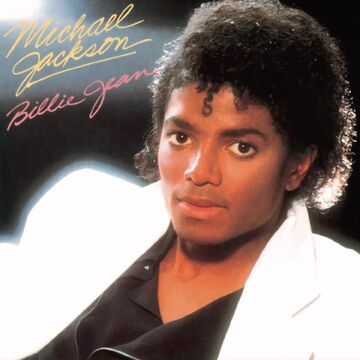
Ladies and gents, it’s time to warm-up that high-pitched “Woo!”, break out the ol’ white glove, black hat, and get those feet moonwalkin’ – because we’ve got one of the biggest hits of the ’80s from one of the greatest entertainers ever to step foot on the stage: Mr. Michael Jackson! For me, it’s a toss-up between Billie Jean and Blackor White as my ultimate desert-island MJ track – what’s yours? Billie Jean is an electrifying dance anthem, and every time I hear it, I feel an uncontrollable urge to move. In fact, when it came on at the gym a few weeks back, my reaction wasn’t far off Brad Pitt’s below in Burn After Reading.
Billie Jean was written and composed by Jackson. It is about a woman who says the singer is the father of her child, but he insists she’s lying. The song tells a tense story about temptation, lies, and the trouble that comes with fame. Behind its catchy beat and famous bassline, it shows how rumors and obsession can turn someone’s life upside down. Jackson said the lyrics were based on groupies’ claims about his older brothers when he toured with them as the Jackson 5. It was the introduction of distrust and paranoia to Jackson’s music which later became a trademark to his later music.
Billie Jean was the second single from Michael Jackson’s sixth studio album, Thriller (1982), released in January 1983. Thriller went on to become the best selling album of all time, with over 70 million copies sold worldwide, turning Jackson into a global phenomenon. Remarkably, Michael also had two of the three highest-selling albums of the 1980s, with Bad taking third place at around 45 million copies sold. Billie Jean topped the Billboard Hot 100 and became Jackson’s fastest-rising number one single since “ABC,” “The Love You Save,” and “I’ll Be There” in 1970.
Jackson’s performance of “Billie Jean” on the TV special Motown 25: Yesterday, Today, Forever (at the bottom of this post) introduced a number of Jackson’s signatures, including the moonwalk, rhinestone glove, black sequined jacket, and high-water pants, and was widely imitated.
[Verse 1] She was more like a beauty queen from a movie scene, uh I said, “Don’t mind, but what do you mean, I am the one? Who will dance on the floor in the round?” She said I am the one Who will dance on the floor in the round? She told me her name was Billie Jean as she caused a scene Then every head turned with eyes that dreamed of bein’ the one, uh Who will dance on the floor in the round?
[Pre-Chorus] People always told me, “Be careful of what you do,” uh “And don’t go around breakin’ young girls’ hearts” (Hee-hee) And mother always told me, “Be careful of who you love And be careful of what you do (Oh, oh) ‘Cause the lie becomes the truth” (Oh, oh), hey
[Chorus] Billie Jean is not my lover, uh She’s just a girl who claims that I am the one (Oh, baby) But the kid is not my son (Woo) Uh, she says I am the one (Oh, baby) But the kid is not my son (Hee-hee-hee; no, no) (Hee-hee-hee, woo)
[Verse 2] For forty days and for forty nights, the law was on her side But who can stand when she’s in demand? Her schemes and plans ‘Cause we danced on the floor in the round (Hee, uh, uh) So take my strong advice Just remember to always think twice (Don’t think twice) Do think twice (A-hoo) She told my baby we danced ’til three, then she looked at me Then showed a photo of a baby cryin’, his eyes were like mine (Oh, no) ‘Cause we danced on the floor in the round, baby (Ooh, hee-hee-hee)
[Pre-Chorus] People always told me, “Be careful of what you do,” uh “And don’t go around breakin’ young girls’ hearts” (Don’t break no hearts; hee-hee) But she came and stood right by me Just the smell of sweet perfume (Ha-oh) This happened much too soon (Ha-oh, ha-ooh) She called me to her room (Ha-oh, hoo), hey
I first heard The Hook on Scott Bunn’s music blog, Recliner Notes. Scott has been running an extensive series on American indie rock musician Stephen Malkmus, and this track caught my attention from the get-go. The Hook is an apt title for a song that does exactly that – it hooks you in. My senses feel almost overloaded when I hear it – and I mean that in the best possible way. It’s got this gnarly, Rolling Stones–esque guitar riff, while Stephen’s vocals channel shades of the late Lou Reed – who, incidentally, passed by this way only two days ago with This Magic Moment. Layer onto that the thoughtful, distinctive cadence reminiscent of Robert Forster from the quintessential Australian indie band The Go-Betweens, and you’ve already got quite a mix. Then, when you stir in the bawdy wit and immersive storytelling of Warren Zevon — think Lawyers, Guns and Money or Mutineer — well folks, you’ve got yourself one pretty darn good track.
I’m going to turn it over to Scott who brought this interesting and talented artist to my attention in the first place:
After 10 years as a singer, songwriter, guitar player and quasi-leader of Pavement, Stephen Malkmus finally released a solo album. The record was self-titled and put out under his name alone, despite Malkmus wanting to call it Swedish Reggae and crediting it to his new band, The Jicks. Graced with cover portraying a mulleted, half-smiling Malkmus during the Hawaiian golden hour, the album contained songs that felt familiar to Pavement fans as well as departures, such as “The Hook”:
“The Hook” begins with the type of cowbell-powered, white funk keyboard-soaked satisfying groove that would make The Rolling Stones and even Joe Walsh envious. Over this roadhouse boogie, Malkmus sings: “At age 19 I was kidnapped by Turkish pirates / Mediterranean thugs.” This opening line thrusts the listener immediately into a story. Yes, Malkmus is telling us a pirate yarn.
– Read the remainder of Scott Bunn’s article here at Recliner Notes
[Verse 1] At age 19 I was kidnapped by Turkish pirates Mediterranean thugs After some torture they considered me their mascot Cypriotic good luck I had to taste the deck and many other things I had to pay the piper with my wedding ring And I would never see my family again
[Verse 2] By 25 I was respected as an equal My art was a knife On countless raids I was the first one up the lanyard Yeah I was seeking a fight There is no time to pray And there’s no time to beg And then it’s off with an arm Or it’s off with a leg And if I spare your life It’s because the tide is leaving Oh yeah
[Guitar solo]
[Verse 3] By 31 I was the captain of a galleon I was Poseidon’s new son The coast of Montenegro was my favorite target It was ever so fun We had no wooden legs Or steel hooks We had no black eye patches Or a starving cook We were just killers with the cold eyes of a sailor Yeah we were killers with the cold eyes of a sailor
A friend, Tatiana – who has a deep fascination with German culture and language – first introduced me to Clueso back in 2017 with the song Wenn Du Liebst (When You Love). It was love at first listen, truly. So much so that in 2019, I chose that song to inaugurate my Music Library Project – a piece that encapsulated the breadth and depth of the music I intended to feature. Years later – thanks be to the Internet gods – Clueso’s 2024 summer tour popped up in my feed. That was the real clincher for me in appreciating the sheer talent and range of the German singer-songwriter and rapper. Today, I’d like to feature another highlight from that concert: “Gewinner” (Winner), which appears at 01:11:34 in the set.
It’s interesting how the language barrier has never really been an obstacle to connecting with Clueso’s music. His alluring melodies, inventive arrangements, and understated yet poignant voice convey emotions that seem to transcend words. If I had to guess what today’s song Gewinner was about before reading the translation below, I doubt I’d have been far off. Gewinner explores the complex and often contradictory emotions of deep personal connection – and the willingness to lose oneself within a relationship.
Like much of Clueso’s work, Gewinner is both introspective and atmospheric. Though its rhythm might at first seem simple, there’s much more beneath the surface – a distinctive and subtle meter that sets it apart. The song carries a quiet melancholy, gradually building in emotional intensity rather than volume, guided by the calmness and warmth of Clueso’s voice. This slow unfolding mirrors the lyrical theme itself – a reflection on how love can make us feel lost and found at once.
The words deepen that mood of uncertainty and self-examination, as Clueso questions belief, trust, and mutual commitment: “Ich glaube nichts, ich glaub an dich, glaubst du an mich? ich glaub ich auch” (“I believe in nothing, I believe in you, do you believe in me? I think I do too”). The central refrain, “Ich bin dabei, du bist dabei, wir sind dabei uns zu verlieren” (“I’m all in, you’re all in, we’re all in to lose ourselves”), captures a kind of shared surrender – a willingness to dissolve the self within love, and the quiet risk that comes with such closeness.
[Verse 1] There’s some truth in everything you say, in everything you say. No matter who comes, no matter who goes, it doesn’t matter, it doesn’t matter. I don’t believe anything, I believe in you, do you believe in me? I think I do too. I wonder, I ask you, but if I don’t ask, do you wonder too?
[Chorus] I’m in, you’re in, we’re in the process of losing ourselves. I’m in, are you in? Are we in the process of losing ourselves? I’m in, you’re in, we’re in the process of losing ourselves. I’m in, are you in? Am I in the process of losing us?
[Verse 2] Easier than easy, is it perhaps easier than what perhaps was? Easier than easy, it’s not far from here to what hasn’t been yet. If you’re looking for me, then I’ll look for you, is the temptation great enough? I’ll allow it, come on, allow it, come on, let’s do it again. I won’t give up, will you come with me, will you come with me, towards us? Can’t think of anything? Come on, don’t hang up, come on, get worked up and calm down.
[Chorus] I’m in, you’re in, we’re in, losing ourselves. I’m in, are you in? Are we in, losing ourselves? I’m in, you’re in, we’re in, losing ourselves. I’m in, are you in? Am I in, losing ourselves? I’m in, you’re in, we’re in, losing ourselves. I’m in, are you in? Are we in, losing ourselves?
[Outro] Ohh, oh-oh, yeah I’m in, you’re in, we’re in Ohh I’m in, are you in, are we in?
If you don’t mind, I’ll take the meandering route to today’s song by tracing a little circle of coincidences. The other day there was a small art fair in the bottom floor of the building where I train. As I was wandering the tables of the various art on offer, there was a young girl and her beau quietly sitting there surrounded by this girl’s paintings. Three small paintings of a night scene stood out to me (see image inset), and I couldn’t look away. I told the girl how they reminded me of a David Lynch film called Lost Highway. I showed her images of a film by him she did recognise called Mulholland Drive which I featured here at Friday’s Finest back in 2021.
So I asked her much they would cost and she told me $35,000 Pesos (US $10.00) and so I snapped them up. She even tied a neat little string to cojoin and enable me to hang them. I asked her to sign the back, which she did – and if my reading serves me right, it’s signed “Hanari-Andrade.” We said our goodbyes, and now the three-piece set hangs on my living room wall beside my son’s Rocky IV poster-gift, an artwork of Jesus Christ called Forgiven by Thomas Blackshear II, and a Superman 3D jigsaw.
Naturally, ever since buying those paintings, both they and the film Lost Highway have been swimming around in my head. Then, by coincidence, today’s song appeared next in the alphabetical listing of my music project to share here – Lou Reed’s This Magic Moment, which just happens to feature in Lynch’s film (you can find the full clip below). So there’s some truth in the old saying: what goes around comes around. Lou Reed is of course no stranger to this blog, and somehow today’s track and his earlier release with the Velvet underground called Sweet Jane (also the last to appear here by him) are musically quite similar in their minimal representation and technique (seemingly deceptively simple) but both resonate more than what they let on.
Lou’s This Magic Moment was originally written by Doc Pomus and Mort Shuman, and first recorded by The Drifters in 1960 and became a Top 20 hit. Lou’s version is from a Doc Pomus tribute album, Till the Night is Gone and was released in the Lynch film as aforementioned in 1997 and thereafter in 1998 on the tribute album by Forward/Rhino. Reed’s rendition stands out for its stripped-down rock and roll style, showcasing his deep affection for R&B and his distinctive guitar work – the dirtiest guitar and I mean that in the best sense, with two contrasting guitar parts accompanied by Fernando Saunders on bass and George Recile on drums. The album features a stellar lineup of artists, including Bob Dylan, B.B. King, Brian Wilson, and Dr. John, among others.
[Verse 1] This magic moment So different and so new Was like any other Until I met you
[Verse 2] And then it happened It took me by surprise I knew that you felt it too I could see it by the look in your eyes
[Pre-Chorus] Sweeter than wine Softer than a summer´s night Everything I want I have Whenever I hold you tight
[Chorus] This magic moment While your lips are close to mine Will last forever Forever till the end of time
So why won´t you dance with me? Hey baby Why won´t you dance with me?
I was in this kitsch little restaurant near where I live in Bogotá a few years ago, having breakfast, when today’s featured song came on the speakers – and it blew me away. I scribbled down some of the chorus so I could look it up later and voilà! My family ancestry partly originates from Scotland, so I’ve always had a soft spot for anything Scottish especially singer-songwriter Amy Macdonald. Not long after locking This Is the Life into my music library project, I came across Amy’s stirring rendition of Flower of Scotland at a bitterly cold and windy Hampden Park in Glasgow.
I was captivated watching her performance. Each exhalation from Amy turns into a cloud of mist — that’s how frickin’ cold it was. Her grin and humility as she walks off stage (so very Scottish, mind you) are the sort of things you rarely see from major commercial artists. Anyone who can pull that off, like this wee lass did, has got the chops in my books. But it was This Is the Life that caught me by the short and curly’s from the get-go – and I’ve never grown tired of hearing it.
This Is the Life is the quintessential modern Celtic-inspired folk-rock party song. You can hear in it the pulse of acoustic guitars and the rhythmic strum reminiscent of Scottish pub folk sessions. Amy revealed in 2023 that she wrote the song when she was just 16 years old. One night she went out using her sister’s ID and had an amazing time. The next day, she was caught and grounded, confined to her room. During that long, dull day, inspired by the unforgettable night before, she wrote the song. The music video, fittingly, is a collage of photos from that night out with friends.
What also struck me about the song was how, melodically and rhythmically, it echoes the Dutch band Shocking Blue’s 1970 hit Never Marry a Railroad Man. Listen to the instrumental break of Shocking Blue’s song from the 1:00 onward, then play through Macdonald’s track – there’s a striking similarity in the guitar phrasing and cadence. Perhaps it’s coincidence, hmm dunno. Either way, both songs are fine examples of catchy, melodic storytelling from two very different rock eras and parts of Europe.
This Is the Life is from Amy’s 2007 debut album of the same name. It became a hit in mainland Europe, topping the charts of five countries but the song did not match the success in the UK of her other release – Mr Rock & Roll which is another fantastic song that will feature here in the not too distant future. This Is the Life was Macdonald’s only song to chart in North America, peaking at number 19 on the US Billboard Adult Alternative Songs chart.
[Verse 1] Oh, the wind whistles down the cold, dark street tonight And the people, they were dancin’ to the music vibe And the boys chase the girls with the curls in their hair While the shy, tormented youth sit way over there And the songs, they get louder, each one better than before
[Chorus] And you’re singin’ the songs, thinkin’ this is the life And you wake up in the mornin’, and your head feels twice the size Where you gonna go, where you gonna go? Where you gonna sleep tonight? And you’re singin’ the songs, thinkin’ this is the life And you wake up in the mornin’, and your head feels twice the size Where you gonna go, where you gonna go? Where you gonna sleep tonight? Where you gonna sleep tonight?
[Verse 2] So you’re headin’ down the road in your taxi for four And you’re waitin’ outside Jimmy’s front door But nobody’s in, and nobody’s home till four So you’re sittin’ there with nothin’ to do Talkin’ about Robert Riger and his motley crew And where you gonna go, and where you gonna sleep tonight
If there’s one song I’ve learned to appreciate with age, it’s today’s featured track. Heck, I doubt I’d have cared much for This Guy’s in Love with You even ten years ago. It’s from my parents’ time – the kind of tune my father might have played to woo my mother before their wedding in 1969. You can almost picture the scene: polished wooden furniture, soft lighting, and the faint scent of mahogany in the air as couples slow-danced in their living rooms. Like the style of that era, This Guy’s in Love with You belongs to its time – and in keeping with what people like to say, they don’t make music like this anymore.
The song was written by the duo Burt Bacharach and Hal David, who were behind countless pop standards of the 1960s. It was first recorded by Herb Alpert, best known as the trumpet-playing leader of the Tijuana Brass. Alpert wasn’t known as a vocalist, but the story goes that he asked Bacharach if he had a song he could sing to his wife on a television special. Bacharach handed him This Guy’s in Love with You – and what began as a casual request turned into a defining moment in Alpert’s career.
Alpert’s vocal isn’t polished in the traditional sense, but it’s sincere, almost shy – which gives the song its charm. Audiences were taken by surprise that the trumpet man could deliver such a heartfelt vocal. Behind him, Bacharach’s signature arrangement of gentle horns and strings completes that unmistakable late-’60s sound: lush, romantic, and slightly wistful.
Released in April 1968 it became the first number-one hit for Herb Alpert topping the Billboard for four weeks and selling over a million copies. It even displaced Simon & Garfunkel’s Mrs. Robinson (coming up real soon here btw) from the top spot. It went on to become one of Bacharach and David’s most-covered compositions, recorded by many from Andy Williams to Noel Gallagher.
You see this guy, this guy’s in love with you Yes I’m in love who looks at you the way I do When you smile I can tell we know each other very Well
How can I show you I’m glad I got to know you cause I’ve heard some talk they say you think I’m fine This guy’s in love and what I’d do to make you mine Tell me now is it so don’t let me be the last to Know
My hands are shaking don’t let my heart keep Breaking cause I need your love, I want your love Say you’re in love, and you will be my guy ( in love with this guy), if not I’ll just die
Tell me now is it so don’t let me be the last to Know My hands are shaking don’t let my heart keep Breaking cause I need your love, I want your love Say you’re in love, and you will be my guy ( in love with this guy), if not I’ll just die
“Practicing an art, no matter how well or badly, is a way to make your soul grow, for heaven’s sake. Sing in the shower. Dance to the radio. Tell stories. Write a poem to a friend, even a lousy poem. Do it as well as you possibly can. You will get an enormous reward. You will have created something.”
– Kurt Vonnegut, A Man Without a Country
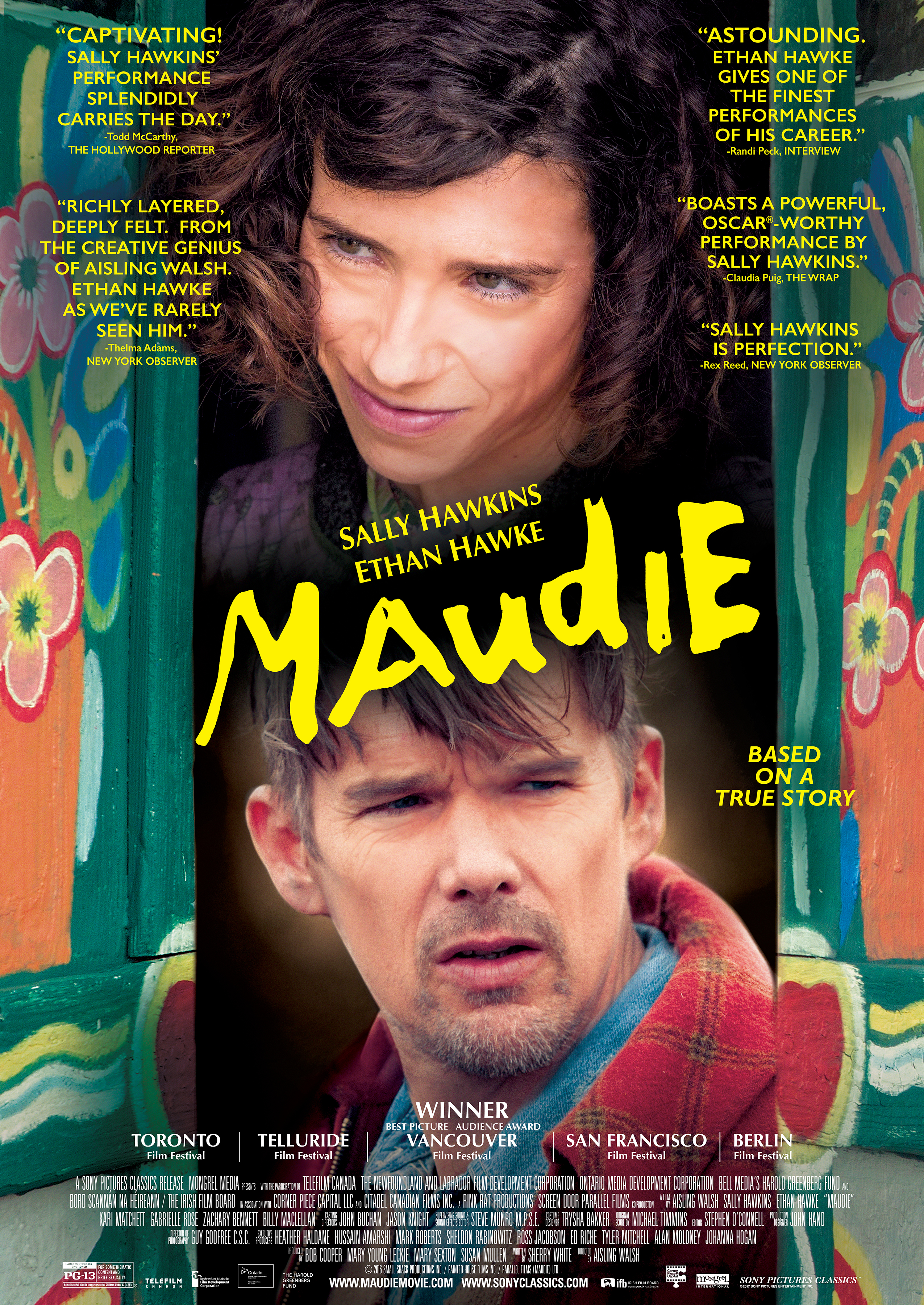
I’ve seen the 2016 biographical drama Maudie twice now on cable, and both times it moved me. It’s a quaint yet touching film based on the life of Canadian folk artist Maud Lewis (pictured inset). In keeping with the above quote – For Maud, painting wasn’t a matter of pride or ambition – it was something she simply did, to make herself happy. If others found joy in it too, that was just a lovely bonus. The story tells of humble people living in hard times, finding love and meaning in the smallest corners of life. But it never feels forced or sentimental.
When I first saw Sally Hawkins cast in the lead, I had my doubts. She’d often been typecast as the fragile, soft-spoken woman – roles that risk drifting into caricature. Yet I loved her in Woody Allen’s magnificent Blue Jasmine, where she portrayed a downtrodden, yes, but far bolder female persona. Her Maudie here is fragile, but also funny, resilient, and quietly defiant. Ethan Hawke, meanwhile, gives a subdued and gruff performance as Everett Lewis — Maudie’s rough-edged husband. It’s an unusually restrained turn for Hawke, who I have enjoyed watching since his break-out role in Dead Poets Society.
The story opens with Maudie struggling to earn respect from her family and community. Crippled by arthritis and loneliness, she answers an advert for a live-in housekeeper and moves in with Everett, a taciturn fishmonger who seems to have forgotten how to smile. What begins as a tense arrangement slowly becomes a partnership — awkward, tender, and oddly moving. Living in Everett’s ramshackle shack, Maudie begins to paint again, first on discarded wood and then on the walls themselves, transforming their drab home into a burst of colour and life.
In real life, Maud Lewis would go on to become one of Canada’s most beloved folk artists – though you’d hardly know it from her humble circumstances. The film captures that paradox beautifully: how someone so physically frail and isolated could fill the world around her with such brightness. Hawkins and Hawke make a curious pair, but their relationship feels utterly real – a strange, weather-beaten love that survives because neither has anywhere else to go, and because, somehow, they find beauty in each other’s roughness.
What makes Maudie stay with you isn’t only its story, but its gentle, immersive sense of place. With Guy Godfree’s beautifully restrained cinematography, the film glows with the warmth of a humble home and the splendor of the Nova Scotian landscape. The wide, open vistas feel both vast and tender – like glimpses into Maud’s own quiet, resilient world.
This song title might as well be the tagline of my solitary, middle-aged existence and longing. But hey – we’ve got a blog to run here! I’m not about to crumble into some “woe is me” dirge and let that derail today’s feature: arguably one of U2’s most beloved and instantly recognisable songs. I mean this song is so iconic it even appeared in that Sing 2 movie -ya know – the one with that f%&king koala – it’s always sweet when they can adapt these treasured songs for a younger, tech savvy and attention-span-deficit audience. I’m hardly a big U2 fan, but I enjoyed listening to some of their earlier output – up to and including the Achtung Baby album.
I Still Haven’t Found What I’m Looking For still holds up for me in its original form. The dozens of soul and gospel reinterpretations over the years don’t do it for me at all – they try too hard to sound earnest and end up missing the song’s gritty, pavement-worn feel in its spiritual yearning. And really, if you strip away that echo-laden, minimalist guitar from The Edge, you may as well be listening to Thunderstruck without Angus Young’s electrifying riff. While we’re on the topic of The Edge’s guitar playing, I have to mention this clip from English musician-comedian Bill Bailey, who demonstrates what might happen if there were a catastrophic technical failure at a U2 concert.
I Still Haven’t Found What I’m Looking For originated from a demo called “The Weather Girls” and “Under the Weather” which the band recorded during a jam session. The band liked the drum part played by drummer Larry Mullen Jr. Co-producer Daniel Lanois (who would later produce two outstanding Bob Dylan records – Oh Mercy (1989) and Time Out of Mind (1997)) said, “It was a very original beat from Larry“. He also added:
“I’ve always liked gospel music and I encouraged Bono to take it to that place … It was a very non-U2 thing to do at the time, to go up the street of gospel. I think it opened a door for them, to experiment with that territory … [Bono]’s singing at the top of his range and there is something very compelling about somebody pushing themselves. It’s like hearing Aretha Franklin almost. It jumps on you and you can’t help but feel the feeling.”
I Still Haven’t Found What I’m Looking For is from the Irish rock band’s 1987 album The Joshua Tree. It was the second consecutive number-one on the US billboard while reaching number 6 on the UK chart.
Many critics and publications have ranked “I Still Haven’t Found What I’m Looking For” among the greatest tracks in music history, including Rolling Stone which ranked the song at number 93 of its 2010 list of “The 500 Greatest Songs of All Time“. The following music video for the song was filmed on Fremont Street in Las Vegas on 12 April 1987 following their Joshua Tree Tour concert in that city.
[Verse 1] I have climbed highest mountain I have run through the fields Only to be with you Only to be with you I have run, I have crawled I have scaled these city walls These city walls Only to be with you
[Chorus] But I still haven’t found what I’m lookin’ for But I still haven’t found what I’m lookin’ for
[Verse 2] I have kissed honey lips Felt the healing fingertips It burned like fire This burnin’ desire I have spoke with the tongue of angels I have held the hand of a devil It was warm in the night I was cold as a stone
[Chorus] But I still haven’t found what I’m lookin’ for But I still haven’t found what I’m lookin’ for
[Verse 3] I believe in the Kingdom Come Then all the colours will bleed into one Bleed into one But yes, I’m still runnin’ You broke the bonds and you loosened the chains Carried the cross of my shame Of my shame You know I believe it
I’m again resuming my Wednesday literature segment, which features an excerpt from Douglas Adams’s The Ultimate Hitchhiker’s Guide to the Galaxy – specifically from Book Two in the series, The Restaurant at the End of the Universe (1980). If you enjoy dabbling in books, feel free to join me on Goodreads [here]. My last extracts were The Gioconda Smile (1922) by Aldous Huxley and The Force of Circumstance (1924) by W. Somerset Maugham.
Following the sound advice of my friend Ashley at Gentle Chapter (an avid reader, I might add), instead of paying for new books – some of which turn out to be duds – I joined my local library here in Bogotá, Colombia: the Julio Mario Santo Domingo (image left). It houses an impressive collection of English literature, which I’ve decided to read alphabetically by the authors’ surnames, arranged left to right along the shelves. This venture, like my Music Library Project (started on July 19th, 2019), will take years – perhaps decades – but I’ll share here my favourite passages as I go, beginning with the first book to appear: the time-honoured, humorous science-fiction saga, The Ultimate Hitchhiker’s Guide to the Galaxy by Douglas Adams.
So here are the five novels from Douglas Adams’s Hitchhiker series. Book One – the most celebrated – opens just before Earth is demolished to make way for a hyperspace bypass. Arthur Dent is rescued by Ford Prefect, a researcher for the Guide, and together they hitch rides through time and space. I’m currently on Book Two, The Restaurant at the End of the Universe, where our ragtag heroes are facing annihilation at the hands of warmongers – though somehow it’s also the perfect time for a nice cup of tea. It’s all wonderfully trippy yet surprisingly relatable. Adams’s genius lies in how he makes the most far-flung absurdities – the bureaucratic nightmares, neurotic machines, and misplaced egos scattered across the cosmos – mirror our own everyday follies here on Earth.
To set the scene for the excerpt below, from Chapter 6: Zaphod Beeblebrox – ex-President of the Galaxy and full-time egomaniac – is reunited with Marvin the Paranoid Android at Megadodo Publications, the headquarters of The Hitchhiker’s Guide to the Galaxy, “the most totally remarkable book in the whole of the known Universe.” Together they approach a bank of elevators, whose job isn’t merely to move up and down but to anticipate passengers’ needs – and, more often than not, argue about them. Their grand cosmic adventure is stalled, hilariously, by the neuroses of sentient machinery. So without further ado, I present today’s featured excerpt from The Restaurant at the End of the Universe:
“So, how are you?” he said aloud. “Oh, fine,” said Marvin, “if you happen to like being me which personally I don’t.” “Yeah, yeah,” said Zaphod as the elevator doors opened. “Hello,” said the elevator sweetly, “I am to be your elevator for this trip to the floor of your choice. I have been designed by the Sirius Cybernetics Corporation to take you, the visitor to the Hitch Hiker’s Guide to the Galaxy, into these their offices. If you enjoy your ride, which will be swift and pleasurable, then you may care to experience some of the other elevators which have recently been installed in the offices of the Galactic tax department, Boobiloo Baby Foods and the Sirian State Mental Hospital, where many ex-Sirius Cybernetics Corporation executives will be delighted to welcome your visits, sympathy, and happy tales of the outside world.” “Yeah,” said Zaphod, stepping into it, “what else do you do besides talk?” “I go up,” said the elevator, “or down.” “Good,” said Zaphod, “We’re going up.” “Or down,” the elevator reminded him. “Yeah, OK, up please.” There was a moment of silence. “Down’s very nice,” suggested the elevator hopefully. “Oh yeah?” “Super.” “Good,” said Zaphod, “Now will you take us up?” “May I ask you,” inquired the elevator in its sweetest, most reasonable voice, “if you’ve considered all the possibilities that down might offer you?” Zaphod knocked one of his heads against the inside wall. He didn’t need this, he thought to himself, this of all things he had no need of. He hadn’t asked to be here. If he was asked at this moment where he would like to be he would probably have said he would like to be lying on the beach with at least fifty beautiful women and a small team of experts working out new ways they could be nice to him, which was his usual reply. To this he would probably have added something passionate on the subject of food. One thing he didn’t want to be doing was chasing after the man who ruled the Universe, who was only doing a job which he might as well keep at, because if it wasn’t him it would only be someone else. Most of all he didn’t want to be standing in an office block arguing with an elevator. “Like what other possibilities?” he asked wearily. “Well,” the voice trickled on like honey on biscuits, “there’s the basement, the microfiles, the heating system … er …” It paused. “Nothing particularly exciting,” it admitted, “but they are alternatives.” “Holy Zarquon,” muttered Zaphod, “did I ask for an existentialist elevator?” he beat his fists against the wall. “What’s the matter with the thing?” he spat. “It doesn’t want to go up,” said Marvin simply, “I think it’s afraid. “Afraid?” cried Zaphod, “Of what? Heights? An elevator that’s afraid of heights?” “No,” said the elevator miserably, “of the future …” “The future?” exclaimed Zaphod, “What does the wretched thing want, a pension scheme?” At that moment a commotion broke out in the reception hall behind them. From the walls around them came the sound of suddenly active machinery. “We can all see into the future,” whispered the elevator in what sounded like terror, “it’s part of our programming.” Zaphod looked out of the elevator – an agitated crowd had gathered round the elevator area, pointing and shouting. Every elevator in the building was coming down, very fast. He ducked back in. “Marvin,” he said, “just get this elevator go up will you? We’ve got to get to Zarniwoop.” “Why?” asked Marvin dolefully. “I don’t know,” said Zaphod, “but when I find him, he’d better have a very good reason for me wanting to see him.” Modern elevators are strange and complex entities. The ancient electric winch and “maximum-capacity-eight-persons“ jobs bear as much relation to a Sirius Cybernetics Corporation Happy Vertical People Transporter as a packet of mixed nuts does to the entire west wing of the Sirian State Mental Hospital. This is because they operate on the curios principle of “defocused temporal perception”. In other words they have the capacity to see dimly into the immediate future, which enables the elevator to be on the right floor to pick you up even before you knew you wanted it, thus eliminating all the tedious chatting, relaxing, and making friends that people were previously forced to do whist waiting for elevators. Not unnaturally, many elevators imbued with intelligence and precognition became terribly frustrated with the mindless business of going up and down, up and down, experimented briefly with the notion of going sideways, as a sort of existential protest, demanded participation in the decision-making process and finally took to squatting in basements sulking. An impoverished hitch-hiker visiting any planets in the Sirius star system these days can pick up easy money working as a counsellor for neurotic elevators. At the fifteenth floor the elevator doors opened quickly. “Fifteenth,” said the elevator, “and remember, I’m only doing this because I like your robot.” Zaphod and Marvin bundled out of the elevator which instantly snapped its doors shut and dropped as fast as its mechanism would take it.











 Observation Blogger