City of Stars (2016) – Justin Hurwitz

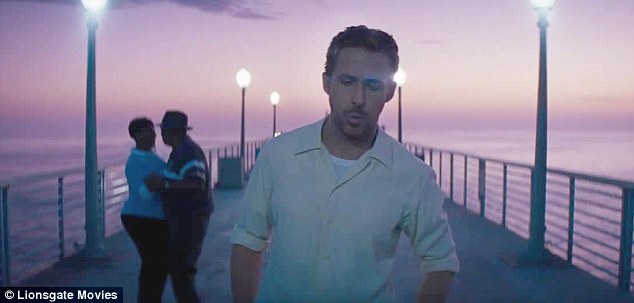
City of Stars is the third song to appear here from my favourite musical La La Land. It won the Academy Award for Best Music (original Song). The music of the song was composed by Justin Hurwitz while the lyrics were provided by Benj Pasek and Justin Paul.

City of stars
Are you shining just for me?
City of stars
There’s so much that I can’t see

Who knows?
Is this the start of something wonderful and new?
Or one more dream that I cannot make true?

In the film, the song is first sung by Gosling alone as the character of Sebastian as he sings and dances on the Hermosa Beach Pier. (see video below).

Justin Hurwitz described the writing of the song: ‘…I was just composing it from an emotional place and thinking about the tone. I would say the tone is hopeful, but melancholy at the same time. And it kind of goes back-and-forth between cadencing in major and cadencing in minor, because I think that’s kind of what the song is about. You have these great moments and then you have these less great moments in life and in Los Angeles and we see it happen in the story….’

Interestingly, the song Hit Number 1 and 2 on Japan and South Korea’s billboard charts respectively.

Tagged with: , ,
Posted in Movies and TV, Music

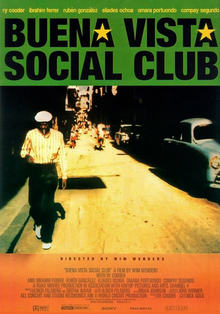
Buena Vista Social Club (1999) – Wim Wenders (Friday’s Finest)

Director Wim Wenders and guitarist Ry Cooder team up again to present this marvellous music documentary Buena Vista Social Club. Cooder did the slide guitar soundtrack for Wender’s Paris, Texas 1984 which featured here recently on Friday’s Finest. Buena Vista (good view) is a celebration of the music of Cuba. I have lived in Latin America for 12 years and heard a great deal of Latina Music, but I would say my preferred music (at least the most reliable) here is Cuban music and in particular a style called Son Cubano (They are Cubans). The musical genius of the Cuban people is undeniable and that is what is shone in this film.

IMDB Movie Summary: Aging Cuban musicians whose talents had been virtually forgotten following Castro’s takeover of Cuba, are brought out of retirement by Ry Cooder, who travelled to Havana in order to bring the musicians together, resulting in triumphant performances of extraordinary music, and resurrecting the musicians’ careers.

The opening scene in Buena Vista which is presented at the end of this post with Ry Cooder and his son Joaquim riding through the streets of Havana and the sublime music of the Chan Chan in the background is something to behold. Anyone who is even remotely interested in musical heritage should find Buena Vista captivating. In 2020, the film was selected for preservation in the United States National Film Registry by the Library of Congress.

The film documents how Ry Cooder, long-time friend of Wenders, brought together the ensemble of legendary Cuban musicians to record an album (also called Buena Vista Social Club) and to perform two times with a full line-up: in April 1998 in Amsterdam (two nights) and the 1st of July 1998 in the United States (at the Carnegie Hall, New York City). Suffice to say the soundtrack of this film is exemplary and the movie received critical acclaim.

The film helped the musicians, some of them already in their nineties, become known to a worldwide audience, with some going on to release popular solo albums. These included Ibrahim Ferrer, Compay Segundo, Rubén González and Elíades Ochoa. The latter went on to support younger musicians making the same style of music beyond 2010 under the name “Buena Vista Social Club”.

Besides the sones, guarachas and boleros (basic styles of good-old Cuban music), the beauty of this documentary relies on Wim Wenders’ magnificent camera use. It is impossible not to feel the emotion of the crowded Carnegie Hall in the climax scenes, but there are also many other images that carry the viewer to more intimate experiences of La Habana, its music and musicians.

References:
1. Buena Vista Social Club – Wikipedia

Tagged with: , ,
Posted in Movies and TV, Music

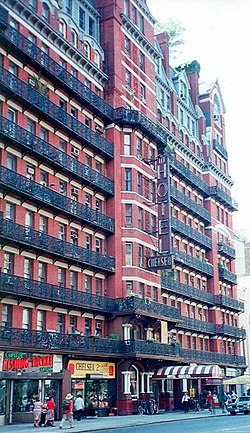
Chelsea Hotel (1974) – Leonard Cohen

Leonard at the Chelsea Hotel

(Reader discretion is advised)
This is Leonard Cohen’s musical attempt of ‘Sex! Now I have your attention.’ Well, not really, but kind of. This infamous song of Leonard’s escapades with Janis Joplin at the Chelsea Hotel will be the discussion of today’s song.

He preluded a live performance of the song saying, ‘A thousand years ago I lived in this hotel in NY and I was a frequent rider of the elevator…I was an expert on the buttons of that elevator. One of the few technologies I ever mastered…I noticed a young woman in the elevator and she was riding it with as much delight as I was. Even though she commanded huge audiences, riding that elevator was the only thing she knew how to do. Finally I gathered my courage and I said to her: ‘Are you looking for someone?’ She said yes, ‘I’m looking for Kris Kristofferson’. I said ‘Little lady, you’re in luck, I’m Kris Kristofferson’. Those were generous times and even though she knew I was shorter than Kris, she never let on…A great generosity prevailed…Anyhow I wrote this song for Janis Joplin at the Chelsea Hotel.‘

I remember you well in the Chelsea Hotel
You were talking so brave and so sweet
Giving me head on the unmade bed
While the limousines wait in the street
Those were the reasons and that was New York
We were running for the money and the flesh
And that was called love for the workers in song
Probably still is for those of them left

I love this song because of its audacity and transparency although paradoxically he often contradicts himself. ‘I need you; I don’t need you’ we’ve all said that at some point and “I don’t even think of you that often”. Oh really, but you wrote a song about it and sing it in concert with preludes. Cohen tells a great story and often it’s humorous:

You told me again you preferred handsome men
But for me you would make an exception...
You fixed yourself, you said, "well, never mind
We are ugly but we have the music"
Chelsea Hotel

As Rolling Stone recalls: While Cohen’s gloomy, gritty and romantic mythology was still in its nascent phase, the Chelsea’s was fully formed. Situated at 222 West 23rd Street, the imposing redbrick ruled the block with a gothic grandeur. Its four hundred rooms had housed literary luminaries including Mark Twain, Charles Bukowski, William S. Burroughs, Jackson Pollock and Arthur Miller, who offered a succinct summation of the bohemian ambiance: “No vacuum cleaners, no rules, no shame.” Arthur C. Clarke wrote 2001: A Space Odyssey while in residence there, and Jack Kerouac pounded out On the Road in his room. Sid Vicious and girlfriend Nancy Spungen’s tragic visit was still more than a decade off, but poet Dylan Thomas entered his fatal coma during his Chelsea stay in 1953.

Below, I will relay Rufus Wainwright’s version of the song at Cohen’s dedication concert/dvd with Spanish subtitles and also with Cohen preluding it in his style.

Tagged with: , ,
Posted in Music

Circle of Life (1994) – Elton John

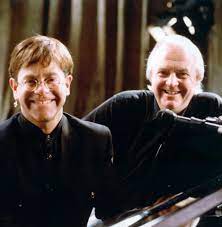
Elton John, Time Rice 1994

I was iffing and butting as to whether to include today’s song just because of how commercial – certainly for its time and mainstream it is. So I listened to it again and it pricked my ears as it has always done, so here goes…To be honest, I probably wouldn’t have included this song if I hadn’t heard recently the Jordan Peterson lecture he gave at Toronto University about the movie which this song was adapted. The movie, of course is The Lion King. Elton John composed this music and I think he did a wondrous job to capture the awe and allure of the story.

The lyrics were written by Tim Rice pictured above beside Elton. The song was performed by Carmen Twillie as the film’s opening song. In an interview, Rice said he was amazed at the speed with which John composed: “I gave him the lyrics at the beginning of the session at about two in the afternoon. By half-past three, he’d finished writing and recording a stunning demo.’ Circle of Life was nominated at 1994 Academy Awards for best song, but lost to another song composed by Elton John for The Lion King – Can You Feel The Love Tonight.

Due to the film’s universal impact on pop culture, the song is often referenced in other media. It’s powerful music and Elton although in the twilight phases of his songwriting prowess proved he was able to punch with the best of them. Below is the official version from Elton and even below that, the Peterson lecture about the Jungian archetypical significance which inspired me to give this article a go. Cheers.

Tagged with: , ,
Posted in Movies and TV, Music

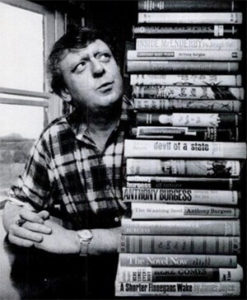
A Snorer is Outsnoored – Earthly Powers (Anthony Burgess)

This week on Wednesday’s literature piece we will continue with Anthony Burgess’s panamoramic saga novel of the 20th century Earthly Powers. The novel appeared on the shortlist for the Booker Prize in the year of its publication but lost out to William Golding’s Rites of Passage. In an October 2006 poll in The Observer, it was named joint third for the best work of British and Commonwealth fiction of the last 25 years.

On The International Anthony Burgess Foundation page Burgess wrote about his motivation to write Earthly Powers:

‘I’m no theologian. All I can do as a novelist is present situations which perhaps theologians can explain, although I doubt it. What I’ve tried to do is to invent characters typical of our age – British, American, Italian, German, black, white, brown – and show them in moral dilemmas damnably hard to resolve. At the same time I try to show the twentieth-century moral situation from the end of the Great War onwards. My Italian priest-bishop-pope believes that God is good, that God made man in his own image, that therefore man is good. Even the Jew-killing SS officer he captures and tries to bring back to the light is, according to his theology, good. It is the devil who causes evil: he gets into us and we have to exorcise him. But suppose a good act, a miraculous saving of life, produces great evil? This is not a question my pope character has to consider, since he is dead when it is asked about his own miracle, and he is on his way to becoming a saint. But what is a saint? There are saints in the story whom the world would call sinners.

I have, I see, said nothing about the novel. Certainly the above lame summary is no substitute for reading it. For me it is rather like trying to summarize the content of Beethoven’s Eroica Symphony. A novel is a novel, a work of craft or art, a structure, a big meal that can’t be turned into a vitamin capsule.’

Today’s short, yet amusing excerpt which I pertly titled ‘A Snorer is Outsnoored‘ is from writer and protagonist Kenneth Toomey recalling a short story he has written. It’s a little on the cheeky side, but it made me chuckle. I hope you enjoy it likewise:

Tagged with: ,
Posted in Reading

Changing of the Guards (1978) – Bob Dylan

Changing of the Guards is one of Dylan’s many masterpieces as is the album it opens – Street Legal. Both are underrated outputs of Dylan’s astounding discography. If I had to choose just one album from Dylan’s catalogue to have with me on a Desert Island, it would be Street Legal and Changing of the Guards is my favourite song from it and one of my top 10 Dylan songs. It showcases Dylan’s intricacy, creative talent and lyrical genius with a new refreshing distinct sound including choir and saxophone. The rhythm and melody are original and powerful and I never grow tired of hearing it. It unpacks such illusory images and shifts between eras of time that make it such a remarkable listen:

Sixteen years
Sixteen banners united over the field
Where the good shepherd grieves
Desperate men, desperate women divided
Spreading their wings ‘neath the falling leaves

Fortune calls
I stepped forth from the shadows to the marketplace
Merchants and thieves, hungry for power, my last deal gone down
She’s smelling sweet like the meadows where she was born
On midsummer’s eve, near the tower

Bob sounds so effervescent and free in Changing, like he is blessed by a new spirit unshackling the negative energy which held him down before. 16 years in the opening line are the sixteen years since he started in the music business and now he is really done with everyone – I don’t need your organization, I’ve shined your shoes and is free while looking into a hopeful future Peace will come. Dylan acknowledged the lyrical ambiguity in a 1978 interview, commenting: “It means something different every time I sing it. ‘Changing of the Guards’ is a thousand years old”. Although Dylan had not professed his conversion to Christianity as of yet there seems to be many references to Christian imagery and one could argue Changing is the New Covenant.

Wikipedia: Changing failed to reach the Billboard Top 100 but the song has been included on compilation albums: Bob Dylan’s Greatest Hits Volume 3, released in 1994, and the Deluxe Edition of Dylan, released in 2007.

Dylan expert Michael Gray, author of The Bob Dylan Encyclopedia, commented that “Changing of the Guards” is a thorough description of Dylan’s personal journey, from the beginning of his musical career, about sixteen years prior (the opening line is “Sixteen years”), through his marriage to and divorce from Sara Dylan, up to his conversion to Christianity, which was announced soon after the song’s release.…Dylan performed “Changing of the Guards” 68 times in concert. All performances were in 1978.

Tagged with: , ,
Posted in Music

12/4 – 18/4/21 Organ Transplantation – Chris Sonnenday

news on the march

Welcome to Monday’s News on the March – The week that was in my digital world. Today’s article unlike others on  News On the March will be dedicated to just one podcast.

Video podcast at Peter Attia MD

Chris Sunnenday

Ordinarily I wouldn’t be anxious to listen to the subject of organ transplantation but given the quality of Peter Attia podcasts I felt compelled to lend a listen. Unexpectedly, I found myself immersed and the two and a half hours flew by. It astounds me how Attia’s podcast hasn’t got over a million subscribers given the extraordinary wealth of ‘untapped’ knowledge his podcasts elicits.

Where this particular podcast enters the stratosphere of being one of my favorites is due to the quality of guest Peter has here. I had never heard of Chris Sonnenday before or understood why Peter was so in awe of him. But it became so apparent Chris made such a lasting impression on Peter due to his remarkable leadership and ability to maintain his humanity through the stressors of the most challenging environments. Chris Sonnenday is the Transplant Center Director for Michigan Medicine and was Peter’s senior resident while at John’s Hopkins. 

‘I felt I was lucky to be there. …there were probably thousands of people who might want that spot… So I felt obligated to maximise that experience.‘

Chris’s general demeanour and manner of expression throughout the podcast was something I was unfamiliar. I was listening to a guy who probably had/has one of the important and stressful jobs in the world, but he conveyed himself in such a modest way it left an indelible mark.

Chris repeatedly transforms Attia’s dizzying display of scientific abbreviations and intellect into something the layperson can understand. He’s breaking down some of the most sophisticated transplant surgeries and his own work history as if he were talking to a relative of a patient he was treating. His calmness and ability to communicate so lucidly given his profession and subject matter, well… I felt very grateful to witness. I hope you enjoy it as well. (Watch podcast).

news on the march the end

Tagged with: , ,
Posted in Health, News

Chaflan (1993) – Jorge Ariza

Jorge Ariza

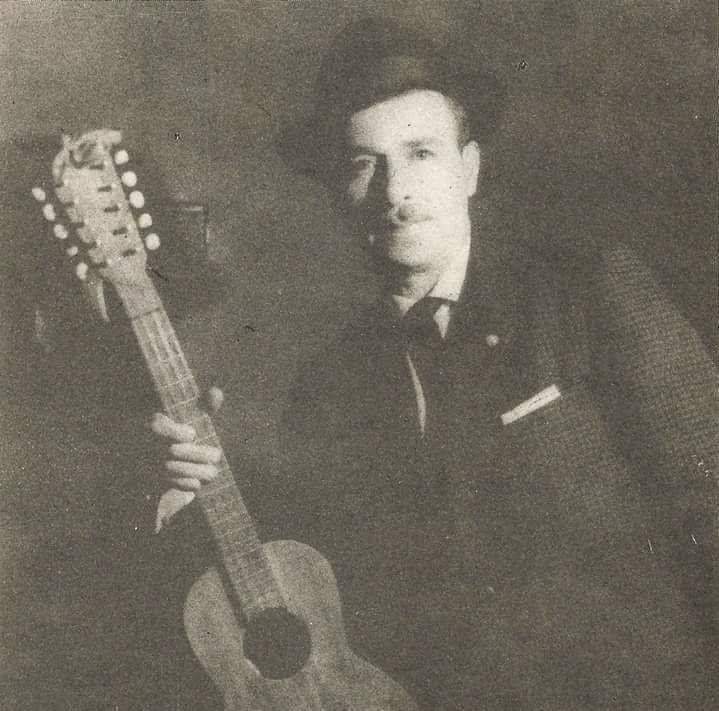
It has been a bit more than a quarter of a century since Colombian Jorge Ariza passed away. He is renowned as the King of the Requinto here and is somewhat a national folklore in Colombian music. The Requinto is a smaller version of the Spanish guitar which you can see him holding in the image above. It has just 4 strings and it is tuned a fourth higher than a standard classical guitar. Today we feature his instrumental Chaflan which was recorded on a 12 metallic string alteration of the Requinto called the Tiple Requinto and released on the 1993 album Vuelve el Requinto (The Requinto Returns), the same year he passed away here in Bogota.

To get a sense of where we are going here we need to look at the title of the song. Chaflan in the denotative sense is a word about construction – when the pointy part of a slab, stone or brick at a corner is bevelled so it doesn’t end up sharp. The musical metaphor of Chaflan is similar in that it cuts notes and makes them more rapid together. So if you repeat chanting tatatatarata, tatatatarata then you effectively have the Chaflan.

Jorge Ariza was born in 1927 in Bolivar in the Santander Department. (see the red pin on the map). He comes from a musical family which was headed by his grandfather Teofilo Ariza who was the creator of a distinct technique of the Requinto. His technique opened the way to show the small tiple Requinto (12 metallic stringed guitar) as a harmonious instrument which pleased those attending in the halls where he offered concerts which showcased chopped bundles of folk melodies impregnated in the spirit of Andean culture.

The life Jorge Ariza is surprisingly less known than his grandfathers. Jorge’s grand nephew Raul Ariza points out that much of the history of his great Uncle, has been passed down in Oral form and Jorge’s immediate family were seemingly unwilling to share about him in order to reconstruct a detailed past. But Raul Ariza has dedicated his musical passion to following his forbears and he himself has passed it onto to his son Raulito both pictured below (left and centre).

Tagged with: ,
Posted in Music

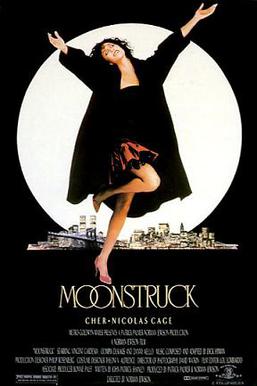
Moonstruck (1987) – Norman Jewison (Friday’s Finest)

Loretta Castorini: Bless me, Father, for I have sinned. It has been two months since my last confession.

Priest: What sins have you to confess?

Loretta Castorini: Twice I took the name of the Lord in vain, once I slept with the brother of my fiancé, and once I bounced a check at the liquor store, but that was really an accident.

Priest: Then it’s not a sin. But… what was that second thing you said, Loretta?

When I was a teenager, Moonstruck was one of family’s favourite movies. We watched it together so often. I purchased the soundtrack on cassette and listened to it to death. It is such a great montage of Italian music. The film borders on art-house because its steeped in cultural content and style distinct from that seen in mainstream film. It’s quirky and certainly brash in terms of performance delivery and writing. Any questions about whether Cher could act were put to bed by her outstanding performance here where she was awarded the Oscar for best actress in 1988.

IMDB Storyline: No sooner does Italian-American widow Loretta accept a marriage proposal from her doltish boyfriend, Johnny, then she finds herself falling for his younger brother, Ronny. She tries to resist, but Ronny lost his hand in an accident he blames on his brother, and has no scruples about aggressively pursuing her while Johnny is out of the country. As Loretta falls deeper in love, she comes to learn that she’s not the only one in her family with a secret romance.

I included Moonstruck in my Friday’s-Finest choices because it has been largely forgotten when people recount some of the great movies of 80’s cinema. It currently sits at No 46 on my 100 favourite movies of all time. I’ve never seen it presented on cable. What I think is so special about Moonstruck is how it is centred on family and its values. And all of these characters are past their prime and in some ways bitter and torn, but they are emboldened and enriched by the family unit. They have each other’s back. Some of the most compelling parts are the conversations around the family kitchen table. The mother who is magnificently played by Olympia Dukakis is one of my favourite minor characters in cinema. It’s under her roof that we hear some outstanding dialogue….’I am not a violent person, but “Old man . . . you give those dogs another piece of my meat and I’ll kick ya til ya dead!‘

I like how IMDB user yayamagic described it: These characters TALK about what’s on their minds. You want to know where the Met is located? You ask your hairdresser. You think your husband is flirting with another woman? You tell him that while you’re both working behind the wine counter – in front of a customer. You’re mad at your brother, you want to know why men need more than one woman, you want your son to pay for the wedding of his only daughter? If you really want to know, if you really want results or answers, you speak up!

Every character is peculiarly delightful and memorable. The movie touches on the complexities of loving relationships in a meaningful way, but never lectures. The script is never condescending towards any character, not even the hapless Johnny. I think it has one of the most charming and enduring endings in all of cinematic history. That reminds me I must watch this again.

Moonstruck Trivia:

* Nicolas Cage’s screen test didn’t impress the studio, and they wanted to get someone else to play Ronny. But Cher insisted that Cage was the one to play that role, and threatened to quit unless he was hired. After a few days, the studio relented.

* Director Norman Jewison was fined by the actors’ union for not allowing his actors to go to lunch until they perfected the moods of their characters for the climax scene in the kitchen.

* While filming between takes, Cher motioned to Olympia Dukakis that the movie was going to be a dud. She originally thought that she was giving a bad performance. She went on to win the Oscar and Golden Globe for Best Actress.
Tagged with: , ,
Posted in Movies and TV

Cemetery Polka (1985) – Tom Waits

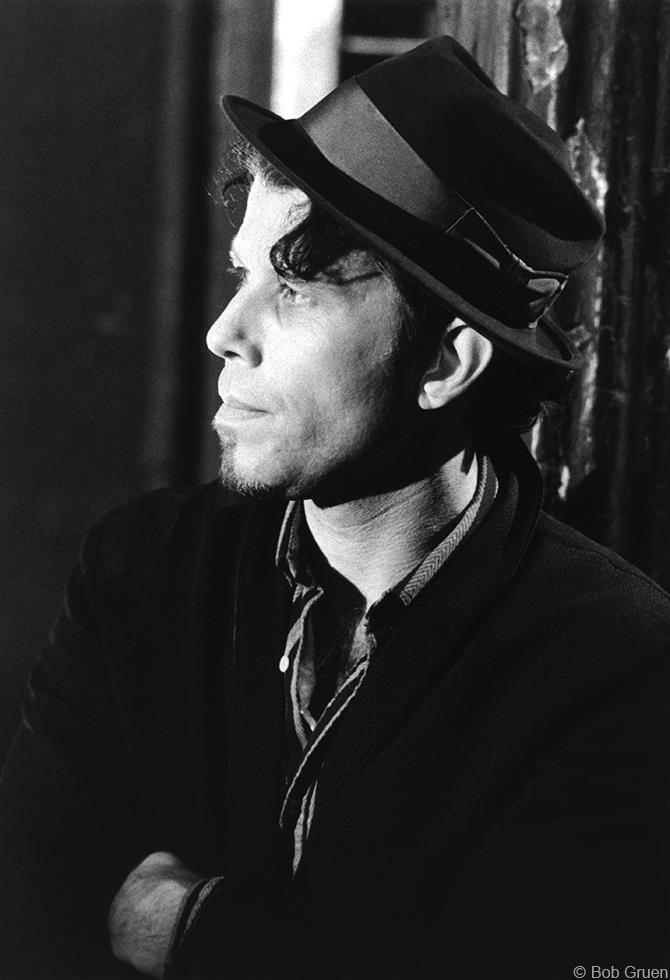
Tom Waits 1985

The whacky circus music and Waits accustomed minstrel role is all here. You know good writing in a song when you have great characterization in few short words, but it’s elusive enough to impel the reader to interpret it based on their lives and worldview. The call-down of the lyrics suggests a disheveled family which we all almost have. But given bad luck almost anybody could wind up where we see this played out. So Cemetery Polka on the surface seems to be a crack at the everyday family and persons failings, but its about much more.

Uncle Vernon, Uncle Vernon, independent as a hog on ice
He’s a big shot down there at the slaughterhouse
Plays accordion for Mr. Weiss

Uncle Biltmore and Uncle William
Made a million during World War Two
But they’re tightwads and they’re cheapskates
And they’ll never give a dime to you

Cemetery Polka is from Waits esteemed ’85 Raindog album which was ranked number 399 on Rolling Stones list of “The 500 Greatest Albums of All Time“. Waits recalled about his time living in NY during the period he did the album: “There is something interesting about Manhattan. Someone could stand out in the middle of Fourteenth Street stark naked, playing a trumpet with a dead pigeon on their head and no one would flinch. In fact, tomorrow there will probably be two guys like that. They’d be lease-letting, trying to get more subscribers.”

Tagged with: , ,
Posted in Music

Follow Blog via Email

Enter your email address to follow this blog and receive notifications of new posts by email.

Join 783 other subscribers

← Back

Thank you for your response. ✨