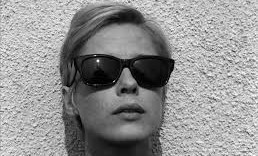
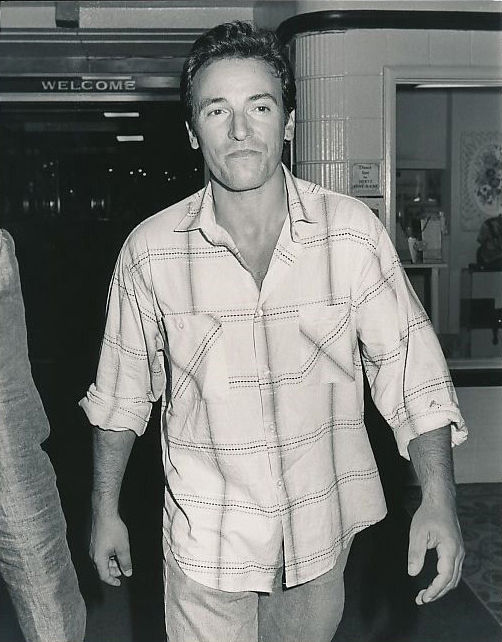
Thanks to my school friend Daniel Olsen at secondary school I had been following the Boss a year or so shy of the release of Brilliant Disguise. I distinctly remember seeing this remarkable music video appear on the Saturday morning top 40 ‘Rage’ music program which I obsessively tuned into. Brilliant Disguise became my favourite song in my ‘Bruuuuce’ collection up to that point. His staring down the camera for 4 minutes in real time as the camera looms in and telling it straight about the demise of a relationship catapulted Bruce into my short-list of favourite artists. I was besotted by his transparency and authenticity that he would even consider attempting to deliver this song the way that he did in that highly synthesised and manufactured pop-era. Not only that, but the lyrics and melody floored me:
I heard somebody call your name
from underneath our willow
I saw something tucked in shame
underneath your pillow
Well I’ve tried so hard baby
but I just can’t see
What a woman like you
is doing with me
So tell me who I see
when I look in your eyes
Is that you baby
or just a brilliant disguise
Brilliant Disguise was released as the first single from his album Tunnel of Love in 1987. It represented a serious departure from his anthemic rock output in his previous record – Born in the USA which remains one of the greatest selling albums of all time. Brilliant Disguise reached No. 5 position on the Billboard Hot 100 chart and No. 1 on the Mainstream Rock chart in the United States. I was in awe at his versatility as a songwriter to be able to leap so far away from the tried and tested formula of his previous music to something so melancholy and country-esque pondering love gone wrong. In 1989, the album was ranked #25 on Rolling Stone magazine’s list of the “100 Best Albums of the Eighties.
Like much of the Tunnel of Love album, “Brilliant Disguise” was recorded in Springsteen’s home studio, called Thrill Hill East, between January and May 1987. The analogies to Springsteen’s personal life at the time are evident: he had recently married then-model and actress Julianne Phillips, and the two would divorce in 1988. The references to marital problems are quite direct, as in the lyrics:
“Oh, we stood at the altar
The gypsy swore our future was right
But come the wee wee hours
Well maybe, baby, the gypsy lied.”
The video of the song below was shot in black and white, and it effectively reflects his emotions as he sits uncomfortably on the edge of a chair. This very personal performance can make it difficult to watch, but it reflects the themes of the song.
References:
1. Brilliant Disguise – Wikipedia


 #The Drive – Peter Attia March 31, 2020
 #Bloggingheads.tv – Gimme Shelter | Glenn Loury & John McWhorter [The Glenn Show] – March 30, 2020