This nearly 3 hour film which is set entirely on a sound stage and filmed like an intimate theatrical production would test just about anyone’s patience. I’m not going to lie. I bought the DVD brand new for about the equivalent of $2US in my local Panamericana store. I had been meaning to watch it since I had read some interesting things about it. The performances are led by Nicole Kidman and Paul Bettany with an imposing supporting cast including Lauren Bacall, James Caan and Philip Baker Hall. It’s also wonderfully narrated by John Hurt. Dogville is an art-house film and Kidman delivers an “A” class performance. She has definitely never lacked the courage to perform in experiential cinema.
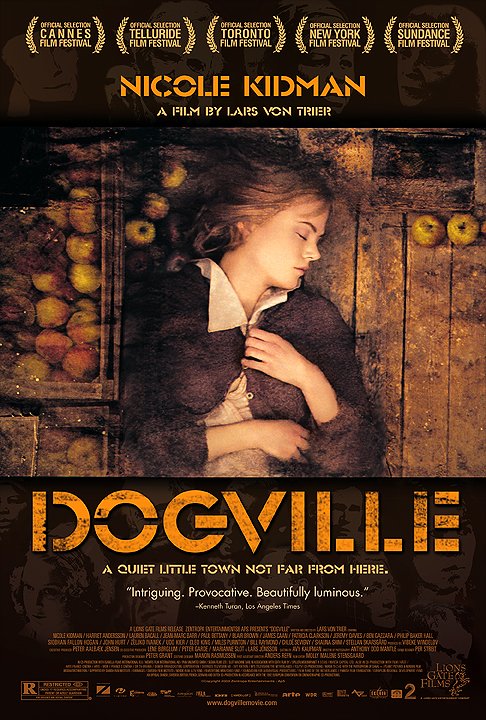
I was wondering if I even should have included it on Friday’s-finest since it’s not exactly a movie I would recommend to anyone unless that any one wanted to rack their brains watching a slow parable being told set in a poverty stricken small town of America during the depression called Dogville. I mean the premise sounds interesting: Kidman plays a woman on the run from the mob and police and she is reluctantly accepted in this small town. In exchange, she agrees to work for them. As a search visits the town, she finds out that their support has a higher price to pay than she had foreseen. But who is this woman and why is she on the run?
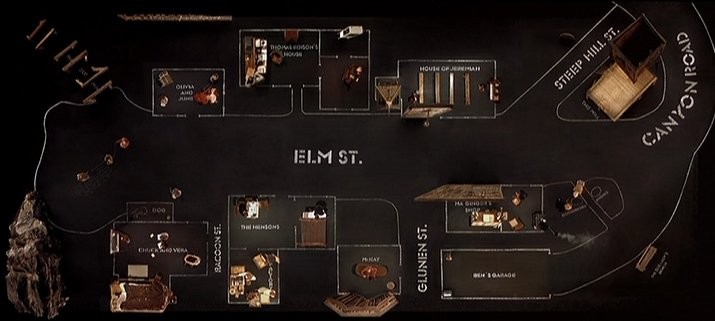
Only you can’t see Dogville. The “town” and its streets, houses and vegetation are all represented by chalked lines on a flat studio floor the size of a football pitch, with bits and pieces of exterior and interior buildings.
It’s best to approach Dogville from the perspective of not expecting to be entertained by the story but instead challenged to interpret the symbolism of this tragic tale. If it’s taken too literally; its surface narrative could be interpreted as intriguing of sorts, but fatally cynical. However if it is viewed metaphorically like a parable of the gospels or even with a particular philosophical concept in mind like Stoicism or Nietzscheism then you should find plenty of meat on Lars Von Trier’s bone to chew on. What it doesn’t shy away from is exposing Humanism as a fatal flaw.
The following is a Spoiler in an allegorical sense, but don’t say I didn’t warn you if you intend on seeing Dogville:
If one considers ‘Grace’ (Kidman character) to be a Christ-like figure as I did, then one can also consider her father to be like the Old Testament’s Yahweh. There is in fact a limit to God’s love, when one considers the Christian perspective on the divine judgement of souls. The final act, where Dogville gets its just desserts, can be viewed as a metaphor for this Final Judgement and God’s wrath acted upon the wicked and evil, with the mobsters acting as the heavenly host of vengeful angels. Or you could also view the whole movie and the soundstage as the temptation of Christ where Jesus fasted for 40 days in the desert and Satan appeared to him and tried to tempt him. Grace’s father appears to Grace in the final act in her Mount of Olives Gethsemane moment where she anguishes over the fate of the people who had sinned against her.
If you have read this far into my post you will have ascertained that Dogville certainly hit all my right buttons as far as being philosophically exigent. As Will Self put it in the London even Standard: ‘The viewer is regaled with more philosophising on the meaning of social responsibility, communal values and existential angst than he might reasonably hope to witness in a lifetime’s cinema- going.’