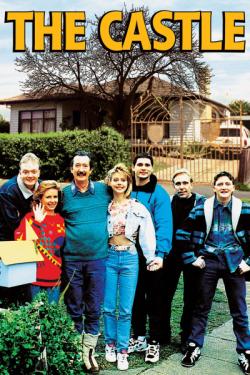
This contains one of my all-time greatest comedic lines in Australian cinema history… Dad says to son Steve: ‘Oh Steve could you move the Camira, I need to get the Torana out so I can get to the Commodore‘. Steve – ‘I’ll have to get the keys to the Cortina if I’m gonna move that Camira‘. Dad – ‘Yeah watch the boat mate‘.
The Castle is the quintessential Australian family movie. I don’t think another was made which depicts so accurately the suburban family culture in Australia during the 80’s / 90’s period. Also it’s offbeat-quirky humour is uniquely Australian and hasn’t been replicated in my estimation in cinema. The humour plays on the national self-image, most notably the concept of working-class Australians and their place in modern Australia. It’s American equivalent for representing the nation’s family and cultural values you could say is Ron Howard’s Parenthood starring Steve Martin.
Internationally, the legendary Crocodile Dundee starring Aussie comedian Paul Hogan which thrilled international audiences and instigated an unprecedented tourist boom to Australia is arguably Australia’s most popular ‘international’ movie. It’s a pity The Castle was never distributed internationally and scantily known in film-circles outside of Australia, except for New Zealand. I know it is almost universally admired back home, making it somewhat of an Australian cult classic.
A Melbourne family is very happy living where they do, near the Melbourne airport (according to Jane Kennedy, it’s “practically their back yard”). However, they are forced to leave their beloved home, by the Government and airport authorities. ‘The Castle’ is the story of how they fight to remain in their house, taking their case as far as the High Court.
There are just so many moments in The Castle where I found myself transported back to my upbringing. It’s probably unsexy to mention it in this day and age but The Castle represents the traditional nuclear family back then when it was made; when the father was the principal breadwinner, the mother the part-time worker and home-caregiver and the sons – spoilt sit-around loafs, including one in jail. But don’t let that turn you off because it’s akin to ‘This Is Spinal Tap’ (a movie I must review here at Friday’s Finest) which aims low but taps into a certain subculture elevating it into something wonderful. Overseas visitors to Australia should watch The Castle in order to “get” Australia and Australians.
The movie was just filmed in 11 days with a budget of just $AU 750,000. It made 13 times the investment at the box office. It’s just plain funny this movie and heart-warming especially how it represents the most humble of families sticking it to the authorities. The film’s title is based upon the English saying, repeatedly referred to in the film, “A man’s home is his castle“. Since the movie is practically unavailable to those outside of Australia, I found a full version of the movie complete on You Tube below. I hope you like it:
Back when Cohen released Democracy I was just out of high school and learning to fly from the nest. If someone had asked me what Democracy was I may have scolded them for eating into my time trying to serenade women about earth angels and how I didn’t like ‘algebra’. Ironically, I would embark on an Arts degree majoring in Political Systems. I hadn’t even heard of Leonard Cohen until a decade later when I saw his name peppered on a Dylan music discussion board. I turned to my neighbour an Irish brick-labourer-music enthusiast seeking advice about Leonard and he told me in no uncertain terms – ‘not to to touch him with a bargepole, because he was a manic-depressive‘. So, I held off, but I eventually succumbed to his music. I find myself still learning about him.
Democracy is the third song to appear from Cohen’s The Future album here. As stated in the previous entry Closing Timethe album was written at the time the Berlin Wall had fallen and Cohen said he wrote 60 verses for Democracy adding:
‘..and everyone was saying democracy is coming to the east. And I was like that gloomy fellow who always turns up at a party to ruin the orgy or something… It’s a song of deep intimacy and affirmation of the experiment of democracy in this country. That this is really where the experiment is unfolding. This is really where the races confront one another, where the classes, where the genders, where even the sexual orientations confront one another. This is the real laboratory of democracy‘.
It’s coming (Democracy) to America first The cradle of the best and of the worst It’s here they got the range And the machinery for change And it’s here they got the spiritual thirst It’s here the family’s broken And it’s here the lonely say That the heart has got to open In a fundamental way Democracy is coming to the USA
The ‘real laboratory’ test of Democracy as Cohen put it, is playing out right now. The polarisation effects he alluded to in his comments between races, genders and sexual orientation is turning this watered down term called Democracy into a fallacy in our current epoch. I refer back to the Future of War article I wrote about the US Navy . The presenter of the US Navy authorised video stated the following:
‘I just had a four star general tell me that the cyber domain and specifically the human elements – that being us affected within that cyber domain is one of the 5 most important components to modern warfare…I believe the biggest threat right now is division. They are going to find the division within our society and they are going to try and amplify it. I would like to submit for your consideration a countermeasure….a way to get through this modern bombardment; this new battle-space that we haven’t considered before. I think if they are going to divide us, I think the way to get around this is proactive intentional unity….if we just extend patience and political grace but also to those we disagree these manoeuvrers in the cyber domain meant to divide us simply will not work. Political grace, the art of disagreeing well. This is the ultimate countermeasure.‘
‘Political Grace‘ is sorely lacking in the laboratory experiment conducted by the mainstream media, multinational corporations and social media platforms. The Daniel Schmachtenber quote in his discussion with Brett Weinstein continues to impress me:
‘Porn and online dating is to intimate relationships what Facebook and Twitter is to tribal bonding’
I’ll leave the last words to the Jewish singer-songwriter trained as a poet and ordained as a Buddhist monk and speaks to our time with astonishing prescience. This was a verse from one of the 60 verses that didn’t make the final cut:
First we killed the Lord and then we stole the blues. This gutter people always in the news, But who really gets to laugh behind the black man’s back When he makes his little crack about the Jews? Who really gets to profit and who really gets to pay? Who really rides the slavery ship right into Charleston Bay? Democracy is coming to the U.S.A.
Below I have added the original video of the song and below that an outstanding Live version subtitled in Spanish.
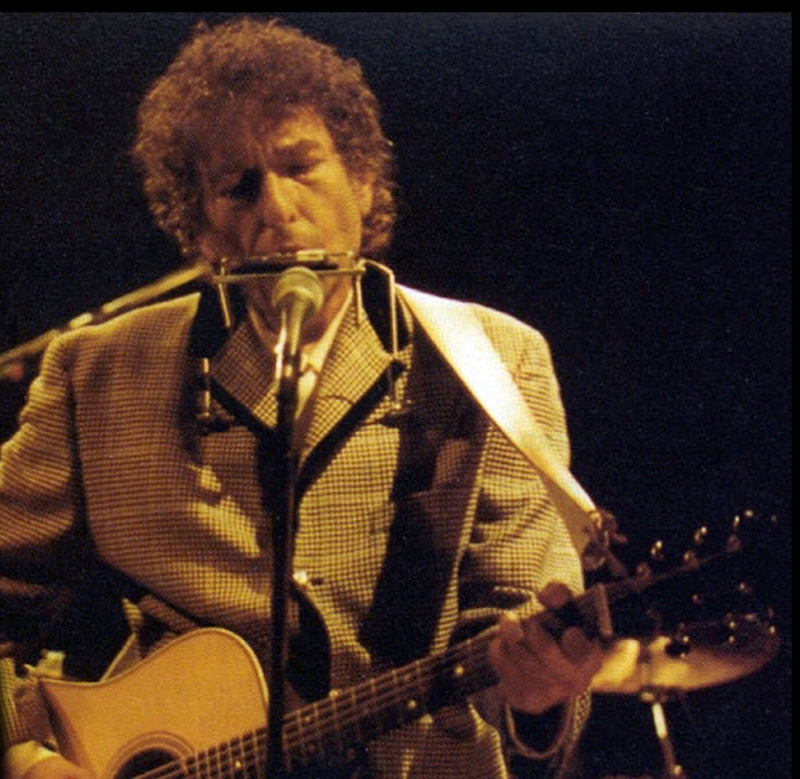
This is the first song to appear here from Dylan’s 1993 traditional-folk record World Gone Wrong (WGW) and kicks off side two of the record. This album was a follow-up to his other acoustic guitar and harmonica record – Good as I Been To You released the year prior. He had a penchant during this phase to draw deep from the wellsprings of by-gone music, but the songs in WGW seem to hone in on darker and more tragic themes than Good as I Been. The album won the Grammy for best traditional-folk album.
Delia was a gambling girl, gambled all around Delia was a gambling girl, she laid her money down All the friends I ever had are gone
Delia’s dear ol’ mother took a trip out West When she returned, little Delia gone to rest All the friends I ever had are gone
Delia’s daddy weeped, Delia’s momma moaned Wouldn’t have been so bad if the poor girl died at home All the friends I ever had are gone
In the context of rural-blues Dylan plays his guitar in a high tin-like raw sound as if he were from a bygone era. You can hear his breathing and distortion throughout. Dylan held sessions at his Malibu home garage studio and recorded the record in a matter of days. Their appears no writer for Delia , but other songs from the record were written by Blind Willie McTell (Broke Down Engine) and Benjamin Franklin White (Lone Pilgrim).
According to Untold Dylan about Delia – The most commonly held view is that the song is about Delia Green who was born in 1886 and killed aged 14. The song appears in many forms but the most common is that she was shot dead on Christmas Day, 1900, by youth named Houston, after the couple had had an argument, seemingly him boasting that he had been to bed with her many times, and she saying that was not so. He served 12 years in prison and died in 1927. Delia Green was buried in an unmarked grave.
Other versions of the song with distinct retelling were released by Blind Willie McTell,Johnny Cash and Pat Boone. Regrettably the original studio version of Dylan’s version from World Gone Wrong is not available online, but I have forwarded a live version (2000) from a fan at the Newcastle show below. Edited: The official Dylan version has been released to the general publicas seen below.
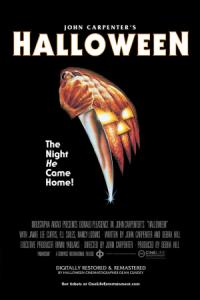
Halloween has nearly been rebooted more times than Britney Spear’s articles have appeared on the BBC home page. From that, you get a sense of the horror theme which coarse through both franchises. Despite the numerous attempts to replicate or revive the original Halloween (1978), not to mention the classic Nightmare on Elm Street (1984); these originals have never been surpassed in terms of their impact on the genre. I revisited Halloween (1978) recently with my kids for the first time in two decades. It didn’t disappoint, on the contrary, I was surprised how well it stood up after all these years. And my kids are terminally traumatised as a result.
I think apart from John William’s piano theme for Spielberg’s Jaws, the score for Halloween composed and performed by its director John Carpenter is one of the most eerily effective and unforgettable piano tunes in cinema. The movie has that B-grade 70’s grindhouse production but not to its detriment because its style fits the substance. Halloween as an independent release is one of the most profitable of all time grossing 70 million. It then spawned a film franchise of 11 films and even a video game was made of it as well as a comic book series. The original stars Jamie Lee Curtis in her film debut who plays a female babysitter stalked by Michael Myers the mental patient on the run from the institute. She earned just $8000 for this, but by golly did she deserve it! The film was selected for preservation in the United States National Film Registry by the Library of Congress.
Carpenter was very patient and careful with Halloween. It’s a slow, but tense build-up, aligning with Michael Myer’s voyeuristic scanning of his childhood neighbourhood for victims. It may have been easier for most directors to just go helter skelter to please a shallow audience craving a splatter, but Carpenter picks his moments and knows when to strike. Irwin Yablans, the film producer wanted a movie that could produce the same impact as The Exorcist… ‘Under pressure’ as David Bowie might put it! The adventurous Carpenter came up with a story – The Babysitter Murderers, however Yablans convinced him to change it to a story on Halloween and call it by that name which Carpenter agreed.
Much of the inspiration behind the story which was written in just 3 weeks came from Celtic traditions of Halloween such as the festival of Samhain. Although Samhain is not mentioned in the plot … ‘the idea was that you couldn’t kill evil, and that was how we came about the story‘ according to Deborah Hill former girlfriend and co-writer with Carpenter. She wrote most of the female characters’ dialogue. According to wikipedia: Many script details were drawn from Carpenter’s and Hill’s own backgrounds and early careers: The fictional town of Haddonfield, Illinois was derived from Haddonfield, New Jersey, where Hill was raised, while several of the street names were taken from Carpenter’s hometown of Bowling Green, Kentucky.
In devising the backstory, Carpenter reflected on the haunted house down everyone’s street. A house perhaps where someone was killed in or at least abandoned. It reminds me of the Boo Radley house in To Kill a Mockingbird and how children coddled stories about what went-on inside. The anomalous endings of both these movies left audiences gobsmacked and challenged their pre-conceived notions and misconceptions. Below is a short audio of the exemplary Halloween soundtrack:
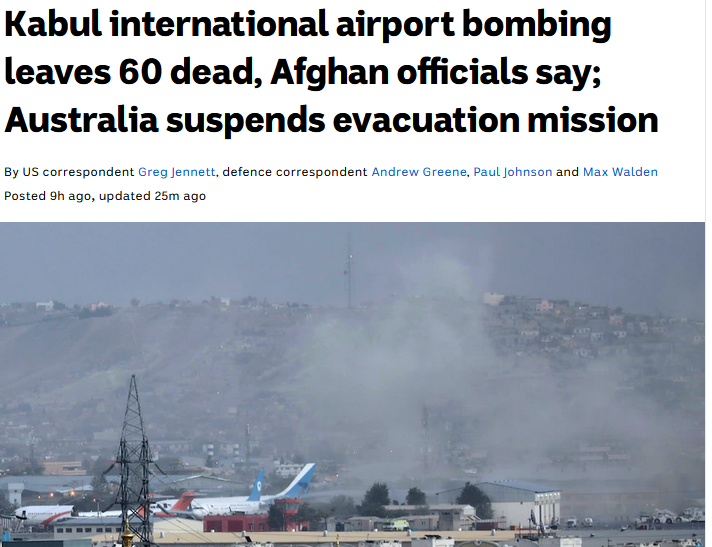
The ABC news Australia article didn’t mention the US military killed in this bombing in its title. When has that ever happened with an ally or previously on this news site? If it was Trump as head of this mayhem, the press would have blamed him ad nauseam. But now the western media don’t seemingly care about western lives in accentuating their reported title.
This will not go well domestically or internationally for the US. I can’t imagine how this turns out.
As much as I despised Trump’s rhetoric (well now both sides), Trump still is the first President not to send troops into war in over 40 years, the Middle East was also as peaceful as we have seen in 40 years or more. The economy was booming and even the blue states were winning. The foreign international scene had not been as calm as its been in many a decade whether between China, Russia and the Middle East. Trump implemented the vaccines initially (which was disdained by all in sundry on the Dems side) and he was in favour of their use.
Now we have a world very different from when Trump left office. A current President openly supporting the radical left’s continued violence and institutional esposure of ‘CRT’ Critical Race Theory; a breakdown in the Middle East, restored tensions with China and Russia, economic ruinations through inflation and unemployment, a migration crises on the border, Socialist revival in the Americas (because of Biden’s policies) and above all THE censorship by the biggest social media platforms against free speech.
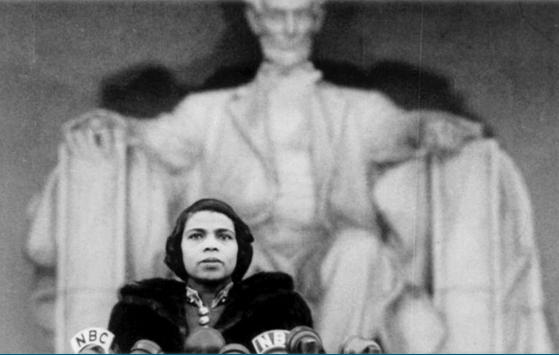
April 9, 1939, on the steps of the Lincoln Memorial in the capital
This is the second song to appear here from the exquisite and rarest of female voices – Marian Anderson. So here I am listening to this song through shoddy laptop speakers. Can one imagine what it must have been like hearing her sing in the same room? Marian, it’s said has been recommended down through the generations from Grandmother to granddaughter: ‘Pay attention, this singer is marvellous‘. Grandmothers as far as I know have the best advice. For a more extensive biography of Marian and her legacy in 20th century Arts, you can view my post – Ave Maria (1944).
Deep River is one of African-America’s most cherished spiritual songs, popularised by Henry Burleigh in his 1916 collection Jubilee Songs of the USA. According to wikpedia:Deep River has been sung in several films. The 1929 film Show Boat featured it mouthed by Laura La Plante to the singing of Eva Olivetti. Paul Robeson famously sang it accompanied by male chorus in the 1940 movie The Proud Valley. And in the 1983 blockbuster hit National Lampoon’s Vacation it was sung by Chevy Chase. Allow me to indulge if you will with this video clip that brings back good memories:
Deep river, my home is over Jordan. Deep river, Lord, I want to cross over into campground.
Oh, don’t you want to go to that Gospel-feast? That Promised Land, where all is peace?
The composer Toscanini said Marian Anderson’s voice had a natural bent toward poetry, and that she really communicated one-on-one with her audience. I couldn’t agree more.
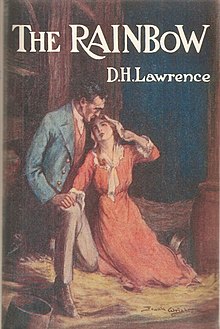
Today’s Wednesday Literature piece presents a second excerpt from D.H. Lawrence’s The Rainbow. Our first encounter with this book told about how Polish refugee, Lydia is tortured by her inability to register with her new English surrounds and her coming into the presence of a local farmer Tom Brangwem. The book starts with a description of the Brangwen dynasty, and how Tom Brangwen, one of several brothers, fell in love with Lydia. Today’s excerpt moves quite a way ahead to the second major story of three in the novel dealing with Lydia’s daughter, Anna and her battle-riven relationship with her husband, Will Brangwen, the son of one of Tom’s brothers.
The novel focuses on the individual’s struggle to growth and fulfilment within the confining strictures of English social life. Lawrence’s 1920 novel Women in Love is a sequel to The Rainbow. Roger Scruton argued in Sexual Desires (1986) that the prevailing theme of Lawrence’s novels is that “In desiring to unite with [the other sex, we are desiring to mingle with something that is deeply – perhaps essentially – not ourselves, and which brings us to experience a character and inwardness that challenge us with their strangeness.” In 1999, the Modern Library ranked The Rainbow forty-eighth on a list of the 100 best novels in English of the 20th century.
The setting for today’s extract is Anna wedding ceremony with Will Brangwen. What I found most evocative from this part is Stepfather of the bride Tom Brangwen’s perspectives about ageing and what it means to him by getting older. Mind you he’s not that old, just 45, but as he puts it, ‘ Forty-five! In five more years fifty. Then sixty—then seventy—then it was finished. My God—and one still was so unestablished!’. I can definitely can attest to holding that same sentiment. This short excerpt finishes on a much brighter note than what the aforementioned quote might have you believe. Oh and if you like wedding stories told succinctly, you are in for a real treat! So without further or do, please enjoy – Wedding at the Marsh:
The church was decorated for Christmas, dark with evergreens, cold and snowy with white flowers. He (Tom Brangwen) went vaguely down to the altar. How long was it since he had gone to be married himself? He was not sure whether he was going to be married now, or what he had come for. He had a troubled notion that he had to do something or other. He saw his wife’s bonnet, and wondered why she wasn’t there with him.
They stood before the altar. He was staring up at the east window, that glowed intensely, a sort of blue purple: it was deep blue glowing, and some crimson, and little yellow flowers held fast in veins of shadow, in a heavy web of darkness. How it burned alive in radiance among its black web.
“Who giveth this woman to be married to this man?” He felt somebody touch him. He started. The words still re-echoed in his memory, but were drawing off.
“Me,” he said hastily.
Anna bent her head and smiled in her veil. How absurd he was.
Brangwen was staring away at the burning blue window at the back of the altar, and wondering vaguely, with pain, if he ever should get old, if he ever should feel arrived and established. He was here at Anna’s wedding. Well, what right had he to feel responsible, like a father? He was still as unsure and unfixed as when he had married himself. His wife and he! With a pang of anguish he realized what uncertainties they both were. He was a man of forty-five. Forty-five! In five more years fifty. Then sixty—then seventy—then it was finished. My God—and one still was so unestablished!
How did one grow old—how could one become confident? He wished he felt older. Why, what difference was there, as far as he felt matured or completed, between him now and him at his own wedding? He might be getting married over again—he and his wife. He felt himself tiny, a little, upright figure on a plain circled round with the immense, roaring sky: he and his wife, two little, upright figures walking across this plain, whilst the heavens shimmered and roared about them. When did one come to an end? In which direction was it finished? There was no end, no finish, only this roaring vast space. Did one never get old, never die? That was the clue. He exulted strangely, with torture. He would go on with his wife, he and she like two children camping in the plains. What was sure but the endless sky? But that was so sure, so boundless.
Still the royal blue colour burned and blazed and sported itself in the web of darkness before him, unwearyingly rich and splendid. How rich and splendid his own life was, red and burning and blazing and sporting itself in the dark meshes of his body: and his wife, how she glowed and burned dark within her meshes! Always it was so unfinished and unformed!
There was a loud noise of the organ. The whole party was trooping to the vestry. There was a blotted, scrawled book—and that young girl putting back her veil in her vanity, and laying her hand with the wedding-ring self-consciously conspicuous, and signing her name proudly because of the vain spectacle she made:
“Anna Theresa Lensky.”
“Anna Theresa Lensky”—what a vain, independent minx she was! The bridegroom, slender in his black swallow-tail and grey trousers, solemn as a young solemn cat, was writing seriously:
“William Brangwen.”
That looked more like it.
“Come and sign, father,” cried the imperious young hussy.
“Thomas Brangwen—clumsy-fist,” he said to himself as he signed.
Then his brother, a big, sallow fellow with black side-whiskers wrote:
“Alfred Brangwen.”
“How many more Brangwens?” said Tom Brangwen, ashamed of the too-frequent recurrence of his family name.
When they were out again in the sunshine, and he saw the frost hoary and blue among the long grass under the tomb-stones, the holly-berries overhead twinkling scarlet as the bells rang, the yew trees hanging their black, motionless, ragged boughs, everything seemed like a vision.
The marriage party went across the graveyard to the wall, mounted it by the little steps, and descended. Oh, a vain white peacock of a bride perching herself on the top of the wall and giving her hand to the bridegroom on the other side, to be helped down! The vanity of her white, slim, daintily-stepping feet, and her arched neck. And the regal impudence with which she seemed to dismiss them all, the others, parents and wedding guests, as she went with her young husband.
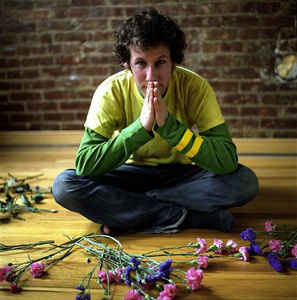
Today we backtrack a little bit in the music library project since I had forgotten to download the following song to my collection. What entails the ‘Music Library Project’? Ben Lee’s Cigarettes Will Kill You is one of my favourite Australian tracks from the 1990s. I never grow tired of hearing this great Alternative music tune. I especially like the rhythm and the simple piano loop of four chords. Cigarettes Will Kill You is a single by Australian singer-songwriter Ben Lee, from his 1998 album Breathing Tornados. It was voted number 2 on the 1998 Triple J Hottest 100.
And I want a TV embrace And I, I’m getting off your boiling plate They swore you’d steal my steam To feed your dream And then be gone I wish I could say that everyone was wrong
At a concert in New York in 2006 Lee described how he came up with the title – Cigarettes Will Kill You. He was so impressed with title of the Verve’s The Drugs Don’t Work that he decided to name his own song with a similarly catchy title. The cigarette smoking is used as a metaphor for continuing to go back to a bad relationship even though everyone knows it will end terribly and cause pain.
According to wikipedia: “I want a TV embrace” was a mondegreen based on a misheard Fiona Apple lyric. In Apple’s song, Criminal, Lee had thought Apple had sung “This mind this body and this voice cannot be stifled by your TV embrace” – the real lyric being “This mind this body and this voice cannot be stifled by your deviant ways”. It was years later Lee realised his mistake but still used the lyric anyway.
Apart from being a singer-songwriter Ben Lee is also an actor. He appeared as the protagonist in the Australian film The Rage in Placid Lake (2003). He has released eleven solo studio albums and won many ARIA and APRA awards for music in the years which followed the release of Breathing Tornados. He is one of those artists I would have liked to followed more closely if I found the time. Lee was born in Sydney and was raised in a Jewish household, but did not consider himself religious as a child. Lee dated Claire Danes for several years but their relationship ended in 2003, and he later married actress Ione Skye on 28 December 2008, in a Hindu wedding ceremony in India.
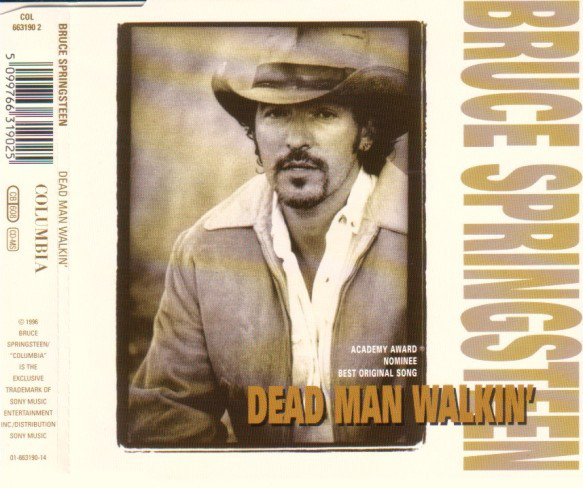
Today’s featured song is Bruce Springsteen’s title track for the movie Dead Man Walkin’. Executive producers, brothers Tim and David Robbins, personally solicited a number of their favorite musicians for contributions to the project whom included other than Bruce; Johnny Cash, Eddie Vedder, Tom Waits and Patti Smith. Bruce spoke as the convict himself in his rendition of the movie’s storyline. Dead Man Walkin’ was nominated for the Academy Award for Best Original Song. This was Bruce’s second Oscar nomination; his first: Streets of Philadelphia in 1993 won for the movie Philadelphia.
This song is written about an inmate on death row, awaiting execution. The movie featured Sean Penn as the convicted convict and Susan Sarandon as the Catholic nun who tries to have his sentence commuted to life imprisonment. It was a critical and commercial success.
There’s a pale horse coming And I’m going to ride it I’ll rise in the morning My fate decided I’m a dead man walking I’m a dead man walking In st james’ parish I was born and christened I’ve got my story mister Ain’t no need for you to listen It’s just a dead man talking
Bruce sings Dead Man Walkin’ with immense conviction. He gets to the underbelly of this man’s attempt to come to terms with the responsibility of his actions. He refuses to beg for forgiveness, maintaining his “sins are all I have”. It reminds me in some sense of The Strangerby Albert Camus. The song was recorded during the The Ghost of Tom Joad sessions, but not used for the album. 17 performances were given during the Ghost of Tom Joad tour. Despite its brevity, Dead Man Walkin’ is one of my favourite acoustic songs by Bruce in his 90’s solo period.
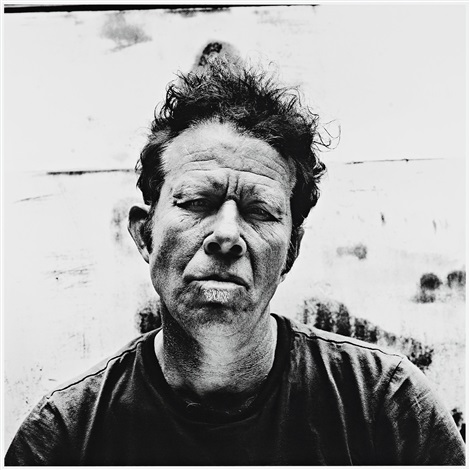
Dead and Lovely is the fifth song presented here by Tom Waits. It comes from his 16th studio album Real Gone. It tells the story steeped in the Noir genre of a middle class girl lured into the underworld by a wicked man with sordid motives. As Tom wrote:
He never gave but he got He kept her on a leash He’s not the kind of wheel You fall asleep at
Tom is at the top of his poetic jagged voice form in Dead and Lovely. If you listen to interviews with him, he talks just like that. You would be excused for thinking his lyrics are the result of hours of hard labor, but it just falls out of his mouth fully formed. Also the music is synchronised beautifully with the great storytelling. Real Gone and Rain Dogs are often cited by many fans as their favourites.
The album features some of the few political songs Waits has written, the most explicit being “Day After Tomorrow”, a song Waits has described as an “elliptical” protest against the Iraq War.
It was chosen by the editors of Harp Magazine as the best album of 2004.