Murky Waters

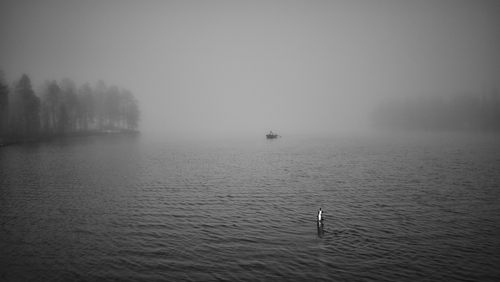
Murky Waters
Deeper thoughts lay within
A cove of great despair
It’s sad and it’s of murky waters
Once shone a lustrous blue

Touching remains sunk deep within
Oh, time heals everything, but
Your stirring love, scarring detail
Treasure chest full, rusted and torn

I hear on the outside, sun is shining
Not in orbit am I, so trodden about
By one way memories, past engraved
A path so strict, I walk before I sleep

Swirling nature, beauty lingers
Catching tunes warrant an ear for listening
Oh, I feel more so of touching
What lay dormant in murky waters.

Tagged with: ,
Posted in Reading, Reflections

The Tattoo

When I was in my late teens I wanted a tattoo. The Navy seemed like the right place to make this happen. Tattooing, I learnt had been linked with the seafaring life of the Navy for centuries. I remember one of our parade trainers hollering, “A sailor without a tattoo is like a ship without grog. Not seaworthy.”

In 1993 on a sea-familiarisation exercise, I and ten others were posted for a week to the Garden Island Navy base in Sydney. It is located next to arguably Australia’s seediest tourist spot – Kings Cross. We were assigned to a frigate alongside, whose name escapes me. Anyway, all we really had eyes for was Kings Cross at night.

Sprawled across a pub booth seat in a state of drunken ruin, my mate Mal and I somehow met two girls. They were Maoris who had been living in the Cross for six months or so. They appeared to be nice girls. I could see three of each in my blurred vision, which only multiplied their beauty.  Welcome to Kings Cross, I thought.

The next night I decided to get a tattoo. I had a few beers to try to settle the nerves but that didn’t work. I stumbled with my Navy mates into a run-down tattoo parlour on the main street of the Cross. Even as I entered the grungy shop I had no idea what I would get. I browsed the tattoo displays, nervously shifting from one board display to another in the hope that an illustration might grab my attention. The guys got bored waiting so they congregated outside. I soon came across a drawing of a treble clef surrounded by flames. I bent my head sideways and down towards the picture. I nodded. “Treble clef … flames”, trying to ascertain its symbolic importance. I noted to myself how the treble clef represented my infinite love of music. The flame was my passion. The fire in my soul as it were. It was the best I could conjure up in response to the inevitable question: “Why did you get that?” My mates quickly stepped back in. They were as excited and curious as I was. They hadn’t seen anyone get a tattoo.

I peered over at the guy at the counter; his stomach hung over the bench. The customer service oozed from him as he snorted and swallowed his phlegm. I peered back at my mates, who all wore cheesy grins as I stood there at the counter. Eventually he looked up, mildly annoyed that I had interrupted his reading.

“Okay. So what ya havin’?”

I pointed to the treble clef and then smeared my mouth with the same hand.

“That,” I said.

He snatched the picture off the wall and I noticed him squinting as he viewed it closer.

“C’mon,” he grunted.

“Um okay.”

When I saw the chair I nearly regurgitated the beer from my stomach. I would have preferred the dentist’s chair at that moment. I removed my shirt. He moved close to me. Too close. His breath stank. Then he coughed and mumbled in between juggling his phlegm. Reassuringly he remarked, “This hurts.”

Did it hurt? Some superheroes in their own lunchtime have described the procedure as a “hot scratch” or just simply “annoying”. For me it felt like someone jabbing a needle into your back and scraping a figure out of it. I think that’s all I have to say about that. I was allowed to take the bandage patch off after twelve hours. On first inspection my friend raised his hand high and slapped his thigh in short repetitive bursts. He was laughing. Laughing so loud. He was hard pressed to put two words together:

“You …”

“You …” he spluttered like a blabbering idiot

“What is it?” I shouted.

“You … you … your treble clef is traced on backwards – inside-out!”

My jaw dropped. I stared at his face fastened to each of those words dangling from his lips. Treble clef backwards inside-out

Everyone wanted to look at my defective tattoo.

Tattoo

My tattoo is small and located on the right shoulder blade where I cannot see it. Its placement is its greatest asset. Suffice to say I am reluctant to show it off. It’s neither sexy or wicked, simply faulty. When people view it they don’t gasp excitedly; they just look at it slightly indifferent and say “Oh” until the penny has dropped of course. It’s never encouraging.

‘You do realise your trebel clef is backwards’?

‘Yes of course’ I reply.

‘Music and what it means to me is internalized deep within’.

‘So that’s how it appears to you on the outside’.
Tagged with: , ,
Posted in Reading, Reflections

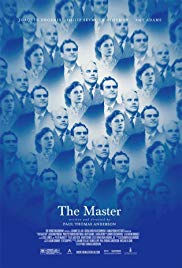
The Master (2012) – Paul Thomas Anderson

Lancaster Dodd: I am a writer, a doctor, a nuclear physicist and a theoretical philosopher. But above all, I am a man, a hopelessly inquisitive man, just like you.

MasterWhile Paul Thomas Anderson’s film catalogue may not be expansive his movies certainly are. He hit fame and encountered some notoriety with his highly original and flamboyant expose of the pornographic industry in Boogie Nights. Since then he has continued to go on to make some of the most challenging and innovative cinema. The Master in particular seems to bottle what is so alluring about how Paul Thomas Anderson makes movies.
IMDB Storyline of The Master: Returning from Navy service in World War II, Freddie Quell drifts through a series of breakdowns. Finally he stumbles upon a cult which engages in exercises to clear emotions and he becomes deeply involved with them.

For the regular cinemagoer The Master might seem like a hard nut to crack. You’ll find no redemption or atonement for wrong doings, nor even a typical narrative structure in this movie. We don’t follow a path well worn by any other movies, none which I can recall anyway. The Master leaves us to pick up the pieces and assess what it means to us. *You will find what it means to me in the last paragraph of this article. The Master on the surface is a story about an intense and complicated friendship (some say love story) between two men with alter egos who despite their obvious inadequacies and at times repulsive behaviour find some extraordinary kinship in trusting and believing in one another.

Here in lies the tragedy – the summation of such a profound friendship does not equate to much by the end. This is where many viewers might find the movie unclear and elusive or simply off putting. We don’t arrive at the end and say, ‘Oh Freddy Quell (Joaquin Phoenix’s character) is a better person for thinking this or behaving like that’. That despite such a profound kinship between the two egomaniacs, the movie and the characters essentially ends where it begun. They seem to be souls touched but as easily untouched by each other and those around them. To me the Joaquin Phoenix character is the alter ego of Hoffman’s Cult Leader character which is alluded to in the last scene between them. ‘If you leave me now, in the next life you will be my sworn enemy‘.

It dawned upon me in a later viewing of the movie when Freddy Quell is watching a movie in a cinema and Lancaster Dodd happens to call him out of the blue, that Paul Thomas Anderson like Dodd is having his way with us.  Anderson in his director’s hat and The Master (The Lancaster Dodd character) are one of the same puppeteer. Dodd is pulling Freddy’s strings and we the audience like Freddy are going wherever he motions us. The irony is like the charismatic cult leader Lancaster Dodd in the movie, Anderson is seemingly making this up as he goes along. But he is The Master and we (the audience) are his loyal followers. Even if he sends Freddy from wooden paneled wall to window and back over and over again we like Freddy go along too despite how futile or meaningless the exercise may appear. He is the Master after all.

Tagged with: , ,
Posted in Movies and TV

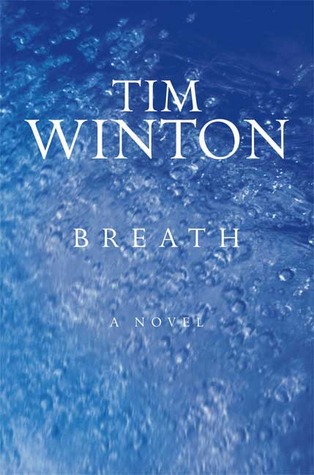
Breath – Tim Winton (A Classic Australian Novel)

“It’s funny, but you never really think much about breathing. Until it’s all you ever think about.”
Tim Winton, Breath
 
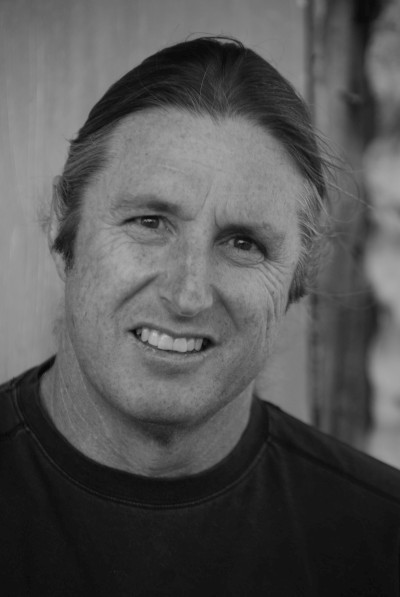
tim-winton-2

Tim Winton is Australia’s most-lauded novelist. He has won Australia’s highest literary merit the Miles Franklin Award an unprecedented 4 times including once for the novel I will discuss here – Breath. I have read nearly all off Tim Winton’s books. He is undoubtedly my favourite Australian author. To me what sets Tim’s writing apart is his ability to capture that almost inexplicable strange beauty of Australia. I have lived overseas a long, long time and of course I miss my home country, but if I ever want to get reacquainted with my island home then I will dive head-first into a Tim Winton novel. I have him to thank for that.

Good reads’ description of Breath: On the wild, lonely coast of Western Australia, two thrillseeking and barely adolescent boys fall into the enigmatic thrall of veteran big-wave surfer Sando. Together they form an odd but elite trio. The grown man initiates the boys into a kind of Spartan ethos, a regimen of risk and challenge, where they test themselves in storm swells on remote and shark-infested reefs, pushing each other to the edges of endurance, courage, and sanity. But where is all this heading? Why is their mentor’s past such forbidden territory? And what can explain his American wife’s peculiar behavior? Venturing beyond all limits—in relationships, in physical challenge, and in sexual behavior—there is a point where oblivion is the only outcome. Full of Winton’s lyrical genius for conveying physical sensation, Breath is a rich and atmospheric coming-of-age tale from one of world literature’s finest storytellers.

breath

Shortly after Breath was published in 2008, I went to see Tim do a book reading in Melbourne to inaugurate the release of his much anticipated book. I had never before or ever since procured a book and read it as quickly as I did with Breath.  I would read it another 3 times that year before I eventually moved overseas. A week ago I dusted it off to rekindle that old flame and see if my obsession with it was justified. Part way through I realised I was reading from a master at work. I was just as mesmerized as I had been 10 years earlier. Every page I was gobsmacked by some outstanding literary prose thinking to myself, ‘How did he come up with that, and that, and that?’. To put it bluntly, reading a Tim Winton book is a very humbling experience for any writing enthusiast. He sets the bar high.

“That was the simple objective, being airborne, up longer, up higher, more casually and with more fuck off elegance than anyone else in the world. I never understood the rules or the science of it but I recognized the single-mindedness it took to match risk with nerve come what may. Some endeavours require a kind of egotism, a near autistic narrowness. Everything conspires against you – the habits of physics, the impulse to flee – and you’re weighed down by every dollop of commonsense dished up. Everyone will tell you your goal is impossible, pointless, stupid, wasteful so you hang tough. You back yourself & only yourself. This idiot resolve is all you have.”
Tim Winton, Breath

What struck me this time around apart from it being more of a page turner and easier to read than I remember; is this coming of age story of two adolescent surfers on the West Australian coast launched me back into my own adolescent self. Better than any family photo album could evoke, all the sights, smells and sounds of my youth in Australia came flooding back.

Arguably, Tim Winton’s magnum opus up to this point is his 1991 novel Cloudstreet. It’s nearly thought of in Australia as un-Australian if you haven’t read that ‘tower of book’. Many would recommend if you were going to get your feet wet with Tim Winton then Cloudtstreet would be the go-to book. However, I would contend that Breath is more easily consumable due to its no-nonsense literary prose and and it can be read in less sittings due to its shorter length and entrancing plot. As a blogging enthusiast, even if this post inspires just one person to read Tim Winton then I will be content.

The first sun gave the water a benign sheen and for a few moments there was nothing to see, little enough for a swoon of relief to course through me. I was, I thought, off the hook. And then a mile out I saw the sudden white flare. A plume of spray lifted off the bommie like the dust kicked up by a convoy of log-trucks and after a second’s delay the sound of it reached us. Now that was a noise to snap a boy out of his dreamy sense of wellbeing.

-Breath

Tagged with: , , , ,
Posted in Reading, Reflections

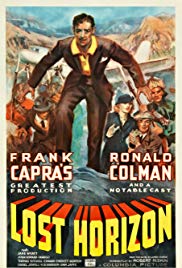
Lost Horizon (1937) – Frank Capra

Lost Horizon

Along with Woody Allen’s Sleeper, Lost Horizon is another movie recommended to me by fellow blogger Badfinger20. It is a Frank Capra film based on the 1933 novel of the same name by James Hilton.

IMDB storyline: British diplomat Robert Conway and a small group of civilians crash land in the Himalayas, and are rescued by the people of the mysterious, Eden-like valley of Shangri-la. Protected by the mountains from the world outside, where the clouds of World War II are gathering, Shangri-la provides a seductive escape for the world-weary Conway. But is it the miraculous utopia it appears to be?

I was a little bit skeptical coming into this since I wouldn’t have exactly classed myself a doting fan of Frank Capra. I found his movies a little bit too saccharine for my tastes. Despite my dubiousness Badfinger20 urged me towards trying this early Capra piece. It is an almost impossible task to discuss this movie without revealing the biggest spoiler of them all which is the answer to the question (which would have all audiences pondering): Is Shangri-la the miraculous utopia it appears to be? 

Firstly, Lost Horizon is a big film production for its time. It took 10 months to shoot and the film well exceeded its original budget. In fact the first cut of the film was six hours long. The studio considered releasing it in two parts, but eventually decided the idea was impractical. The version of the movie I saw was the complete 123-minute soundtrack. Some of the film was badly degraded and useless, so the restorers used sills to fill in the missing minutes. I only found it partially distracting but moreover I felt the scenes with the audio and sills were necessary to the story.

The sets they used in Lost Horizon were astounding. I doubt Capra’ vision of Shangri-la could even be replicated by today’s production standards. Interestingly, according to Wikipedia: Harry E. Huffman, owner of a chain of movie theaters in downtown Denver, Colorado, built a replica of the monastery depicted in the film as a private residence in 1937, calling it Shangri-La which still remains to this day. Honestly, I don’t know how Capra and his team pulled it off. Also the avalanche and mountain trekking scenes are outstanding even by today’s standards of hammy computer effects.

Ronald Colman was fabulous in the demanding lead role. It’s difficult to think of another actor who could have filled the shoes of the alluring Robert Conway as well as he did. He truly made it his.  The three supporting beautiful actresses were stellar as well.

High Lama Lost Horizon

The mystical and captivating High Lama who we learn was in fact the founder of Shangri-la 200 years before explains to our protagonist Robert Conway that his presence at Shangri-la is by no way an accident. On a side note, the High Lama’s dazzling speech to Conway is almost prophetical as he describes his vision of forthcoming destruction. The prophecy would nearly eventuate two years after the movie’s release with the invasion of Poland and later the bombing of Pearl Harbor.

Shangri-la is essentially a Christian missionary’s version of paradise. It’s been attempted many times in history. I had only seen more sober takes on the reality of attempting such quests such as De Niro in The Mission, Scorsese’s Silence and Peter Weir’s Mosquito Coast.  Half way through the movie I thought I was in Conway’s dream or even his after-life after his plane went down in the Himalayas.

Lost Horizon is a wonderful movie. Probably few movies demonstrate like Lost Horizon just how movies used to be made – a little bit of blood, sweat and tears, and that in itself is its crowning achievement. You can envisage just how much work went into this movie to bring you this endearing tale. It definitely had me by the short and curlies when Conway’s brother brings a young female Shangri-la resident to Conway to convince him to escape with them from the idyllic Shangri-la.

‘I believe it (Shangri-La) because I want to believe it’

Tagged with: , , , ,
Posted in Movies and TV, politics

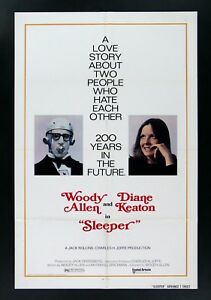
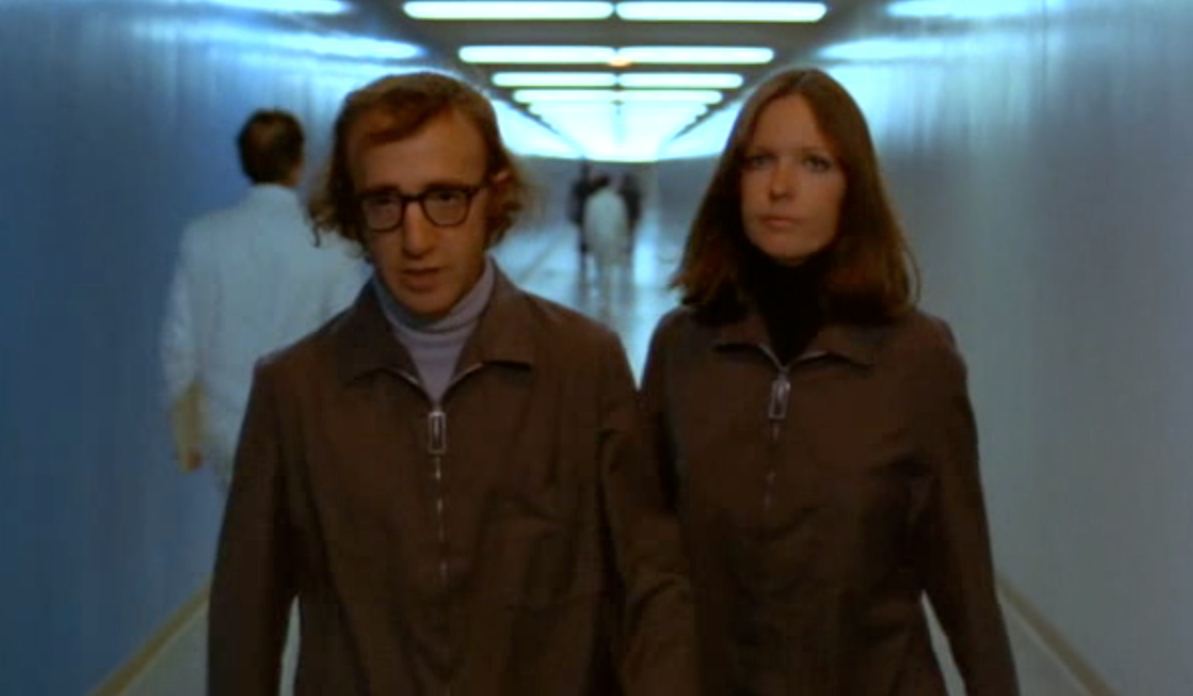
Sleeper (1973) – Woody Allen

Sleeper

Sleeper is a scantly known Woody Allen movie recommended to me by fellow blogger badfinger20. I was enthralled by it and frankly it remains a mystery how it isn’t more widely known. I cannot remember the last time I laughed so hard watching a movie.

IMDB: Miles, a nebbishy clarinet player who also runs a health food store in NYC’s Greenwich Village, is cryogenically frozen, and brought back – 200 years in the future, by anti-government radicals in order to assist them in their attempt to overthrow the oppressive government. When he goes off on his own, he begins to explore this brave new world, which has Orgasmatron booths to replace sex and confessional robots.

“I don’t know what the hell I’m doing here. I’m 237 years old; I should be collecting social security.”

Apart from being one of the funniest movies I’ve seen, it also contains one of the wittiest premises. I’ve watched a fair few Allen movies and I have enjoyed them all, but his comedic genius radiates most intensely in this. I for one did not know that Woody was such a great physical comedian. His physical slap stick comedy is brilliant.
But the intelligence behind his manic goofiness in Sleeper is the crowning achievement. Despite how different things are in the future, his neurotic Jewish Brooklynite’s wry sense of humour stays the same. The movie is interspersed with occasional ragtime theme music and stepped-up film speed which despite harping back to the comedic pioneers like Charlie Chaplin and Buster Keaton, still looks and feels as fresh as yesterday’s coat of paint.

Diane Keaton

Diane Keaton who regularly appears as Woody Allen’s confidante in his movies, is more than his match here and regularly steals the limelight. It showcases her unassailable comedic talents like no other movie I have seen her in.  The highlight for me and what is one of the funniest scenes in the entire film involves her doing an impression of Marlon Brando. Her performance in Sleeper is one of the most hilarious I have seen by an actress full-stop.

The other aspect of Sleeper which impressed me greatly were the props and production design. The orgasm-machine, futuristic houses, round vehicles, stiff servant gay-robots, gigantic fruits all seem to indicate we are moving towards times where ignorance revels and empty pleasure-hunting is celebrated as the correct form of bliss. It genuinely feels like something you might expect to see if Aldous Huxley’s dystopian novel Brave New World was adapted for the screen, with of course a twisted comedic flavor. And regarding the premise and political commentary, you could throw George Orwell’s 1984 into the mix as well.

As far as sci-fi comedies go, Sleeper is a definite winner. I had so much fun with it. There wasn’t a pedestrian moment in it. Also, there aren’t many comedies out there which can top this in terms of gags-per-second ratio and just sheer quality. The ‘rewatchability’ force is strong with this one!

Tagged with: , , , , , ,
Posted in Movies and TV

Reflections on The ‘Who Killed JFK’ Article

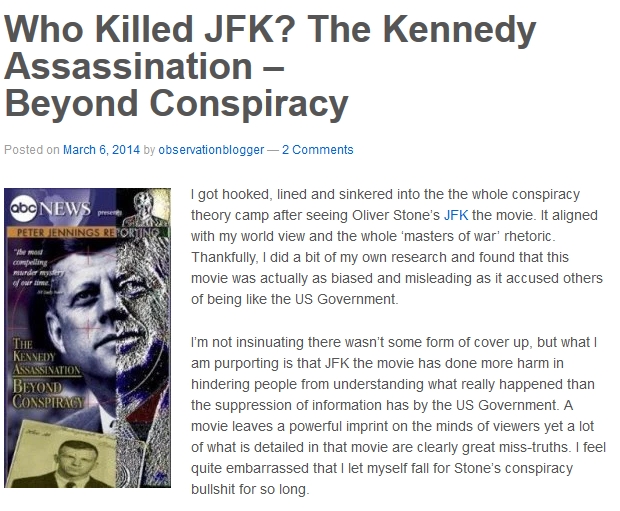
I wrote an article here in 2014 about the documentary – The Kennedy Assassination – Beyond Conspiracy. I wrote excerpts from the documentary in an attempt to expose the hypocrisy and misleading farse that which is the famous JFK movie directed by Oliver Stone.

I’m not insinuating there wasn’t some form of cover up, but what I am purporting is that JFK the movie has done more harm in hindering people from understanding what really happened than the suppression of information has by the US Government

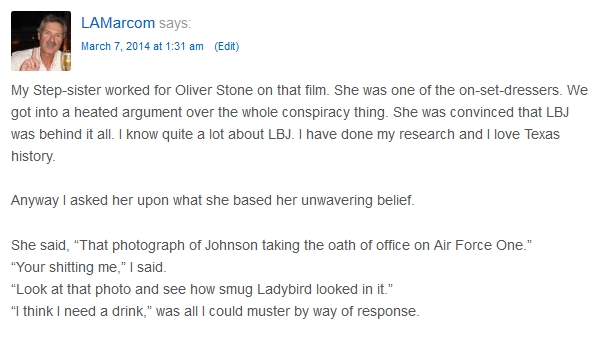
Just this morning as I was doing some tidying up of my post, I came across this comment from Lance (who was once a keen blogger himself) in response to my article. Lets just say his comment induced a big belly laugh which I suspect it would have done the first time I read it:

LAMarcom comment

You can read the whole article here which includes the documentary – The Kennedy Assassination – Beyond Conspiracy.
Who killed JFK

Tagged with: , , ,
Posted in Movies and TV, politics

A Little Known Australian Movie called ‘Candy’ and Tim Buckley’s ‘Song to the Siren’

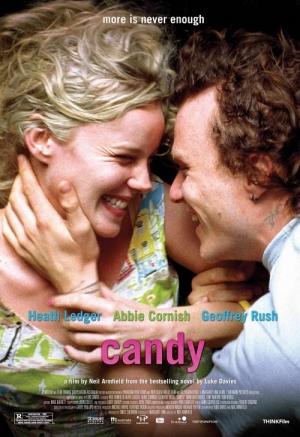
Heath Ledger was at the peak of his acting prowess when he sadly departed from this great play we all take part called ‘Life’.  He was posthumously awarded the Oscar for best supporting actor in his role as the Joker in The Dark Knight. Despite the magnificence of his performance in Christopher Nolan’s 2nd film of his Batman reboot, I remember Heath more fondly for two other outstanding performances which often get overlooked in his film canon, namely Brokeback Mountain and Candy.   Regarding Heath in Brokeback, I would prefer to let Daniel Day Lewis do the talking which he does so eloquently here about Heath’s ‘perfect’ acting in Brokeback. Daniel who dedicated his award to the memory of Heath received best actor in There Will Be Blood on the same night Heath’s father accepted his son’s award:

Candy

Candy, I find worth discussing because so few people are aware of it. That could be because it was poorly received.  Why the critics didn’t like it is a mystery to me. Candy is a romantic drama centered around a couple’s drug addiction. I found that Heath Ledger and Abby Cornish gave such raw and salient performances and their chemistry was alluring and authentic. The story is engrossing and the ending very poignant as Tim Buckley’s song ‘Song to the Siren‘ draws the story to a close. Below is Paula Arundell’s gorgeous rendition of ‘Song to the Siren’ set to scenes from the movie (warning some scenes contain spoilers). Whenever I watch this clip I feel very sad about the passing of Heath Ledger.

I would be doing this post a disservice if I ended it without presenting the original singer-song writer of ‘Song to the Siren’ – Tim Buckley who tragically passed away without finding commercial success in his lifetime.

Tagged with: , , , , , , ,
Posted in Movies and TV, Music, Reflections

Leonard Cohen’s ‘Come Healing’ and 5 Other Contemporary Spiritual Masterpieces

As far as musical sub-genres go, contemporary-spiritual music doesn’t get its just-deserts!  Heck, we might have got into the weeds professing our love for folk-rock and alternative seattle music, but when did you ever hear people spout on about ‘contemporary-spiritual music’?
As I was listening to Leonard Cohen’s ‘Come Healing‘ it got me thinking about some of my other favorite contemporary-spiritual songs:

1. Leonard Cohen’s Hallelujah sung by the enormously talented Rufus Wainright.

2. Peter, Paul and Mary’s cover of Bob Dylan’s transcendent Blowin in the Wind became a huge mainstream hit in the 60’s.

3. I posit that Nick Cave’s The Ship Song is one of Australia’s greatest ‘unheralded’ contemporary spiritual anthems.

4. Australian aboriginal Archie Roach’s There is a Garden produced by Australian songwriter David Bridie might also be in contention.

When all the trees have gone,
All the rivers dry,
Don’t despair when all the flowers have died,
For I have heard, there’s a Garden somewhere…

When you hear the children cry,
When you see them die,
And Mother can’t sing a lullaby
I can smell the blessed warm spring rain.

We are young, we are old,
Oh but what we had, can’t be bought or sold,
And we are paying for your crimes,
Oh but everyday and every way, we get better all the time.

And when everything is gone,
And you’ve lost all hope,
And you have come to the end of your rope,
Well I believe that the flowers will bloom again.

5. Archie Roach wasn’t alone. Fellow Australian Aboriginal singer Geoffrey Gurrumul delivered some of the most spiritually powerful songs heard in the last decade. This blind aboriginal singer who plays the guitar upside down delivered this absolute treasure, Djarimirri. Soon after Elton John and Sting wanted to appear on stage with him.

Tagged with: , , , , , , , , , , ,
Posted in Music, Reflections

The Liam Neeson Farce. Why is Psychological Insight of this Nature Being Scorned?

I thought it was good for men ‘to talk about their feelings’?

What surprised me was how the interviewer stated his remarks have offended people of colour.

How on earth could his remarks be interpreted as a racial slur or blight on black people? His point was clearly to acknowledge his own deep psychological suffering and tribal angst in that era of his life. That took courage in my book.

In effect, his openness about this issue may prevent or dissuade the next person who is out for blood when they or someone close to them has become the victim of violence.

Instead, the ‘modern’ left pigeon-holed Liam’s reflections into their collectivist ‘group identity’ narrative. His individuality; remorse; intended message; and of course the actual victim are really of little or no consequence.

I remember a time when the ‘left’ would be lining up to give someone like that a medal. Now the the ‘modern left’ want him publicly shamed and his career effectively terminated.

Below is Joe Rogan & Sam Harris’ take on the Liam Neeson Controversy:

Tagged with: , , , , ,
Posted in News, politics, Reflections

Follow Blog via Email

Enter your email address to follow this blog and receive notifications of new posts by email.

Join 753 other subscribers

← Back

Thank you for your response. ✨