Gillette is on Point

Read the full Reddit Post and responses here:

So there I was, putting on my rape slippers and practicing my sexual harassment pickup lines this morning. I had just got done cyberbullying my co-workers and neighbours as one does before coffee in the morning.

It was time to shave.

Walking up the stairs, I yelled at my wife to smile because she should do as she’s told, before pinching her butt right after she told me she didn’t consent to it. Putting on the shaving cream and thinking about how I can get my boys into a fight at the next neighbourhood BBQ, I replaced the worn Gillette brand Mach3 and began to chant “boys will be boys” as I started to shave.

Suddenly, my wife bursts into the bathroom holding her phone. I viciously grabbed her by the hair because, as my father taught me, every man is has the god given right to abuse females. I angrily began to mansplain to her why she isn’t smart enough to know my shaving time is my time and she should get back to the kitchen.

With tears in her eyes, she showed me the new Gillette ad.

I realized how my every view and behaviour I’ve ever held dear was wrong. I’m calling in sick at the toxic masculinity factory today and registering as a submissive at the Fawcett Society. I may even dispose of my Otaku Hitler body pillow.

Thanks Gillette. 👌

Some You tube responses:
gillete comments

Related Articles:
1. What happened to the political left and why I bailed out?
2. The Political Compass Test. Where do you sit on the Political Spectrum?
3. Ezra Klein, a rational or irrational lefty?

Tagged with: , , , ,
Posted in politics

Ain’t Got No, I Got Life (1968) – Nina Simone

Ain’t Got No, I got Life is my favourite song from Nina Simone and it also includes my favourite performance of her at the end of this post. I’ve listened to and watched this performance at least 50 times. It gives me chills every time I see it.

Ain’t Got No, I got Life is a 1968 single from Nina’s album ‘Nuff Said. According to wikipediaThe song peaked at number 2 in the UK and at number 1 in the Netherlands. It also charted on the Billboard Hot 100, where it reached number 94. The song helped Simone gain popularity under a new, younger audience, and became a standard in her repertoire….In 2010, research conducted by PRS for Music revealed that the song was the second most performed in UK television advertising due to its use in Müller yoghurt adverts. “Ain’t Got No, I Got Life” was included in the book 1001 Songs You Must Hear Before you Die.

To demonstrate just how well regarded Nina Simone was amongst her peers, below are recollections from Bob Dylan and Nick Cave respectively. Nick Cave’s account of Nina in the two short videos below I consider almost compulsory viewing for any music enthusiast. It’s a blast!

Nina Simone. I used to cross paths with her in New York City in the Village Gate nightclub. She was an artist I definitely looked up to. She recorded some of my songs that she learned directly from me, sitting in a dressing room. She was an overwhelming artist, piano player and singer. Very strong woman, very outspoken and dynamite to see perform. That she was recording my songs validated everything that I was about. Nina was the kind of artist that I loved and admired.
Bob Dylan (Musicares Person of the Year 2015 Award)

And now for Nick Cave’s take on his experience opening for Nina…

Tagged with: , , , ,
Posted in Music

Chomsky on Žižek and Peterson’s ‘Logos’ and ‘I Act as if God Exists’

You can read the full Reddit response to my post below here.

Edited (13/01/2019): Jordan Peterson on his Q&A for January has just stated that he and Žižek have a debate tentatively lined up for April in Toronto and he just downloaded 6 of Žižek books to study-up on his material. See Jordan’s announcement here.
Here is an excerpt of Zizek’s critique on Peterson.

(13/07/2019): On the 19/4/2019 The two great public intellectual heavyweights Jordan Peterson and Slavoj Žižek met for their much anticipated debate:  Happiness: Capitalism v Marxism. You can read my post about the debate here.

Noam Chomsky hit the nail on the head when discussing Slavov Žižek with words to the effect: ‘Where’s the theory? Where’s the content? It’s just posturing’. I have watched a fair few videos of Žižek and I fail to find anything of substance/empirical in his discussions. I can’t help but agree with Chomsky’s opinion of Žižek. Take Peterson or even Chomsky for that matter, there is a lot of substance and empirical data behind a lot of what they have to say. I just don’t see that when I listen to Žižek.

Jordan Peterson isn’t an empirical theorist exactly. He reflects heavily on Jungian psychoanalysis. Based on his expert determination in the psychoanalytical realm he believes that a Jungian psychoanalytical voice transfigured into layman’s speak is required in the world right now. Dr Peterson has single-handedly brought contemporary empirical psychoanalysis data out from the cobwebs of fancy psycho-babble journal articles and applied them to addressing what he deems as fundamental problems in western culture.

The argument by his critics that he really is just a ‘Post-Modernist – Conservative’ I would contend relates principally to his modus operandi when discussing religion, such as his ‘Logos’ interpretation and ‘I act as if God exists’ rhetoric. The former; his explanation / interpretation of ‘the Logos’ and it’s application is a huge paradigm shift in traditional religious thought especially regarding its practical application of the Bible and the metaphorical significance of the archetypes (meta-heroes) and stories (meta-truths) on ‘Judea-Christian’ western culture.

On the latter ‘I act as though God exists’, take for example this exert from the recent interview with British GQ:
https://youtu.be/yZYQpge1W5s?t=4019

The interviewer is trying to insinuate she knows how he thinks and implies there is something illogical in his argument, but he ‘won’t have any of that’ – to use a familiar Peterson turn of phrase. I don’t think that Peterson brought his A game to this interview, but more often than not he slithers out from the interviewers’ grasp and turns the interview on its head illustrating the nonsensical nature of the questions and disingenuous motives of the interviewers. More over, very few can match his command of the English language and his ability to make a reasonable argument.

Peterson has said ten’s of times in other interviews that the Bible is not science. To him as aforementioned the stories in the bible encapsulate spiritual truths or meta-truths and the archetypes are like meta-heroes. How many more times does he have to repeat the same thing until people understand this? Regarding Peterson’s answer: ‘I act as if God exists’, critics jump on Peterson’s apparent reluctance to just simply express a simple ‘yes’ or ‘no’ to that age-old question ‘Do you believe in….’?  The irony is Jesus was just as elusive in the gospels when asked similar questions about his divinity by mainly those wanting to trap him. I think Peterson’s answer is deftly nuanced and is in harmony with his Logos interpretation.

Wait! Jordan Peterson has already debated Slavoj Zizek on the Rueben Report.
https://www.youtube.com/watch?v=43vRoD8GnIY

Tagged with: , , , , , ,
Posted in politics, Reflections

Today’s Click-Bait BBC Article Promoting a ‘High-Fibre’ Diet Doesn’t Stack Up

bbc high fibre diet

See responses in Reddit to my post below here.

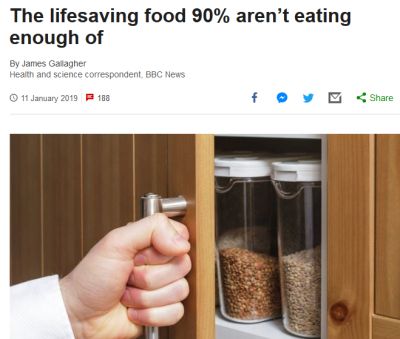
I just finished reading about this study on the BBC news. It’s the second major story shown on BBC world news. They called it ‘The Lifesaving Food 90% aren’t eating enough of’ .

Firstly, why does this article have a “click-bait” title and tagline? I thought this was supposed to be a reputable source of news…

What surprised me were the types of foods with Fibre in it that they promoted. They were mainly refined carbs including cereals. I don’t think there was mention of a leafy green vegetable. But it is also the quantity of these types of foods which they stipulate you should be eating.
In addition, their interpretation of the results in the study appears skewed and sensationalized. Take these examples:

It suggests if you shifted 1,000 people from a low fibre diet (less than 15g) to a high-fibre one (25-29g), then it would prevent 13 deaths and six cases of heart disease.
Well, after analysing 185 studies and 58 clinical trials, the results are in and have been published in the Lancet medical journal.

“The evidence is now overwhelming and this is a game-changer that people have to start doing something about it,” one of the researchers, Prof John Cummings, tells BBC News.”

The question remains what else were they eating? I would maintain that people who consumed more fibre in their diet probably also ate less junk food, smoked less, drank less alcohol and ate more vegetables. Why is fibre from refined carb meals promoted as a result of this study? And it would prevent 13 deaths from a 1000? How can something so small demonstrate anything remotely conclusive that high-fibre diets can avoid ‘deaths’?
Something doesn’t stack up at all.

Warbutons, Kellogg’s and Nestle must be suitably pleased with this article.

I think I’ll take Dr. Paul Mason’s advice over this BBC news article – ‘From fibre to the microbiome: low carb gut health’.

Related Articles:
1. Readdressing the Dietary Guidelines which have made us fat and unhealthy.
2. How to read your blood test results. And reading Cholesterol is not what you think.
3. Ketogenic forums response to the above study

Tagged with: , , , , ,
Posted in Health, News, Science

Consciousness and Quantum Mechanics – Is it Too Early to Rule out the Copenhagen Classic Interpretation?

Dr Sean Carroll in his ‘Many-World’ theory interpretation dismissed the supremacy of the ‘Conscious’ observer argument related to the the Copenhagen interpretation of Quantum Mechanics. In this video, he didn’t explain his objections exactly, but it is probably derived from something like, ‘Another atom, rock, camera or any other inanimate object could cause wave function collapse – so the assumption of the supremacy of consciousness is invalid’. Sean Carroll has a huge social-media ‘science’ presence and is a well-respected theoretical physicist in the real world so I wouldn’t entertain the presumption he is necessarily incorrect. Having said that, isn’t it even remotely possible that Everett’s Many-Worlds interpretation and also Carroll’s may have been too presumptuous in ruling out the Copenhagen classic interpretation of Quantum Mechanics?

So that an inanimate object can cause a wave function collapse seems to be the principle argument against the supremacy of ‘consciousness interaction’ in quantum mechanics. However, the moment ‘conscious’ observation is realised we don’t know where the particle is, except that it is acts as a wave function. There is only probability and vibration in the quantum field. But what is observing the wave function collapse by an atom, a rock or inanimate object? We know as ‘conscious observers’ that the wave function collapsed and ‘we’ are able to locate the position of the particle at that instant.
Moreover aren’t we as humans seeing and interpreting from our delayed conscious reaction the wave function collapse in whatever we do, see and experience? Our consciousness based on ‘probability-awareness’ extrapolates sense of the wave function for ‘Darwinian fitness‘ purposes. I will expand on this Darwinian feature below and its relation to this subject matter.

At the microscopic level we as conscious beings can only identify the position of a particle the moment it is consciously observed by ‘us’.  So that which is observed; the location and extrapolated ‘sense’ about the state of matter at the macroscopic and indeed the microscopic level can only be done by the ‘conscious’ observer – ‘Us’. We can make better predictions, but no better than 50% at the microscopic level of the path an electron; whether it is moving clockwise or counter clockwise. At the macroscopic level in this actual world and despite the self locating uncertainty of the branching of the wave function we interpret what we need to know for ‘Darwinian fitness’. Probability to us is everything!

Regarding the Schrödinger’s Cat Thought Experiment we can know if the cat will most probably be alive or dead, based on nuclear decay and the wave function squared. We as humans through scientific endeavor try and take the probability out of a deterministic theory such as ‘Many-worlds’. The paradox is, as humans ‘probability’ for purposes of the survival of the species is our ‘bread and butter’. Probability is what helps us predict the future since the future is non-deterministic. Our brains, our consciousness if you like (unlike the study of quantum mechanics) acts as if it is a time machine. See my previous post on ‘Be prepared to lose all your concept of time‘ by Carlo Rovelli about this phenomenon.

As Rovelli states or words to the effect: ‘The Universe and Newton’s empty space and quantum mechanics dismisses pieces of time as we get down to the microscopic level and also as we venture far beyond the shallow curve bubble of our earthly state (where light seems nearly infinitely fast to us)’.

Only consciousness can find traces in time and anticipate the future. That’s what makes us a biological marvel (see Darwinian fitness).  The fact our consciousness can make much better predictions of the state of matter at the macroscopic level isn’t as mysterious as it may seem because our brains act as time machines (as aforementioned). Probability is our game! Consciousness is everything because unless the state of matter is observed (entanglement) from the cat at the macroscopic level and the particle at the microscopic level, the matter just is. Without consciousness the cat is alive or dead or the particle is here or there. Position-less is what we don’t see, but we know it is there in all of its probability of being here or there – but that doesn’t serve our purpose for longevity of the species, at least for now. High entropy is not deterministic, whichever way you look at it or try to want to make it so.

Related Articles:
1. Reflections on ‘The Many-Worlds’ Theory by Sean Carroll
2. Be prepared to lose all your concept of time.

Tagged with: , , , , , , , ,
Posted in Reflections, Science

Reflections on ‘The Many-Worlds’ Theory by Sean Carroll

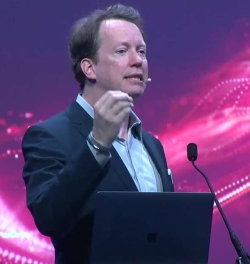
Sean CarrollI have been watching many science lectures of late; specifically those relating to cosmology, the origins of the universe and quantum mechanics. I do not have a physics or science background, but I like to educate myself about what is considered at the cutting edge of science. Essentially, I want to learn more about the Universe we live in. Sean Carroll is one of the few scientists who apart from being a very smart guy is an immensely engaging presenter.


The mark of true intelligence is not to understand a difficult thing, but to make a difficult thing understandable.

A quick bio:
Sean Carroll is a cosmologist and physics professor specializing in dark energy and general relativity. He is a research professor in the Department of Physics at the California Institute of Technology. Sean Carroll also hosts conversations in his ‘Mindscape’ podcasts with the world’s most interesting thinkers of Science, society, philosophy, culture, arts, and ideas.

There are few videos I find which linger in my psyche long enough; continually prodding me to revisit them until I can sufficiently internalise their full scope and meaning. The above ‘Many-Worlds’ lecture is one such video. To me at least, it seems overwhelmingly relevant; like the Geoffrey West – ‘From Cells to Cities podcast that I felt compelled to write excerpts as a personal development exercise. Some of what is written below is verbatim and some of it is redacted to be more reader-friendly.

Edited: At the time of writing this post I had linked Sean’s presentation above, but it has since been removed from You tube. Despite not having the source material handy, I believe the following excerpts entail the most important parts of the presentation:

The Quantum Mechanics Dilemma

If I were to tell you the position and velocity of every piece of stuff in the universe, the laws of physics can tell you exactly where it will go and where it has been. This is classical Newtonian mechanics.

In the 1920’s Quantum mechanics became a full-fledged theory. Newton’s laws were replaced by the Schrödinger equation for the quantum wave function. The equation tells you how the quantum mechanical wave function evolves with time. The Schrödinger equation is the quantum version of Isaac newton’s second law. It seems parallel to Classical mechanics, however:

The bottom line on Quantum Mechanics: What we observe is much less than what actually exists. Position and velocity are what you observe, but until you measure the particles, their positions don’t actually exist. Only the wave function does. Fundamentally, there is a difference between a thing when you are looking at it and when you are not looking at it. You cannot observe the wave function.
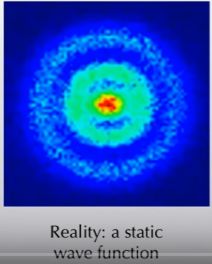
Wave function

So it’s a particularly different view of reality.
The question you might want to ask is why does reality look normal to us at all. Why don’t I see a probability cloud all over the place? We don’t know.

The Copenhagen Interpretation of Quantum Mechanics

According to the Copenhagen interpretation, the act of observing a system  plays a crucially important central role in the formulation of quantum mechanics.  The wave function collapses and you see the electron in a certain position. The cloud tells you the probability of getting certain outcomes. The question remains; what was the law of physics doing before anyone was measuring things? What do we mean by measurement? Does it have to be a conscious human being? Can a rock, a virus and earthworm do an observation? This is known as the measurement problem in quantum mechanics.

 I think I can safely say nobody understands quantum mechanics. – Richard Feynman

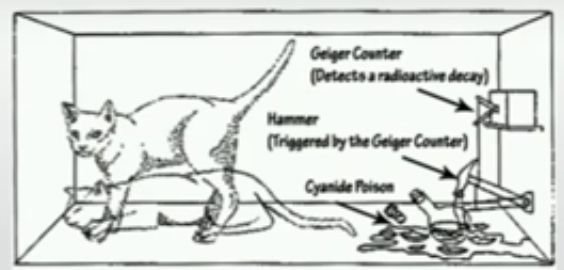
Schrödinger’s Cat:
shrodinger's cat

For explanation of what consists ofthe Schrödinger’s Cat Thought Experiment watch from 18.00 minutes in the ‘Many-Worlds’ video at the top of this page.

The system is in a ‘superposition‘ of all the possible measurement outcomes. Schrödinger took that idea of the superposition of possibilities and amplified until it was macroscopically real.

Entanglement: The state of one part of the universe can be related to the state of another part. As an observer, when you open the box you become entangled with the cat. Before there was a superposition of cat awake and cat asleep. Now there is a superposition of the cat awake and you seeing the cat awake or the cat asleep and you see the cat asleep. So we move into a superposition with the cat. But shouldn’t we include everything such as the whole universe? This is called the ‘environment’.

Process of Decoherence: The ‘environment’ has been interacting with the cat all along. Even before we open the box, the cat becomes entangled with the environment. When we open the box we become entangled with both. This is profound, because once the cat becomes entangled with the environment it can never become disentangled. It’s like mixing cream and coffee together; the increasing of entropy over time. The environment with the awake cat and the environment with the asleep cat will never interact with each other. They have split, they have gone their own ways. They have become two separate worlds and in these two versions ‘you’ can never talk to each other. The decoherence process of entanglement branches the wave function into two copies of the world. Fundamentally, this is pure quantum mechanics. All we did was obey the law of physics. What naturally happens is the wave function of the universe branches into different parts which do not interact with each other and hence they are described as different worlds. This encapsulates the Many-Worlds interpretation of quantum mechanics.

At no point did we put new worlds in. The worlds were already there. In the Copenhagen textbook Schrödinger’s Cat Thought Experiment, we had to erase part of the wave function. So if you saw the cat awake you erase the part where the cat was asleep and vice versa. And ‘you’ are quantum mechanical just like everything else in the Many-Worlds interpretation of quantum mechanics. If an electron can be in a superposition of that place, then a cat can be in a superposition of awake and asleep and you can be in a superposition of seeing the cat awake and seeing the cat asleep. And finally the Universe can be in a superposition of one where you saw the cat awake and one where you saw the cat asleep.

‘It’s not that ‘Many-Worlds’ is a theory of extra worlds, it’s that once you do quantum mechanics all the different worlds are already there. You can’t get to them, you can’t see them.

Hugh Everett, a graduate student of the 1950s examined in his PHD thesis what quantum mechanics is really trying to tell us. He argued there is no classical realm. There is no separate realm of people making observations of quantum systems because essentially you and I are made of atoms which are made of elementary particles which in-turn obey the rules of quantum mechanics. What this implies is that there are all these separate copies of reality. Every time a nucleus decays (or it doesn’t decay) it branches the wave function of the universe; every time particles scatter off each other and become entangled in their environment that also branches the wave function of the universe. There are many branches of the wave function that might come into existence. The space of all possible wave functions is called Hilbert’s space. It’s very very big.

The entirety of the assumptions that go into the Many-Worlds theory is: there are wave functions and we obey the Schrödinger equation. That’s it. Everything else is a consequence, a prediction, an implication of those assumptions. Are those assumptions testable? Yes of course. Whenever we do a quantum mechanics experiment we are testing the Many-Worlds theory. Despite what has been done up to this point, it still isn’t a fully-developed theory.

In Everett’s version ‘Many-Worlds’ there is nothing random about the world. The Schrödinger equation always applies and simply says what will happen next. It is completely deterministic. The problem is when you do experiments you see probabilities. When you have in front of you a nucleus which you know is going to decay we have no way of predicting with certainty when that decay will happen. The best we can do is ‘probability’.

There is something fundamentally stochastic and random about how nature works.

So there is a challenge to ‘Many-Worlds’. We know what the future wave function is going to be, but how do you get the probabilities out of a theory which has no probabilities in it?

Self locating uncertainty: You know the wave function of the universe, but not where you are within it. Among other things; you branch, and I branch. There are two copies of me, two future-selves and neither one of them know which branch they are on. There will necessarily be a short period of time when the branching has already happened. This process of decoherence in which the cat and its quantum system interacts with the environment is incredibly fast like 10 to the minus 20 seconds. Decoherence has happened much before your conscious-mind can process the outcome of that particular experiment.
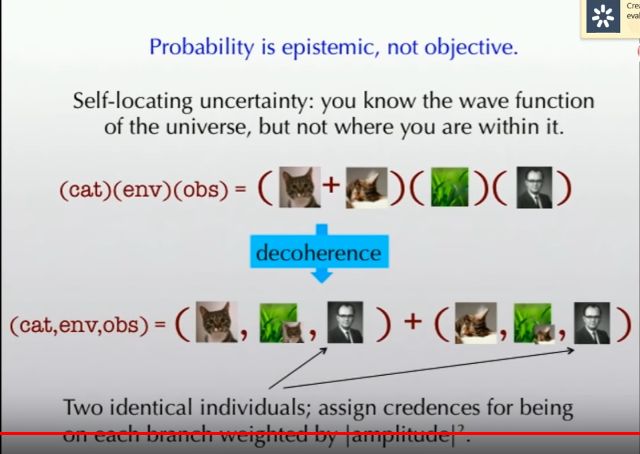
self locating uncertaintySo which branch are you on? The answer is it is the wave function squared. If the amplitude of the wave function of the cat being asleep was the square root of 30% then you should give yourself a 30% chance on being on the branch of wave function where the cat was asleep and vice versa.


Entanglement and Quantum fields

Atoms are not empty space. Atoms are mostly wave function. Electrons are either spinning clockwise or counterclockwise. Two electrons because of entanglement can be in a state of either; both spinning clockwise or both spinning counterclockwise. There is no possibility of one spinning counter and the other clockwise. But what will I observe when I look at a particle?  There would be a 50% probability that it is either spinning clockwise or counter. All I know is the other ‘entangled’ electron is spinning the same way. As Einstein demonstrated, the amount of entanglement between two particles doesn’t depend on how far away the 2 particles are.

These days our best theories are not about ‘particles’ per se rather of ‘fields’, like the electric field, the magnetic field, and the gravitational field. And essentially what a particle is; is a ‘vibration’ in the field. There are many different fields in this room. And if it’s vibrating softly we don’t see anything and if it’s vibrating enough you see a particle. Fields which are nearby are highly entangled and those which are far way not so-entangled.
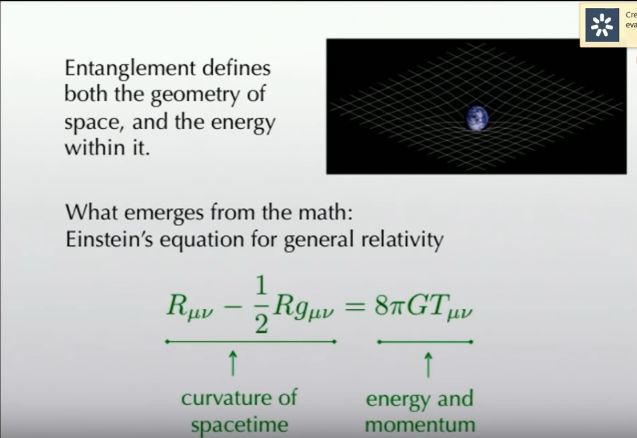
entanglementWhat we have are different quantum mechanical degrees of freedom that are entangled or not. When the degrees of freedom are highly entangled we define that to be nearby and when they are disentangled we define that to be far away. You get an emergent notion of geometry of distances and time out of the quantum mechanical properties of entanglement. This theory seems to work. Entanglement defines both the geometry of space, and the energy within it. This is a new exciting perspective of the problem of quantum gravity. ‘Nature’ of course doesn’t start with a classical theory and therafter quantized, rather, nature is quantum from the start.

We shouldn’t be starting with the classical theory of relativity and then applying rules to turn it into a quantum theory.  Maybe we should be starting with quantum mechanics.

Perhaps we shouldn’t be quantising gravity but finding gravity within quantum mechanics. What we find; and it seems reasonable; is that this emergent geometry that we define from quantum entanglement obeys the above equation (see above image). It obeys Einstein’s equation for general relativity. On the left hand side is the expression how much curvature there is in space-time and on the right an expression of how much ‘stuff’ there is in the Universe. How much energy, heat, and momentum etc. So Einstein’s version of the gravitational field between two bodies depends on how far away they are – Newton’s law of Gravity. This rule governs how the curvature of space time responds to energy and momentum and we are able to see that rule emerge from a theory that doesn’t even have space-time in it. It is solely quantum entanglement.

By taking quantum mechanics seriously; by thinking deeply about what it means to be in a quantum state; how it evolves; branching, decoherence and asking questions about the classical world in that theory you not only get an answer that explains cats and electrons, but maybe the universe itself.

Related Links:
1. Sean Carroll – Mindscape podcast Episode 28: Roger Penrose on Spacetime, Consciousness, and the Universe.


Tagged with: , , , , , , , , , , , , , , , ,
Posted in Science

The Political Compass Test. Where do You Sit on the Political Spectrum?

The Political Compass

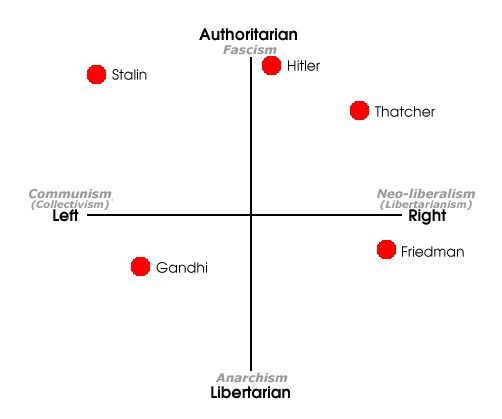
Hitler, on an economic scale, was not an extreme right-winger. His economic policies were broadly Keynesian, and to the left of some of today’s Labour parties. If you could get Hitler and Stalin to sit down together and avoid economics, the two diehard authoritarians would find plenty of common ground.- The Political Compass

Take the Political Compass Test here.

At this Subreddit link I was asked what were my policy positions on size of Government, taxation, and social safety etc. So in pondering this I thought I would explore Google to see if there were any quizzes to find out my position on the political spectrum. That’s how I came across the Political Compass.

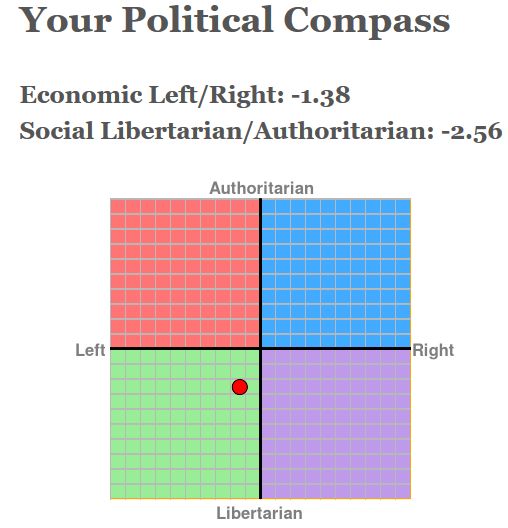
My results are below and they match fairly well with where I saw myself broadly standing:

My Political Compass
Personally, I believe in a moderate market economy which entails a rigorous legal separation between the church and State (secular society), public and private education, social welfare system, universal health care, and very progressive income tax system without loopholes for the rich. I am quite liberal in my stance towards abortion, LGBT rights, and legalization of drugs.

I think Australia’s moderate market economy, healthcare, legal system, education and political system is ideally a good representation of what I lean towards and how I prefer a society governed.

Tagged with: , , , , , , , ,
Posted in politics, Reflections

Roma – A Latino Cinematic Masterpiece (2018)

Roma

I watched Roma two days ago and I felt that as an ‘art-house’ feature it was a masterpiece. I think unless you have lived in Latin America for an extended period it may be difficult to become emotionally attached to the movie like some have commented. So if you aren’t familiar with the social class structure and indigenous culture and their integration / segregation in Latin America, the movie may not feel so engaging as otherwise.

There was so little plot, just like in life, which may be another turn-off for the regular cinema-goer. But when things do go awry just like in life, they kind of creep up on you and then Bang! I felt very present in this movie. It can feel surreal in the moment of crises and watching the three major crises points in the movie I felt profoundly immersed. The cinematography, sound and the performances were impeccable. To include children as much they did in this movie and for it to feel utterly convincing is a wondrous achievement in itself.

I live in Colombia and I felt some of the themes and the general feel of the movie a bit close to home. For instance, the sounds and the images of the women doing the washing on the terraces is remarkably similar to what one might experience in much of Bogota today despite Roma being set in the 1970s! Also Roma exuded this melancholic state which is so pervasive in Latin cinema when dealing with historical events and themes of social classes and race. Moreover, it encapsulated the cultural and interpersonal passion and vibe so inherent in Latin America. It got to that almost inexplicable core of what it feels like to live in a Latino family and its broader society.

Roma is just so unashamedly raw and in some sense too realistic for me. But I was in awe of the quality of this movie. Roma is unequivocally the best movie I saw in 2018.

Related Articles:
1. Could watching the Phantom Thread become a *new* New Year’s tradition?
2. Winter Light (1963) Ingmar Bergman
3. Another Earth (2011) What is it about?

Posted in Movies and TV, Reflections

Do you Believe in Santa Claus?

How Jordan Peterson might respond to the question (From Dr Beckerwood on Reddit):

Santa lobsterI act as if Santa Claus exists.

People have often asked me (especially around this time of year) if I believe in Santa Claus… and I don’t like that question because it’s an attempt to box me up, to put a bow on me in a sense. It’s like, what do you mean, “believe”? We know what Santa looks like. We know what he sounds like. We know how he behaves. We put up pictures and statues of him. We even make offerings to him! Do I believe the man at the mall with the white beard is the one and only Santa? Crowds are addressing him as Santa and he is responding to the name “Santa” and answering AS Santa as such, so some extent at least, he is real. To the degree he is a “good” Santa he is transcending his material substrate to give rebirth to the neurological patterns of the eternal spirit of Santa as it has descended across time. It’s like, is that “real” enough for you? In the Jungian sense you could argue that in that moment he is more real than real.

Look, any smart 11 year old can point out the logistical problems with time zones, flying reindeer, and countless cubic tons of milk and cookies, but, you know, perhaps that’s the wrong level of analysis. When a child sits on Santa’s lap it’s an intimidating thing because Santa is a judge. It’s like, are you on the good list or the naughty list? Because you certainly don’t want to be on the naughty list, that’s for sure, so how about we avoid that; how about we avoid the coal in the stocking? So what do we tell our kids? It’s like, clean up your room! Straighten yourself out and try to be a good person. Then maybe Santa judges you favorably and you get a few decent toys out the deal, eh? I don’t know, maybe Red Dead Redemption 2 or maybe a Hatchimal. But you’re not getting anywhere by stepping up on your soap box and announcing “I’m so smart, I figured out that the physical manifestation of the spirit of giving isn’t real.” I mean, you can think that if you want, but it’s not the proper way of looking at Santa Claus. There’s way, way more to him than that.

And there are actually not a lot of people, percentage-wise, who are ok with saying out loud that they don’t believe in him. Why is that? It feels like a sin to even suggest something like that. On the contrary, people go door to door singing songs about him. So some folks might say he doesn’t exist maybe just because they’re afraid of appearing foolish, but I’m not convinced. It’s like, you know what you truly believe, eh? You’re transparent to yourself? Guess again, sunshine. We act as if Santa Claus exists. And that’s right. That’s true, and it is good. And that’s all I have to say about that.

Merry Christmas Buckos

Tagged with: , ,
Posted in Reflections

What Happened to the Political Left and Why I Bailed Out

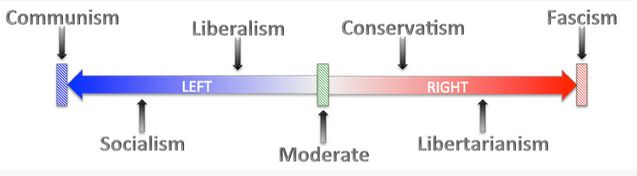
political spectrum

I have been maintaining and updating this blog space for over 4 years and until very recently I have been reluctant to voice my opinion and publish articles steeped in political debate, bias and rhetoric. My reluctance to enter into the political sphere is because I don’t find the tug-of war of Politics in and of itself very interesting, factual-based or educative.  It’s speculative at best. However, more recently I have found myself propelled into the political debate for reasons I will explain below:

I was what one might label a progressive-leftist for over 20 years. I would probably call myself more classical liberal today even still a little left leaning in my politics. Why the move?  I got very disenchanted with the left’s endless use of Social Justice Warrior rhetoric and virtue signalling; identity politics and tribal wars; and even their encroachment on free speech by de-platforming speakers and deliberately omitting factual and scientific evidence if it didn’t align with their collectivist aim. I think my disenchantment is best encapsulated publicly by the frustration and frankly ‘fear’ expressed by left leaning (or former leftists) IDW (Intellectual Dark Web) constituents Sam Harris, Eric and Bret Weinstein, Dave Rubin and Jonathan Haidt.

As Eric Weinstein stated about the modern left in the Glitch in the Matrix conversation on Rebel Wisdom.

They are attaching themselves to real conversations and blowing up the conversation so that you can’t actually speak. You don’t want a single person at the table who wants to scuttle the conversation… The modern left is very often focused on scuttling any realistic conversation.

I think why I am no longer a supporter of the left is because it appears to me at least the left ‘today’ is a shadow of its previous self even that of 10 years ago. The left used to be about fighting the big social injustice issues of the world that truly needed fighting. Fortunately, the state of the world today compared to even 70 years ago is nothing short of miraculous and I think the left played a pivotal part in that socioeconomic progress. But something has changed in the last 10 years and even more so recently with their causes which has left a very sour taste in my mouth. Instead of viewing them as the great moral bastions of real inequality and injustice, I now see them playing a conniving collectivist game which is threatening what I consider the foundational core of western liberal democracy: free speech and individual expression. Any major ideology and sociopolitical value structure started out from a position of weakness in which it couldn’t enforce itself. Christianity for example used to be a persecuted religion and subsequently evolved into something that practiced persecution of other religions.

You’ll notice I didn’t mention Post-modernism nor Neo-Marxism until now although I will admit, this particular nihilistic world-view is what concerns me most about the activists stance on the left today. I speak of activists especially because they are the ones who do the leg work and / or speak out for their causes. So they essentially represent what we see of the left. These activists have been so successful in recent years, and as I alluded to already I have noticed a real encroachment on individual freedom of expression and speech. People are downright afraid and have been for quite sometime to speak out against what may be perceived as contravening the leftist collective opinion and narrative. Many have spoken out and paid a high price. I don’t think I need to go into that, but unless you’ve been living in a cocoon in recent times you’ll know that list is very long.

I could continue for hours and write page upon page about my critical observations of the left today, but I don’t have the time right now to pursue it. Except I will say that I can no longer go to the BBC news web page without being inundated with ‘not news’ but pro diversity and minority group articles trying to tell me how I should think because supposedly I have implicit biases and prejudices. As psychologist Dr Jonathan Haidt stated, ‘Implicit associations and attitudes are of course real. We can’t stop ourselves from picking up associations with the world’. But I don’t expect the BBC to push their ideological agenda down my throat by telling me how I should think. Even my beloved Australian go to news site the ABC is pushing out this stuff in bucket loads. I’m running out of places to get ‘actual’ news.

I couldn’t but help admire chartbuster’s following critique about my original post as well as some of the Reddit replies :

You’re encountering some obscurantism fyi.

This may be a third layer of meta-analysis but there is some assumptive bias, point-dodging, and exaggeration going on regarding your post. It’s not as airtight and rigorous as it could be (although it is a good read) for this particular crowd of Anarchist desperados who gravitate towards this ‘bait’ so to speak. I have no doubt certain users will find something wrong with your argument no matter what it says— if they disagree with it for any opaque or concrete reasons they will change your argument. When all else fails and they have little to say, they’ll distort the truth and strawman the living hell out of it.

Their arguments are generally so wispy thin that their only choice is to obfuscate and create pseudo-complex denialist rhetorical gotchas.

They think if they get you semantically it somehow makes the rest of your points invalid.

Related Articles:
1. The Political Compass Test. Where do you sit on the Political Spectrum?
2. Ezra Klein, a rational or irrational lefty?
3. The Righteousness and the Woke – Why Evangelicals and Social Justice Warriors Trigger Me in the Same Way – Valerie Tariko

Tagged with: , , , , , , , , , , , , , , ,
Posted in News, politics, Reflections

Follow Blog via Email

Enter your email address to follow this blog and receive notifications of new posts by email.

Join 753 other subscribers

← Back

Thank you for your response. ✨